
🐾What Animals Hibernate? 10 Animals That Hibernate and How They Survive
Animals Who Hibernate? 10 Animals That Hibernate and How They Survive Winter
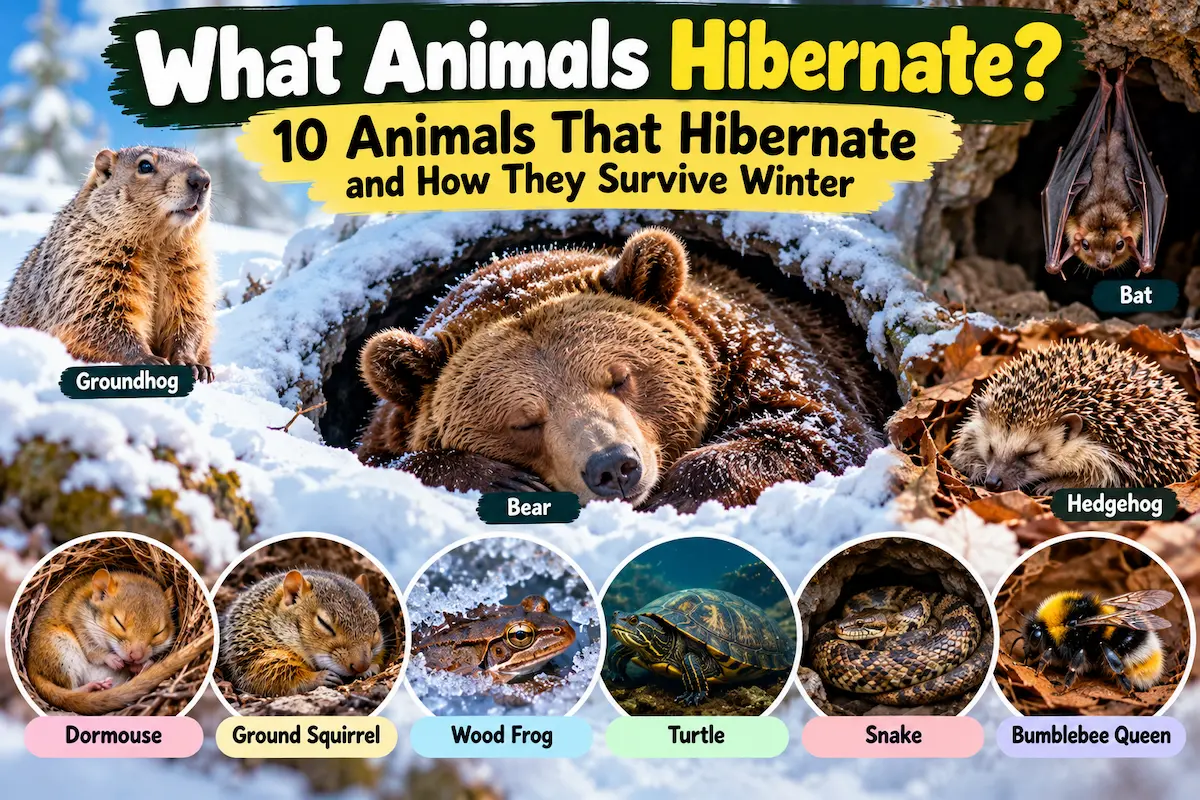
Educational illustration showing 10 animals associated with hibernation or winter dormancy, including a groundhog, bear, bat, hedgehog, dormouse, ground squirrel, wood frog, turtle, snake and bumblebee queen.Quick Answer: What Animals Hibernate?
Many animals use hibernation or related forms of dormancy to survive periods when food is difficult to find.
When winter arrives, food can become scarce and temperatures can fall sharply. Some animals solve this problem by slowing their bodies down and entering a state of dormancy.
But what animals actually hibernate?
Animals known for hibernation or hibernation-like winter dormancy include groundhogs, ground squirrels, bats, dormice, hedgehogs, bears, and some frogs and other animals. The exact winter strategy differs from species to species.
Some animals enter deep hibernation. Others enter torpor, brumation, or another form of dormancy.
Let's look at how these remarkable animals survive the cold. Explore 🐿️Do Squirrels See People?
Table of Contents
- Animals Who Hibernate? 10 Animals That Hibernate and How They Survive Winter
- What Is Hibernation?
- Why Do Animals Hibernate?
- 10 Animals That Hibernate or Use Winter Dormancy
- Hibernation Is Not the Same for Every Animal
- How Do Animals Survive Without Eating?
- Do Animals Really Sleep All Winter?
- Which Animal Hibernates the Longest?
- Family Example: “Why Isn't the Squirrel Sleeping?”
- 🧠 MFJ Nature Insight: Nature Has More Than One Winter Plan
- 🔬 MFJ Educational Enhancement: The Winter Energy Budget
- 🐿️ MFJ Field Connection: The Squirrel Question
- Quick Summary
- 🧠 Quick Quiz
- Frequently Asked Questions
- Final Thought
10 animals associated with hibernation or winter dormancy
| Animal | Winter strategy | Where it may spend winter |
|---|---|---|
| Groundhog | Hibernation | Underground burrow |
| Arctic ground squirrel | Deep hibernation | Underground burrow |
| Bat | Hibernation or torpor | Caves, mines or other sheltered sites |
| Hedgehog | Hibernation | Nest or sheltered ground location |
| Dormouse | Long hibernation | Nest or underground shelter |
| Bear | Winter hibernation-like state | Den |
| Wood frog | Winter dormancy / hibernation-like state | Leaf litter or forest debris |
| Some turtles | Brumation / winter dormancy | Water or sheltered habitat |
| Some snakes | Brumation | Underground dens or hibernacula |
| Bumblebee queen | Winter dormancy | Protected underground location |
Important: “Hibernation” is often used as a general word for winter dormancy, but scientists distinguish between different forms of dormancy. True hibernation involves major reductions in metabolism and other body functions; reptiles such as snakes generally undergo brumation instead. Read 🐿️Do Squirrels Hibernate?
What Is Hibernation?
Hibernation is a remarkable survival strategy in which an animal greatly reduces its energy use for an extended period.
During hibernation, an animal may experience major changes such as:
Lower metabolic activity
Slower heart rate
Slower breathing
Lower body temperature in many species
Much lower energy requirements
Long periods of inactivity
This allows the animal to survive when normal food sources are unavailable.
Hibernation is not simply ordinary sleep.
An animal in hibernation undergoes much deeper physiological changes than a sleeping animal.
Why Do Animals Hibernate?
Winter creates two major problems:
Cold + Less Food
An active animal normally needs energy to move, maintain body temperature, find food and escape predators.
When food becomes scarce, maintaining that normal level of activity can become difficult.
Hibernation helps some animals reduce their energy requirements dramatically.
Think of it as switching from:
Normal mode → Energy-saving mode
The animal enters a period when its body uses far less energy than it normally would.
10 Animals That Hibernate or Use Winter Dormancy
1. Groundhog
The groundhog, also called a woodchuck, is one of the classic examples of a true hibernator.
Before winter, groundhogs build up fat reserves. They then retreat into underground burrows and enter periods of torpor during the winter.
Their heart rate and body temperature can fall dramatically.
Interestingly, hibernation isn't necessarily one uninterrupted sleep. Groundhogs can go through repeated cycles of torpor and arousal during the season.
MFJ Fact: Groundhogs are actually members of the squirrel family.
2. Arctic Ground Squirrel
The Arctic ground squirrel has one of the most extreme hibernation strategies known among mammals.
These squirrels spend much of the winter underground.
During hibernation, their body temperature can fall below freezing.
They periodically warm themselves before returning to their extremely cold hibernating state.
This is an extraordinary example of how animals can adapt their bodies to extreme environments.
3. Bats
Some bat species hibernate during winter.
Why?
Because many insect-eating bats depend on insects for food, and insects become much harder to find during cold weather.
Instead of spending enormous amounts of energy searching for scarce food, some bats enter torpor and hibernate in protected locations.
Depending on the species, these places can include:
Caves
Mines
Rock crevices
Other sheltered structures
Some bats migrate instead, while some species can use both strategies.
So not every bat hibernates.
4. Hedgehogs
Hedgehogs are another well-known winter hibernator.
When temperatures fall and food becomes harder to find, they can enter hibernation and remain inactive for extended periods.
They typically prepare a sheltered nest or hiding place before entering their winter state.
Their body functions slow down, allowing them to conserve energy.
5. Dormice
Dormice are small rodents famous for their long periods of winter dormancy.
Some species can remain dormant for an exceptionally long time.
The edible dormouse is particularly remarkable: under some conditions, it can remain dormant for more than 11 months.
That means a large part of its life can be spent in a dormant state.
MFJ Wonder: Imagine spending almost an entire year in energy-saving mode!
6. Bears
Bears are probably the animals most people associate with hibernation.
During winter, many bears retreat to dens and dramatically reduce their activity and energy use.
They can survive for long periods without eating, drinking, urinating or defecating.
However, bears are also an interesting scientific case.
Their winter state is different from the deep hibernation seen in some small mammals. Bears can reduce their metabolism substantially without lowering their body temperature as dramatically as many true hibernators.
For this reason, scientists have sometimes debated exactly how the word “hibernation” should be applied to bears.
For everyday understanding, however, bears are commonly described as hibernating during winter.
7. Wood Frogs
Wood frogs have one of the strangest winter survival strategies in the animal kingdom.
They can survive freezing conditions by entering a dormant state beneath leaves and other forest debris.
Parts of their bodies can actually freeze during winter.
Their heartbeat and breathing can stop temporarily while they remain frozen.
When temperatures rise again, they thaw and become active.
MFJ Nature Wonder: A frog can survive winter by becoming almost like a living ice cube.
8. Some Turtles
Some turtles survive winter in cold water or sheltered environments by entering a low-energy state.
This is generally described as brumation, rather than mammalian-style hibernation.
During brumation, reptiles become much less active because their body temperature and metabolism are strongly influenced by the surrounding environment.
Some aquatic turtles can remain underwater for long periods during winter.
Their unusual adaptations allow them to survive conditions that would be extremely difficult for an active animal.
9. Some Snakes
Snakes do not hibernate in exactly the same way mammals do.
Instead, they generally enter brumation during cold periods.
Their metabolism slows, they become inactive, and they may gather together in protected winter locations called hibernacula.
Some species may share these shelters with large numbers of other snakes.
When temperatures rise, they become active again.
Hibernation vs Brumation
| Hibernation | Brumation |
|---|---|
| Commonly used for mammals | Commonly used for reptiles |
| Metabolism decreases greatly | Metabolism decreases greatly |
| Body temperature may fall significantly | Body temperature follows environmental conditions more strongly |
| Animals can remain dormant for long periods | Reptiles become sluggish and inactive |
| Example: groundhog | Example: snake |
10. Bumblebee Queens
Some insects also use winter dormancy.
In bumblebees, the queen is the member of the colony that survives winter and begins a new colony when conditions improve.
She spends winter in a protected location and becomes active again when warmer conditions return.
This is another reminder that winter dormancy isn't limited to mammals.
Hibernation Is Not the Same for Every Animal
One of the biggest mistakes people make is imagining that every hibernating animal simply falls asleep for the entire winter.
Nature is much more complicated.
Different animals use different strategies.
Three useful terms
Hibernation
A prolonged state involving major reductions in metabolism and other body functions.
Torpor
A shorter or temporary period of reduced metabolic activity. Torpor can occur daily or as part of a longer hibernation cycle.
Brumation
A winter dormancy state commonly associated with reptiles and amphibians.
So when someone says:
“The animal sleeps all winter.”
The scientific answer may actually be:
“Not exactly.”
How Do Animals Survive Without Eating?
This is one of the most fascinating parts of hibernation.
Animals prepare before entering dormancy.
Depending on the species, they may:
Eat large amounts of food.
Build up body-fat reserves.
Store food nearby.
Find a protected shelter.
Reduce their activity.
Slow their metabolism.
Use stored energy throughout winter.
Different animals use different combinations of these strategies.
For example, a groundhog builds up body fat, while some squirrels also store food that they can eat during winter.
Do Animals Really Sleep All Winter?
No—not in the normal sense of sleep.
Hibernation is much more than ordinary sleep.
During deep hibernation, an animal's body can undergo dramatic physiological changes.
Some animals also periodically wake or partially recover their normal body temperature before returning to dormancy.
So the popular image of an animal sleeping continuously from autumn until spring is an oversimplification.
Which Animal Hibernates the Longest?
There isn't one simple answer because hibernation duration varies by species, climate, food availability and individual animal.
The edible dormouse is one remarkable example. National Geographic reports that it can remain dormant for more than 11 months in the wild under some circumstances.
Some bats can also spend many months in hibernation.
Arctic ground squirrels can spend roughly 7–8 months in hibernation.
That means some animals can spend an astonishing portion of their year in a dormant state.
Family Example: “Why Isn't the Squirrel Sleeping?”
Imagine a child sees a squirrel running around during winter and asks:
“I thought animals hibernate in winter. Why is that squirrel still running?”
That's a perfect opportunity to explain that not all squirrels use the same winter strategy.
Many tree squirrels remain active during winter.
They may search for stored food, move between shelters and reduce their activity during particularly harsh weather.
Some ground squirrels, however, enter deep hibernation.
So two animals from the same broad family can have completely different ways of surviving winter.
🧠 MFJ Nature Insight: Nature Has More Than One Winter Plan
Animals don't all solve the winter problem in the same way.
Think of winter survival as four different strategies:
| Strategy | What the animal does | Example |
|---|---|---|
| Hibernate | Greatly slows body functions | Groundhog |
| Enter torpor | Temporarily reduces energy use | Some bats |
| Brumate | Becomes inactive during cold conditions | Snakes |
| Stay active | Keeps searching for food and shelter | Many tree squirrels |
The lesson:
Winter doesn't create one survival strategy. It creates a survival challenge—and evolution produces different solutions.
🔬 MFJ Educational Enhancement: The Winter Energy Budget
Think about an animal's energy like money in a bank account.
Normal summer:
Food available → Active → High energy use
Winter:
Food scarce → Reduce activity → Save energy
Hibernation:
Very little food → Dramatically reduce energy use → Survive on stored reserves
This simple “energy budget” explains why hibernation is so useful.
The animal isn't simply being lazy.
It is reducing the cost of staying alive.
🐿️ MFJ Field Connection: The Squirrel Question
This article connects directly to our MFJ article:
Do Squirrels Hibernate?
The important lesson is that the word “squirrel” isn't enough to predict winter behavior.
Tree squirrels and ground squirrels can have very different winter strategies.
That is why animal facts should be connected to the species, not just the common animal name.
Quick Summary
Many animals use hibernation or other forms of winter dormancy.
Groundhogs and many ground squirrels are classic hibernators.
Some bats hibernate, while others migrate.
Bears enter a prolonged winter state commonly called hibernation.
Hedgehogs and dormice can spend long periods dormant.
Wood frogs have an extraordinary ability to survive freezing conditions.
Snakes and many other reptiles use brumation rather than mammalian-style hibernation.
Hibernation is not the same as ordinary sleep.
Animals use dormancy primarily to conserve energy during difficult conditions.
Not every animal survives winter by hibernating.
🧠 Quick Quiz
1. Why do animals hibernate?
A. To become stronger
B. To conserve energy during difficult conditions
C. To avoid sunlight
D. To grow new fur
Answer: B
2. Which animal is a classic true hibernator?
A. Groundhog
B. Horse
C. Elephant
D. Giraffe
Answer: A
3. What is brumation commonly associated with?
A. Birds
B. Reptiles
C. Whales
D. Primates
Answer: B
4. Do all bats hibernate?
A. Yes
B. No
Answer: B
5. What happens to an animal's metabolism during hibernation?
A. It greatly increases
B. It stays exactly the same
C. It decreases substantially
D. It stops permanently
Answer: C
Frequently Asked Questions
What animals hibernate?
Animals associated with hibernation or winter dormancy include groundhogs, ground squirrels, some bats, hedgehogs, dormice, bears and some amphibians. Reptiles such as snakes generally undergo brumation rather than true mammalian hibernation.
What are 10 animals that hibernate?
Examples include groundhogs, Arctic ground squirrels, some bats, hedgehogs, dormice, bears, wood frogs and other animals that use prolonged winter dormancy. Some reptiles and insects use different forms of dormancy.
Why do animals hibernate?
Animals hibernate primarily to conserve energy when environmental conditions make normal activity difficult, especially when temperatures are low and food is scarce.
Do animals eat while hibernating?
It depends on the species. Some animals rely mainly on stored body fat, while others may periodically wake and use stored food or available resources.
Do animals sleep during hibernation?
Hibernation is not simply ordinary sleep. It involves major physiological changes, including reduced metabolism and, in many species, reduced heart rate and body temperature.
Which animal hibernates the longest?
The answer depends on how hibernation is measured. Edible dormice can remain dormant for more than 11 months under some circumstances, while some other animals also spend many months in winter dormancy.
Do bears really hibernate?
Bears enter a prolonged winter state commonly called hibernation. However, their physiology differs from that of small mammals that undergo very deep hibernation, which is why scientists have debated the terminology.
Do snakes hibernate?
Snakes generally enter a winter dormancy called brumation rather than mammalian-style hibernation.
Can frogs hibernate?
Some frogs enter winter dormancy, and species such as wood frogs have extraordinary adaptations that allow them to survive freezing conditions.
Do all squirrels hibernate?
No. Many tree squirrels remain active during winter, while some ground squirrels enter deep hibernation. The winter behavior depends on the species.
Final Thought
When winter arrives, animals don't all disappear for the same reason.
Some burrow underground.
Some hide in caves.
Some slow their bodies almost to a standstill.
Some tolerate freezing temperatures.
Some migrate.
And some simply keep moving.
Hibernation is not just “sleeping through winter.” It is one of nature's most fascinating energy-saving survival strategies.
Related Articles
References:
- National Geographic — Some Animals Don't Actually Sleep for the Winter — explains hibernation, torpor, bears, dormice and the diversity of hibernating animals.
- National Park Service — Hibernation: Nature’s Nap Time — particularly useful for the distinction between hibernation, dormancy and brumation.
- National Park Service — Arctic Ground Squirrel — excellent primary reference for the extreme hibernation of Arctic ground squirrels.
- National Park Service — Hibernate or Migrate: Bats — supports the bat hibernation/migration distinction.
- National Geographic — Groundhog facts and photos — useful for groundhog hibernation and its squirrel-family connection.