
🐦100 Common Birds in the USA: Names, Pictures & Where to See Them
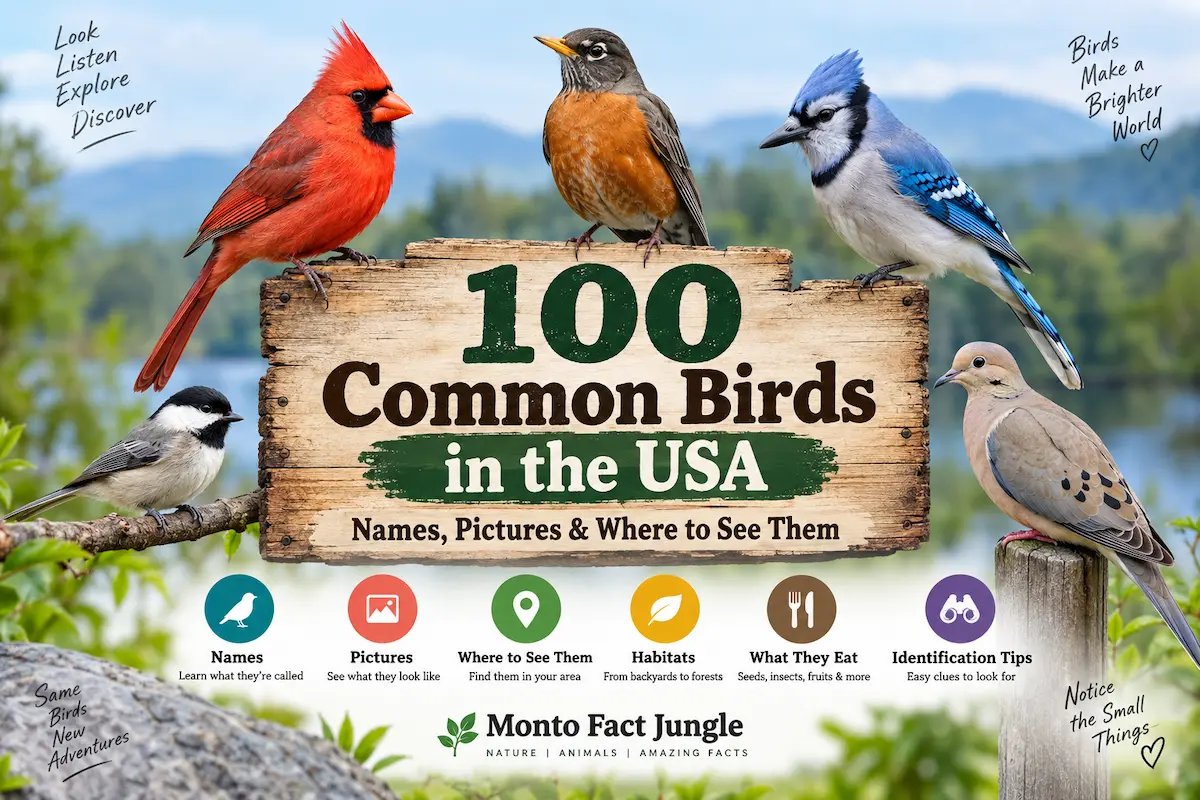
🐦 100 Common Birds in the USA: Names, Pictures & Where to See Them
⚡ Quick Answer
The USA is home to hundreds of regularly seen bird species, but which birds are considered “common” depends on your location, habitat, and season. This guide highlights 100 birds you may commonly encounter across different parts of the United States, including backyard birds, songbirds, waterfowl, raptors, owls, shorebirds, and other familiar species.
Use the list below to quickly learn each bird's name, appearance, food, habitat, behavior, and where you may have a chance to see it.
Birds are everywhere in the United States. You may notice an American Robin searching a lawn for food, a Mourning Dove sitting quietly on a telephone wire, or a Northern Cardinal visiting a backyard feeder. Some birds are easy to recognize, while others take a little more practice. 🔎
But what are the most common birds in the USA?
There is no single official nationwide ranking of the “100 most common birds” because bird populations and sightings vary by location, habitat, and season. Instead, this guide brings together 100 birds that people commonly encounter across American backyards, neighborhoods, parks, fields, forests, wetlands, and other everyday places. 🇺🇸🌳
The list includes familiar backyard birds, colorful songbirds, waterbirds, birds of prey, and species that are especially common in particular regions of the country.
Whether you are beginning birdwatching, trying to identify a bird outside your window, or simply curious about the birds around you, these are some of the species worth knowing. 🐦👀Explore 100 interesting facts about birds, and Do birds have ears? guide
🌳 A Real-Life Birding Example
You don't need to visit a wildlife reserve to start noticing common birds. A quiet morning in your own neighborhood can be enough.
For example, you might see a Rock Pigeon on a rooftop, hear an American Robin searching through a lawn, notice a Northern Cardinal near a backyard shrub, or spot an American Crow moving between trees and buildings.
Once you start paying attention to where birds are, what they are doing, and what they sound like, familiar places can become surprisingly interesting bird-watching spots. 📸🐦
The 100 birds below are a starting point for recognizing some of the species you may encounter across different parts of the United States. Read Do birds have Feathers?
📊 Quick Guide to the 100 Birds
| # | Bird | Type | Where you may see it |
|---|---|---|---|
| 1 | American Robin | Songbird | Lawns, gardens, parks |
| 2 | Northern Cardinal | Songbird | Backyards, shrubs, woodland edges |
| 3 | Mourning Dove | Dove | Yards, open areas, city edges |
| 4 | American Crow | Crow | Cities, farms, parks, woodlands |
| 5 | Blue Jay | Songbird | Woodlands, suburbs, backyards |
| 6 | House Sparrow | Sparrow | Buildings, towns, farms |
| 7 | European Starling | Starling | Cities, fields, lawns |
| 8 | House Finch | Finch | Backyards, feeders, urban areas |
| 9 | American Goldfinch | Finch | Fields, gardens, feeders |
| 10 | Song Sparrow | Sparrow | Gardens, wetlands, brushy areas |
The table continues with the remaining birds in the guide. Read Do Birds Pee?
1. American Robin 🐦
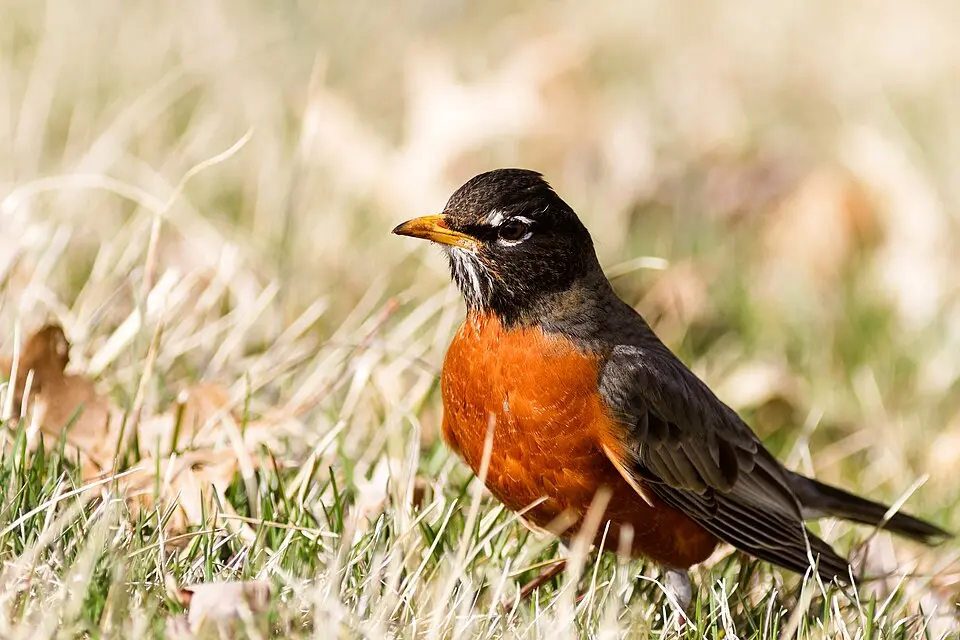
The American Robin is one of the most familiar birds in the United States. It is often seen hopping or running across lawns while searching for food.
Scientific name: Turdus migratorius
📍 Where you may see it: Lawns, gardens, parks, yards, and woodland edges
👀 What it looks like: Orange-red breast, gray-brown back, and a dark head
🍽️ What it eats: Earthworms, insects, fruits, and berries
🔎 Easy clue: Look for a robin moving across a lawn and stopping suddenly to search the ground.
American Robins are particularly noticeable in spring and summer, when their songs can be heard around neighborhoods and parks. 🎵🌳
2. Northern Cardinal ❤️
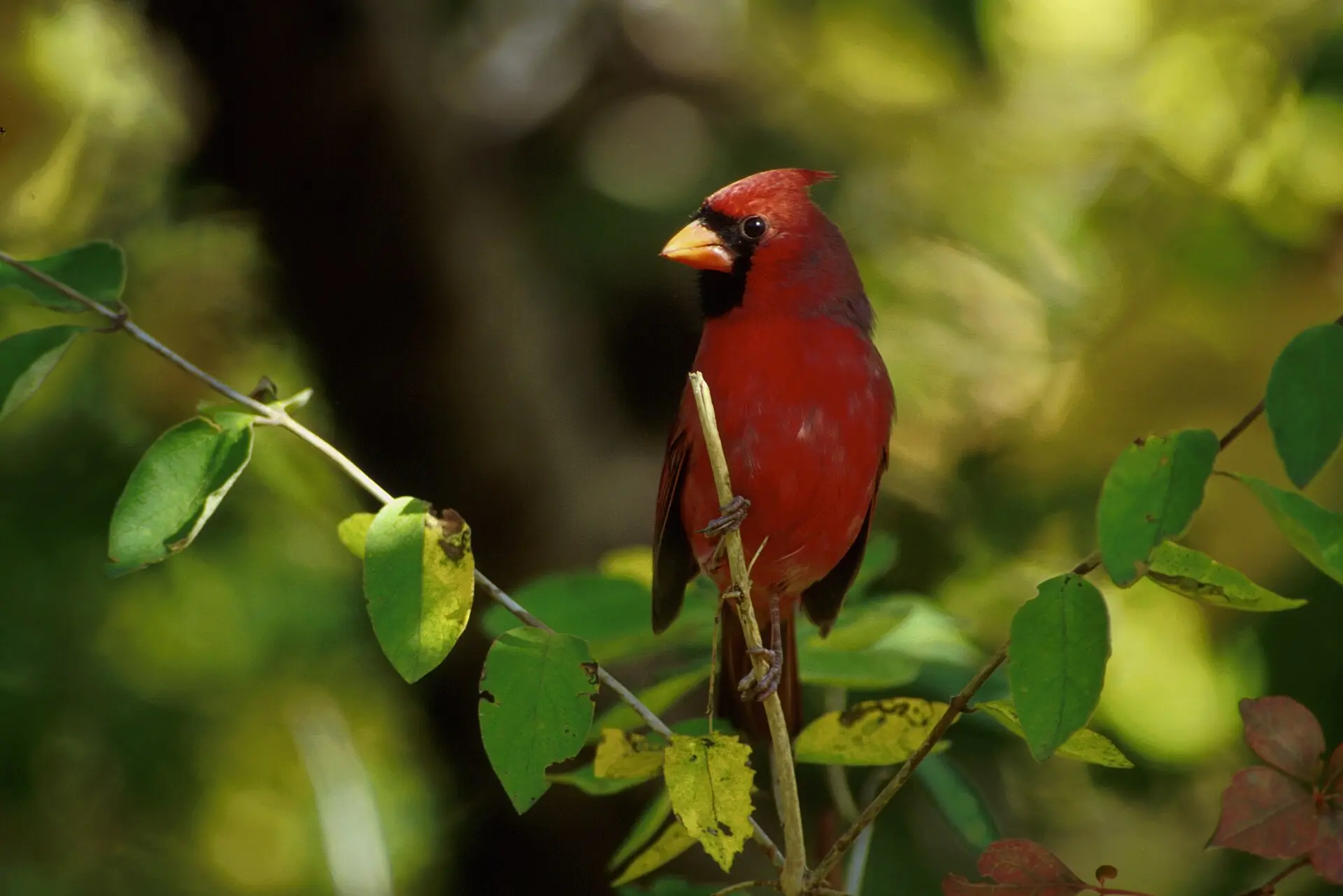
The Northern Cardinal is one of the easiest American birds to recognize, especially the bright-red adult male. Females are mostly warm brown with reddish highlights.
Scientific name: Cardinalis cardinalis
📍 Where you may see it: Backyards, gardens, woodland edges, parks, and shrubs
👀 What it looks like: Males are bright red with a black face; females are brownish-red with a crest
🍽️ What it eats: Seeds, grains, insects, fruits, and berries
🔎 Easy clue: Look for the pointed crest and reddish-orange bill.
Northern Cardinals are frequent visitors to bird feeders and can remain in the same general area throughout the year. 🌳🐦
3. Mourning Dove 🕊️
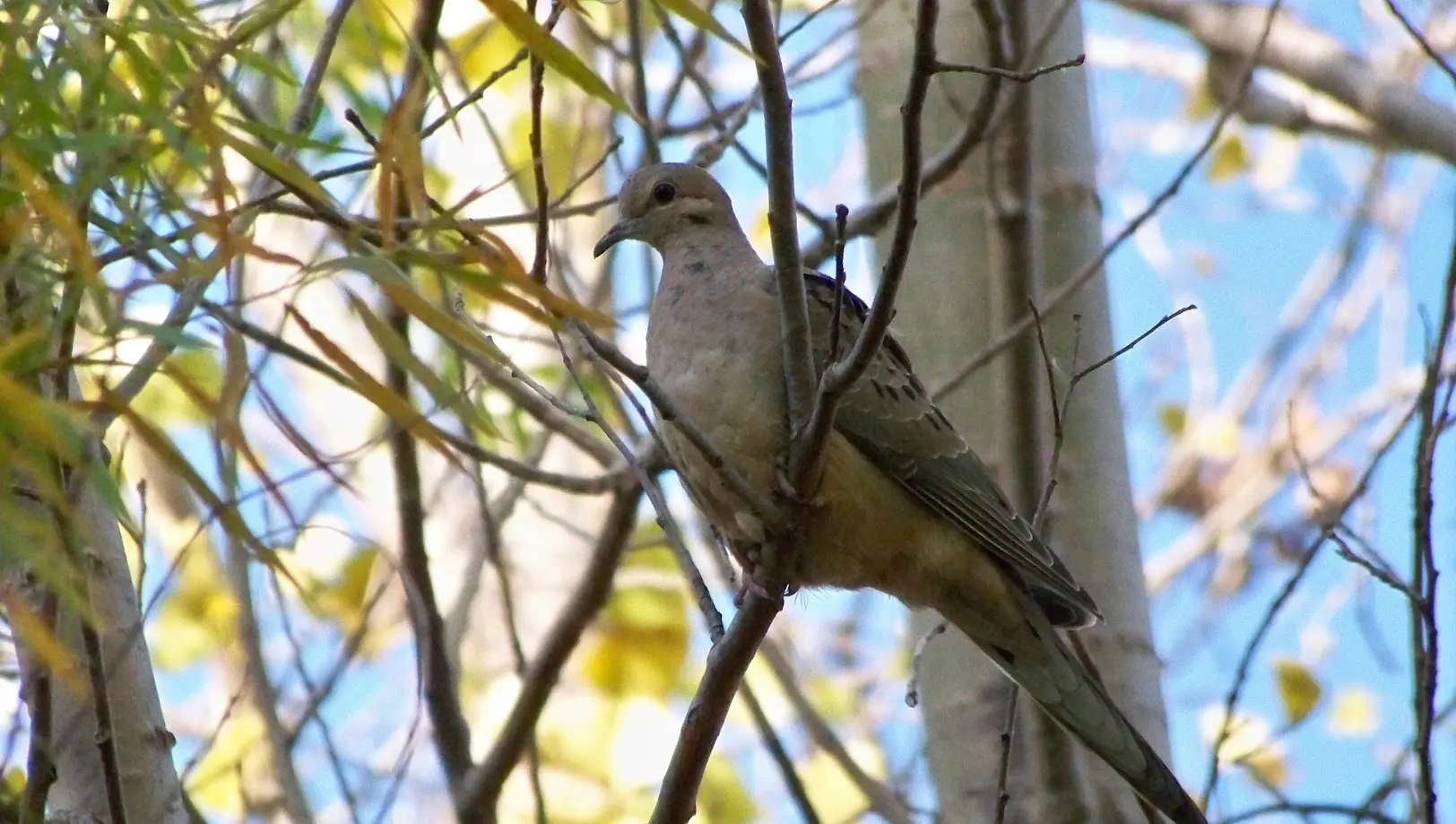
The Mourning Dove is a slim, soft-colored bird commonly seen sitting on wires, fences, rooftops, and tree branches.
Scientific name: Zenaida macroura
📍 Where you may see it: Neighborhoods, farms, open woodland, parks, and backyards
👀 What it looks like: Pale brown and gray body with dark spots on the wings
🍽️ What it eats: Mostly seeds
🔎 Easy clue: Its long, pointed tail and gentle cooing call make it easy to recognize.
Mourning Doves often spend time on the ground looking for seeds. Their soft, repetitive calls are one of the familiar sounds of many American neighborhoods. 🎵🏡
4. American Crow 🖤
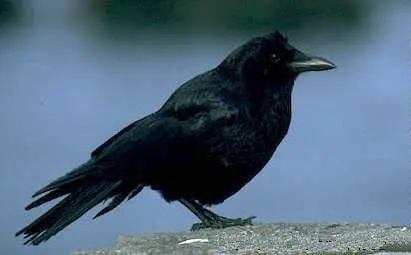
The American Crow is a large, completely black bird that can be found in cities as well as rural areas.
Scientific name: Corvus brachyrhynchos
📍 Where you may see it: Cities, suburbs, farms, fields, parks, roadsides, and forests
👀 What it looks like: Entirely black plumage, sturdy body, and a strong bill
🍽️ What it eats: Insects, seeds, fruits, carrion, food scraps, and many other foods
🔎 Easy clue: Its size, black feathers, and loud “caw” make it hard to mistake.
American Crows are highly adaptable birds. They can live close to people and often gather in groups. 🏙️🌳
5. Blue Jay 💙
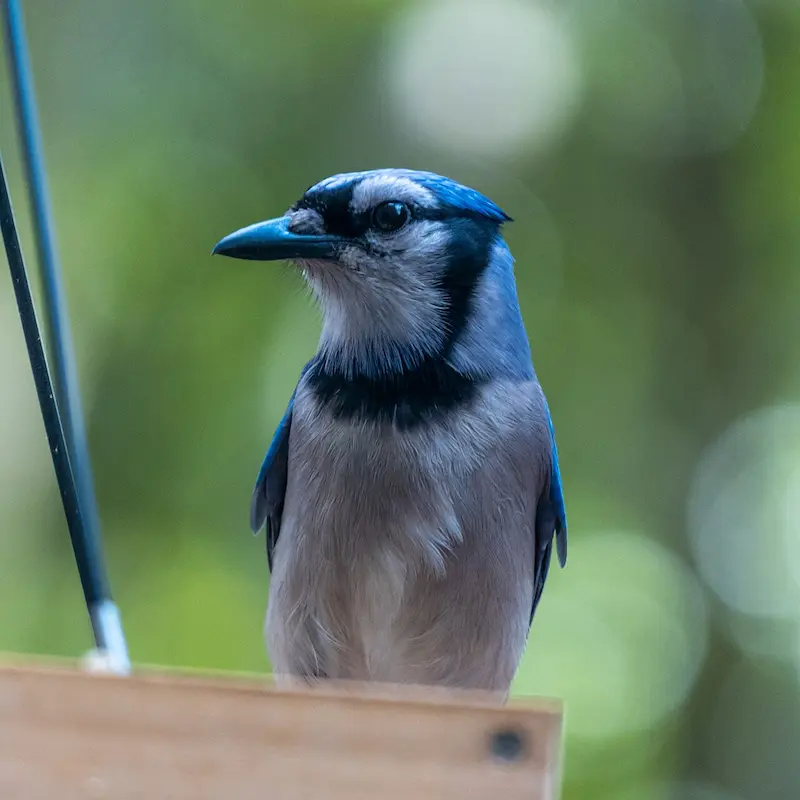
The Blue Jay is a colorful and noisy bird recognized by its blue, white, and black plumage and prominent crest.
Scientific name: Cyanocitta cristata
📍 Where you may see it: Backyards, parks, forests, woodland edges, and neighborhoods
👀 What it looks like: Blue upperparts, white underside, black markings, and a pointed crest
🍽️ What it eats: Seeds, nuts, insects, fruits, and other foods
🔎 Easy clue: Its blue coloration and tall crest are the quickest identification clues.
Blue Jays are especially noticeable because they are vocal birds. You may hear one before you see it. 🎵👂
6. House Sparrow 🏡
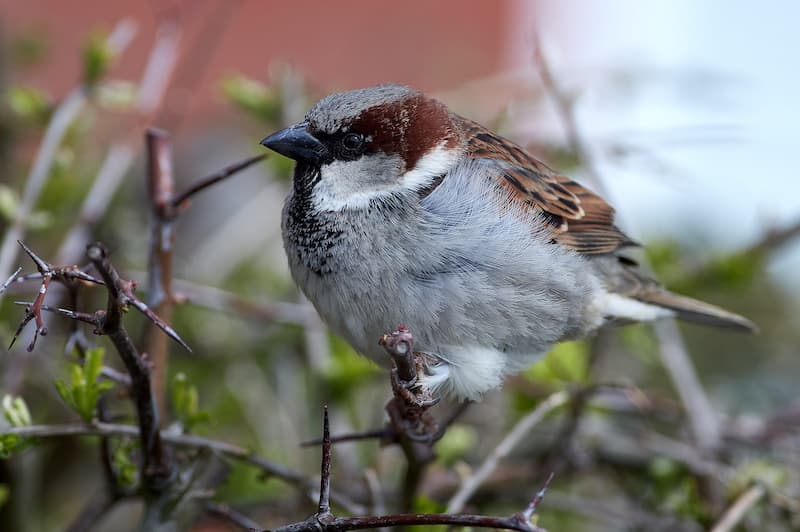
The House Sparrow is a small bird that has lived alongside people for centuries and is now familiar in many towns and cities.
Scientific name: Passer domesticus
📍 Where you may see it: Buildings, streets, gardens, farms, parks, and other places close to people
👀 What it looks like: Males have gray crowns, black markings, and brown backs; females are mostly brown and buff
🍽️ What it eats: Seeds, grains, insects, and food scraps
🔎 Easy clue: Look around buildings and busy human areas for small brown-and-gray birds moving in groups.
House Sparrows are comfortable around people and often nest in or around buildings. 🏠🐦
7. European Starling ✨
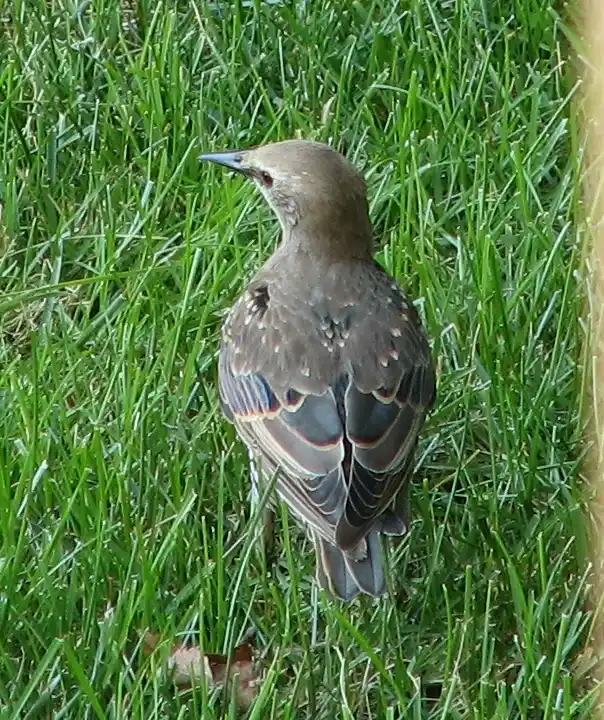
The European Starling is a compact dark bird with glossy plumage that can show purple, green, and blue tones in good light.
Scientific name: Sturnus vulgaris
📍 Where you may see it: Cities, lawns, farms, parking lots, fields, and open areas
👀 What it looks like: Dark glossy feathers with small pale spots, especially during parts of the year
🍽️ What it eats: Insects, fruits, seeds, and other foods
🔎 Easy clue: Watch for groups of dark birds walking across lawns or gathering together.
Starlings are social birds and can form large flocks. Their ability to live successfully around people has helped them become a familiar sight in many parts of the United States. 🐦🐦🐦
8. House Finch 🐦❤️
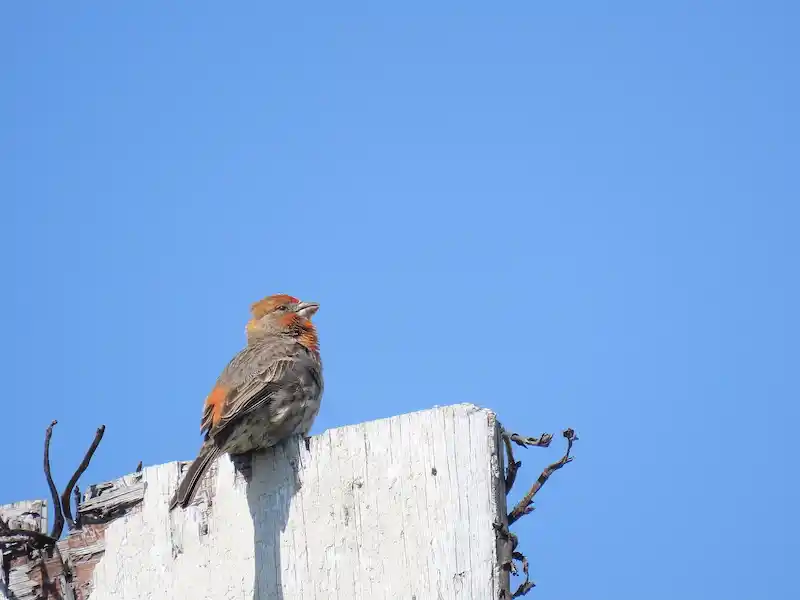
The House Finch is a small songbird frequently found around homes and bird feeders. Adult males are particularly noticeable because of their reddish coloring.
Scientific name: Haemorhous mexicanus
📍 Where you may see it: Backyards, gardens, neighborhoods, parks, and feeders
👀 What it looks like: Brown-streaked body; males often have red on the head and upper chest
🍽️ What it eats: Seeds, fruits, and plant material
🔎 Easy clue: Look for a small finch with a reddish head and chest among other feeder birds.
House Finches are well adapted to human environments and can be seen throughout much of the United States. 🏡🌿
9. American Goldfinch 💛
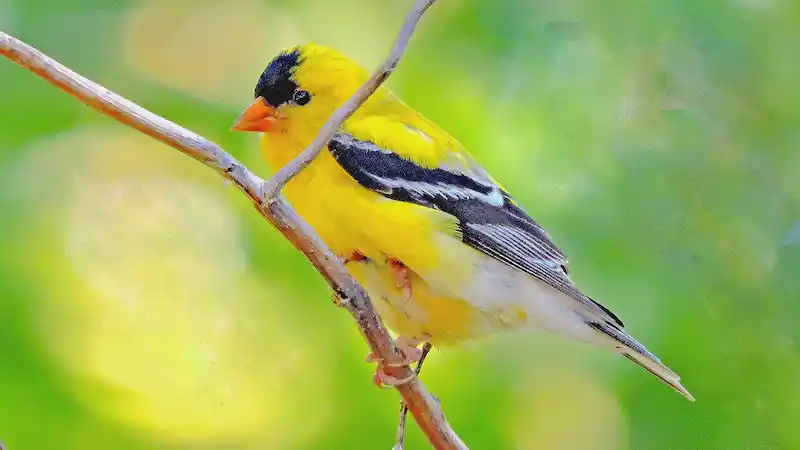
The American Goldfinch is one of the most recognizable small birds in North America. The breeding male has bright yellow plumage contrasted with black wings and a black cap.
Scientific name: Spinus tristis
📍 Where you may see it: Backyards, gardens, fields, meadows, and areas with seed-producing plants
👀 What it looks like: Breeding males are bright yellow with black wings and a black cap; females and nonbreeding birds are duller
🍽️ What it eats: Mostly seeds, especially from plants such as thistles and sunflowers
🔎 Easy clue: Look for a small yellow bird with black wings feeding on seeds.
American Goldfinches are often associated with plants that produce small seeds, making gardens and feeders good places to look for them. 🌻🐦
10. Song Sparrow 🎵
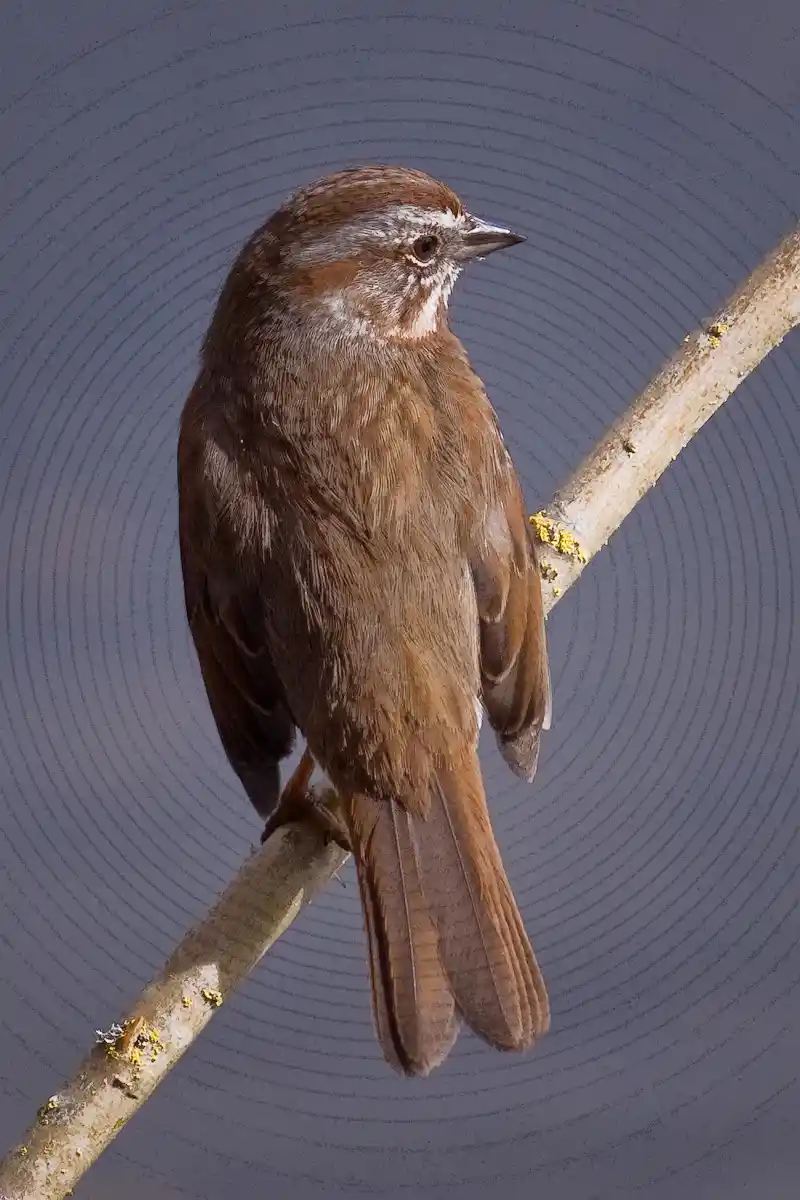
The Song Sparrow is a small brown bird that can be easy to overlook until you notice its streaked breast and hear its varied song.
Scientific name: Melospiza melodia
📍 Where you may see it: Backyards, shrubs, parks, fields, wetlands, and woodland edges
👀 What it looks like: Brown and gray plumage with dark streaks across the breast
🍽️ What it eats: Seeds, insects, and other small foods
🔎 Easy clue: A streaky brown sparrow singing from a shrub or low perch is a good candidate.
Song Sparrows are widespread and adaptable. Their appearance can vary considerably across different parts of the United States. 🌿🎵
🔎 Quick Look: Birds 1–10
| 🐦 Bird | 🔎 Easy identification clue | 📍 Common places |
|---|---|---|
| American Robin | Orange-red breast | Lawns, parks, yards |
| Northern Cardinal | Red male + crest | Backyards, shrubs |
| Mourning Dove | Long tail + soft coo | Wires, yards, open areas |
| American Crow | Completely black + loud caw | Cities, fields, parks |
| Blue Jay | Blue feathers + crest | Backyards, forests |
| House Sparrow | Small brown-and-gray bird | Buildings, streets, yards |
| European Starling | Glossy dark plumage | Lawns, cities, fields |
| House Finch | Red-headed male | Feeders, neighborhoods |
| American Goldfinch | Bright yellow male | Gardens, fields, feeders |
| Song Sparrow | Streaked breast + song | Shrubs, yards, wetlands |
🧭 A Simple Way to Use This Guide
You do not need to memorize all 100 birds at once. Start with the birds you see regularly. 🐦
Notice their size, colors, shape, behavior, habitat, and sounds. Those clues can often help narrow down an identification much faster than looking at a long list of bird names. 🔎
And if you photograph a bird, keep the picture. 📸 A photograph can give you time to compare details that may be difficult to notice when the bird is only around for a few seconds.
11. 🖤 Red-winged Blackbird
The Red-winged Blackbird is one of the easiest blackbirds to recognize, thanks to the male’s bright red-and-yellow shoulder patches. You’ll often spot them perched on tall grasses, reeds, fence posts, or wetland vegetation.
📍 Where you’ll see them: Wetlands, marshes, fields, roadsides, and open areas across much of the USA.
👀 What to look for: Males are glossy black with vivid red shoulder patches. Females are brown and heavily streaked, making them look quite different from males.
🍽️ What they eat: Seeds, grains, insects, and other small invertebrates.
🔎 Interesting behavior: Males often defend territories by displaying their colorful shoulder patches and calling loudly from exposed perches.
12. 🖤 Common Grackle
The Common Grackle is a large, long-tailed blackbird that can look almost blue or purple when sunlight catches its feathers. They are often found in groups, especially around open areas and places where food is easy to find.
📍 Where you’ll see them: Lawns, parks, agricultural areas, wetlands, parking lots, and neighborhoods.
👀 What to look for: A long tail, pale yellow eye, and glossy body with blue, purple, or bronze tones.
🍽️ What they eat: Seeds, grains, insects, small animals, and many types of food they find around people.
🔎 Interesting behavior: Grackles can gather in surprisingly large groups, creating a noisy and impressive sight.
13. 🎶 Northern Mockingbird
The Northern Mockingbird is famous for its ability to imitate the songs and sounds of other birds. A single bird may sing many different phrases, sometimes repeating sounds it has heard around its territory.
📍 Where you’ll see them: Neighborhoods, gardens, parks, roadsides, and open areas with shrubs.
👀 What to look for: Gray upperparts, a pale underside, white wing patches, and a long tail.
🍽️ What it eats: Insects, fruits, berries, and other small foods.
🔎 Interesting behavior: Northern Mockingbirds are especially noticeable because of their varied songs. Some males may sing for long periods, particularly during breeding season.
14. 🐥 Black-capped Chickadee
The Black-capped Chickadee is a tiny, energetic bird that is a favorite visitor to backyard feeders. Its black cap and bib, white cheeks, and compact body make it easy to recognize.
📍 Where you’ll see them: Woodlands, suburban yards, parks, and neighborhoods, especially in the northern USA.
👀 What to look for: A black cap, black throat patch, white cheeks, gray back, and pale underside.
🍽️ What they eat: Seeds, insects, berries, and other small foods.
🔎 Interesting behavior: Chickadees are active little birds that often move quickly between branches while searching for food.
💡 Fun fact: Their familiar “chick-a-dee-dee-dee” call is one of the most recognizable bird sounds in many parts of North America.
15. 🌳 Tufted Titmouse
The Tufted Titmouse is a small gray bird with a noticeable crest on its head. It is a common sight in eastern U.S. forests, parks, and suburban backyards.
📍 Where you’ll see them: Deciduous forests, wooded neighborhoods, parks, and backyard feeders.
👀 What to look for: Gray body, white underside, black forehead patch, and a pointed gray crest.
🍽️ What they eat: Seeds, insects, berries, and nuts.
🔎 Interesting behavior: They often visit feeders and may quickly grab a seed before flying away to eat it somewhere safer.
16. 🤍 White-breasted Nuthatch
The White-breasted Nuthatch is a small climbing bird with a distinctive habit of moving headfirst down tree trunks.
📍 Where you’ll see them: Mature trees, wooded parks, forests, and suburban yards.
👀 What to look for: White face and underside, blue-gray back, black stripe over the head, and a short tail.
🍽️ What they eat: Insects, seeds, nuts, and other small foods.
🔎 Interesting behavior: Unlike many birds that climb upward on tree trunks, White-breasted Nuthatches commonly move downward headfirst.
🌳 Look closely: If you see a small bird creeping down a tree trunk instead of flying from branch to branch, a nuthatch is worth considering.
17. 🪵 Downy Woodpecker
The Downy Woodpecker is one of the smallest and most familiar woodpeckers in North America. Its small size makes it a frequent visitor to backyard feeders.
📍 Where you’ll see them: Forests, parks, wooded neighborhoods, gardens, and backyards.
👀 What to look for: Black-and-white plumage, a short bill, and a small body. Males have a red patch on the back of the head.
🍽️ What they eat: Insects, larvae, seeds, berries, and suet at feeders.
🔎 Interesting behavior: They use their strong bills to search tree bark for insects and larvae.
💡 Identification tip: The Downy Woodpecker looks very similar to the larger Hairy Woodpecker. Size and bill length are useful clues when comparing the two.
18. 🤎 Dark-eyed Junco
The Dark-eyed Junco is a small sparrow-like bird that is especially familiar during the colder months in many parts of the USA.
📍 Where you’ll see them: Backyards, woodland edges, parks, gardens, and areas with leaf litter.
👀 What to look for: A rounded body, short bill, contrasting upperparts and belly; plumage varies considerably across regions.
🍽️ What they eat: Mostly seeds, along with some insects during warmer months.
🔎 Interesting behavior: Juncos often forage on the ground, hopping through leaves and vegetation while searching for food.
🍂 Seasonal clue: In many areas, seeing juncos around yards and feeders becomes more common during fall and winter.
19. 🏡 Carolina Wren
The Carolina Wren is a small but surprisingly loud bird. Its rich, repeated song can seem much bigger than the bird itself.
📍 Where you’ll see them: Backyards, gardens, wooded neighborhoods, forest edges, and areas with dense vegetation.
👀 What to look for: Warm reddish-brown upperparts, a pale underside, a bold white eyebrow stripe, and an upright posture.
🍽️ What they eat: Insects, spiders, and other small invertebrates, along with some seeds and fruits.
🎵 What you’ll hear: A loud, repeated song often described as sounding like “tea-kettle.”
🔎 Interesting behavior: Carolina Wrens frequently explore low vegetation, wood piles, shrubs, and other sheltered spaces while searching for food.
20. 🐦 Rock Pigeon
The Rock Pigeon is one of the most familiar birds in cities and towns around the world. You may see them on sidewalks, rooftops, bridges, parking lots, and building ledges.
📍 Where you’ll see them: Cities, suburbs, towns, parks, bridges, rooftops, and other areas with human structures.
👀 What to look for: Usually gray with darker wings, two dark wing bars, and an iridescent green-purple neck. Color patterns can vary greatly.
🍽️ What they eat: Seeds, grains, food scraps, and other easily available foods.
🔎 Interesting behavior: Rock Pigeons are exceptionally comfortable around buildings and people. They often use ledges and other structures as substitutes for natural cliffs.
📸 Real-life connection: If you’ve ever watched pigeons gathering around a street, balcony, park, or building, you’ve already had a close-up encounter with one of America’s most familiar urban birds. Explore our Original Field note obserbations on rock pigeon
🐦 Quick Look: Birds 11–20
| # | Bird | Easy Identification Clue |
|---|---|---|
| 11 | 🖤 Red-winged Blackbird | Red-and-yellow shoulder patch |
| 12 | 🖤 Common Grackle | Long tail + pale yellow eye |
| 13 | 🎶 Northern Mockingbird | Excellent song mimic |
| 14 | 🐥 Black-capped Chickadee | Black cap + white cheeks |
| 15 | 🌳 Tufted Titmouse | Gray crest |
| 16 | 🤍 White-breasted Nuthatch | Often climbs down trees headfirst |
| 17 | 🪵 Downy Woodpecker | Small black-and-white woodpecker |
| 18 | 🤎 Dark-eyed Junco | Ground-feeding, rounded sparrow-like bird |
| 19 | 🏡 Carolina Wren | Loud “tea-kettle” song |
| 20 | 🐦 Rock Pigeon | Familiar city and rooftop bird |
Birds 1–20: What They Have in Common
The first 20 birds in this guide show just how varied everyday birdwatching can be.
Some are strongly associated with backyards and gardens, such as Northern Cardinals, House Finches, Chickadees, and Tufted Titmice. Others are more often noticed in open spaces, including American Robins, Red-winged Blackbirds, and Common Grackles. Rock Pigeons and House Sparrows are especially comfortable around human buildings and cities.
You don't need to travel to a remote forest to start noticing birds. A lawn, balcony, neighborhood street, garden, park, or even the trees outside a window can become a small birdwatching spot.
The more often you observe birds, the easier it becomes to notice the details that separate one species from another—size, shape, colors, markings, movement, habitat, and sound.
And sometimes, the simplest observation is the most interesting one: what was the bird actually doing?
21. House Wren 🐦
The House Wren is a tiny, energetic bird that often stays close to shrubs, gardens, fences, and buildings. It may be easier to hear than see because it moves quickly through dense vegetation.
Scientific name: Troglodytes aedon
📍 Where you may see it: Backyards, gardens, shrubs, parks, woodland edges, and neighborhoods
👀 What it looks like: Small brown bird with a slightly barred tail and compact body
🍽️ What it eats: Insects, spiders, and other small invertebrates
🔎 Easy clue: Listen for a surprisingly loud, bubbling song coming from a shrub or nearby vegetation.
House Wrens often investigate small spaces around homes and gardens while searching for insects.
22. Carolina Chickadee 🖤
The Carolina Chickadee is a tiny black-and-white bird commonly found in the southeastern United States. It looks very similar to the Black-capped Chickadee.
Scientific name: Poecile carolinensis
📍 Where you may see it: Woodlands, parks, gardens, neighborhoods, and backyard feeders
👀 What it looks like: Black cap and bib, white cheeks, gray back, and pale underside
🍽️ What it eats: Seeds, insects, berries, and other small foods
🔎 Easy clue: A tiny black-capped bird with bright white cheeks moving quickly through branches.
Carolina Chickadees are active little birds and frequently visit feeders. Their familiar chickadee calls can also help with identification.
23. Red-bellied Woodpecker ❤️
Despite its name, the Red-bellied Woodpecker is often recognized more easily by the red coloring on its head than by its belly.
Scientific name: Melanerpes carolinus
📍 Where you may see it: Woodlands, parks, mature neighborhoods, gardens, and backyard trees
👀 What it looks like: Black-and-white barred back with reddish coloring on the head and neck
🍽️ What it eats: Insects, nuts, seeds, fruits, and other foods
🔎 Easy clue: Look for a medium-sized woodpecker with a boldly barred back and red crown/nape.
It may climb tree trunks while searching for insects or visit feeders for seeds and nuts.
24. Northern Flicker 🪵
The Northern Flicker is a large woodpecker that often spends more time on the ground than many other woodpecker species.
Scientific name: Colaptes auratus
📍 Where you may see it: Lawns, parks, open woodland, backyards, and forest edges
👀 What it looks like: Brown body with black spots, a barred back, and a distinctive dark crescent on the chest
🍽️ What it eats: Ants, beetles, other insects, fruits, and seeds
🔎 Easy clue: A large brownish woodpecker feeding on the ground is worth checking for a Northern Flicker.
When it flies, the bright color visible under its wings and tail can provide another useful identification clue.
25. Hairy Woodpecker 🪶
The Hairy Woodpecker is a medium-sized black-and-white woodpecker that can look remarkably similar to the smaller Downy Woodpecker.
Scientific name: Dryobates villosus
📍 Where you may see it: Forests, parks, mature trees, and wooded backyards
👀 What it looks like: Black-and-white pattern, white underside, black wings, and a relatively long bill
🍽️ What it eats: Insects, larvae, seeds, nuts, and berries
🔎 Easy clue: Compare its larger body and longer bill with the smaller Downy Woodpecker.
This is a great example of why size matters when identifying birds. Two species can have very similar colors but still be separated by proportions and bill size.
26. Eastern Bluebird 💙
The Eastern Bluebird is a colorful thrush often associated with open country, farms, gardens, and suburban areas.
Scientific name: Sialia sialis
📍 Where you may see it: Open woodland, fields, farms, gardens, parks, and suburban yards
👀 What it looks like: Males have bright blue upperparts and a warm reddish-orange breast; females are more subdued
🍽️ What it eats: Insects, berries, and other fruits
🔎 Easy clue: Look for a small blue bird with a warm orange breast sitting on a fence, branch, or low perch.
Eastern Bluebirds often hunt insects from exposed perches and then drop down to the ground to catch them.
27. Western Bluebird 💙
The Western Bluebird fills a similar ecological role in much of the western United States and is a familiar sight in open woodland and suburban areas.
Scientific name: Sialia mexicana
📍 Where you may see it: Western forests, open woodland, parks, farms, gardens, and suburbs
👀 What it looks like: Males have deep blue coloring with a rusty-orange chest and sides
🍽️ What it eats: Insects, berries, and other fruits
🔎 Easy clue: A blue bird with a rusty-colored chest in the western United States may be a Western Bluebird.
Its habit of using exposed perches makes it easier to spot in open habitats.
28. Cedar Waxwing 🍒
The Cedar Waxwing is a sleek, social bird that is particularly associated with fruiting trees and shrubs.
Scientific name: Bombycilla cedrorum
📍 Where you may see it: Gardens, parks, woodland edges, orchards, and areas with berry-producing plants
👀 What it looks like: Smooth brown, gray, and yellow plumage with a black mask and pointed wings
🍽️ What it eats: Mostly fruits and berries, along with insects during parts of the year
🔎 Easy clue: Look for a smooth-looking bird with a black eye mask and yellow-tipped tail.
Cedar Waxwings often travel in groups. Finding one feeding on berries may mean several more are nearby. 🍓
29. Gray Catbird 🩶
The Gray Catbird is a medium-sized songbird with a mostly gray body and a darker cap. Its name comes partly from one of its distinctive calls, which can sound surprisingly cat-like.
Scientific name: Dumetella carolinensis
📍 Where you may see it: Shrubs, gardens, woodland edges, parks, and dense vegetation
👀 What it looks like: Slate-gray body, black cap, dark tail, and rusty patch under the tail
🍽️ What it eats: Berries, fruits, insects, and other small foods
🔎 Easy clue: Listen for unusual calls coming from dense shrubs, then look for a gray bird with a black cap.
Gray Catbirds often remain hidden inside vegetation, so listening can be just as useful as looking.
30. Brown Thrasher 🤎
The Brown Thrasher is a large, long-tailed songbird with a strongly streaked breast and an impressive variety of vocalizations.
Scientific name: Toxostoma rufum
📍 Where you may see it: Shrublands, woodland edges, gardens, parks, and suburban areas
👀 What it looks like: Reddish-brown back, heavily streaked underside, long tail, and yellowish eyes
🍽️ What it eats: Insects, fruits, seeds, and other foods
🔎 Easy clue: A long-tailed reddish-brown bird scratching through leaf litter or singing from dense vegetation may be a Brown Thrasher.
Brown Thrashers spend considerable time searching through leaves and soil for food. Their songs can contain a remarkable variety of sounds.
🔎 Quick Look: Birds 21–30
| Bird | Easy identification clue | Common places |
|---|---|---|
| House Wren | Tiny brown bird + loud song | Gardens, shrubs, yards |
| Carolina Chickadee | Black cap + white cheeks | Woods, feeders, gardens |
| Red-bellied Woodpecker | Barred back + red head | Trees, parks, yards |
| Northern Flicker | Large brown woodpecker on ground | Lawns, parks, woodland |
| Hairy Woodpecker | Larger black-and-white woodpecker | Forests, mature trees |
| Eastern Bluebird | Blue + orange breast | Fields, gardens, open woodland |
| Western Bluebird | Blue + rusty chest | Western open woodland |
| Cedar Waxwing | Black mask + yellow tail tip | Fruiting trees, parks |
| Gray Catbird | Gray body + black cap | Shrubs, gardens |
| Brown Thrasher | Streaked body + long tail | Shrubs, leaf litter |
🌳 A Pattern to Notice
By the time you've reached 30 birds, an interesting pattern starts to emerge: habitat can be just as useful as color when identifying a bird.
A bird sitting on a wire in a city, a bird scratching through leaves beneath a shrub, and a bird climbing vertically up a tree are giving you different clues before you even identify their species.
So when you see an unfamiliar bird, don't ask only:
“What color is it?”
Also ask:
👀 How big is it?
🪶 What shape is its body and bill?
🌳 Where is it?
🐾 What is it doing?
🎵 What does it sound like?
🪽 How does it move or fly?
Those simple observations can turn a confusing bird encounter into an identification puzzle—and that's where birdwatching gets fun.
31. Eastern Phoebe 🩶
The Eastern Phoebe is a small flycatcher that is often seen sitting quietly on a low branch, fence, or other exposed perch before suddenly flying out to catch an insect.
Scientific name: Sayornis phoebe
📍 Where you may see it: Gardens, parks, woodland edges, farms, bridges, and backyards
👀 What it looks like: Gray-brown upperparts, pale underside, dark head, and a relatively long tail
🍽️ What it eats: Flying insects, spiders, and other small invertebrates
🔎 Easy clue: Watch for a small grayish bird repeatedly returning to the same perch after short flights.
Eastern Phoebes often bob their tails while perched, which can be another useful clue when identifying them.
32. Barn Swallow 🪶
The Barn Swallow is a fast-flying bird often seen swooping over fields, water, and open spaces while catching insects in the air.
Scientific name: Hirundo rustica
📍 Where you may see it: Farms, fields, lakes, ponds, barns, bridges, and open countryside
👀 What it looks like: Blue-black upperparts, rusty throat and forehead, pale underside, and a deeply forked tail
🍽️ What it eats: Flying insects
🔎 Easy clue: A small bird making quick, low swooping flights with a long forked tail may be a Barn Swallow.
Barn Swallows frequently forage in groups, especially where flying insects are abundant. 🦟
33. Tree Swallow 🌳
The Tree Swallow is a sleek swallow that can often be seen flying over fields and wetlands while searching for insects.
Scientific name: Tachycineta bicolor
📍 Where you may see it: Wetlands, ponds, fields, meadows, parks, and open woodland
👀 What it looks like: Glossy blue-green upperparts and clean white underside
🍽️ What it eats: Flying insects, along with berries and other foods at certain times
🔎 Easy clue: Look for a streamlined dark-and-white bird flying quickly over water or open ground.
Tree Swallows can also use nest boxes, making them a familiar bird around some parks, farms, and bird-friendly properties.
34. Chipping Sparrow 🤎
The Chipping Sparrow is a small sparrow with a distinctive reddish cap during the breeding season. It is often found in open areas rather than deep forest.
Scientific name: Spizella passerina
📍 Where you may see it: Yards, parks, fields, gardens, woodland edges, and open forests
👀 What it looks like: Breeding adults have a rusty-red cap, gray face, and brown-streaked back
🍽️ What it eats: Seeds and insects
🔎 Easy clue: A small sparrow with a rusty cap feeding on the ground or around grassy areas may be a Chipping Sparrow.
Its name comes from its distinctive, rapid-sounding song.
35. White-throated Sparrow 🤍
The White-throated Sparrow is a medium-sized sparrow recognized by its bold head pattern and bright white throat.
Scientific name: Zonotrichia albicollis
📍 Where you may see it: Shrubs, woodland edges, gardens, backyards, and forest clearings
👀 What it looks like: Brown-streaked body with a black-and-white striped head and white throat
🍽️ What it eats: Seeds, insects, and plant material
🔎 Easy clue: Look for the bright white throat and bold black-and-white head stripes.
Its clear, whistled song is another useful identification clue, particularly during the breeding season. 🎵
36. American Tree Sparrow 🌾
The American Tree Sparrow is a small sparrow that is especially associated with open habitats and is often seen during the colder months in many parts of the United States.
Scientific name: Spizelloides arborea
📍 Where you may see it: Fields, weedy areas, brushy edges, farms, and open country
👀 What it looks like: Rusty cap, brown-streaked back, pale underside, and a small dark spot on the chest
🍽️ What it eats: Seeds, grains, and insects
🔎 Easy clue: Look for a small sparrow with a rusty cap and a central dark chest spot in open winter habitats.
Despite its name, the American Tree Sparrow is frequently found feeding on or near the ground.
37. Eastern Towhee 🖤🧡
The Eastern Towhee is a large sparrow commonly found scratching through leaves beneath shrubs and woodland edges.
Scientific name: Pipilo erythrophthalmus
📍 Where you may see it: Shrublands, forest edges, gardens, parks, and areas with dense undergrowth
👀 What it looks like: Males are black with a white belly and rusty-red sides; females are brown with similar markings
🍽️ What it eats: Seeds, insects, fruits, and other small foods
🔎 Easy clue: Listen for its familiar “drink your tea” song and look beneath shrubs for a large, dark sparrow.
Eastern Towhees often spend more time on the ground than in the open branches, scratching through fallen leaves as they search for food. 🍂
38. Brown-headed Cowbird 🤎
The Brown-headed Cowbird is a stocky blackbird whose males have a dark brown head contrasting with a glossy black body.
Scientific name: Molothrus ater
📍 Where you may see it: Fields, pastures, lawns, farms, parks, and open woodland
👀 What it looks like: Males have a brown head and black body; females are mostly brown and lighter overall
🍽️ What it eats: Seeds, grains, insects, and other foods
🔎 Easy clue: Look for a stocky blackbird with a distinctly brown head among groups of birds feeding on open ground.
Brown-headed Cowbirds are often seen walking through fields and lawns searching for food.
39. Common Yellowthroat 💛
The Common Yellowthroat is a small warbler that frequently hides among grasses, reeds, and dense vegetation.
Scientific name: Geothlypis trichas
📍 Where you may see it: Marshes, wetlands, fields, gardens, brush, and dense vegetation
👀 What it looks like: Males have a bright yellow throat and breast with a distinctive black mask; females are more subdued
🍽️ What it eats: Insects and other small invertebrates
🔎 Easy clue: A small yellow bird disappearing into thick vegetation may be a Common Yellowthroat.
Because it often stays low and hidden, its distinctive song can be easier to notice than the bird itself. 🎵
40. Indigo Bunting 💙
The Indigo Bunting is a small songbird whose brilliant blue breeding plumage makes it one of the most eye-catching birds in this guide.
Scientific name: Passerina cyanea
📍 Where you may see it: Fields, woodland edges, roadsides, brushy areas, and open habitats
👀 What it looks like: Breeding males are vivid blue; females are mostly brown
🍽️ What it eats: Seeds, insects, and other small foods
🔎 Easy clue: A small, intensely blue bird singing from a shrub or exposed perch is likely an Indigo Bunting.
The male's bright blue appearance comes from the structure of its feathers rather than from blue pigment alone. ✨
🔎 Quick Look: Birds 31–40
| Bird | Easy identification clue | Common places |
|---|---|---|
| Eastern Phoebe | Gray bird that returns to the same perch | Gardens, parks, woodland edges |
| Barn Swallow | Deeply forked tail + fast flight | Farms, fields, barns |
| Tree Swallow | Blue-green back + white underside | Ponds, wetlands, fields |
| Chipping Sparrow | Rusty cap + small size | Yards, parks, open woodland |
| White-throated Sparrow | White throat + striped head | Shrubs, yards, woodland edges |
| American Tree Sparrow | Rusty cap + chest spot | Fields, open country |
| Eastern Towhee | Black/orange male + ground scratching | Shrubs, woodland edges |
| Brown-headed Cowbird | Brown head + black body | Fields, lawns, farms |
| Common Yellowthroat | Yellow throat + black mask | Marshes, dense vegetation |
| Indigo Bunting | Brilliant blue male | Fields, brush, woodland edges |
🌿 Look Beyond the Bird
Some of these birds teach an important birdwatching lesson: you don't always need a clear view to identify a species.
A bird hidden inside grass may reveal itself through its song. 🎵 A bird flying over a pond may be easier to identify by its flight pattern. A bird scratching through fallen leaves may give away its identity through its behavior.
When you start combining appearance + sound + habitat + behavior, bird identification becomes much easier—and much more interesting than simply matching a picture to a name.
41. Mallard 🦆
The Mallard is one of the most familiar ducks in North America. It is commonly seen in ponds, lakes, rivers, wetlands, and even city parks.
Scientific name: Anas platyrhynchos
📍 Where you may see it: Ponds, lakes, rivers, wetlands, parks, and city waterways
👀 What it looks like: Males have a glossy green head, yellow bill, gray body, and curled black tail feathers; females are mostly mottled brown
🍽️ What it eats: Seeds, aquatic plants, insects, and other small foods
🔎 Easy clue: A duck with a green-headed male and brown-speckled female is likely a Mallard.
Mallards are comfortable around people, which is why they are often among the first ducks beginners learn to recognize.
42. Canada Goose 🪿
The Canada Goose is a large, familiar waterbird that can be found around lakes, ponds, rivers, fields, and many urban parks.
Scientific name: Branta canadensis
📍 Where you may see it: Lakes, ponds, rivers, wetlands, fields, golf courses, and parks
👀 What it looks like: Large brownish body, black head and neck, and a distinctive white chinstrap
🍽️ What it eats: Grasses, aquatic plants, grains, and other vegetation
🔎 Easy clue: A large goose with a black head and white patch across the cheeks.
Canada Geese often travel in family groups, and their loud honking calls can make them noticeable even when they are out of sight. 📣
43. Wood Duck 🌳🦆
The Wood Duck is one of the most colorful ducks found in North America. The breeding male has an elaborate combination of green, blue, red, white, and chestnut markings.
Scientific name: Aix sponsa
📍 Where you may see it: Woodland ponds, rivers, marshes, swamps, and forested wetlands
👀 What it looks like: Males have an iridescent green-and-white head with red eyes and a colorful chest; females are mostly gray-brown with a distinctive white eye patch
🍽️ What it eats: Seeds, aquatic plants, fruits, insects, and other small foods
🔎 Easy clue: A brightly patterned duck around a wooded pond may be a male Wood Duck.
Unlike many ducks that prefer open water, Wood Ducks are strongly associated with wooded wetlands and can perch in trees.
44. American Coot 🖤
The American Coot may look like a duck from a distance, but it belongs to a completely different bird family.
Scientific name: Fulica americana
📍 Where you may see it: Lakes, ponds, marshes, wetlands, and slow-moving waterways
👀 What it looks like: Dark gray or black body, white bill, and a white patch on the forehead
🍽️ What it eats: Aquatic plants, seeds, insects, and small aquatic animals
🔎 Easy clue: Look for a dark waterbird with a bright white bill and forehead.
American Coots are strong swimmers and may gather in large groups on lakes and ponds.
45. Great Blue Heron 💙
The Great Blue Heron is a tall wading bird that can often be seen standing almost motionless beside water while waiting for prey.
Scientific name: Ardea herodias
📍 Where you may see it: Lakes, rivers, ponds, marshes, wetlands, coastlines, and streams
👀 What it looks like: Tall blue-gray body, long legs, long neck, and long pointed bill
🍽️ What it eats: Fish, frogs, aquatic animals, insects, and other small prey
🔎 Easy clue: A very tall gray-blue bird standing motionless near water is likely a Great Blue Heron.
Its patient hunting strategy can make it appear almost statue-like. Then, with surprising speed, it can strike at prey with its long bill. 🎣
46. Great Egret 🤍
The Great Egret is a large, elegant white wading bird often seen around shallow water.
Scientific name: Ardea alba
📍 Where you may see it: Marshes, ponds, lakes, rivers, wetlands, and coastal areas
👀 What it looks like: Completely white body, long black legs, long neck, and a long pointed yellow bill
🍽️ What it eats: Fish, frogs, insects, crustaceans, and other small animals
🔎 Easy clue: A tall white bird with black legs standing in shallow water is a strong match.
During the breeding season, adults develop long ornamental feathers that were historically valued in the fashion trade.
Today, the Great Egret is a protected species and a familiar sight in many American wetlands.
47. Double-crested Cormorant 🖤🌊
The Double-crested Cormorant is a large dark waterbird that is often seen swimming low in the water or standing with its wings spread out.
Scientific name: Nannopterum auritum
📍 Where you may see it: Lakes, rivers, reservoirs, wetlands, and coastlines
👀 What it looks like: Dark body, long neck, hooked bill, and a distinctive yellow-orange facial area
🍽️ What it eats: Mostly fish
🔎 Easy clue: A large dark bird swimming low in the water or standing with wings spread is likely a cormorant.
Cormorants are excellent underwater hunters. After diving, they may sit with their wings extended, which is one of their most recognizable behaviors.
48. Killdeer 🏃
The Killdeer is a shorebird that doesn't always live beside water. It is surprisingly comfortable in parking lots, lawns, gravel areas, and open fields.
Scientific name: Charadrius vociferus
📍 Where you may see it: Mudflats, fields, lawns, gravel areas, parking lots, shorelines, and open ground
👀 What it looks like: Brown back, white underside, orange-brown rump, and two distinctive black bands across the chest
🍽️ What it eats: Insects, worms, spiders, and other small invertebrates
🔎 Easy clue: A small shorebird with two dark chest bands running around the neck and breast.
Killdeer are famous for their loud calls and their behavior around nests. An adult may pretend to have a broken wing to draw a potential predator away from its young. 🐣
49. Ring-billed Gull 🌊
The Ring-billed Gull is a medium-sized gull that is commonly encountered around inland water as well as coastal areas.
Scientific name: Larus delawarensis
📍 Where you may see it: Lakes, rivers, beaches, parking lots, landfills, parks, and cities
👀 What it looks like: White head and underside, gray back, black-tipped wings, and a yellow bill with a dark ring
🍽️ What it eats: Fish, insects, grains, carrion, and food scraps
🔎 Easy clue: Look closely at the yellow bill—the dark ring near the tip is an important identification feature.
Ring-billed Gulls are highly adaptable and can be found far from the ocean, including around shopping centers, reservoirs, and city lakes.
50. Herring Gull 🌊
The Herring Gull is a large, familiar gull found along much of the North American coast and also around large inland bodies of water.
Scientific name: Larus argentatus
📍 Where you may see it: Beaches, coastlines, harbors, lakes, rivers, landfills, and urban waterfronts
👀 What it looks like: Gray back, white head and underside, black wingtips, and a yellow bill with a red spot
🍽️ What it eats: Fish, shellfish, insects, carrion, eggs, and human food scraps
🔎 Easy clue: A large gull with a yellow bill and gray back is a likely Herring Gull, although gull identification can require a closer look.
Herring Gulls are opportunistic feeders and can make use of a surprisingly wide range of food sources.
🔎 Quick Look: Birds 41–50
| Bird | Easy identification clue | Common places |
|---|---|---|
| Mallard | Green-headed male | Ponds, lakes, parks |
| Canada Goose | Black head + white chinstrap | Lakes, fields, parks |
| Wood Duck | Colorful male + wooded water | Forested ponds, wetlands |
| American Coot | Dark body + white bill | Lakes, marshes |
| Great Blue Heron | Tall gray-blue wader | Rivers, ponds, wetlands |
| Great Egret | White body + black legs | Wetlands, shallow water |
| Double-crested Cormorant | Dark swimmer + spread wings | Lakes, rivers, coast |
| Killdeer | Two black chest bands | Fields, lawns, gravel |
| Ring-billed Gull | Dark ring on yellow bill | Lakes, beaches, cities |
| Herring Gull | Large gull + yellow bill | Coast, lakes, waterfronts |
🌊 Birds Around Water Are Not All Ducks
When people think about waterbirds, ducks are often the first birds that come to mind. But look closely at a pond or lake and you'll find a much wider cast of characters.
🦆 Ducks swim and dive.
🪿 Geese graze on land and water.
🪶 Herons stalk prey in shallow water.
🤍 Egrets wade through wetlands.
🖤 Cormorants dive beneath the surface.
🏃 Killdeer may completely ignore the water and feed on nearby open ground.
A single pond can therefore become a surprisingly good place to practice bird identification.
And the next time you see a “duck” swimming across a lake, take a second look. It might not be a duck at all. 😄
51. Belted Kingfisher 🎣
The Belted Kingfisher is a distinctive water-loving bird often seen perched above a lake, river, or pond before diving toward the water to catch prey.
Scientific name: Megaceryle alcyon
📍 Where you may see it: Rivers, lakes, ponds, streams, reservoirs, and coastal waterways
👀 What it looks like: Large head with a shaggy crest, long dark bill, blue-gray upperparts, and a white underside with a dark breast band
🍽️ What it eats: Mostly fish, along with aquatic insects, crayfish, and other small animals
🔎 Easy clue: Look for a crested bird sitting on a branch or wire above water and repeatedly diving downward.
The Belted Kingfisher is often easier to notice because of its rattling call before you actually spot it. 🎵
52. Pied-billed Grebe 🪶🌊
The Pied-billed Grebe is a small waterbird that can disappear surprisingly quickly when it feels threatened.
Scientific name: Podilymbus podiceps
📍 Where you may see it: Ponds, lakes, marshes, wetlands, and slow-moving waterways
👀 What it looks like: Small brownish body, short neck, rounded head, and a thick bill with a dark band during breeding season
🍽️ What it eats: Fish, insects, crustaceans, and other small aquatic animals
🔎 Easy clue: Look for a small, compact waterbird that sits low in the water.
Instead of immediately flying away, a Pied-billed Grebe may simply sink until only part of its head is visible. It's almost like watching a bird perform a tiny underwater magic trick. 🎩
53. Common Loon 🎵🌊
The Common Loon is a large waterbird famous for its haunting calls and striking breeding plumage.
Scientific name: Gavia immer
📍 Where you may see it: Lakes, large ponds, and other freshwater bodies, especially in northern regions
👀 What it looks like: Breeding adults have a black head, white necklace, patterned back, and red eyes
🍽️ What it eats: Mostly fish, along with some aquatic animals
🔎 Easy clue: A large diving bird sitting low in a northern lake may be a Common Loon.
Loons are powerful divers and can disappear beneath the surface for surprisingly long periods before resurfacing somewhere else.
Their calls are among the most recognizable sounds associated with northern lakes. 🎶
54. Northern Shoveler 🦆
The Northern Shoveler is a duck named for its unusually broad, spoon-shaped bill.
Scientific name: Spatula clypeata
📍 Where you may see it: Marshes, shallow lakes, ponds, wetlands, and flooded fields
👀 What it looks like: Males have a dark green head, white chest, and rusty sides; females are mottled brown with a large orange-brown bill
🍽️ What it eats: Aquatic plants, seeds, small invertebrates, and other tiny organisms
🔎 Easy clue: The broad, oversized bill is the quickest feature to notice.
Northern Shovelers often feed by sweeping their bills through shallow water, filtering small food items from the water.
55. Gadwall 🦆
The Gadwall is a medium-sized duck with relatively understated coloring compared with some of North America's more colorful waterfowl.
Scientific name: Mareca strepera
📍 Where you may see it: Lakes, ponds, marshes, wetlands, and flooded areas
👀 What it looks like: Males are mostly gray with a black rear; females are mottled brown and can resemble female Mallards
🍽️ What it eats: Aquatic plants, seeds, and small invertebrates
🔎 Easy clue: Look for a grayish duck with a darker rear end, especially among groups of mixed ducks.
Gadwalls can be easy to overlook at first, but once you learn their pattern, they become much easier to pick out from a group of ducks.
56. American Wigeon 🦆
The American Wigeon is a medium-sized duck whose male has a distinctive green stripe behind the eye and a pale crown.
Scientific name: Mareca americana
📍 Where you may see it: Lakes, ponds, marshes, wetlands, and coastal areas
👀 What it looks like: Males have a green eye patch, pale crown, gray body, and white forehead; females are mostly brown
🍽️ What it eats: Aquatic plants, grasses, seeds, and small invertebrates
🔎 Easy clue: Look for a duck with a pale forehead and green stripe behind the eye.
American Wigeons often graze on land as well as feed in water, so don't assume a duck has to be swimming to be a waterbird.
57. Bufflehead 🖤🤍
The Bufflehead is a small diving duck with a striking black-and-white appearance.
Scientific name: Bucephala albeola
📍 Where you may see it: Lakes, ponds, rivers, bays, and coastal waters
👀 What it looks like: Males have a dark head with a large white patch and a white body; females are smaller and mostly gray-brown
🍽️ What it eats: Aquatic insects, crustaceans, mollusks, and other small aquatic animals
🔎 Easy clue: A small black-and-white duck that repeatedly dives beneath the water may be a Bufflehead.
Buffleheads are compact birds, and their quick dives can make them challenging to follow with your eyes.
58. Hooded Merganser 🦆
The Hooded Merganser is a striking diving duck named for the large crest that can be raised or lowered on its head.
Scientific name: Lophodytes cucullatus
📍 Where you may see it: Wooded ponds, rivers, lakes, wetlands, and coastal waterways
👀 What it looks like: Males have a large black-and-white fan-shaped crest, black body, and rusty-brown sides; females are brown with a smaller crest
🍽️ What it eats: Fish, aquatic insects, crustaceans, and other aquatic prey
🔎 Easy clue: The male's dramatic black-and-white crest is difficult to miss.
Hooded Mergansers are excellent divers. They use their narrow, serrated bills to help catch slippery prey underwater. 🐟
59. Green-winged Teal 🦆💚
The Green-winged Teal is one of the smallest dabbling ducks found in North America.
Scientific name: Anas crecca
📍 Where you may see it: Marshes, ponds, shallow wetlands, flooded fields, and small waterways
👀 What it looks like: Males have a chestnut-colored head with a distinctive green stripe around the eye; females are mottled brown
🍽️ What it eats: Seeds, aquatic plants, and small invertebrates
🔎 Easy clue: Look for a very small duck, especially a male with a green facial stripe.
Green-winged Teal often feed in shallow water where they can reach plants and small food items close to the surface.
60. Brown Pelican 🤎🌊
The Brown Pelican is one of the most recognizable large waterbirds in the United States, especially along the coasts.
Scientific name: Pelecanus occidentalis
📍 Where you may see it: Coastal waters, beaches, bays, estuaries, harbors, and islands
👀 What it looks like: Large brown-gray body, very long bill, and a huge expandable throat pouch
🍽️ What it eats: Mostly fish
🔎 Easy clue: A large coastal bird with an enormous bill and throat pouch is unmistakable as a pelican.
Brown Pelicans have one of the most dramatic feeding behaviors among American birds. They can plunge from the air into the water to catch fish. 🌊💥
Their throat pouch is not simply a storage bag for food—it helps them scoop fish and water, after which the water can be drained before swallowing the catch.
🔎 Quick Look: Birds 51–60
| Bird | Easy identification clue | Common places |
|---|---|---|
| Belted Kingfisher | Crest + long bill over water | Rivers, lakes, ponds |
| Pied-billed Grebe | Small body sitting low in water | Ponds, marshes |
| Common Loon | Large diver + haunting call | Northern lakes |
| Northern Shoveler | Broad spoon-shaped bill | Shallow wetlands |
| Gadwall | Gray male + dark rear | Lakes, ponds, marshes |
| American Wigeon | Pale crown + green eye stripe | Wetlands, lakes |
| Bufflehead | Small black-and-white diver | Lakes, bays, ponds |
| Hooded Merganser | Large fan-shaped crest | Wooded waterways |
| Green-winged Teal | Tiny duck + green facial stripe | Marshes, shallow water |
| Brown Pelican | Huge bill + throat pouch | Coasts, bays, beaches |
🌊 A Pond Can Hide More Birds Than You Think
A quiet lake may look like it has only a few ducks swimming across it. But spend a little more time watching and you may notice birds doing completely different things.
🎣 A kingfisher waits above the water.
🤿 A grebe disappears beneath it.
🎵 A loon calls from farther across the lake.
🦆 Teal and shovelers feed in the shallows.
🌳 A Hooded Merganser may appear near a wooded shoreline.
🌊 And along the coast, a Brown Pelican may suddenly plunge into the water.
Birdwatching rewards patience. Sometimes the bird you are looking for isn't the one sitting in plain sight—it's the one that dives, calls, flies past, or suddenly appears from behind the reeds.
61. Red-tailed Hawk 🦅
The Red-tailed Hawk is one of the most widespread and familiar large hawks in North America. It is often seen soaring over open land or perched beside roads.
Scientific name: Buteo jamaicensis
📍 Where you may see it: Fields, grasslands, roadsides, farms, forests, parks, and suburban areas
👀 What it looks like: Large hawk with broad wings, a pale underside, and a reddish-orange tail in adults
🍽️ What it eats: Rodents, rabbits, birds, reptiles, and other small animals
🔎 Easy clue: Look for a large hawk perched on a roadside pole or soaring in broad circles overhead.
The red tail is the feature that gives this hawk its common name, although young birds do not develop the characteristic adult tail immediately.
Its loud, descending scream is also a familiar sound in movies and television. 🎬🦅
62. Cooper's Hawk 🦅
Cooper's Hawk is a medium-sized hawk that has become increasingly familiar in suburban neighborhoods and around bird feeders.
Scientific name: Accipiter cooperii
📍 Where you may see it: Woodlands, parks, suburbs, neighborhoods, and backyards
👀 What it looks like: Long tail, broad wings, rounded wings in flight, and relatively large head
🍽️ What it eats: Mainly birds, along with small mammals
🔎 Easy clue: A medium-sized hawk weaving quickly between trees or chasing birds around a feeder may be a Cooper's Hawk.
Unlike soaring hawks that often circle high overhead, Cooper's Hawks are built for maneuvering through trees.
Their long tails help them steer through tight spaces while pursuing prey. 🌳💨
63. Sharp-shinned Hawk 🦅
The Sharp-shinned Hawk is a small, agile hawk that specializes in catching smaller birds.
Scientific name: Accipiter striatus
📍 Where you may see it: Forests, woodland edges, parks, and areas around bird feeders
👀 What it looks like: Small hawk with short rounded wings and a long tail; adults have a blue-gray back and reddish-orange barring below
🍽️ What it eats: Mostly small birds, with some small animals and insects
🔎 Easy clue: A small hawk making fast, low flights through trees may be a Sharp-shinned Hawk.
It can be difficult to distinguish from a Cooper's Hawk because the two species have similar shapes and habits.
When comparing them, size, head shape, tail shape, and proportions are more useful than color alone.
64. Turkey Vulture 🦃
The Turkey Vulture is a large soaring bird that is often seen circling high above roads, fields, forests, and open country.
Scientific name: Cathartes aura
📍 Where you may see it: Roadsides, fields, forests, mountains, open country, and suburban areas
👀 What it looks like: Large dark body, broad wings, small red head, and long wings held in a shallow “V” while soaring
🍽️ What it eats: Carrion
🔎 Easy clue: A large dark bird soaring with its wings held in a slight V is likely a Turkey Vulture.
Turkey Vultures have an excellent sense of smell, which helps them locate carrion. They play an important role in nature by helping remove dead animals from the environment.
And yes, despite their somewhat unusual appearance, they're basically nature's cleanup crew. 🧹🌎
65. Black Vulture 🖤
The Black Vulture is a stocky dark bird that often soars and gathers in groups. It is particularly common in the southeastern United States and parts of the Southwest.
Scientific name: Coragyps atratus
📍 Where you may see it: Open country, farmland, roadsides, forests, towns, and areas with human activity
👀 What it looks like: Black body, short tail, broad wings, and a small grayish-black head
🍽️ What it eats: Carrion and discarded food
🔎 Easy clue: A compact black vulture with broad wings and a relatively short tail may be a Black Vulture.
Black Vultures often soar together and may gather around food sources.
Compared with Turkey Vultures, their wings tend to look broader and their tails shorter.
66. Bald Eagle 🦅🤍
The Bald Eagle is one of the most recognizable birds in the United States and the national bird of the country.
Scientific name: Haliaeetus leucocephalus
📍 Where you may see it: Lakes, rivers, reservoirs, wetlands, coastlines, and areas with large trees
👀 What it looks like: Adults have a dark brown body with a white head and white tail and a large yellow bill
🍽️ What it eats: Mainly fish, along with birds, mammals, and carrion
🔎 Easy clue: A large eagle with a white head and tail is an adult Bald Eagle.
Young Bald Eagles do not have the familiar white head and tail. Their plumage changes gradually as they mature.
Bald Eagles are especially associated with waterways because fish are an important part of their diet. 🎣
67. Osprey 🎣
The Osprey is a large bird of prey that specializes in catching fish. It can often be seen hovering above water before plunging down to grab its prey.
Scientific name: Pandion haliaetus
📍 Where you may see it: Lakes, rivers, reservoirs, estuaries, bays, and coastlines
👀 What it looks like: White underside, dark wings, white head with a dark eye stripe, and long wings
🍽️ What it eats: Almost entirely fish
🔎 Easy clue: A large bird hovering over water before diving feet-first for a fish is likely an Osprey.
Ospreys have specialized feet with curved talons that help them grip slippery fish.
Watching an Osprey hunt can be one of the most exciting wildlife experiences around a lake. 🎣💦
68. American Kestrel 🧡💙
The American Kestrel is North America's smallest falcon and one of the most colorful birds of prey.
Scientific name: Falco sparverius
📍 Where you may see it: Fields, grasslands, farms, roadsides, parks, and open suburban areas
👀 What it looks like: Small falcon with pointed wings; males have blue-gray wings, rusty back, and a warm-colored belly
🍽️ What it eats: Insects, small mammals, reptiles, and small birds
🔎 Easy clue: A small colorful falcon perched on a roadside wire or hovering over a field may be an American Kestrel.
American Kestrels frequently hunt from exposed perches and can also hover while searching for prey.
Their small size can be surprising the first time you realize that the colorful bird on a fence post is actually a falcon.
69. Peregrine Falcon 🦅💨
The Peregrine Falcon is famous for its speed and is one of the world's most widespread falcons.
Scientific name: Falco peregrinus
📍 Where you may see it: Cliffs, coastlines, wetlands, cities, bridges, and tall buildings
👀 What it looks like: Dark hood and back, pale barred underside, pointed wings, and strong hooked bill
🍽️ What it eats: Mostly birds
🔎 Easy clue: Look for a powerful, streamlined falcon with pointed wings and a dark head.
Peregrines have adapted surprisingly well to cities. Tall buildings can resemble the cliffs they traditionally used for nesting.
They are famous for hunting birds in flight and can reach extraordinary speeds during steep dives called stoops. 💨
70. Great Horned Owl 🦉
The Great Horned Owl is a large, powerful owl recognized by its prominent feather tufts and deep hooting calls.
Scientific name: Bubo virginianus
📍 Where you may see it: Woodlands, farmland, parks, deserts, suburbs, and areas with mature trees
👀 What it looks like: Large owl with prominent ear tufts, large yellow eyes, and mottled brown-gray plumage
🍽️ What it eats: Mammals, birds, reptiles, amphibians, and other animals
🔎 Easy clue: Large ear tufts and a deep hooting call are strong clues.
Despite the name, the “horns” are not actually ears. They are tufts of feathers on the head.
Great Horned Owls are primarily nocturnal, so you are much more likely to hear one at night than see it during the day. 🌙
🔎 Quick Look: Birds 61–70
| Bird | Easy identification clue | Common places |
|---|---|---|
| Red-tailed Hawk | Reddish adult tail | Fields, roadsides, open country |
| Cooper's Hawk | Long tail + woodland flight | Suburbs, forests, feeders |
| Sharp-shinned Hawk | Small agile hawk | Woods, parks, feeders |
| Turkey Vulture | V-shaped soaring wings | Roadsides, fields, forests |
| Black Vulture | Broad wings + short tail | Open country, farms |
| Bald Eagle | White adult head + tail | Lakes, rivers, coasts |
| Osprey | Fish-catching diving bird | Lakes, rivers, coast |
| American Kestrel | Small colorful falcon | Fields, roadsides |
| Peregrine Falcon | Pointed wings + dark hood | Cities, cliffs, coasts |
| Great Horned Owl | Large owl + ear tufts | Woods, parks, suburbs |
🦅 Look Up!
Some of the easiest birds to miss are the ones that aren't sitting at eye level.
A bird soaring over a road may be a Turkey Vulture.
A tiny falcon may be sitting on a utility wire.
An Osprey may suddenly plunge into a lake.
A Bald Eagle may circle over a river.
And an owl may be sitting silently in a tree while you walk right past it. 🌳
So when you're outside, occasionally look up.
The sky is part of the birdwatching trail too. 🐦☁️
71. Barred Owl 🦉
The Barred Owl is a large woodland owl named for the horizontal and vertical streaks that create a barred pattern across its feathers.
Scientific name: Strix varia
📍 Where you may see it: Mature forests, swamps, wooded parks, and neighborhoods with large trees
👀 What it looks like: Brown-and-white barred plumage, dark eyes, rounded head, and no prominent ear tufts
🍽️ What it eats: Small mammals, birds, amphibians, reptiles, and other animals
🔎 Easy clue: Listen for its distinctive series of hoots, often described as sounding like a repeated question-and-answer pattern.
Barred Owls are mostly active at night, but they can occasionally be seen during daylight, especially in heavily wooded areas.
Their large dark eyes are another useful clue when comparing them with other common American owls.
72. Eastern Screech-Owl 🌙🦉
The Eastern Screech-Owl is a small owl that can be surprisingly difficult to spot because its feathers provide excellent camouflage against tree bark.
Scientific name: Megascops asio
📍 Where you may see it: Woodlands, parks, orchards, suburban neighborhoods, and mature trees
👀 What it looks like: Small owl with a large head and feather tufts; can be gray, reddish, or intermediate in color
🍽️ What it eats: Insects, small mammals, birds, reptiles, amphibians, and other small animals
🔎 Easy clue: Look for a small camouflaged owl tucked into a tree cavity or listen for its distinctive whinnying or trilling calls.
Eastern Screech-Owls can squeeze into surprisingly small cavities and may use nest boxes provided for them.
During the day, their camouflage can make them look almost like part of the tree itself. 🌳
73. Barn Owl 🤍🦉
The Barn Owl is a distinctive pale owl with a heart-shaped face. It is often associated with farms and open country.
Scientific name: Tyto furcata
📍 Where you may see it: Farms, grasslands, barns, fields, deserts, and open countryside
👀 What it looks like: Pale body, long wings, and a bright heart-shaped facial disk
🍽️ What it eats: Mostly rodents and other small mammals
🔎 Easy clue: A pale owl with a heart-shaped face flying over open land at dusk is a strong candidate.
Barn Owls hunt primarily at night and rely heavily on hearing to locate prey.
Their ability to catch rodents makes them valuable residents around agricultural areas. 🌾🐭
74. Common Nighthawk 🌙
The Common Nighthawk is not actually a hawk. It is a night-flying bird that often becomes visible around sunset when it begins catching insects in the air.
Scientific name: Chordeiles minor
📍 Where you may see it: Cities, open fields, grasslands, woodland edges, rooftops, and above lakes
👀 What it looks like: Mottled brown-and-gray plumage, long pointed wings, and a white wing patch visible in flight
🍽️ What it eats: Flying insects
🔎 Easy clue: Watch the sky around dusk for a bird making erratic, swooping flights while catching insects.
Common Nighthawks can be surprisingly hard to see during the day because their mottled feathers blend into rooftops and other surfaces.
Their evening flights can suddenly fill the sky with activity just as many daytime birds are settling down. 🌅
75. Chimney Swift 🏙️🪶
The Chimney Swift is a small, fast-flying bird that spends much of its life in the air.
Scientific name: Chaetura pelagica
📍 Where you may see it: Cities, towns, forests, parks, and areas with tall chimneys or other vertical structures
👀 What it looks like: Small dark bird with narrow, curved wings and a short tail
🍽️ What it eats: Flying insects
🔎 Easy clue: Look high overhead for small dark birds rapidly twisting and turning through the sky.
Chimney Swifts have an unusual relationship with human structures. They often use chimneys and other vertical spaces for roosting and nesting.
They spend so much time flying that they can be easy to mistake for swallows, but their flight style and shape are different.
76. Common Raven 🖤
The Common Raven is a large, intelligent member of the crow family. It is noticeably bigger than an American Crow and has a thicker bill and longer, more pointed wings.
Scientific name: Corvus corax
📍 Where you may see it: Mountains, forests, deserts, open country, roadsides, and some cities
👀 What it looks like: Large black bird with a heavy bill, shaggy throat feathers, and a wedge-shaped tail
🍽️ What it eats: Carrion, insects, small animals, fruits, seeds, and human food
🔎 Easy clue: A very large black bird with a thick bill and wedge-shaped tail is likely a Common Raven.
Ravens are highly intelligent and capable of solving complex problems. They can also imitate sounds and use a wide variety of vocalizations.
If you see a black bird and think, “That crow looks enormous,” it might actually be a raven. 😄
77. Sandhill Crane 🪶
The Sandhill Crane is a tall, long-legged bird that can gather in large groups in open landscapes and wetlands.
Scientific name: Antigone canadensis
📍 Where you may see it: Wetlands, grasslands, agricultural fields, prairies, and river valleys
👀 What it looks like: Tall gray body, long legs, long neck, and a red patch on the forehead
🍽️ What it eats: Seeds, grains, roots, insects, small animals, and other foods
🔎 Easy clue: A very tall gray bird with a long neck and legs, often seen in groups, may be a Sandhill Crane.
Sandhill Cranes are famous for their loud, rolling calls, which can carry long distances across open landscapes. 📣
Their spring and fall migrations can produce spectacular gatherings in parts of the United States.
78. Wild Turkey 🦃
The Wild Turkey is a large ground-dwelling bird native to North America and one of the most recognizable birds in the United States.
Scientific name: Meleagris gallopavo
📍 Where you may see it: Forests, woodland edges, fields, farms, parks, and suburban areas
👀 What it looks like: Large body, long legs, fan-shaped tail, bare head, and dark iridescent feathers
🍽️ What it eats: Seeds, nuts, berries, insects, roots, and other plant and animal foods
🔎 Easy clue: A large, long-legged bird walking through woodland or open ground may be a Wild Turkey.
Wild Turkeys spend much of their time on the ground, but they are capable of surprisingly strong flight over short distances.
The males are particularly noticeable during breeding season when they display their fanned tails. 🪶
79. Northern Harrier 🦅
The Northern Harrier is a long-winged hawk that often flies low over fields and marshes while searching for prey.
Scientific name: Circus hudsonius
📍 Where you may see it: Grasslands, marshes, fields, prairies, and open countryside
👀 What it looks like: Long wings, long tail, and an owl-like facial disk; adult males are gray above while females are brown
🍽️ What it eats: Small mammals, birds, reptiles, amphibians, and insects
🔎 Easy clue: A hawk flying low over a field with wings held in a shallow V may be a Northern Harrier.
The facial disk is especially interesting. Like an owl, it helps funnel sound toward the ears, which can assist the bird in locating prey.
Northern Harriers often hunt close to the ground rather than soaring high above it.
80. Great Black-backed Gull 🌊
The Great Black-backed Gull is the largest gull in the world and can be found along parts of the Atlantic coast of the United States.
Scientific name: Larus marinus
📍 Where you may see it: Beaches, rocky coastlines, harbors, islands, estuaries, and waterfronts
👀 What it looks like: Very large gull with a dark blackish back, white head and underside, and large yellow bill
🍽️ What it eats: Fish, shellfish, birds, eggs, carrion, and discarded food
🔎 Easy clue: Look for an exceptionally large gull with a very dark back and powerful bill.
Great Black-backed Gulls are strong, opportunistic predators and scavengers. They can take advantage of many different food sources along the coast.
🔎 Quick Look: Birds 71–80
| Bird | Easy identification clue | Common places |
|---|---|---|
| Barred Owl | Dark eyes + barred plumage | Mature forests |
| Eastern Screech-Owl | Small camouflaged owl | Woodlands, suburbs |
| Barn Owl | Heart-shaped pale face | Farms, fields, barns |
| Common Nighthawk | Erratic evening flight | Cities, fields, open areas |
| Chimney Swift | Small dark bird flying rapidly | Cities, towns, forests |
| Common Raven | Large black bird + wedge tail | Mountains, forests, open country |
| Sandhill Crane | Tall gray bird + red forehead | Wetlands, fields |
| Wild Turkey | Large ground bird + fan tail | Forests, farms, parks |
| Northern Harrier | Low flight over fields | Marshes, grasslands |
| Great Black-backed Gull | Huge gull + dark back | Atlantic coast |
🌙 When Daylight Ends, Another Bird World Begins
One of the easiest ways to expand your birdwatching is to change when you look.
During daylight, you may notice robins, sparrows, ducks, hawks, and songbirds.
But around sunset, a different cast begins to appear. 🌅
🦉 Owls become active.
🌙 Nighthawks begin hunting insects.
🪶 Chimney Swifts continue racing through the sky.
🦅 Harriers may make low hunting flights over fields.
And sometimes the best clue isn't a photograph at all.
It's a sound in the darkness.
If you hear an unfamiliar hoot, trill, whistle, or call after sunset, don't automatically assume it's an insect or something in the trees. There may be a bird nearby that you simply can't see. 👂🌙
81. Eastern Meadowlark 🌾💛
The Eastern Meadowlark is a medium-sized grassland bird recognized by its bright yellow breast and distinctive black “V” marking.
Scientific name: Sturnella magna
📍 Where you may see it: Grasslands, pastures, farms, meadows, roadsides, and open fields
👀 What it looks like: Yellow underside with a bold black V on the chest, brown-and-white patterned back
🍽️ What it eats: Insects, seeds, grains, and other small foods
🔎 Easy clue: Look across open fields for a chunky bird with a bright yellow breast and black chest marking.
Eastern Meadowlarks often perch on fences, posts, or low vegetation where they can sing and watch their surroundings.
Their cheerful, flute-like song can carry across open farmland. 🎵
82. Western Meadowlark 🌾💛
The Western Meadowlark is the western counterpart of the Eastern Meadowlark and is one of the characteristic birds of America's grasslands.
Scientific name: Sturnella neglecta
📍 Where you may see it: Prairies, grasslands, ranches, agricultural fields, and open country
👀 What it looks like: Yellow breast with a black V, brown-and-white patterned back, and relatively long bill
🍽️ What it eats: Insects, seeds, grains, and other small foods
🔎 Easy clue: A yellow-breasted bird with a black chest marking standing in open grassland may be a Western Meadowlark.
The Western Meadowlark is particularly well known for its rich, melodic song. 🎶
Although the Eastern and Western Meadowlarks look similar, their songs are very different and can be extremely useful for identification.
83. Baltimore Oriole 🧡🖤
The Baltimore Oriole is a striking orange-and-black songbird that is especially noticeable when it visits flowering trees or fruit.
Scientific name: Icterus galbula
📍 Where you may see it: Woodlands, parks, gardens, orchards, and neighborhoods with mature trees
👀 What it looks like: Males have bright orange underparts with a black head and back; females are more yellowish-brown
🍽️ What it eats: Insects, fruit, nectar, and other foods
🔎 Easy clue: Look high in trees for a bright orange-and-black bird moving among leaves.
Baltimore Orioles are attracted to sweet foods and may visit backyard feeders containing fruit or nectar. 🍊
Their hanging, woven nests are another remarkable feature of the species.
84. Orchard Oriole 🧡
The Orchard Oriole is a smaller oriole associated with open woodland, gardens, river edges, and other habitats with scattered trees.
Scientific name: Icterus spurius
📍 Where you may see it: Orchards, parks, gardens, woodland edges, and riversides
👀 What it looks like: Breeding males have dark chestnut underparts with black upperparts; females are yellow-green
🍽️ What it eats: Insects, fruit, nectar, and other foods
🔎 Easy clue: Look for a relatively small oriole with dark chestnut coloring rather than the brighter orange of a Baltimore Oriole.
Orchard Orioles often stay high in vegetation, so movement and song can help you locate them.
85. Scarlet Tanager ❤️🖤
The Scarlet Tanager is one of the most spectacularly colored songbirds found in eastern forests.
Scientific name: Piranga olivacea
📍 Where you may see it: Mature forests, woodland edges, parks, and large wooded areas
👀 What it looks like: Breeding males have brilliant red bodies with black wings and tail; females are yellow-green
🍽️ What it eats: Insects, fruits, and other foods
🔎 Easy clue: A bright red bird high in a leafy forest canopy may be a male Scarlet Tanager.
Despite its vivid color, the Scarlet Tanager can be surprisingly difficult to spot because it often stays high in the tree canopy.
Sometimes the song gives away its presence before the red bird appears. 🎵🌳
86. Rose-breasted Grosbeak 🌹
The Rose-breasted Grosbeak is a large, seed-eating songbird with a thick bill and a striking red or pink patch on the breast of adult males.
Scientific name: Pheucticus ludovicianus
📍 Where you may see it: Forests, woodland edges, gardens, and backyard feeders
👀 What it looks like: Males have black-and-white plumage with a vivid rose-red breast; females are brown and heavily streaked
🍽️ What it eats: Seeds, fruits, insects, and other foods
🔎 Easy clue: A chunky black-and-white songbird with a bright red breast patch is a male Rose-breasted Grosbeak.
Their large bills are useful for cracking seeds and handling other foods.
They can be especially exciting visitors to backyard feeders during migration. 🐦
87. Purple Finch 💜
The Purple Finch is a small finch whose males have a raspberry-red wash over the head, chest, and back.
Scientific name: Haemorhous purpureus
📍 Where you may see it: Coniferous forests, woodland edges, gardens, and bird feeders
👀 What it looks like: Males have raspberry-red coloring over much of the head and upper body; females are brown and heavily streaked
🍽️ What it eats: Seeds, buds, fruits, and insects
🔎 Easy clue: Look for a finch with a rosy-red head and chest and a softer, more blended red color than a House Finch.
Purple Finches are often confused with House Finches, so comparing the overall pattern and shape of the red coloring can be useful.
88. Yellow Warbler 💛
The Yellow Warbler is a small, bright songbird that becomes especially noticeable when it moves through trees and shrubs during the warmer months.
Scientific name: Setophaga petechia
📍 Where you may see it: Shrublands, woodland edges, gardens, wetlands, and riversides
👀 What it looks like: Bright yellow overall with olive-green upperparts; males often have reddish streaks on the breast
🍽️ What it eats: Mostly insects and other small invertebrates
🔎 Easy clue: A small yellow bird actively moving through shrubs and foliage may be a Yellow Warbler.
Yellow Warblers spend much of their time searching leaves for insects, so patience and careful watching can reveal them among dense vegetation.
Their clear song is another excellent identification clue. 🎵
89. Ruby-throated Hummingbird ❤️🪽
The Ruby-throated Hummingbird is the most widespread hummingbird in the eastern United States and a familiar visitor to gardens and hummingbird feeders.
Scientific name: Archilochus colubris
📍 Where you may see it: Gardens, backyards, flowering plants, woodland edges, parks, and feeders
👀 What it looks like: Tiny green-backed hummingbird; adult males have a brilliant ruby-red throat
🍽️ What it eats: Flower nectar and small insects
🔎 Easy clue: A tiny bird hovering in place near flowers, especially a male with a bright red throat, is likely a Ruby-throated Hummingbird.
Hummingbirds can beat their wings extremely rapidly, allowing them to hover while feeding.
They are also capable of flying backward—a trick that few other birds can perform. 🔄🪽
90. Anna's Hummingbird 🌸🪽
Anna's Hummingbird is a small hummingbird commonly encountered in gardens and urban areas of the western United States.
Scientific name: Calypte anna
📍 Where you may see it: Gardens, parks, backyards, coastal areas, and urban neighborhoods
👀 What it looks like: Green body; males have a brilliant reddish-pink head and throat, while females have a more subdued appearance
🍽️ What it eats: Flower nectar, small insects, and other tiny foods
🔎 Easy clue: A hummingbird with a sparkling reddish-pink head in the western United States may be an Anna's Hummingbird.
Anna's Hummingbirds are especially interesting because they can remain in parts of the West throughout the year rather than following the same seasonal pattern as many migratory hummingbirds.
They are also comfortable around people and can become regular visitors to flowering gardens. 🌺
🔎 Quick Look: Birds 81–90
| Bird | Easy identification clue | Common places |
|---|---|---|
| Eastern Meadowlark | Yellow breast + black V | Fields, pastures |
| Western Meadowlark | Yellow breast + black V | Prairies, grasslands |
| Baltimore Oriole | Orange + black | Trees, gardens |
| Orchard Oriole | Dark chestnut + black male | Orchards, woodland edges |
| Scarlet Tanager | Bright red male | Mature forests |
| Rose-breasted Grosbeak | Red breast patch | Woods, feeders |
| Purple Finch | Raspberry-red coloring | Woods, feeders |
| Yellow Warbler | Bright yellow body | Shrubs, wetlands |
| Ruby-throated Hummingbird | Tiny bird + ruby throat | Gardens, flowers |
| Anna's Hummingbird | Pink-red head | Western gardens |
🌈 Color Can Help—But Don't Trust Color Alone
Bright colors make some birds easy to notice, but color can sometimes fool you.
A male Scarlet Tanager is dramatically red. A male Baltimore Oriole is orange and black. A Ruby-throated Hummingbird can flash brilliant red when sunlight catches its throat.
But many of these birds look completely different when they are female, young, or outside the breeding season.
That's why good bird identification combines several clues:
👀 Shape
📍 Location
🌳 Habitat
🎵 Sound
🪽 Behavior
🪶 Plumage
If one clue doesn't fit, don't force the identification. Take another look.
Sometimes the bird that seems “wrong” is actually showing you a different age, sex, or seasonal plumage. 🐦🔎
91. California Scrub-Jay 💙
The California Scrub-Jay is a bold blue-and-gray bird found throughout much of the western United States. It is especially familiar in California and nearby regions.
Scientific name: Aphelocoma californica
📍 Where you may see it: Oak woodland, parks, gardens, suburbs, chaparral, and dry woodland
👀 What it looks like: Blue upperparts, grayish back, pale underside, and a long tail
🍽️ What it eats: Acorns, insects, fruits, seeds, and other foods
🔎 Easy clue: A blue bird with a long tail and grayish back in the western United States may be a California Scrub-Jay.
These jays are intelligent and adaptable. They are also strongly associated with oak habitats, where acorns provide an important food source. 🌳
92. Steller's Jay 💙🖤
Steller's Jay is a striking dark blue-and-black jay with a tall crest. It is particularly associated with mountainous and forested areas of western North America.
Scientific name: Cyanocitta stelleri
📍 Where you may see it: Mountain forests, coniferous woodland, parks, campgrounds, and wooded neighborhoods
👀 What it looks like: Dark blue body, black head, and prominent pointed crest
🍽️ What it eats: Seeds, nuts, insects, fruits, eggs, and other foods
🔎 Easy clue: A large dark blue jay with a tall black crest is likely a Steller's Jay.
Steller's Jays can be bold around people, especially in places where food is readily available.
Their strong calls can also announce their presence long before you see them. 📣
93. Black-billed Magpie 🖤🤍
The Black-billed Magpie is a long-tailed black-and-white bird with flashes of iridescent blue and green.
Scientific name: Pica hudsonia
📍 Where you may see it: Open woodland, fields, ranches, parks, roadsides, and towns in the western United States
👀 What it looks like: Black-and-white body, very long tail, and dark bill
🍽️ What it eats: Insects, seeds, fruits, carrion, small animals, and food scraps
🔎 Easy clue: A large black-and-white bird with an exceptionally long tail is hard to mistake for most other American birds.
Black-billed Magpies are members of the crow family and are known for their intelligence and curiosity.
Their long tails make them particularly noticeable when they fly between trees or across open ground.
94. Bushtit 🌿
The Bushtit is a tiny, active bird that often travels in groups through shrubs and trees.
Scientific name: Psaltriparus minimus
📍 Where you may see it: Shrublands, gardens, oak woodland, parks, and suburban neighborhoods in the West
👀 What it looks like: Very small grayish bird with a long tail and short bill
🍽️ What it eats: Small insects, spiders, and other tiny invertebrates
🔎 Easy clue: A group of tiny birds constantly moving through shrubs and foliage may be Bushtits.
Bushtits are social birds and often travel in small flocks. Their quick movements can make them difficult to follow individually.
If you see one tiny bird, look around—there may be several more nearby. 👀🐦🐦🐦
95. Acorn Woodpecker 🌳
The Acorn Woodpecker is a distinctive western woodpecker famous for storing acorns in specially selected holes in trees and wooden structures.
Scientific name: Melanerpes formicivorus
📍 Where you may see it: Oak woodlands, mountain forests, parks, and areas with mature oak trees
👀 What it looks like: Black-and-white body, red crown, white face, and bold facial markings
🍽️ What it eats: Acorns, insects, fruits, and other foods
🔎 Easy clue: Look for a black-and-white woodpecker around oak trees, especially where many small holes have been filled with acorns.
These storage trees are sometimes called granaries. 🌳🌰
Acorn Woodpeckers may work together in family groups to maintain their food stores, making their social behavior particularly fascinating.
96. Black Phoebe 🖤
The Black Phoebe is a small flycatcher strongly associated with water in much of the western United States.
Scientific name: Sayornis nigricans
📍 Where you may see it: Streams, ponds, wetlands, canals, gardens, parks, and urban waterways
👀 What it looks like: Mostly black upperparts with a bright white belly
🍽️ What it eats: Flying insects and other small invertebrates
🔎 Easy clue: A small black-and-white bird repeatedly flying out from a perch beside water may be a Black Phoebe.
Like other phoebes, it often catches insects from an exposed perch and returns to the same area.
Look for its characteristic tail-bobbing behavior while it waits for its next meal. 🪰
97. Cassin's Kingbird 🩶
Cassin's Kingbird is a medium-sized flycatcher of open western landscapes. It often sits prominently on fences, wires, and other exposed perches.
Scientific name: Tyrannus vociferans
📍 Where you may see it: Open woodland, grasslands, ranches, fields, parks, and roadsides in the West
👀 What it looks like: Gray head and chest, darker back and wings, white throat, and yellowish underside
🍽️ What it eats: Insects, fruits, and other small foods
🔎 Easy clue: Look for a medium-sized gray-and-yellow bird perched prominently over open ground.
Cassin's Kingbirds often defend territories from exposed locations, giving birdwatchers a good chance to observe them.
98. Gambel's Quail 🪶
Gambel's Quail is a distinctive desert bird recognized by its rounded body, forward-pointing head plume, and bold facial markings.
Scientific name: Callipepla gambelii
📍 Where you may see it: Deserts, dry scrub, brushlands, parks, and suburban areas of the Southwest
👀 What it looks like: Round-bodied bird with gray and brown plumage; males have bold facial markings and a distinctive black-tipped head plume
🍽️ What it eats: Seeds, leaves, fruits, and insects
🔎 Easy clue: A group of plump birds moving quickly through desert shrubs may be Gambel's Quail.
Gambel's Quail usually spend much of their time on the ground and may move together in groups called coveys.
Their distinctive topknot makes them one of the easiest desert birds to recognize once you've seen one. 🏜️
99. Eurasian Collared-Dove 🤍
The Eurasian Collared-Dove is a pale, long-tailed dove that has spread widely across North America since becoming established in the United States.
Scientific name: Streptopelia decaocto
📍 Where you may see it: Towns, farms, gardens, open country, parks, and neighborhoods
👀 What it looks like: Pale gray-beige body, long tail, and a distinctive black collar on the back of the neck
🍽️ What it eats: Seeds, grains, fruits, and other plant material
🔎 Easy clue: Look for a large pale dove with a black half-collar around the back of its neck.
Eurasian Collared-Doves are comfortable around people and often perch on rooftops, wires, and other elevated structures.
Their repeated cooing call can become a familiar sound in areas where they are established. 🎵
100. California Gull 🌊
The California Gull is a medium-sized gull that is especially familiar in the western United States.
Scientific name: Larus californicus
📍 Where you may see it: Lakes, reservoirs, rivers, beaches, fields, parking lots, and inland waterways
👀 What it looks like: White head and underside, gray back, dark wingtips, and a yellow bill with a distinctive black-and-red pattern
🍽️ What it eats: Fish, insects, eggs, carrion, grains, and food scraps
🔎 Easy clue: Look for a medium-sized gull with a gray back and a patterned yellow bill around western lakes or coastal areas.
Despite its name, the California Gull isn't restricted to California. It can be found well beyond the state's borders, particularly around inland lakes and waterways.
🎉 You Made It to 100!
You have now reached the end of our 100 Common Birds in the USA.
But the list is really just the beginning.
The United States has far more than 100 bird species, and the birds you see will depend on where you live, the habitat around you, and the time of year.
A person watching birds in a New England backyard may see a very different collection of species from someone exploring a desert park in Arizona or a coastal neighborhood in California.
That's part of what makes birdwatching so interesting. 🌎🐦
🔎 The Best Way to Start
You don't need expensive binoculars or a complicated field guide.
Start with the birds around you.
Look at:
👀 Appearance — What colors and markings do you notice?
📏 Size — Is it smaller than a sparrow, about crow-sized, or much larger?
🪶 Shape — What do the wings, tail, bill, and body look like?
🌳 Habitat — Is it in a tree, on the ground, near water, or around buildings?
🐾 Behavior — Is it hopping, swimming, climbing, diving, soaring, or chasing another bird?
🎵 Sound — What does its call or song sound like?
📍 Location — Where in the United States did you see it?
The more of these clues you notice, the easier identification becomes.
📸 And Don't Forget the Camera
Sometimes a bird appears for only a few seconds.
If you have a phone nearby, take a picture—even if it isn't perfect.
A photograph gives you something to examine later: the shape of the bill, wing markings, tail pattern, eye color, or even a small patch of color you didn't notice in the moment.
And sometimes, the photograph becomes more than an identification record.
It becomes a memory of something you noticed in the ordinary world around you. 🌿📸
🐦 Keep Exploring Birds
There is no need to stop at 100.
Every bird has something worth noticing—where it lives, what it eats, how it moves, how it communicates, how it raises its young, and how it interacts with the world around it.
So the next time you see a bird outside your window, in a park, on a telephone wire, beside a pond, or walking across a lawn, take a few seconds to watch.
You might be surprised by how much is happening once you slow down and look.
Happy birdwatching! 🐦🌳🔎
❓ Frequently Asked Questions
🐦 What are the most common birds in the USA?
Some of the most familiar birds in the United States include the American Robin, Northern Cardinal, Mourning Dove, American Crow, Blue Jay, House Sparrow, European Starling, House Finch, American Goldfinch, and Song Sparrow. Which birds are most common can vary depending on location, habitat, and season.
🇺🇸 How many bird species are found in the USA?
The United States is home to hundreds of bird species, including year-round residents, seasonal visitors, migrants, and occasional species. The exact number depends on how species and geographic regions are counted.
🔎 What is the easiest way to identify a bird?
Start with a few obvious clues: size, shape, colors, bill shape, behavior, habitat, and sound. Also note where and when you saw the bird. Comparing several clues together is usually more reliable than identifying a bird from color alone.
🌳 Where can I see common birds in the USA?
You can find common birds in many everyday places, including backyards, parks, gardens, neighborhoods, fields, wetlands, lakes, forests, and city streets. You don't always need to visit a wildlife reserve to start birding.
🏡 What birds are commonly seen in backyards?
Backyard visitors can include Northern Cardinals, American Robins, Mourning Doves, House Sparrows, House Finches, American Goldfinches, Blue Jays, Black-capped Chickadees, and White-breasted Nuthatches. The species you see will depend heavily on your region and habitat.
🦅 What are some common birds of prey in the USA?
Familiar birds of prey include Red-tailed Hawks, Cooper's Hawks, Sharp-shinned Hawks, Bald Eagles, Ospreys, American Kestrels, and Peregrine Falcons. Owls such as the Great Horned Owl, Barred Owl, and Eastern Screech-Owl are also found in many parts of the country.
🌎 Are all 100 birds found everywhere in the USA?
No. This is a curated collection of birds commonly encountered across different parts of the United States, not a list claiming that every species occurs in every state. Range, habitat, migration, and season all affect which birds you are likely to see.
📸 Can I identify a bird from a picture?
Often, yes. A clear photograph can provide useful clues about size, shape, plumage, bill, wings, and other features. For a more reliable identification, combine the photograph with information about where and when you saw the bird and what the bird was doing.
🐣 What is the best way to start bird watching?
Start close to home. Spend a few quiet minutes watching birds in your yard, neighborhood, local park, or other nearby green space. Learn to recognize a few familiar species first, then gradually expand your list.
📚 What should I do after learning these 100 common birds?
Choose a few birds that you regularly see and learn more about their behavior, calls, habitat, food, and seasonal movements. Keeping your own observations and photographs can also make birding much more rewarding.
📚 References & Sources
The information in this guide was cross-checked with established birding and conservation resources:
Cornell Lab of Ornithology – All About Birds — Species identification, behavior, habitat, food, and range information.
Cornell Lab of Ornithology – All About BirdsAudubon – Birds & Birding — Bird identification, bird groups, habitats, and birding guidance.
Audubon – Birds & BirdingAmerican Bird Conservancy — Bird conservation, species information, habitats, and range resources.
American Bird ConservancyeBird — Bird observations, species distributions, sightings, and birding information from around the world.
eBird
You should also read:
Water Birds Name in English and Hindi (पानी में रहने वाले पक्षियों के नाम)
🦆Water Birds Name in English and Hindi (पानी में रहने वाले पक्षियों के नाम) A goose (Anser cygnoides) is a water bird commonly found near lakes, rivers, wetlands, and coastal areas. A high-quality image of a Goose (Anser cygnoides), a water bird adapted to lakes,…
Continue reading...100 Birds Name in Hindi and English-पक्षियों के नाम हिंदी और अंग्रेज़ी में – आसान, मज़ेदार और पूरी सूची
100 पक्षियों के नाम हिंदी और अंग्रेज़ी में 🌿 Real-Life Example (Gaon Ki Kahani) Maan lo aap summer vacation me gaon gaye ho. Subah 5 baje murga "kukdukoo" karta hai. Thodi der baad ped par baithi koil ki "koo-koo" awaaz aati hai. Ghar ke aas-paas…
Continue reading...20 Birds Name in Hindi and English (20 पक्षियों के नाम) | For Students & Easy Pronunciation
20 Birds Name in Hindi and English Here is a fresh set of 20 birds: क्या आपने कभी notice किया है कि हम रोज़ कई birds देखते हैं, लेकिन उनके English ya Hindi names हमें हमेशा याद नहीं रहते? इसीलिए students अक्सर search करते हैं…
Continue reading...10 Birds Name in Hindi and English (With Easy Meaning & GK Use)
🐦10 Birds Name in Hindi and English Quick Answer: 10 Birds Name in Hindi and English are Hoopoe, Woodpecker, Goose, Dove, Kingfisher, Indian Roller, Bulbul, Lapwing, Penguin, and Kiwi. Kya aapko school homework ya GK preparation ke liye birds ke naam chahiye? Bahut baar students…
Continue reading...