
🐦100 Interesting Facts About Birds: Amazing, Fun & Weird Bird Facts
100 Interesting Facts About Birds: Amazing, Fun & Weird Bird Facts
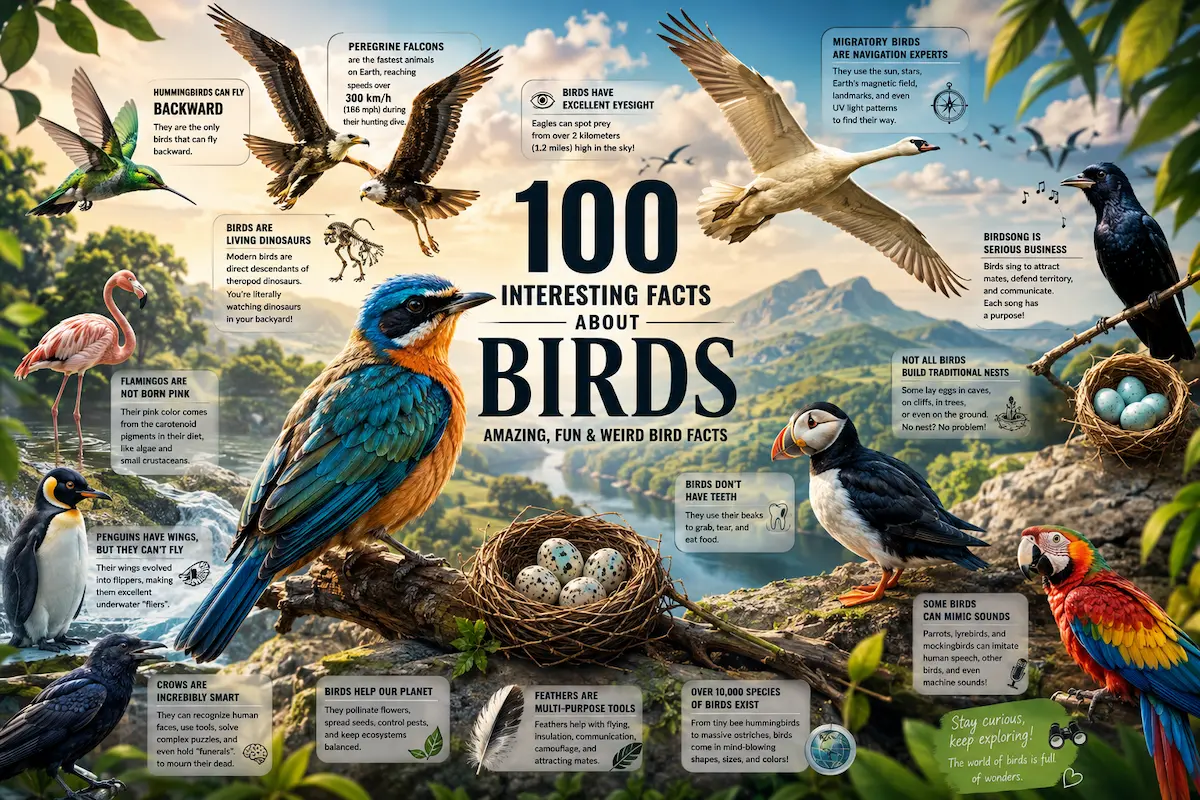
Above is a Colorful bird infographic featuring examples of amazing, fun and weird bird facts, including bird flight, feathers, migration, intelligence, nesting, feeding and bird diversity.
🐦 Quick Answer: What Are Some Interesting Facts About Birds?
Birds are remarkable animals with feathers, wings and highly specialized bodies. They are the only living animals with feathers and are the surviving descendants of theropod dinosaurs. Some birds can fly backward, migrate thousands of kilometres, see ultraviolet light, use tools and even mimic human speech. Not all birds can fly, and different species have evolved unusual adaptations for feeding, nesting, communication and survival. From tiny hummingbirds to enormous ostriches, birds are one of the most diverse and fascinating groups of animals on Earth.
Birds come in an astonishing variety of shapes, sizes and behaviors. If you're just beginning to learn their names, you can also explore our Birds Name in English and Hindi guide also explore our Why Do Birds Have Hollow Bones? guide
🐦 Bird Facts at a Glance
| Question | Quick Answer |
|---|---|
| What makes birds unique? | Birds are the only living animals with feathers. |
| Are birds dinosaurs? | Yes. Modern birds are surviving descendants of theropod dinosaurs. |
| Can all birds fly? | No. Penguins, ostriches, emus and kiwis are examples of flightless birds. |
| Can any bird fly backward? | Yes. Hummingbirds can fly backward and hover. |
| Do birds have teeth? | No. Modern birds use their beaks instead of teeth. |
| Are bird bones hollow? | Many flying birds have lightweight, air-filled bones, but not every bird has completely hollow bones. |
| What is the fastest bird? | The peregrine falcon is famous for its extremely fast hunting dive. |
| Can birds see ultraviolet light? | Some bird species can see ultraviolet wavelengths that humans cannot. |
| Why do birds migrate? | Many migrate to find food, breeding grounds or more suitable seasonal conditions. |
| Why do birds swallow stones? | Some birds swallow small stones or grit to help grind food in the gizzard. |
| Why are flamingos pink? | Carotenoid pigments in their food contribute to their pink coloration. |
| Why do birds build nests? | Nests provide suitable places to lay eggs and raise young. |
Table of Contents
- 100 Interesting Facts About Birds: Amazing, Fun & Weird Bird Facts
- 🐦 Quick Answer: What Are Some Interesting Facts About Birds?
- 🐦 Bird Facts at a Glance
- 🏡 A Simple Bird Observation From Everyday Life
- 🪶 1. Birds Are the Only Living Animals With True Feathers
- 🦖 2. Birds Are Living Dinosaurs
- 🪶 3. Feathers Help Birds Stay Warm
- 🪽 4. Not Every Bird Can Fly
- 🐧 5. Penguins Have Wings Too
- 🪽 6. Hummingbirds Can Fly Backward
- 🏎️ 7. The Peregrine Falcon Is an Incredible Speedster
- 🐦 8. Birds Have Lightweight Skeletons
- 🦴 9. Not Every Bird Has the Same Type of Skeleton
- 🪶 10. Birds Replace Old Feathers
- 🧠 Bird Intelligence & Senses
- 11. Some Birds Are Surprisingly Intelligent
- 12. Crows Can Recognize Individual Human Faces
- 13. Some Birds Can Use Tools
- 14. Parrots Can Learn Human Words
- 15. Birds Can Learn From Experience
- 👀 16. Birds Can Have Excellent Eyesight
- 🌈 17. Some Birds Can See Ultraviolet Light
- 🐦 18. Birds Use Their Eyes for More Than Finding Food
- 👂 19. Birds Hear Much Better Than We Might Expect
- 🎵 20. Birdsong Is Often a Serious Business
- 🎵 Bird Sounds & Communication
- 21. Birds Don't All "Sing" in the Same Way
- 22. Birds Have Different Calls for Different Situations
- 23. Some Birds Can Mimic Other Sounds
- 24. Lyrebirds Are Extraordinary Mimics
- 25. Some Birds Sing to Their Eggs
- 🍽️ Bird Food & Digestion
- 26. Birds Don't Have Teeth
- 27. Some Birds Swallow Food Whole
- 🪨 28. Some Birds Swallow Grit or Small Stones
- 29. Birds Have a Gizzard
- 🐦 30. A Bird's Beak Reveals a Lot About Its Diet
- 🐜 31. Some Birds Eat Astonishing Numbers of Insects
- 🐛32. Some Birds Can Eat Toxic Foods Without Getting Sick
- 🍎 33. Some Birds Eat Fruit
- 🐟 34. Pelicans Can Scoop Up Huge Amounts of Water With Their Bills
- 🦴 35. Some Vultures Drop Bones From the Sky
- 🥚 Eggs & Baby Birds
- 36. Birds Lay Eggs
- 37. Hoatzin Chicks Have Claws on Their Wings
- 🥚 38. A Kiwi's Egg Is Enormous Compared With Its Body
- 39. Baby Birds Need Different Amounts of Care
- 🐣 40. Many Baby Birds Need Their Parents for Food
- 🪺 41. Birds Build Different Types of Nests
- 42. Some Birds Barely Build Traditional Nests
- 🪹 43. Some Birds Build Nests Using Spider Silk
- 🐣 44. Some Birds Can Identify Their Own Chicks
- 🌡️ 45. Malleefowl Use Rotting Vegetation to Incubate Their Eggs
- 🏡 Bird Nests & Parenting
- 46. Birds Build Nests for Different Reasons
- 47. Birds Use Surprisingly Many Materials
- 🏗️ 48. Some Birds Build Nests That Look Like Entire Buildings
- 49. Parent Birds Work Hard to Feed Their Young
- ❤️ 50. Bird Parenting Can Be a Team Effort
- 🌍 Migration & Navigation
- 51. Many Birds Migrate
- 🧭 52. Birds Have Remarkable Navigation Abilities
- 🌍 53. Arctic Terns Make One of the Longest Migrations on Earth
- 🐦 54. Not Every Bird Migrates
- 🌙 55. Millions of Birds Can Migrate Through the Night Sky
- 🧭 56. Young Birds Can Learn Migration Routes
- 🧭57. Birds Can Use Multiple Navigation Systems
- 🧲 58. Earth's Magnetic Field Can Help Birds Navigate
- 🪽 59. Birds Sometimes Fly in Formation
- 🐦 60. Migration Is Physically Demanding
- 🤯 Weird & Amazing Bird Behavior
- 🦩 62. Flamingo Color Comes From Their Food
- 🦉 63. Some Owls Fly With Remarkably Little Noise
- 🪶 64. Birds Take Dust Baths
- 💦 65. Birds Also Bathe in Water
- 🪶 66. Some Birds Use Feathers as Visual Signals
- 🪶 67. Birds Spend Hours Maintaining Their Feathers
- 🐦 68. Crows Are Social Birds
- ⚰️ 69. Crows May Gather Around Dead Crows
- 🐦 70. Birds Can Have Surprisingly Complicated Social Lives
- 🏆 Record-Breaking Birds
- 🏎️ 71. The Peregrine Falcon Is Famous for Its Diving Speed
- 🐦 72. The Ostrich Is the Largest Living Bird
- 🏃 73. Ostriches Are Excellent Runners
- 🐦 74. The Bee Hummingbird Is the Smallest Living Bird
- 🪽 75. Albatrosses Have Enormous Wingspans
- 🌊 76. Albatrosses Can Travel Huge Distances
- 🐦 77. Some Birds Can Stay Aloft for Extraordinary Periods
- 🌊 78. Frigatebirds Can Spend Long Periods in the Air
- 🏔️ 79. Some Birds Fly at Remarkably High Altitudes
- 🏔️ 80. Bar-Headed Geese Are High-Altitude Specialists
- 🏆 Bird Records at a Glance
- 🌿 Birds & Nature
- 81. Birds Help Spread Seeds
- 🌸 82. Some Birds Pollinate Flowers
- 🐛 83. Birds Help Control Insects
- 🌱 84. Birds Are Part of Food Webs
- 🌳 85. Birds Can Tell Us About Ecosystem Health
- 🏡 Common Garden Bird Facts
- 86. Garden Birds Learn to Use Reliable Food Sources
- 👀 87. Birds Quickly Notice Changes Around Them
- 🌳 88. Trees Provide Birds With More Than Food
- 💧 89. Clean Water Can Be Valuable to Garden Birds
- 🐦 90. Different Birds Prefer Different Food
- 😲 Ten More Bird Facts That Might Surprise You
- 91. Birds Are Warm-Blooded
- 92. Birds Have Four-Chambered Hearts
- 93. Birds Breathe Differently From Humans
- 94. Some Birds Can Hover Almost Perfectly
- 95. Birds Can Sleep in Different Ways
- 96. Some Birds Can Sleep With One Brain Hemisphere More Alert
- 97. Birds Have Claws on Their Feet
- 98. A Bird's Feet Can Reveal Its Lifestyle
- 99. Birds Have Been Adapting for Millions of Years
- 🐦 100. The Most Amazing Bird Fact May Be How Much Variety Exists
- 🤔 Why Are Birds So Important?
- 📝 10 Bird Facts to Remember
- 🏡 A Bird-Watching Moment From My Home
- ❓ Frequently Asked Questions About Birds
- What is the most interesting fact about birds?
- How many species of birds are there?
- Are all bird bones hollow?
- Can birds fly backward?
- Do birds have teeth?
- Why do birds swallow stones?
- Why are flamingos pink?
- Why do birds migrate?
- Can birds recognize humans?
- Why do birds build nests?
- 🐦 Final Thought
- 📚 Continue Learning at Monto Fact Jungle
- 📷 MFJ Field Notes: Looking at the Birds Around Home
- 📚 External References
- 🌍 Migration Sources
- 🪽 Flight & Bird Anatomy
🏡 A Simple Bird Observation From Everyday Life
You don't need binoculars or a trip to a wildlife sanctuary to start noticing interesting bird behavior. Check bird migration post to know their behaviour about migration
I've often noticed common garden birds around home, hopping between branches, searching for food, calling to one another and suddenly flying away when something catches their attention. check this interesting birds food post
At first, it is easy to think, "It's just a bird."
But stop and watch for a few minutes.
Why is it choosing that particular branch? What is it looking for? Why did it suddenly make that sound? Why does another bird respond? How does it know when to fly away?
Those little everyday moments are actually a great introduction to bird behavior.
For me, that's what makes learning about birds enjoyable. You don't always have to travel somewhere special to discover something new. Sometimes the best wildlife observation is happening right outside your door. You can also browse our 200+ Birds Name in Hindi and English, with pictures and scientific names and Do Birds Have Ears? guide and do birds have teeth guide
Birds are everywhere.
You might see one sitting quietly on a wall, hear another calling from a tree, or notice a tiny bird hopping around your garden looking for food. We often see birds so regularly that we stop noticing just how remarkable they are.
I’ve had plenty of those ordinary bird encounters around home and in the garden. Sometimes I’ve watched common garden birds for only a few minutes, but even those small observations can make you wonder: How does a bird know where to go? Why does it keep making that sound? How can such a tiny creature fly so far?
The more you look at birds, the more interesting they become.
Birds have feathers, wings, remarkable senses, unusual feeding habits, incredible migration abilities and some genuinely strange behaviors. Some can hover, some cannot fly at all, some can imitate sounds, and some travel thousands of kilometres during migration.
So, let’s take a closer look.
Here are 100 interesting, amazing, fun and weird facts about birds—with simple explanations that make them easy to understand.
From tiny hummingbirds to enormous ostriches, birds occupy an incredible range of habitats. If you'd like to start identifying some familiar species, explore our 50 Birds Name in English and Hindi guide.
🪶 1. Birds Are the Only Living Animals With True Feathers
Feathers are one of the defining features of birds. No other living animal naturally has true feathers.
Birds use feathers for much more than flying. They also help with insulation, communication, camouflage and attracting mates.
🦖 2. Birds Are Living Dinosaurs
This one still sounds strange when you first hear it.
Modern birds are the surviving descendants of theropod dinosaurs. So when you watch a little bird hopping around your garden, you're looking at a very distant relative of animals such as Tyrannosaurus rex. Birds are the only dinosaurs still living today.
Pretty wild for something that looks like it is waiting for a few grains of rice. Read Do Birds Pee?
🪶 3. Feathers Help Birds Stay Warm
Feathers trap layers of air close to a bird's body, helping reduce heat loss.
This is especially important for birds living in cold environments.
🪽 4. Not Every Bird Can Fly
Having wings doesn't automatically mean a bird can fly.
Ostriches, emus, cassowaries, kiwis and penguins are examples of birds that cannot fly.
Their wings have evolved for other purposes or become greatly reduced.
🐧 5. Penguins Have Wings Too
Penguins cannot fly through the air, but their wings are excellent underwater.
They have evolved into powerful flippers that help penguins "fly" through water.
🪽 6. Hummingbirds Can Fly Backward
Hummingbirds are famous for their unusual flight ability.
They can hover and, unlike most birds, can fly backward for short periods.
Their wing movement allows them to control their position with extraordinary precision.
🏎️ 7. The Peregrine Falcon Is an Incredible Speedster
The peregrine falcon is famous for its high-speed hunting dive, called a stoop.
During a dive, it can reach speeds of more than 300 km/h under suitable conditions, making it one of the fastest animals on Earth.
🐦 8. Birds Have Lightweight Skeletons
Many flying birds have bones with hollow or air-filled sections.
But here's an important correction to a common myth: bird bones aren't simply empty tubes.
Many contain internal struts that provide strength while keeping the skeleton relatively lightweight.
🦴 9. Not Every Bird Has the Same Type of Skeleton
Bird skeletons vary according to how they live.
A flying bird, diving bird and flightless bird can have very different skeletal adaptations.
Evolution has basically given birds different versions of the same toolkit.
🪶 10. Birds Replace Old Feathers
Feathers don't last forever.
Birds periodically shed old feathers and grow new ones through a process called moulting.
🔎 Fact Check #1: Are All Bird Bones Completely Hollow?
❌ Myth: Every bird has completely hollow bones.
✅ Reality: Not exactly.
Many flying birds have lightweight bones with air-filled spaces and internal structures that provide strength. But bird skeletons vary between species, and saying that all bird bones are simply hollow is an oversimplification.
The interesting part: birds didn't become good flyers simply by having "hollow bones." Their entire bodies—including their muscles, feathers, respiratory system and skeleton—work together for flight.
🦜 Do Parrots Have Teeth?
No, parrots do not have true teeth. Instead, they use their strong, curved beaks to crack seeds, nuts, and other foods into smaller pieces. Their beaks are highly specialized for gripping, crushing, and manipulating food.
Like other birds, parrots do not chew food with teeth. After food is swallowed, their digestive system—including the muscular gizzard—helps break it down.
This is one reason parrots can crack surprisingly hard foods even though they have no teeth. explore
🧠 Bird Intelligence & Senses
11. Some Birds Are Surprisingly Intelligent
Bird intelligence can be impressive.
Crows, ravens, parrots and some other birds have demonstrated sophisticated problem-solving and learning abilities. Some parrots are excellent mimics of human speech. If you're interested in birds commonly kept as pets, see our 100 Pet Birds Name in English and Hindi guide.
12. Crows Can Recognize Individual Human Faces
Research has shown that some crow species can learn to recognize individual human faces.
That means being rude to a crow may be a terrible long-term strategy.
You might accidentally end up on its blacklist.
13. Some Birds Can Use Tools
Certain birds, especially members of the crow family, have been observed using tools to obtain food.
New Caledonian crows are particularly famous for sophisticated tool use.
14. Parrots Can Learn Human Words
Some parrots can imitate human speech remarkably well.
They aren't necessarily using language exactly like humans do, but they can learn and reproduce many sounds and vocal patterns.
15. Birds Can Learn From Experience
Birds don't simply operate like tiny flying machines following fixed instructions.
Many species can learn from their environment and experience.
👀 16. Birds Can Have Excellent Eyesight
Many birds rely heavily on vision.
Birds of prey such as eagles and hawks are especially famous for their ability to detect prey from considerable distances.
🌈 17. Some Birds Can See Ultraviolet Light
Some bird species can perceive ultraviolet wavelengths that humans cannot see.
This can help them detect patterns, find food or recognize other birds.
🐦 18. Birds Use Their Eyes for More Than Finding Food
Vision can help birds navigate, recognize mates, identify predators and communicate through visual signals.
For a bird, the world can literally look different from the way it looks to us.
👂 19. Birds Hear Much Better Than We Might Expect
Birds depend on hearing for communication, detecting danger and sometimes locating prey.
Owls are particularly specialized for using sound while hunting.
🎵 20. Birdsong Is Often a Serious Business
Birdsong can communicate territory, attract mates and signal information to other birds.
What sounds like a pleasant morning concert to us may actually be a very important conversation.
🔎 Fact Check #2: Do Crows Actually Hold Funerals?
❌ Myth: Crows hold human-like funerals for their dead.
✅ Reality: Crows do gather around dead crows, but calling these gatherings "funerals" can make the behavior sound more human than the scientific evidence supports.
Researchers think these gatherings may help crows investigate what happened and learn about possible dangers.
So yes, the behavior is fascinating—but "crow funeral" is a catchy label, not the whole scientific story.
🎵 Bird Sounds & Communication
21. Birds Don't All "Sing" in the Same Way
Some birds produce elaborate songs, while others use simpler calls.
Scientists often distinguish between songs and calls because they can serve different purposes.
22. Birds Have Different Calls for Different Situations
A bird may produce different sounds for alarm, contact, courtship or territorial behavior.
Once you start paying attention, the garden becomes much noisier—and much more interesting.
23. Some Birds Can Mimic Other Sounds
Certain birds can imitate other birds, animals and even human-made sounds.
Mockingbirds are particularly well known for vocal mimicry.
24. Lyrebirds Are Extraordinary Mimics
Lyrebirds can imitate a remarkable range of sounds.
Their vocal repertoire can include sounds from other birds as well as environmental noises.
25. Some Birds Sing to Their Eggs
Scientists have discovered fascinating examples of birds communicating with embryos before they hatch.
In some species, parents produce sounds that can influence how developing chicks respond to environmental conditions.
🍽️ Bird Food & Digestion
26. Birds Don't Have Teeth
Modern birds lack teeth.
Instead, they use their beaks to pick up, tear, crush or manipulate food.
27. Some Birds Swallow Food Whole
Depending on the species and food, birds may swallow pieces of food without chewing them.
Their digestive system handles the next stage.
🪨 28. Some Birds Swallow Grit or Small Stones
Some birds intentionally swallow small stones or grit.
These materials can remain in the gizzard and help mechanically break down hard food.
29. Birds Have a Gizzard
The gizzard is a muscular part of the digestive system.
It helps grind food, especially in birds that eat seeds and other tough foods.
🐦 30. A Bird's Beak Reveals a Lot About Its Diet
Different beak shapes are linked to different feeding strategies.
A seed-eating bird, nectar-feeding bird and bird of prey don't need the same kind of beak.
Nature basically customized the tool according to the job. Explore Do birds have teeth in this guide
🔎 Fact Check #3: Can All Birds Fly?
❌ Myth: If it has wings, it can fly.
✅ Reality: Several living bird species are flightless.
Ostriches, emus, cassowaries, kiwis and penguins are famous examples.
Their wings and bodies have evolved for different lifestyles, such as running or swimming.
🐜 31. Some Birds Eat Astonishing Numbers of Insects
Insect-eating birds can consume huge quantities of insects, especially when feeding growing chicks.
This is important because insects provide concentrated protein and other nutrients during periods of rapid growth.
🐛32. Some Birds Can Eat Toxic Foods Without Getting Sick
Insects provide valuable protein and are especially important for many birds during breeding season.
Baby birds of some species may receive huge numbers of insects from their parents.
🍎 33. Some Birds Eat Fruit
Fruit-eating birds can play an important role in ecosystems by moving seeds from one location to another.
So that bird eating your garden fruit may also be doing some accidental gardening.
🐟 34. Pelicans Can Scoop Up Huge Amounts of Water With Their Bills
A pelican's expandable throat pouch allows it to scoop fish and large amounts of water at once.
The pouch is not a storage tank for drinking water—the bird drains much of the water before swallowing its prey.
🦴 35. Some Vultures Drop Bones From the Sky
The bearded vulture, also called the lammergeier, deliberately drops large bones onto rocks to break them into smaller pieces.
It can then swallow the fragments and extract nutrients from bones that many other animals cannot use.
🥚 Eggs & Baby Birds
36. Birds Lay Eggs
All living bird species reproduce by laying eggs.
The egg protects the developing embryo while providing nutrients needed for growth.
37. Hoatzin Chicks Have Claws on Their Wings
Baby hoatzins are born with functional claws on the first two digits of their wings.
When threatened, young hoatzins can use these claws to climb through vegetation and away from predators. The claws disappear as the birds mature.
Why it's amazing: a baby bird can temporarily use its wings like tiny climbing tools.
🥚 38. A Kiwi's Egg Is Enormous Compared With Its Body
The kiwi lays an unusually large egg relative to the size of the female.
That extreme egg-to-body relationship is one of the kiwi's most remarkable reproductive adaptations.
39. Baby Birds Need Different Amounts of Care
Some chicks hatch relatively developed and can move around soon after hatching.
Others hatch helpless, with little or no ability to care for themselves.
🐣 40. Many Baby Birds Need Their Parents for Food
Parent birds may make repeated trips to collect food for hungry chicks.
Watching a small bird repeatedly flying back and forth with food is a reminder of just how much work goes into raising a family.
🔎 Fact Check #4: Can Birds Really Fly Backward?
✅ Reality: Yes—but there is an important detail.
Hummingbirds are famous for their ability to fly backward as well as hover.
Their unusual wing movement allows them to generate lift during both parts of the wing stroke, giving them extraordinary control in the air.
Most birds simply cannot do this.
🪺 41. Birds Build Different Types of Nests
Nests can be cups, cavities, platforms, burrows, hanging structures and many other forms.
There isn't one universal bird blueprint.
42. Some Birds Barely Build Traditional Nests
Not every bird builds the classic little cup we imagine when we hear the word "nest."
Some species lay eggs in cavities, on cliffs, on the ground or in other unusual locations.
🪹 43. Some Birds Build Nests Using Spider Silk
Some birds use spider silk to help construct remarkably flexible nests.
Long-tailed tits, for example, weave moss together with spider silk and line the inside with feathers. The resulting pouch-like nest can expand as the chicks grow
🐣 44. Some Birds Can Identify Their Own Chicks
Bird parents can use a combination of cues—including sounds and appearance—to distinguish their offspring in species where this is necessary.
🌡️ 45. Malleefowl Use Rotting Vegetation to Incubate Their Eggs
Male malleefowl build enormous mounds of vegetation and soil, using heat generated by decomposing plant material to incubate their eggs.
The male continually monitors and adjusts the mound's temperature by adding or removing material.
Browse our 200+ Birds Name in Hindi and English, with pictures and scientific names and Do Birds Have Ears? guide and do birds have teeth guide
🏡 Bird Nests & Parenting
46. Birds Build Nests for Different Reasons
A nest can provide a place to lay eggs, protect young and create a suitable environment for raising chicks.
47. Birds Use Surprisingly Many Materials
Depending on the species, birds may use grass, twigs, leaves, feathers, mud, moss, fibres, spider silk and even human-made materials.
🏗️ 48. Some Birds Build Nests That Look Like Entire Buildings
Social weaverbirds construct enormous communal nests that can contain many individual chambers.
Instead of one nest belonging to one pair, a single structure can become a large colony of interconnected nesting spaces.
49. Parent Birds Work Hard to Feed Their Young
Some parents make hundreds of feeding trips during the period when chicks are growing rapidly.
❤️ 50. Bird Parenting Can Be a Team Effort
In many species, both parents participate in incubation, feeding or protecting their young.
But parenting systems vary greatly between species.
🔎 Fact Check #5: Do Birds Sleep While Flying?
⚠️ Reality: This is more complicated than the viral version suggests.
Some birds have remarkable sleep adaptations, and research has shown that certain birds can sleep during flight. But this should not be turned into the blanket statement that "birds routinely sleep while flying."
The ability depends on the species and its lifestyle.
Bird fact: nature often has exceptions hiding behind the headline.
🌍 Migration & Navigation
51. Many Birds Migrate
Migration is the regular seasonal movement of animals between different areas.
Bird migration can involve enormous distances.
🧭 52. Birds Have Remarkable Navigation Abilities
Migrating birds can use several environmental cues to navigate.
Depending on the species, these may include the sun, stars, Earth's magnetic field, landmarks and other signals.
🌍 53. Arctic Terns Make One of the Longest Migrations on Earth
Arctic terns undertake an extraordinary annual migration between the Arctic and Antarctic regions.
The exact distance varies with the route, but some journeys can span tens of thousands of kilometres in a year.
🐦 54. Not Every Bird Migrates
Some species remain in roughly the same region throughout the year.
Migration depends on the species and environmental conditions.
🌙 55. Millions of Birds Can Migrate Through the Night Sky
Many migratory birds travel at night, using environmental cues such as stars, Earth's magnetic field and landscape features to help navigate.
🧭 56. Young Birds Can Learn Migration Routes
Migration strategies can involve both inherited behavior and learning.
In some species, young birds learn routes from older individuals.
🧭57. Birds Can Use Multiple Navigation Systems
Migrating birds don't rely on a single "GPS."
Depending on the species and situation, they can combine cues from the sun, stars, Earth's magnetic field, landmarks and other environmental signals.
🧲 58. Earth's Magnetic Field Can Help Birds Navigate
Research indicates that many birds can sense Earth's magnetic field and use it as one source of navigational information.
Nature's GPS doesn't require a monthly subscription.
🪽 59. Birds Sometimes Fly in Formation
Some migrating birds fly in formations such as a V shape.
This can help reduce aerodynamic costs for birds following another bird.
🐦 60. Migration Is Physically Demanding
Migration requires enormous amounts of energy.
Birds may need to feed heavily before and during long journeys to build the energy reserves required for travel.
🔎 Fact Check #6: Are Flamingos Naturally Pink?
❌ Myth: Flamingos are born pink.
✅ Reality: Flamingo chicks are not born bright pink.
Their famous coloration develops as they grow and consume foods containing carotenoid pigments.
In other words, their diet helps paint their feathers.
🤯 Weird & Amazing Bird Behavior
🐦 61. Some Birds Practice a Behavior Called Anting
Some birds deliberately place ants on their feathers, a behavior known as anting.
Scientists have proposed several explanations, including possible effects on parasites and feather maintenance, but the exact function may differ between species.
The weird part: the bird is deliberately recruiting another animal as part of its own feather-care routine.
🦩 62. Flamingo Color Comes From Their Food
Carotenoid pigments from food such as algae and small aquatic organisms contribute to flamingos' pink coloration.
In simple terms: you are what you eat—even if you're a flamingo.
🦉 63. Some Owls Fly With Remarkably Little Noise
Specialized feather structures help many owls reduce the sound produced by their wings during flight.
This helps them approach prey more quietly.
🪶 64. Birds Take Dust Baths
Some birds roll or flutter in dry soil.
Dust bathing may help maintain feathers and reduce parasites.
💦 65. Birds Also Bathe in Water
Many birds regularly bathe in water to clean and maintain their feathers. Check water birds article.
If you've ever watched a tiny garden bird turn a puddle into its personal swimming pool, you know how enthusiastically they can do this.
🪶 66. Some Birds Use Feathers as Visual Signals
Then explain how feather displays can communicate during courtship, threat displays or social interactions.
But again, I'd rather choose a specific species example after verification.
🪶 67. Birds Spend Hours Maintaining Their Feathers
Preening isn't just birds "cleaning themselves."
Birds use their beaks to realign feathers, remove debris and maintain the structures that keep feathers functional.
Some species also distribute oils from the preen gland across their plumage.
🐦 68. Crows Are Social Birds
Many crow species live in complex social groups and communicate extensively.
Their intelligence and social behavior have fascinated researchers for years.
⚰️ 69. Crows May Gather Around Dead Crows
Crows have been observed gathering around dead members of their species.
Scientists have studied this behavior and suggest it may help crows learn about dangers in their environment.
Calling it a human-style "funeral" can oversimplify what is actually happening.
🐦 70. Birds Can Have Surprisingly Complicated Social Lives
Birds may form pairs, family groups, flocks or larger social communities.
Their social systems vary enormously from one species to another.
🔎 Fact Check #7: Do Birds Swallow Stones Because They Are Hungry?
❌ Myth: When a bird swallows a small stone, it is eating the stone as food.
✅ Reality: Some birds swallow grit or small stones as part of digestion.
These materials can remain in the muscular gizzard and help grind tough food.
The stone isn't lunch.
It's more like a tiny digestive tool.
🏆 Record-Breaking Birds
🏎️ 71. The Peregrine Falcon Is Famous for Its Diving Speed
During its hunting dive, the peregrine falcon can reach extraordinary speeds.
It is one of the greatest speed specialists in the animal kingdom.
🐦 72. The Ostrich Is the Largest Living Bird
The ostrich is the largest living bird species.
It is also the tallest living bird.
🏃 73. Ostriches Are Excellent Runners
Ostriches cannot fly, but their long legs make them remarkably fast runners.
They can reach speeds of roughly 70 km/h for short periods.
🐦 74. The Bee Hummingbird Is the Smallest Living Bird
The bee hummingbird is the smallest living bird species and is native to Cuba.
🪽 75. Albatrosses Have Enormous Wingspans
Some albatross species have wingspans exceeding 3 metres.
Their huge wings are adapted for efficient long-distance flight over the ocean.
🌊 76. Albatrosses Can Travel Huge Distances
Albatrosses spend much of their lives at sea and can travel enormous distances while searching for food.
🐦 77. Some Birds Can Stay Aloft for Extraordinary Periods
Certain seabirds and migratory birds spend long periods flying or gliding.
Their bodies are highly adapted for energy-efficient travel.
🌊 78. Frigatebirds Can Spend Long Periods in the Air
Frigatebirds are exceptional aerial specialists.
They can remain airborne for long periods and are capable of using rising air currents to conserve energy.
🏔️ 79. Some Birds Fly at Remarkably High Altitudes
Some birds are capable of flying at altitudes where the air contains far less oxygen than at sea level.
Bar-headed geese are especially famous for high-altitude migration across the Himalayas, although their actual flight altitude varies with route and conditions.
🏔️ 80. Bar-Headed Geese Are High-Altitude Specialists
Bar-headed geese migrate across the Himalayan region and have remarkable physiological adaptations for coping with thin air.
🏆 Bird Records at a Glance
| Bird Record / Specialization | Example |
|---|---|
| Extreme diving speed | Peregrine falcon |
| Largest living bird | Ostrich |
| Smallest living bird | Bee hummingbird |
| Largest wingspan | Wandering albatross |
| High-altitude migration | Bar-headed goose |
| Extreme long-distance migration | Arctic tern |
| Long-duration flight | Frigatebirds |
| Hovering specialist | Hummingbirds |
🔎 Fact Check #8: Are Penguins the Only Flightless Birds?
❌ Myth: Penguins are the only birds that cannot fly.
✅ Reality: Penguins are just one group of flightless birds.
Ostriches, emus, cassowaries, kiwis, rheas and several other birds have also lost the ability to fly.
Flightlessness has evolved independently in different bird lineages.
🌿 Birds & Nature
81. Birds Help Spread Seeds
Fruit-eating birds can swallow fruits and later deposit seeds elsewhere.
This helps many plants reproduce and spread.
🌸 82. Some Birds Pollinate Flowers
Birds such as hummingbirds and sunbirds can transfer pollen while feeding on nectar.
This makes them important pollinators in some ecosystems.
🐛 83. Birds Help Control Insects
Insect-eating birds consume huge numbers of insects.
They can therefore play an important role in ecosystems and agriculture.
🌱 84. Birds Are Part of Food Webs
Birds can be predators, prey, seed dispersers and pollinators.
Their role changes depending on the species and ecosystem.
🌳 85. Birds Can Tell Us About Ecosystem Health
Changes in bird populations can provide useful information about environmental changes.
Birds are therefore important subjects for ecological monitoring.
🏡 Common Garden Bird Facts
86. Garden Birds Learn to Use Reliable Food Sources
Birds can learn where dependable food and water are available.
This is one reason you may notice the same species repeatedly visiting a garden.
👀 87. Birds Quickly Notice Changes Around Them
Birds are highly alert animals.
A new object, unfamiliar person or sudden movement can make a bird investigate—or immediately disappear.
🌳 88. Trees Provide Birds With More Than Food
Trees can provide shelter, nesting locations, perches, insects, fruits and protection from weather.
A single mature tree can therefore be surprisingly valuable to birds.
💧 89. Clean Water Can Be Valuable to Garden Birds
Birds need water for drinking and, for many species, bathing.
A clean, shallow water source can become an important resource in a garden.
🐦 90. Different Birds Prefer Different Food
There isn't one food that is ideal for every bird.
Different species have different diets, and feeding birds should be done responsibly with suitable foods.
🔎 Fact Check #9: Is the Peregrine Falcon the Fastest Animal Because It Flies Fast?
⚠️ Reality: The famous claim needs a little context.
Peregrine falcons can reach extraordinary speeds during their hunting dives, called stoops. Their diving speed is why they are often described as the fastest animals on Earth.
But comparing animal speeds isn't always straightforward because scientists measure different types of movement under different conditions.
The safe takeaway: the peregrine falcon is an astonishing aerial speed specialist.
😲 Ten More Bird Facts That Might Surprise You
91. Birds Are Warm-Blooded
Birds maintain a relatively stable internal body temperature using their metabolism.
This helps them remain active across a wide range of environments.
92. Birds Have Four-Chambered Hearts
Like mammals, birds have four-chambered hearts.
This supports efficient circulation and the high metabolic demands of active lifestyles.
93. Birds Breathe Differently From Humans
Birds have a highly specialized respiratory system involving lungs and air sacs.
Their respiratory system is particularly efficient for supporting flight and high activity levels.
94. Some Birds Can Hover Almost Perfectly
Hummingbirds are the masters of hovering.
Their wing movements allow them to remain almost stationary while feeding from flowers.
95. Birds Can Sleep in Different Ways
Bird sleep varies between species.
Some birds can rest while perched, and some species have unusual adaptations associated with sleeping during migration.
96. Some Birds Can Sleep With One Brain Hemisphere More Alert
Certain birds can use a form of unihemispheric sleep, allowing one side of the brain to remain more alert while the other rests.
This can be useful in particular situations.
97. Birds Have Claws on Their Feet
Bird feet are adapted for different lifestyles.
Perching birds, birds of prey, swimming birds and running birds can have dramatically different foot structures.
98. A Bird's Feet Can Reveal Its Lifestyle
Webbed feet suggest an adaptation for swimming.
Strong grasping feet are common in birds of prey.
Perching birds have feet adapted for gripping branches.
The feet often tell us a surprising amount about how a bird lives.
99. Birds Have Been Adapting for Millions of Years
The incredible variety of modern birds is the result of a very long evolutionary history.
From tiny hummingbirds to enormous ostriches, birds have adapted to forests, deserts, oceans, mountains, cities and gardens.
🐦 100. The Most Amazing Bird Fact May Be How Much Variety Exists
After looking at 100 bird facts, this is probably the biggest takeaway:
There is no single "typical bird."
A hummingbird, penguin, eagle, ostrich, flamingo, crow and tiny garden bird can look and behave completely differently—yet they are all birds.
And that's what makes birds so fascinating.
🔎 Fact Check #10: Do All Birds Migrate?
❌ Myth: Every bird migrates to another country or continent.
✅ Reality: No.
Some birds migrate seasonally over enormous distances, while others remain in the same general region throughout the year.
Even within a species, migration behavior can vary depending on location and environmental conditions.
This is a good reminder: whenever you see the words "all birds," "always" or "never," it's worth checking the claim twice.
🤔 Why Are Birds So Important?
Birds aren't just beautiful animals to watch.
They are important parts of ecosystems.
They help disperse seeds, pollinate flowers, control insects and form links between different parts of food webs.
Even the ordinary birds we see around our homes can play important roles in the environment.
And personally, I think that's one of the nicest things about watching common garden birds.
You don't always need to travel to a wildlife sanctuary or go on an expensive safari.
Sometimes you just need to stop for a minute and look at the tree outside your home.
There may already be something fascinating happening there.
📝 10 Bird Facts to Remember
If you don't want to remember all 100 facts, start with these:
Birds are the only animals with feathers.
Birds are living descendants of dinosaurs.
Not all birds can fly.
Hummingbirds can fly backward.
Peregrine falcons can reach extraordinary speeds during dives.
Birds don't have teeth.
Some birds swallow small stones to help digest food.
Some birds can see ultraviolet light.
Many birds migrate thousands of kilometres.
Birds play important roles in ecosystems.
🏡 A Bird-Watching Moment From My Home
I never really needed a special place to start noticing birds.
Some of the birds I've paid attention to have simply been the common ones around home and in the garden. They hop between branches, search around for food, call to one another and disappear almost instantly when something catches their attention.
I've also photographed and observed birds from time to time, and one thing I've noticed is how easy it is to see a bird without actually watching it.
You might see a bird sitting on a branch and think that's all it's doing.
But stay there for a little longer.
It may suddenly change its position, look in several directions, make a short call, fly down to the ground, pick something up and disappear into the trees. Sometimes another bird responds to its call.
Those little moments made me more curious.
What was it doing? Why did it choose that particular place? What was it looking for? And how did it know when it was time to fly away?
That's one reason I enjoy learning about birds. You don't always need binoculars, a wildlife park or a trip to some distant forest.
Sometimes you can start with the bird sitting right outside your home.
And once you start paying attention, the ordinary birds don't seem quite so ordinary anymore.
📚 Continue Exploring the Bird World
If you enjoyed learning about bird nests, there is much more to discover. Explore these related guides to learn about bird types, habitats, flight, body parts, and different kinds of birds.
- 🐦 200 Birds Name in Hindi and English — Explore a large collection of bird names in both Hindi and English.
- 🪶 Types of Birds — Learn about different types of birds and how they are commonly classified.
- 🇮🇳 Birds in India — Discover birds found across India and the habitats they call home.
- ✈️ Flying Birds — Learn how flying birds use flight to feed, migrate, escape predators, and survive.
- 🐧 Flightless Birds — Discover birds that cannot fly and the adaptations that help them survive.
- 👃 Bird Beaks — Understand the different shapes of bird beaks and how they help birds feed.
- 🔤 A–Z Birds Name List (Complete Table) — Find bird names arranged alphabetically from A to Z.
- 🌊 Water Birds Name List — Explore birds commonly found around rivers, lakes, ponds, wetlands, and other water habitats.
- 🏡 Pet Birds Name List — Learn about popular birds commonly kept as pets.
- do birds have tongues
- do birds have teeth
- do birds have nose
- how do birds sleep
❓ Frequently Asked Questions About Birds
What is the most interesting fact about birds?
One of the most fascinating facts is that birds are living descendants of theropod dinosaurs. Modern birds are the only surviving dinosaur lineage.
How many species of birds are there?
There are more than 10,000 recognized living bird species, although the exact number can change as scientists revise classifications and discover new information.
Are all bird bones hollow?
No. The idea that every bird has completely hollow bones is a myth. Many flying birds have bones with air-filled spaces and internal structures that provide strength while reducing weight, but bird skeletons vary by species.
Can birds fly backward?
Hummingbirds are famous for being able to fly backward. Their unusual wing motion also allows them to hover.
Do birds have teeth?
Modern birds do not have teeth. Their beaks perform many of the functions that teeth perform in other animals.
Why do birds swallow stones?
Some birds swallow small stones or grit that can remain in the gizzard and help mechanically grind food.
Why are flamingos pink?
Flamingos obtain carotenoid pigments from their food. These pigments contribute to the pink coloration of their feathers.
Why do birds migrate?
Birds migrate for different reasons, including finding food, breeding in suitable locations and avoiding harsh seasonal conditions.
Can birds recognize humans?
Some bird species can recognize individual humans. Crows, for example, have demonstrated an impressive ability to remember human faces.
Why do birds build nests?
Birds build nests or use other nesting sites to provide a suitable place for laying eggs and raising their young. Nesting behavior varies enormously between species.
🐦 Final Thought
The next time you see a bird sitting quietly on a wall, hopping across your garden or calling from a tree, take a second look.
It might look ordinary.
But underneath those feathers is a remarkably specialized animal—with a powerful respiratory system, sophisticated senses, incredible navigation abilities and millions of years of evolutionary history behind it.
I've found that once you start paying attention to the common birds around you, they stop feeling quite so ordinary.
And that's probably the best thing about learning about birds:
You don't have to go far to find something amazing.
📚 Continue Learning at Monto Fact Jungle
Explore our most popular educational resources designed for students, parents, teachers, and lifelong learners.
🍎 Fruits Name in English and Hindi
🌸 Flowers Name in English and Hindi
🦁 Animals Kya Khate Hain List
⌨️ Keyboard Symbols Name in Hindi
📖 Meaning in Hindi with Examples
🦁 50 fruits name in hindi and english
Thank You So Much Meaning in Hindi Examples
🧠 100+ Body Parts Name in Hindi and English
Spices Name in English and Hindi
📷 MFJ Field Notes: Looking at the Birds Around Home
One thing I've learned from observing birds is that you don't always notice their behavior the first time you see them.
A bird may visit the same area repeatedly, use a particular branch as a lookout, search the ground for food, call from a tree or suddenly disappear when it senses movement.
These are small things, but they become much more interesting when you stop and watch instead of simply noticing that "there is a bird."
👀 What I Look For
When I observe a bird around home or in the garden, I try to pay attention to simple things:
Where does it spend most of its time?
Is it alone or with other birds?
What is it looking for?
What does it eat?
Does it return to the same place?
How does it react when something approaches?
What sounds does it make?
Does its behavior change during different times of the day?
I don't need to know the species immediately to find the observation interesting.
Sometimes the question comes first, and the identification comes later.
📸 From Observation to Learning
When I photograph or observe a bird, I like to think of the photograph as the beginning of the story rather than the end of it.
The picture tells me what I saw.
The research helps me understand why I saw it behaving that way.
That combination—observation + curiosity + research—is one of the things I want Monto Fact Jungle to encourage.
You don't have to be a professional birder to start.
You can begin with the birds already living around you.
🐦 MFJ Field Note
The next time a bird catches your attention, don't immediately move on. Watch it for two or three minutes. Notice where it goes, what it does and how it reacts to its surroundings.
You may not discover a world-changing scientific fact.
But you might discover something you've never noticed before.
Read our Morning Bird Calls and Pigeon Observation field note
❤️ A Little Note From Monto Fact Jungle
This article was created with a lot of curiosity, care, and love for the amazing world of birds.
If you enjoyed discovering these facts, share it with someone who loves birds—and spread a little love for our feathered friends.
Share it. Love it. Keep exploring. 🐦❤️
Cheers,
Monto Fact Jungle
📚 External References
1. IOC World Bird List — species count
Use this for your "How many species of birds are there?" FAQ and any current species-count statement.
IOC World Bird List — Version 15.2
The current Version 15.2 lists 11,227 bird species, including 164 extinct species.
Use for: species count, taxonomy, current bird classification.
2. Cornell Lab of Ornithology — Bird Academy
Cornell Lab Bird Academy — Bird Terms & Glossary
This is particularly useful for general bird biology and terminology. Its Hoatzin entry specifically notes that nestlings can leave the nest and climb using their temporary wing claws.
Use for: Hoatzin, bird terminology, flight adaptations, general biology.
3. Animal Diversity Web — Hoatzin
Animal Diversity Web — Hoatzin
This is an excellent direct reference for your new #37 Hoatzin fact. It documents the functional wing claws on the first and second digits of young Hoatzins and notes that the feature is lost in adults.
Use for: #37.
4. Animal Diversity Web — Bearded Vulture
Animal Diversity Web — Bearded Vulture (Gypaetus barbatus)
This is perfect for your new #35.
It documents the bird's bone-heavy diet and its behavior of carrying bones upward and dropping them onto rocky sites until they break, allowing the bird to consume the bone marrow.
Use for: #35.
5. Cornell Lab — Long-eared Owl
Excellent source for your new #63 owl silent-flight fact.
Cornell specifically describes fringed flight feathers and downy surfaces that help mute the sound of flight.
Use for: #63.
6. Cornell Lab — All About Birds
This should be one of your core reference resources rather than just a source for one fact.
It's Cornell's bird guide containing species identification and life-history information.
Use for: general bird biology, species behavior, migration, anatomy, diet, sounds, etc.
🌍 Migration Sources
7. Audubon — Arctic Tern
Audubon — Arctic Tern Field Guide
Audubon describes the Arctic tern as a long-distance migration champion traveling between the high Arctic and Antarctic regions.
Use for: #53 and your migration section.
8. Audubon — Arctic Tern Migration Explorer
Audubon Bird Migration Explorer — Arctic Tern
This is even better for the migration section because it's specifically a migration-data resource, with migration routes and tracked-bird information.
Use for: #53 and potentially your migration/navigation section.
9. Audubon — Longest Migration Record
Audubon — How a Tern Broke the Record for the Longest Known Migration
This is useful if you decide to add a precise Arctic tern distance.
Audubon reported a tracked Arctic tern covering approximately 59,650 miles on its yearly migration, while noting that this was likely an underestimate of the actual distance flown.
🪽 Flight & Bird Anatomy
10. Cornell Lab — Bird Glossary
Cornell Lab Bird Academy Glossary
Useful for:
- wings
- feathers
- flight
- bird anatomy
- Hoatzin
- flight adaptations
It also explains high-aspect-ratio wings and their association with efficient soaring birds such as albatrosses.
11. Cornell Lab — All About Birds Species Guide
You should also read:
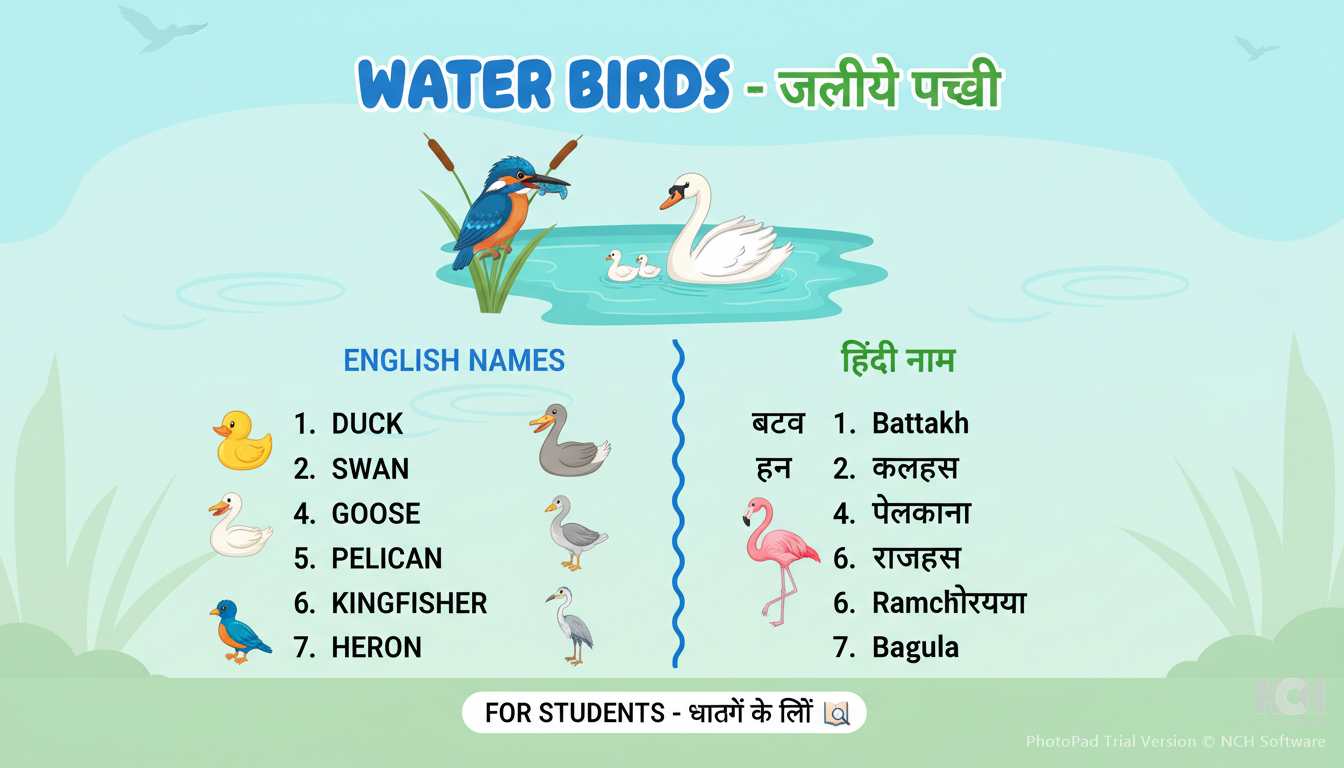
Water Birds Name in English and Hindi (पानी में रहने वाले पक्षियों के नाम)
🦆Water Birds Name in English and Hindi (पानी में रहने वाले पक्षियों के नाम) A goose (Anser cygnoides) is a water bird commonly found near lakes, rivers, wetlands, and coastal areas. A high-quality image of a Goose (Anser cygnoides), a water bird adapted to lakes,…
Continue reading...100 Birds Name in Hindi and English-पक्षियों के नाम हिंदी और अंग्रेज़ी में – आसान, मज़ेदार और पूरी सूची
100 पक्षियों के नाम हिंदी और अंग्रेज़ी में 🌿 Real-Life Example (Gaon Ki Kahani) Maan lo aap summer vacation me gaon gaye ho. Subah 5 baje murga "kukdukoo" karta hai. Thodi der baad ped par baithi koil ki "koo-koo" awaaz aati hai. Ghar ke aas-paas…
Continue reading...20 Birds Name in Hindi and English (20 पक्षियों के नाम) | For Students & Easy Pronunciation
20 Birds Name in Hindi and English Here is a fresh set of 20 birds: क्या आपने कभी notice किया है कि हम रोज़ कई birds देखते हैं, लेकिन उनके English ya Hindi names हमें हमेशा याद नहीं रहते? इसीलिए students अक्सर search करते हैं…
Continue reading...10 Birds Name in Hindi and English (With Easy Meaning & GK Use)
🐦10 Birds Name in Hindi and English Quick Answer: 10 Birds Name in Hindi and English are Hoopoe, Woodpecker, Goose, Dove, Kingfisher, Indian Roller, Bulbul, Lapwing, Penguin, and Kiwi. Kya aapko school homework ya GK preparation ke liye birds ke naam chahiye? Bahut baar students…
Continue reading...