
🏦Best Zero Balance Savings Accounts in India (2026): No Minimum Balance & Charges Compared
🏦 Best Zero Balance Savings Accounts in India
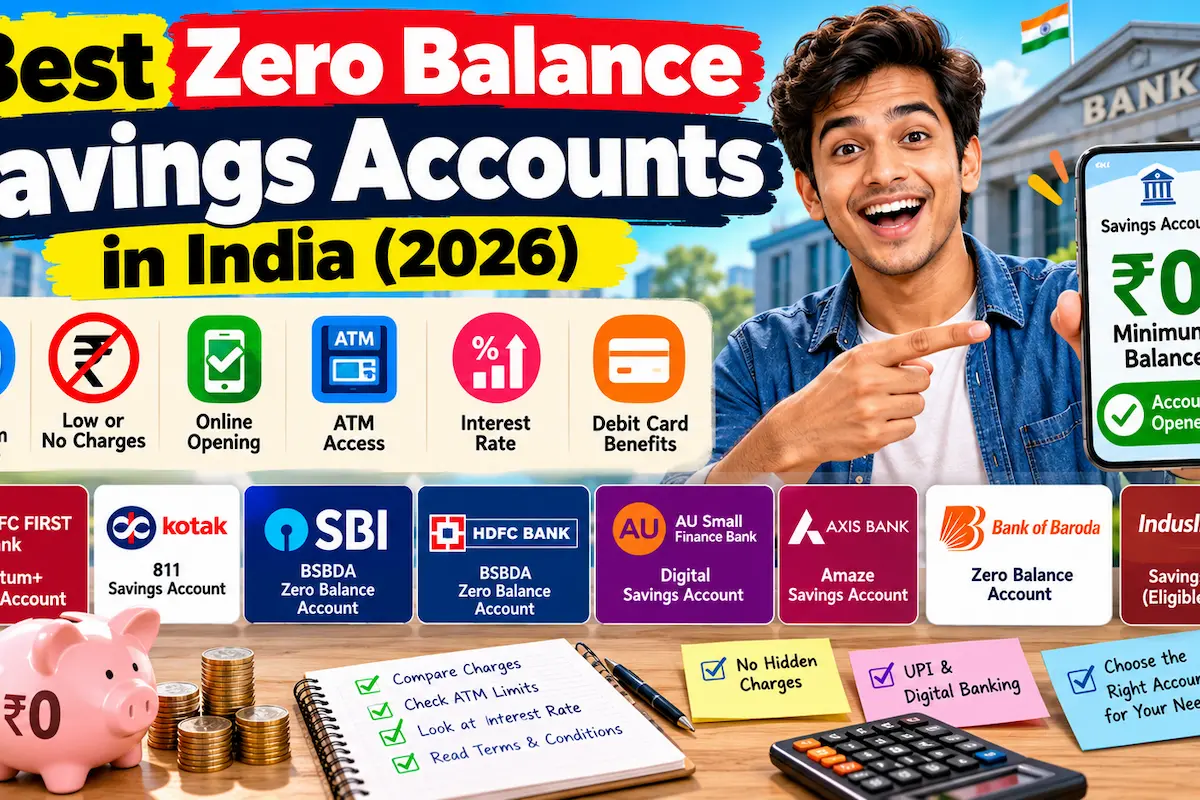
Looking for a zero balance savings account in India can sound simple: find an account that lets you keep ₹0 without paying a minimum-balance penalty.
But there is an important catch.
“Zero balance” does not always mean “zero charges.”
An account may have no minimum balance requirement while still having charges for a debit card, certain ATM transactions, cash services, cheque books, or other optional services.
That is why comparing only the words “zero balance” can give you an incomplete picture.
In this guide, we explain how zero-balance accounts work, compare popular options, highlight important charges to check, and explain what to look for before opening an account online.
Important: Banking products, interest rates, fees, eligibility requirements, and promotional offers can change. Always check the bank's current official product page and schedule of charges before opening an account.
Read 💵100 Budget Categories to Organize Your Monthly Budget
⚡ Quick Answer
Some of the zero-balance or no-minimum-balance savings options worth comparing in India include IDFC FIRST Bank, Kotak 811, SBI Basic Savings Bank Deposit Account (BSBDA), HDFC Bank BSBDA, AU Small Finance Bank, IndusInd Bank's eligible zero-balance variants, and other bank-specific BSBDA or digital accounts.
Table of Contents
- 🏦 Best Zero Balance Savings Accounts in India
- ⚡ Quick Answer
- 💡 What Is a Zero Balance Savings Account?
- 🔎 What Should You Check Before Opening One?
- 🏆 Popular Zero Balance Savings Accounts to Compare
- 🥇 Best Zero Balance Account for Different Needs
- 🏛️ What Is a BSBDA Account?
- 🆚 Zero Balance vs Regular Savings Account
- 🚨 “Zero Balance” Does Not Mean Everything Is Free
- 💳 What About “No Charges” Accounts?
- 📲 Can You Open a Zero Balance Account Online?
- 💰 Does a Zero Balance Account Earn Interest?
- 👨🎓 Who Can Benefit From a Zero Balance Account?
- ⚠️ Things to Check Before You Apply
- 📊 How We Would Compare Zero Balance Accounts
- 💡 Simple Example
- 🏦 Our Take
- ❓ Frequently Asked Questions
- Which savings account has no minimum balance in India?
- Which bank account has zero charges?
- Is a zero-balance account really free?
- Can I open a zero-balance account online?
- Which is better: BSBDA or a digital zero-balance savings account?
- Can I have two zero-balance savings accounts?
- Is a zero-balance savings account safe?
- Which zero-balance account is best for students?
- What is the difference between zero balance and zero deposit?
- 🏛️ What Does the RBI Say About Zero-Balance Accounts?
- 🔗 Related Money & Budgeting Guides
- 📌 Final Takeaway
However, there is no single account that is automatically the “best” for everyone.
The right choice depends on what you care about most:
₹0 minimum balance
No initial funding
Low or no account maintenance charges
ATM access
UPI and digital banking
Debit card fees
Cash withdrawal limits
Interest rate
Branch availability
Online account opening
Transaction limits
💡 What Is a Zero Balance Savings Account?
A zero balance savings account is an account that does not require you to maintain a specified minimum balance.
This means you may be able to keep the balance at ₹0 without paying a non-maintenance penalty, subject to the specific account's terms.
One important category is the Basic Savings Bank Deposit Account (BSBDA).
The Reserve Bank of India requires banks to offer basic banking facilities through BSBD accounts without a minimum balance requirement. The basic framework also includes certain free services, while banks can charge for additional value-added services under their applicable terms.
That means a BSBDA is not necessarily the same thing as every commercially advertised “zero balance savings account.”
🧠 Zero balance vs zero charges
These terms are easy to confuse.
Zero balance generally refers to the minimum balance requirement.
Zero charges would mean there are no applicable fees for the particular service or account.
For example, a bank could offer:
₹0 minimum balance + debit card fee
or:
₹0 minimum balance + limited free ATM withdrawals + charges after the limit
So always check the complete fee schedule rather than relying on the account's headline.
👤 About This Guide
Written and reviewed by Mohanramus, Founder & Editor, Monto Fact Jungle
This guide was prepared as part of Monto Fact Jungle's Money & Budgeting content series, with a focus on helping Indian readers understand everyday banking and personal-finance topics in simple language.
For banking comparisons, we prioritize official bank documents, current fee schedules and RBI regulations rather than relying solely on third-party comparison websites.
Last reviewed: October 8, 2026
Next review: When major account fees, interest rates, eligibility rules or product terms change.
🔎 How We Check Zero-Balance Bank Accounts
At Monto Fact Jungle, we don't treat the phrase “zero balance” as meaning that every banking service is free.
For this comparison, we check the exact account variant, not just the bank name. We look at the bank's official product page, applicable schedule of charges, account terms and conditions, and relevant RBI rules where applicable.
Our comparison focuses on:
Minimum balance requirement
Initial funding requirement
Account maintenance charges
Debit card issuance and annual fees
ATM withdrawal limits and charges
Cash deposit and withdrawal charges
NEFT, RTGS, IMPS and other transaction charges
Online account-opening availability
Account-specific restrictions
Current interest-rate information
Eligibility and KYC requirements
🏦 Our source policy
Whenever possible, we use the bank's official website or official fee schedule for account-specific information.
For regulatory information, we refer to the Reserve Bank of India (RBI).
We do not consider an account “best” simply because it advertises the highest interest rate or because it may offer an affiliate opportunity.
📅 Information checked
Last verified: October 8, 2026
Banking fees, interest rates, account variants, eligibility requirements and promotional offers can change. We therefore recommend checking the bank's current official terms and schedule of charges immediately before opening an account.
Affiliate disclosure: Some links on this page may be affiliate links. If you apply through one of these links, Monto Fact Jungle may receive a commission at no additional cost to you. Our comparison criteria and editorial conclusions are not based on the commission offered.
🔎 What Should You Check Before Opening One?
Before choosing a zero-balance account, check these eight things.
1. Minimum balance requirement
This is the first thing most people check.
Look for wording such as:
Minimum balance: ₹0
No minimum balance requirement
Nil non-maintenance charges
Be careful with accounts that say “zero balance” but require a large initial deposit.
There is a difference between:
No minimum balance after opening
and
No money required to open the account.
2. Initial funding requirement
Some digital savings accounts may have a minimum amount that must be deposited when opening the account even though the ongoing minimum balance requirement is ₹0.
For example, a product can have:
Minimum balance: ₹0
but
Initial funding: ₹10,000
Those are not contradictory.
They describe two different stages of the account.
3. Debit card charges
Check:
Card issuance fee
Annual maintenance fee
Replacement fee
Premium card upgrade charges
International usage charges
A “free account” can still have a charge attached to a particular debit card.
4. ATM withdrawal limits
Check how many free ATM transactions you receive and what happens after the free limit.
Also check whether the rules differ between:
Your bank's ATM
Other-bank ATMs
Metro locations
Non-metro locations
Cash withdrawals
Non-cash ATM transactions
5. Cash deposit and withdrawal charges
If you frequently deal with cash, this can be more important than the headline interest rate.
Look for:
Free cash deposit limits
Free cash withdrawal limits
Branch transaction charges
Cash handling fees
Monthly transaction limits
6. Digital transaction charges
Check the applicable charges for:
UPI
IMPS
NEFT
RTGS
Online transfers
Bill payments
Do not assume every transaction is free simply because the account has zero minimum balance.
7. Interest rate
A higher savings interest rate can be attractive, but don't choose an account based on the headline rate alone.
Check:
Applicable balance slab
Whether the rate changes at different balances
How interest is calculated
How frequently interest is credited
Whether the advertised rate is promotional
Current effective date
Interest rates can change, so verify the latest rate directly with the bank before applying.
8. Account restrictions
Some basic or simplified accounts may have restrictions on transactions, balances, or eligibility.
Read the account's terms carefully before opening it.
🏆 Popular Zero Balance Savings Accounts to Compare
The following are examples of accounts and account types that can appear in the zero-balance or no-minimum-balance segment.
This is a comparison starting point—not a ranking based solely on interest rate.
| Bank | Specific account / variant | Minimum balance | Initial funding | What we verified |
|---|---|---|---|---|
| IDFC FIRST Bank | Pratham Savings Account / BSBDA | Nil | Verify current terms | Zero-balance BSBDA; separate regular accounts can require AMB |
| Kotak | 811 variants | ₹0 for eligible variants | Check variant | Official 811 schedule shows different variants and different requirements |
| HDFC Bank | BSBDA | Nil | Check current terms | Zero-balance BSBDA; free RuPay card and four free cash withdrawals stated |
| SBI | BSBDA | Nil under BSBDA framework | Check current terms | BSBDA account type; exact current service terms should be checked |
| AU Small Finance Bank | BSBDA variants | Nil for applicable variants | Check variant | Official fee schedule lists BSBDA products with nil AMB |
| IndusInd Bank | Indus Easy BSBD | Zero balance | Check current terms | Official product page describes it as a zero-balance BSBD account |
| Axis Bank | Amaze | Nil AMB | ₹10,000 initial funding shown | Fixed ₹200/month or ₹2,200/year plan |
| Bank of Baroda | Eligible zero-balance account | Check current variant | Check current terms | Verify exact account and fee schedule before applying |
⚠️ Important: Banks can have several savings-account variants. Two accounts from the same bank can have completely different balance requirements and fees.
Always compare the exact account name, not just the bank name.
🥇 Best Zero Balance Account for Different Needs
Instead of saying one bank is universally the best, it is more useful to match the account to the reason you need it.
💻 Best for digital banking
Look for an account that provides:
Online/video KYC
Mobile banking
UPI
Online transfers
Digital statements
Easy account management
Digital accounts can be convenient, but check whether there is an initial funding requirement or debit-card fee.
🏦 Best for branch access
If you regularly deposit or withdraw cash or want face-to-face banking, a bank with a convenient branch network may matter more than a slightly higher interest rate.
💰 Best for keeping a small balance
A BSBDA or another genuine no-minimum-balance account can make sense if you do not want to worry about maintaining a monthly balance.
📱 Best for online account opening
Look for banks that offer digital account opening with Aadhaar/PAN verification and video KYC, where available.
But remember:
Online opening ≠ zero initial funding.
Check both separately.
🧾 Best for basic banking
If you mainly need an account for receiving money, making basic payments, UPI transactions, and occasional withdrawals, a BSBDA may be worth considering.
However, basic accounts can have transaction restrictions that do not apply to full-service savings accounts.
🏛️ What Is a BSBDA Account?
BSBDA stands for Basic Savings Bank Deposit Account.
It is an important type of basic savings account designed to provide essential banking facilities without requiring a minimum balance.
The RBI's framework includes basic facilities such as deposits and withdrawals, electronic credits, and an ATM/debit-card facility, with specified basic services provided without charges.
A key point is the withdrawal limit associated with the basic BSBDA framework.
The RBI framework provides for a maximum of four withdrawals per month as part of the basic free facilities.
Banks may provide additional services under their own terms and pricing.
⚠️ BSBDA is not always the same as a premium digital zero-balance account
This distinction matters.
A bank may offer:
BSBDA
and separately offer:
A digital zero-balance savings account
Both may have ₹0 minimum balance, but their features, fees, limits, and eligibility can be very different.
🆚 Zero Balance vs Regular Savings Account
| Feature | Zero-Balance Account | Regular Savings Account |
|---|---|---|
| Minimum balance | Usually ₹0 | May have a required balance |
| Low-balance penalty | Generally not applicable for minimum-balance requirement | May apply depending on account |
| Interest | Depends on bank/account | Depends on bank/account |
| Debit card | Depends on variant | Usually available |
| ATM access | Depends on account | Usually available |
| Digital banking | Often available | Usually available |
| Transaction limits | May apply | Usually broader, depending on account |
| Initial funding | May or may not be required | Depends on account |
| Additional services | May carry charges | Depends on account |
🚨 “Zero Balance” Does Not Mean Everything Is Free
This is probably the most important thing to understand before opening an account.
Imagine you find an account advertised as:
₹0 minimum balance
That tells you something about the balance requirement.
It does not automatically tell you:
Whether the debit card is free
Whether there is an annual card fee
How many ATM withdrawals are free
Whether cash deposits have limits
Whether branch services cost money
Whether there is an initial funding requirement
Whether premium services cost extra
Example: a zero-balance account can still have a plan fee
Axis Bank's current Amaze documentation illustrates why readers need to look beyond the phrase “zero balance.” The account can have a zero-balance feature, while its terms specify a fixed monthly or annual plan fee.
So:
Zero balance ≠ zero cost.
That is exactly why comparing the complete fee structure is more useful than simply making a list of zero-balance accounts.
💳 What About “No Charges” Accounts?
If your goal is to find an account with as few charges as possible, create a checklist before applying.
Look for:
☑️ ₹0 minimum balance
☑️ ₹0 account maintenance charge
☑️ Free basic debit card
☑️ Free required ATM transactions
☑️ Free UPI
☑️ Free online NEFT/RTGS/IMPS where applicable
☑️ No mandatory subscription fee
☑️ No unexpected initial funding requirement
☑️ Clear fee schedule
☑️ Convenient customer support
You may not find an account that provides every feature completely free.
The better approach is to identify the services you actually use and compare their costs.
📲 Can You Open a Zero Balance Account Online?
Yes, some banks provide digital account-opening options.
Depending on the bank and account type, you may be asked for:
PAN
Aadhaar
Aadhaar-linked mobile number
Other identity/address documents where required
Video KYC
A smartphone or camera-enabled device
The exact process varies by bank.
Some accounts can be opened almost entirely online, while BSBDA products or certain variants may require a branch visit.
💡 Before starting an online application, check whether the account requires an initial deposit.
💰 Does a Zero Balance Account Earn Interest?
A zero-balance savings account can earn interest on the money actually held in the account, depending on the product.
But the fact that an account has a ₹0 minimum balance does not determine its interest rate.
For example, two accounts can both have:
Minimum balance = ₹0
while offering different interest rates.
When comparing rates, look at the current official rate, applicable balance slab, and interest-credit terms.
👨🎓 Who Can Benefit From a Zero Balance Account?
A zero-balance account may be useful for people who:
Have irregular income
Are students or young adults
Want a secondary account
Want to separate spending from savings
Do not want to maintain a large idle balance
Need a basic account for receiving money
Prefer digital banking
But the right account still depends on your banking needs.
Someone who frequently visits a branch and handles cash may value branch access more than a digital-only experience.
Someone who makes almost all payments through UPI may care more about digital features and transaction policies.
⚠️ Things to Check Before You Apply
Before clicking an account-opening button, take two minutes to check the following.
1. Read the current Schedule of Charges
Do not rely only on advertisements or comparison articles.
2. Check the exact account variant
A bank may have multiple zero-balance products.
3. Check the initial funding requirement
₹0 minimum balance does not necessarily mean ₹0 to open.
4. Check debit card fees
Especially if you want a physical card.
5. Check ATM limits
Find out what happens after the free transaction limit.
6. Check whether you can hold another savings account
Some BSBDA arrangements have restrictions on holding another savings account with the same bank.
7. Check KYC requirements
Make sure you have the required documents before starting the application.
8. Check current interest rates
Rates and slabs can change.
9. Check terms before accepting
A few minutes of reading can prevent unexpected fees later.
📊 How We Would Compare Zero Balance Accounts
At Monto Fact Jungle, we would not rank a bank simply because it advertises a high savings interest rate.
Our comparison should consider:
Minimum balance + initial funding + account fees + debit card cost + ATM rules + digital banking + transaction charges + restrictions + branch access.
This gives a more useful picture of the account's actual value.
A high interest rate may not matter much if you maintain only a small balance.
Likewise, an account with a slightly lower rate may be more useful if it has lower fees and better access for the services you use regularly.
💡 Simple Example
Suppose two accounts both advertise:
₹0 minimum balance
Account A:
Higher advertised interest
Physical debit card fee
Limited free ATM withdrawals
Initial funding requirement
Account B:
Slightly lower interest
Free basic debit card
Better ATM allowance
Lower service charges
If you maintain only ₹5,000 and frequently use ATMs, Account B could potentially be more practical.
The “best” account depends on how you actually use it.
🚨 Zero Balance ≠ Zero Charges
This is the most important distinction in this comparison.
Zero balance generally refers to the minimum balance you are required to maintain.
It does not automatically mean every service is free.
For example, an account may have:
₹0 minimum balance + debit card fee
or:
₹0 minimum balance + limited free ATM transactions
or:
₹0 minimum balance + paid premium plan
Axis Bank's current Amaze documentation is a good example: the account has no average-balance requirement, but the official terms specify a fixed-fee plan of ₹200 per month or ₹2,200 per year.
That is why we recommend checking the complete fee schedule for the exact account variant before opening an account.
🏦 Our Take
If your main goal is simply to avoid minimum-balance requirements, start by checking BSBDA accounts and genuine no-minimum-balance savings variants.
If your priority is online banking, compare digital accounts.
If you frequently use cash, focus heavily on ATM and cash transaction rules.
And if you are chasing a higher interest rate, check the balance slabs and current official interest-rate table, rather than relying on a headline percentage.
⭐ The most important rule
Don't ask only: “Which bank has a zero-balance account?”
Ask:
“What will this account actually cost me based on the way I use it?”
That is the better comparison.
❓ Frequently Asked Questions
Which savings account has no minimum balance in India?
Several banks offer savings accounts or BSBDA variants with no minimum balance requirement. The exact features and charges depend on the account variant, so check the bank's current official terms before opening one.
Which bank account has zero charges?
There is no single bank account that is completely free for every possible service. Basic services under BSBDA rules have specified free facilities, while additional services can have charges. Always check the current schedule of charges.
Is a zero-balance account really free?
Not necessarily. “Zero balance” usually refers to the minimum balance requirement. An account can still have debit-card fees, ATM charges after free limits, cash-service fees, plan fees, or other applicable charges.
Can I open a zero-balance account online?
Some banks offer online or video-KYC account opening for eligible savings products. However, the exact process depends on the account type, and some products may require initial funding or a branch visit.
Which is better: BSBDA or a digital zero-balance savings account?
It depends on your needs. A BSBDA is designed around basic banking facilities and no minimum balance, while a digital zero-balance account may offer more features but can have different fees, funding requirements, or transaction conditions.
Can I have two zero-balance savings accounts?
This depends on the account type and bank. BSBDA rules can restrict a customer from holding another savings account with the same bank. Check the specific bank's terms before opening another account.
Is a zero-balance savings account safe?
A zero-balance account is not inherently less safe because of its balance requirement. Choose a regulated bank, complete the required KYC, use official banking channels, and review the account terms before opening it.
Which zero-balance account is best for students?
A student may prefer an account with no minimum balance, low debit-card costs, convenient UPI and mobile banking, and minimal transaction fees. Check whether the bank offers a student-specific or basic account before choosing a general product.
What is the difference between zero balance and zero deposit?
Zero balance generally means you do not have to maintain a minimum balance after opening the account.
Zero deposit means no initial deposit is required to open the account.
An account can have a ₹0 minimum balance but still require an initial deposit.
🏛️ What Does the RBI Say About Zero-Balance Accounts?
The Basic Savings Bank Deposit Account (BSBDA) provides the regulatory foundation for many basic zero-balance banking products in India.
According to the Reserve Bank of India's BSBDA framework, a BSBDA:
Does not require a minimum balance.
Allows deposits without a monthly limit on the number of deposits.
Provides a minimum of four withdrawals per month as part of the prescribed basic facilities.
Includes an ATM or ATM-cum-debit card facility.
Provides the prescribed basic facilities without charges.
Allows banks to introduce additional value-added services under reasonable and transparent pricing arrangements.
This distinction is important because a bank may offer additional services beyond the basic BSBDA facilities, and those additional services can have their own terms or charges.
So when comparing accounts, we separate:
RBI-mandated basic BSBDA features
from
bank-specific features, limits and optional services.
This is one reason why two accounts advertised as “zero balance” can still have very different costs and features.
🔗 Related Money & Budgeting Guides
Once you have your bank account set up, the next step is knowing how to manage the money inside it.
👉 How to Make a Monthly Budget: A Simple Step-by-Step Guide
👉 100 Budget Categories to Organize Your Monthly Budget
👉 Download our Free Monthly Budget Template to track income, expenses, savings, and actual spending.
📌 Final Takeaway
A zero-balance savings account can be useful if you do not want to maintain a minimum amount in your account—but don't stop your comparison there.
Before opening an account, check the minimum balance, initial funding, debit-card charges, ATM limits, transaction fees, interest rate, account restrictions, and online-opening requirements.
Most importantly, remember:
₹0 minimum balance does not automatically mean ₹0 charges.
The best account is the one whose total features and costs match the way you actually bank.
Banking products, fees, interest rates, transaction limits, and eligibility requirements may change. This article is for general educational and comparison purposes and is not personalized financial advice. Always verify the latest terms directly with the bank before opening an account.
Absolutely bro. For the article, I’d use a Primary Sources / Official References section with direct official links—not third-party comparison sites. I verified the main sources again, and these are the strongest ones to cite.
📚 Primary Sources & Official References
Reserve Bank of India (RBI) — Basic Savings Bank Deposit Account (BSBDA)
RBI guidance covering the zero-minimum-balance requirement, basic free facilities, four free withdrawals, and additional-charge rules. Reserve Bank of India
RBI — BSBDA official guidanceIDFC FIRST Bank — Savings Accounts / Pratham BSBDA
Official page confirming the Pratham Savings Account as an IDFC FIRST Bank zero-balance BSBDA. idfcfirstbank
IDFC FIRST Bank — Savings AccountsIDFC FIRST Bank — BSBDA Fees & Charges
Useful for verifying minimum balance, account-opening amount and transaction/service charges. idfcfirstbank
IDFC FIRST Bank — BSBDA Fees & ChargesKotak Mahindra Bank — 811 Schedule of Features & Charges
Official fee schedule showing 811 account variants, debit-card charges and ATM transaction limits. Kotak Mahindra Bank
Kotak Mahindra Bank — 811 Fees & Charges PDFState Bank of India — Basic Savings Bank Deposit Account
SBI's official BSBDA page states that the minimum balance is zero and describes the basic account features. State Bank of India
SBI — Basic Savings Bank Deposit AccountSBI — PMJDY / BSBD FAQ
Useful official SBI explanation of BSBDA facilities, four monthly withdrawals, zero minimum balance and the restriction on another savings account at the same bank. State Bank of India
SBI — BSBD Account FAQHDFC Bank — Savings Accounts / BSBDA
HDFC's official page identifies its Basic Savings Bank Deposit Account as a zero-balance account and describes the free RuPay card and four free cash withdrawals. HDFC Bank
HDFC Bank — Savings AccountsHDFC Bank — BSBDA Product Document
Official HDFC document detailing the nil minimum balance, RuPay card, withdrawal allowance and account restrictions. HDFC Bank
You should also read:
MFJ Field Note #002: Indian Borage (Coleus amboinicus)
MFJ Field Note #002: Indian Borage (Coleus amboinicus) A Household Observation from Bengaluru, Karnataka Mohanramus, CC BY 4.0 <https://creativecommons.org/licenses/by/4.0>, via Wikimedia Commons File:Indian Borage Coleus amboinicus.jpg - Wikimedia Commons On 31 July 2026, Monto Fact Jungle photographed an Indian borage plant (Coleus amboinicus) growing in…
Continue reading...
🌶️50 Indian Spices and Their Uses (भारतीय मसालों के उपयोग) – Cooking & Kitchen Guide
🌶️50 Complete Indian Spices and Their Uses (भारतीय मसालों के उपयोग) – Cooking & Kitchen Guide Introduction Indian food is famous around the world because of its rich flavors, colors, and aroma. The secret behind these delicious dishes is spices. From a simple bowl of…
Continue reading...
🐦100+ Birds in India Name in Hindi and English with Pictures (भारतीय पक्षियों के नाम)
🐦100+ Birds in India Name in Hindi and English with Pictures (भारतीय पक्षियों के नाम) Introduction India(Bharat) is one of the richest countries in the world when it comes to bird diversity. From the snow-covered Himalayas to the evergreen forests of the Western Ghats, the…
Continue reading...Ultimate Attendance Calculator (India) — Check Current %, Classes Needed & Bunk Days
Ultimate Attendance Calculator (India) Agar aap ko aur daily-use words samajhne hain, to humari complete list of English words meaning in Hindi zaroor dekhiye. Calculate your attendance %, required classes, safe bunk days & predicted percentage. <style> .attend-wrap{ max-width:980px; margin:2rem auto; padding:1rem; } .attend-card{ background:linear-gradient(180deg,…
Continue reading...