
💰How to Make a Monthly Budget: A Simple Step-by-Step Guide
💰How to Make a Monthly Budget: A Simple Step-by-Step Guide
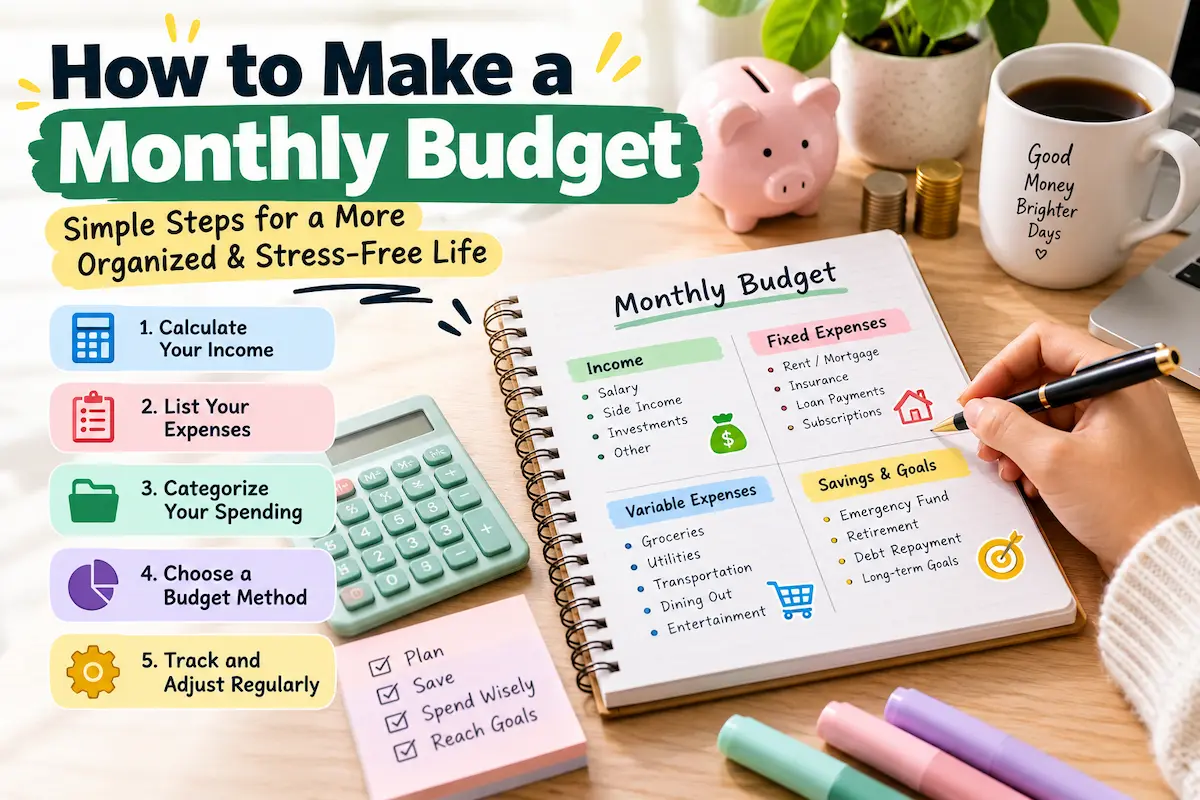
A bright monthly budgeting infographic showing five beginner-friendly steps: calculate monthly income, list expenses, categorize spending, choose a budget method, and track and adjust regularly. The desk scene includes a budget notebook, calculator, piggy bank, coins, and savings goals.
Making a monthly budget does not have to mean tracking every dollar perfectly or giving up everything you enjoy. A budget is simply a plan for how you will use the money coming into your household.
The process starts with understanding your take-home income, reviewing your spending, organizing expenses, and deciding how much to set aside for your priorities. You then compare your plan with what you actually spend and adjust it as your circumstances change.
Whether you are preparing your first budget, managing household expenses, or trying to save for a specific goal, this beginner-friendly guide will walk you through the process—with a practical monthly budget example and a free spreadsheet template. Checkout 💵 12 Essential Budget Categories to Organize Your Money
Quick Answer: To make a monthly budget, calculate your take-home income, list your expenses, organize them into categories, include savings and debt payments, and compare your planned spending with your income. Track your actual spending during the month and adjust your plan based on what you learn.
📘 What Is a Monthly Budget?
A monthly budget is a written plan showing how much money you expect to receive, how you plan to spend it, and how much you want to save or use toward financial goals.
It helps you see whether your planned expenses fit within your available income. It can also help you prepare for upcoming bills, identify spending patterns, and plan for less frequent expenses.
A budget is not just a record of money you have already spent. It is a plan you create before or at the beginning of a month, then update using your actual income and expenses.
The U.S. government’s consumer budgeting guide describes budgeting as a way to plan monthly spending, understand where money goes, and make adjustments when expenses exceed income.
🧭 How to Make a Monthly Budget in 7 Steps
Step 1: Calculate Your Monthly Take-Home Income
Start by finding out how much money is actually available for your monthly budget.
Use your take-home income—the amount you receive after deductions such as taxes and workplace benefits—not your gross salary.
Include income sources that regularly contribute to your household, such as:
Salary or wages after deductions
Regular freelance or self-employment income
Reliable side-income
Pension or other regular payments
Other recurring household income
If your income changes from month to month, avoid building your plan around an unusually high month. Review your previous income and choose a conservative estimate that is realistic for your situation.
For example:
| Income source | Monthly amount |
|---|---|
| Main take-home pay | $3,800 |
| Regular side income | $400 |
| Other regular income | $300 |
| Total monthly income | $4,500 |
Illustrative example only. Replace these figures with your own income.
If you do not receive income monthly, you can estimate a monthly amount from your past income records. Consumer.gov explains one approach: add your income over the previous year and divide by 12 to estimate a monthly figure.
💡 Tip: Use money you can reasonably expect to receive. Do not rely on uncertain bonuses, occasional gifts, or hoped-for income to cover essential bills.
Step 2: Review Your Recent Spending
Before deciding how much to spend in each category, find out where your money currently goes.
Review your recent:
Bank statements
Credit card statements
Digital wallet transactions
Bills and receipts
Cash spending records
Look for regular payments as well as small purchases that are easy to overlook. If possible, review several months so you can identify expenses that do not occur every month.
For example, you may notice that your monthly spending includes:
Rent or mortgage payments
Groceries and household supplies
Electricity, water, and internet
Transportation and fuel
Subscriptions
Dining out
Medical expenses
Gifts and occasional purchases
The Consumer Financial Protection Bureau recommends tracking spending to understand current habits before building a budget. Its spending tracker guidance suggests recording expenses over a period of time and reviewing the results for patterns.
💡 Tip: Do not judge your spending while collecting the information. First understand what is happening. You can decide what to change when you have a clearer picture.
Step 3: List Your Fixed and Variable Expenses
Now organize your expenses into two useful groups: fixed and variable.
Fixed expenses
Fixed expenses are costs that generally stay the same or are due regularly.
Examples include:
Rent or mortgage
Loan payments
Insurance premiums
Phone plans
Internet subscriptions
School or childcare fees
Some fixed expenses may change occasionally, but their amount is usually predictable.
Variable expenses
Variable expenses change depending on your usage, choices, or circumstances.
Examples include:
Groceries
Electricity and water bills
Fuel or public transportation
Dining out
Clothing
Entertainment
Personal care
Household shopping
| Expense type | Examples | How to estimate |
|---|---|---|
| Fixed | Rent, loan payment, insurance | Use the current bill or payment amount |
| Variable | Groceries, fuel, dining out | Review past spending and estimate realistically |
| Occasional | Repairs, gifts, annual fees | Review previous costs and plan ahead |
Remember: A bill does not have to be identical every month to be included in your budget. If it is a regular cost, estimate it using available records.
Step 4: Organize Expenses Into Budget Categories
Budget categories help you group similar expenses so your plan is easier to understand and update.
You can start with broad categories such as:
Housing
Utilities
Food and groceries
Transportation
Insurance
Healthcare
Personal care and clothing
Family and childcare
Debt repayment
Savings
Entertainment and lifestyle
Gifts, donations, and miscellaneous expenses
You do not need to use every possible category. Choose a level of detail that you can maintain.
For a more detailed list, see our guide: 100 Budget Categories to Organize Your Monthly Budget. It includes examples you can use to create or customize your own budget categories.
Should you use broad categories or detailed subcategories?
A broad category is useful when you want a simple overview. Subcategories help when you need to understand exactly where money is going.
For example:
| Main category | Possible subcategories |
|---|---|
| Food and groceries | Groceries, restaurants, coffee, takeout |
| Transportation | Fuel, public transport, parking, maintenance |
| Housing | Rent, repairs, household supplies |
| Healthcare | Insurance, medicine, appointments |
Start simple. Add subcategories only when they help you make a useful decision.
Step 5: Choose a Budgeting Method
A budgeting method gives you a structure for assigning your income to expenses, savings, and goals. Different methods suit different needs, so choose one you can understand and maintain.
1. The 50/30/20 Budget Rule
This method divides after-tax income into three broad groups:
| Allocation | What it covers |
|---|---|
| 50% for needs | Essential costs such as housing, basic groceries, utilities, and necessary transportation |
| 30% for wants | Optional spending such as entertainment, hobbies, and dining out |
| 20% for savings and debt goals | Savings, emergency funds, and additional debt payments |
The percentages are a guideline, not a rule that every household can follow exactly. Housing costs, family responsibilities, income, and debt obligations can make these proportions difficult to achieve.
2. Zero-Based Budgeting
With zero-based budgeting, you assign your expected income to planned expenses, savings, and other goals until the amount left unassigned is zero.
The calculation is:
Income − Planned expenses − Planned savings = $0
This does not mean spending all your money. Savings and debt goals can also receive an assignment in the budget.
3. Pay-Yourself-First Budgeting
This method begins by assigning a planned amount to savings or a financial goal. You then plan your remaining spending around the money left.
It can be straightforward if you have a clear savings target, but you still need to account for essential bills and regular expenses.
💡 Which method should you use? Choose the method that makes it easiest for you to plan, track, and review your money. You can also combine ideas—for example, use broad percentage targets while tracking expenses in more detail.
Step 6: Create Your Monthly Budget
Now bring your income and expenses together.
Start with your take-home income. Add your expected expenses, debt payments, and savings contributions. Then compare the total with your available income.
Here is an illustrative monthly budget for a household with $5,000 in take-home income.
📊 Monthly Budget Example
| Budget category | Planned amount |
|---|---|
| Housing | $1,500 |
| Utilities | $250 |
| Food and groceries | $600 |
| Transportation | $450 |
| Insurance | $250 |
| Healthcare | $150 |
| Personal care and clothing | $150 |
| Family and childcare | $400 |
| Debt repayment | $350 |
| Savings | $500 |
| Entertainment and lifestyle | $250 |
| Gifts, donations, and miscellaneous | $150 |
| Total planned | $5,000 |
| Monthly income | $5,000 |
| Unassigned amount | $0 |
This is an illustrative example, not a recommended allocation or spending limit. Your actual budget will depend on your income, location, household size, obligations, and financial goals.
In this example, the full $5,000 has been assigned to expenses, debt repayment, savings, and other planned costs.
If your planned expenses are higher than your income, review the budget before the month begins. Check whether any estimates are inaccurate, whether optional spending can be adjusted, or whether a bill can be managed differently.
If your income is higher than your planned expenses, decide how you want to assign the remaining amount. You might direct it toward savings, upcoming expenses, debt repayment, or another goal.
📝 Use a planned-versus-actual budget
A useful budget does not stop at the planned amount. At the end of the month, compare your plan with what you actually spent.
| Category | Planned | Actual | Difference |
|---|---|---|---|
| Groceries | $600 | $640 | -$40 |
| Transportation | $450 | $420 | +$30 |
| Entertainment | $250 | $210 | +$40 |
Illustrative figures. In this table, a positive difference means spending was below the planned amount; a negative difference means spending was above it.
This comparison helps you identify which estimates were realistic and which categories may need adjustment next month.
Step 7: Track, Review, and Adjust Your Budget
A budget becomes useful when you use it throughout the month.
Choose a tracking method that fits your routine:
A spreadsheet
A budgeting app
A notebook
A simple list of transactions
Your bank’s spending records, where available
Record expenses regularly rather than relying on memory at the end of the month.
A simple monthly review routine
At the beginning of the month
Enter your expected income.
Add bills and planned expenses.
Set amounts for savings and financial goals.
Check upcoming annual or occasional costs.
During the month
Record purchases and payments.
Check categories that are close to their planned amounts.
Update estimates if something unexpected happens.
At the end of the month
Compare planned and actual spending.
Identify categories that were over or under budget.
Note any missed or unexpected expenses.
Adjust next month’s plan.
The Oregon Division of Financial Regulation also recommends comparing estimated income and expenses, tracking actual spending, and adjusting the budget as needed in its personal budgeting guide.
💡 Remember: Your first budget is a starting point. It may take a few months of tracking to understand your regular spending patterns and create estimates that reflect your real life.
📥 Free Monthly Budget Template
You do not need to build a budget spreadsheet from scratch.
Use our free monthly budget template to organize income, expenses, and savings in one place. The workbook is designed to help you enter planned amounts, record actual amounts, and compare the difference.
[Download the Free Monthly Budget Template]
What does the template help you track?
Monthly income
Planned and actual expenses
Main budget categories and subcategories
Savings and debt payments
Category totals
Remaining budget amount
How to use the template
Open the Monthly Budget worksheet.
Enter your budget month and currency.
Add your expected income.
Enter planned amounts for each category.
Record actual spending as the month progresses.
Review the totals and differences.
Use the How to Use worksheet if you need help getting started.
A note about tracking: If you use a credit card, avoid counting both the original purchase and the later card bill payment as separate expenses. Record the purchase in its relevant category and treat the payment as settling the card balance, so your spending is not counted twice.
⚠️ Common Monthly Budgeting Mistakes
Even a simple budget can become difficult to use if important costs are left out. Watch for these common issues.
1. Using gross income instead of take-home income
Your gross salary may be higher than the amount deposited into your account. Build your spending plan around the money actually available to you.
2. Guessing every expense
Estimates are useful, but guesses can make a budget unrealistic. Review bank statements, bills, and receipts to establish a starting point.
3. Forgetting occasional expenses
Some costs do not arrive every month, such as annual insurance, repairs, school expenses, or holiday spending.
If an expense is predictable, estimate its yearly cost and divide it by 12. For example, a $600 annual bill can be planned as $50 per month.
4. Making the budget too restrictive
A plan that ignores your actual lifestyle may be difficult to maintain. Include reasonable amounts for optional spending as well as essential costs and goals.
5. Not tracking actual spending
A budget is an estimate until you compare it with real transactions. Record spending during the month so you can make informed adjustments.
6. Treating the first budget as permanent
Income, bills, household needs, and priorities can change. Review your plan regularly and update it when your circumstances change.
👨👩👧 How to Make a Monthly Family Budget
A family budget follows the same basic process, but it should include the income and expenses that affect the household.
Start by listing the household’s available take-home income. Then include shared expenses such as housing, groceries, utilities, transportation, childcare, education, healthcare, and debt payments.
It can also help to plan for expenses that do not occur every month, including school supplies, family travel, celebrations, home repairs, and annual bills.
If more than one person manages household spending, agree on how expenses will be recorded and reviewed. A shared spreadsheet or regular household check-in can help everyone understand the plan.
For a family budget, the goal is not to make every person’s spending identical. It is to create a shared view of household income, commitments, and priorities.
💵 How to Budget on a Low or Irregular Income
When income is limited or changes from month to month, begin with the amount you can reasonably rely on.
List essential costs first, such as housing, basic utilities, food, necessary transportation, healthcare, and required debt payments. Then review other expenses and identify which ones can be reduced, delayed, or planned for later.
For irregular income, consider using a conservative estimate based on your income history. When you receive more than expected, decide how to use the extra amount—such as covering upcoming bills, building a buffer, or working toward a savings goal.
If your essential expenses are already greater than your available income, a budget can help you see the shortfall, but it cannot create money that is not there. You may need to explore changes to bills, income, payment arrangements, or available support.
❓ Frequently Asked Questions
How do I create a simple monthly budget?
Calculate your take-home income, list your expenses, group them into categories, and assign planned amounts to each category. Compare your planned expenses with your income, then track actual spending and adjust the plan.
How should a beginner budget?
Start with a small number of broad categories. Use your recent bank statements and bills to estimate expenses, include savings and debt payments, and choose a tracking method you can maintain. You can add more detail as you become familiar with your spending.
What is the easiest budgeting method?
The easiest method depends on how you prefer to manage money. The 50/30/20 rule uses three broad groups, while zero-based budgeting assigns income to individual expenses and goals. Choose a method that is practical for your circumstances.
What is a realistic monthly budget?
A realistic budget is based on your actual take-home income, regular bills, recent spending, household needs, and financial priorities. It should also account for expenses that occur less frequently. There is no single monthly budget that works for every household.
How do I budget on a low income?
Start with your available income and essential expenses. Identify required payments, estimate basic living costs, and review flexible expenses. If essential costs exceed available income, the budget can help show the gap and support decisions about payment arrangements, assistance, or changes to income and expenses.
Should savings be included in a monthly budget?
Yes. You can include savings as a planned line in your budget, just like other financial goals. This makes the amount visible and helps you compare your planned contribution with what you actually set aside.
How often should I review my budget?
Track spending during the month and review the results at the end of the month. You may also want to check your budget when income, bills, household needs, or financial goals change.
What should I do if my expenses are higher than my income?
First, check that your income and expense figures are accurate. Then review flexible spending, upcoming costs, and payment dates. If essential expenses still exceed income, consider contacting relevant service providers or creditors to discuss available options and look into support that may apply to your situation.
✅ Final Thoughts
Making a monthly budget is a process of planning, tracking, and adjusting—not getting every number right on the first try.
Begin with your take-home income, use real spending records to estimate expenses, and organize your money into categories that make sense for your household. Choose a budgeting method you can maintain, then compare your planned amounts with actual spending each month.
If you want help organizing your categories, explore our guide to 100 Budget Categories to Organize Your Monthly Budget. When you are ready to put your numbers into practice, use the free monthly budget template above.
A simple budget you review regularly can give you a clearer picture of your money and help you plan your next steps.
📚 References and Further Reading
The following consumer-finance resources support the general budgeting practices discussed in this guide:
These resources explain general budgeting methods and tools. They do not establish one universally correct budget or spending percentage. The examples in this article are illustrative and should be adapted to individual circumstances.