
💵 12 Essential Budget Categories to Organize Your Money
💵 12 Essential Budget Categories to Organize Your Money
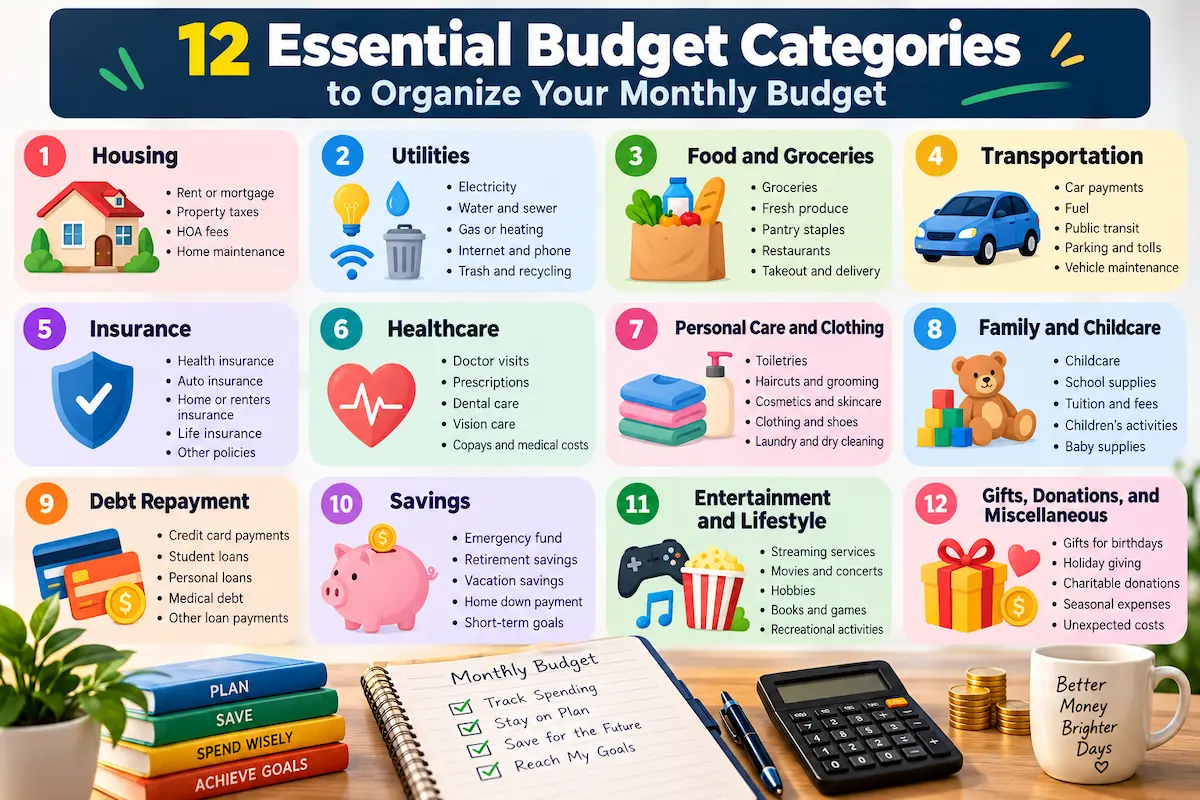
A colorful infographic illustrating 12 essential budget categories for organizing a monthly budget. Each numbered panel highlights a category with examples, including housing, utilities, food and groceries, transportation, insurance, healthcare, personal care and clothing, family and childcare, debt repayment, savings, entertainment and lifestyle, and gifts, donations, and miscellaneous expenses.
Quick Answer: The 12 essential budget categories are housing, utilities, food and groceries, transportation, insurance, healthcare, personal care and clothing, family and childcare, debt repayment, savings, entertainment and lifestyle, and gifts, donations, and miscellaneous expenses. These categories help you organize monthly spending, plan for financial goals, and track where your money goes. You can combine or customize them to fit your household.
Read the complete list of 100 budget categories
📥 Download Your Free Monthly Budget Template
Ready to organize your money? Download this free, editable monthly budgeting template to plan your income, track actual expenses, and see how much money remains.
Customize the categories to fit your household and use it month after month.
[Download the Free Monthly Budget Template (Excel)]
You don’t need dozens of categories to start budgeting. In fact, a simple budget with 12 essential categories can help you understand where your money goes, plan your monthly expenses, and make room for savings.
Think of these as your main budget groups. You can add smaller subcategories whenever you need more detail.
🏠 1. Housing
Housing is often one of the largest parts of a household budget. Include the regular costs of keeping your home.
Examples:
Rent or mortgage payments
Property taxes
Homeowners or renters insurance
Homeowners association (HOA) fees
Basic home maintenance and repairs
💡 2. Utilities
This category covers the services that keep your home running and connected.
Examples:
Electricity
Natural gas or heating
Water and sewer
Trash and recycling
Internet and phone bills
🛒 3. Food and Groceries
Track the money you spend on food at home and meals purchased outside.
Examples:
Groceries
Fresh fruits and vegetables
Meat, seafood, and dairy
Pantry staples
Restaurants, takeout, and food delivery
You can split groceries and dining out into separate subcategories if you want to see how much you spend on each.
🚗 4. Transportation
Include the costs of getting to work, school, appointments, and other destinations.
Examples:
Car payments
Fuel
Public transportation
Parking and tolls
Vehicle maintenance and repairs
If you use rideshare services or taxis regularly, you can track those here too.
🛡️ 5. Insurance
Insurance helps protect you from certain financial risks. Record the premiums you pay for your policies.
Examples:
Health insurance
Auto insurance
Homeowners or renters insurance
Life insurance
Other personal insurance policies
If an insurance premium is already included in another payment, avoid counting it twice.
🩺 6. Healthcare
Use this category for medical costs that are not included in your insurance premiums.
Examples:
Doctor and specialist visits
Dental care
Vision care
Prescription medications
Copays and other out-of-pocket medical expenses
🧴 7. Personal Care and Clothing
This category covers everyday personal needs and grooming.
Examples:
Toiletries
Haircuts and grooming
Cosmetics and skincare
Clothing and shoes
Laundry and dry cleaning
You may separate clothing from personal care if either one takes up a significant part of your spending.
👨👩👧 8. Family and Childcare
If you support children or other family members, this category can help you track those costs.
Examples:
Childcare
School supplies and fees
Tuition
Children’s activities
Baby supplies
You can also add a separate pet category if you have recurring expenses for pets.
💳 9. Debt Repayment
Track payments toward money you owe. This helps you plan required payments and monitor progress toward reducing debt.
Examples:
Credit card payments
Student loan payments
Personal loan payments
Medical debt payments
Other loan repayments
Be consistent about how you record credit card spending and payments. If you already record each purchase in its spending category, don’t count the same purchases again when paying the card bill.
🌱 10. Savings
Savings should have a place in your budget, even if you are starting with a small amount.
Examples:
Emergency fund
Short-term savings goals
Vacation savings
Home down payment savings
Money set aside for planned future expenses
You can create separate savings categories for goals that matter to you.
🎬 11. Entertainment and Lifestyle
This category includes optional spending that makes everyday life enjoyable.
Examples:
Streaming subscriptions
Movies and concerts
Hobbies
Books and games
Recreational activities and outings
If you want to manage these expenses more closely, divide them into smaller categories.
🎁 12. Gifts, Donations, and Miscellaneous
Some expenses do not happen every month or do not fit neatly into another group. This category helps you plan for them.
Examples:
Birthday and holiday gifts
Charitable donations
Community contributions
Seasonal expenses
Small unexpected costs
For larger or predictable expenses, consider creating a separate category instead of relying on Miscellaneous.
📌 How to Use These 12 Categories in Your Monthly Budget
Start by listing your monthly income. Then decide how much you can allocate to each category based on your actual expenses, financial responsibilities, and goals.
A simple budget can look like this:
| Budget category | Planned amount | Actual amount |
|---|---|---|
| Housing | $___ | $___ |
| Utilities | $___ | $___ |
| Food and Groceries | $___ | $___ |
| Transportation | $___ | $___ |
| Insurance | $___ | $___ |
| Healthcare | $___ | $___ |
| Personal Care and Clothing | $___ | $___ |
| Family and Childcare | $___ | $___ |
| Debt Repayment | $___ | $___ |
| Savings | $___ | $___ |
| Entertainment and Lifestyle | $___ | $___ |
| Gifts, Donations, and Miscellaneous | $___ | $___ |
These are broad categories, not fixed spending limits. Your amounts will depend on your income, household, location, and priorities.
🤔 Do You Need All 12 Budget Categories?
Not necessarily. If you are new to budgeting, start with the categories that match your regular expenses. You can combine categories or add subcategories as you learn more about your spending.
For example, you might begin with Food and Groceries as one category. Later, you may split it into Groceries, Restaurants, and Food Delivery if that distinction helps you make better decisions.
The goal is not to track every dollar in the most complicated way possible. The goal is to create a budget you can understand and maintain.
💡 Want a More Detailed Budget Categories List?
These 12 categories are a simple starting point. If you want to organize your budget in greater detail, explore the complete list of 100 budget categories, including housing, food, transportation, healthcare, debt, savings, lifestyle, and travel expenses.
Use the categories that fit your life—and leave out the ones you do not need.
🧾 Real-Life Example: How to Use 12 Budget Categories
Imagine a household with a monthly take-home income of $5,000. Instead of tracking every purchase separately, they organize their budget using 12 main categories.
Here is one example of how they might plan their monthly spending:
| Budget category | Planned amount |
|---|---|
| 🏠 Housing | $1,500 |
| 💡 Utilities | $250 |
| 🛒 Food and Groceries | $600 |
| 🚗 Transportation | $450 |
| 🛡️ Insurance | $250 |
| 🩺 Healthcare | $150 |
| 🧴 Personal Care and Clothing | $150 |
| 👨👩👧 Family and Childcare | $400 |
| 💳 Debt Repayment | $350 |
| 🌱 Savings | $500 |
| 🎬 Entertainment and Lifestyle | $250 |
| 🎁 Gifts, Donations, and Miscellaneous | $150 |
| Total planned | $5,000 |
In this example, the household assigns every dollar of its take-home income to a planned category. The amounts are illustrative—not recommended spending limits—and a real budget should reflect the household’s needs and obligations.
At the end of the month, they compare planned amounts with actual spending. If they spent less on transportation, they can decide whether to move the difference toward savings, debt repayment, or another priority.
The important part is having a clear plan and reviewing it regularly—not making every category perfect from the beginning.
❓ Frequently Asked Questions About Budget Categories
1. What are the 12 essential budget categories?
A simple budget can use these 12 broad categories: housing, utilities, food and groceries, transportation, insurance, healthcare, personal care and clothing, family and childcare, debt repayment, savings, entertainment and lifestyle, and gifts, donations, and miscellaneous expenses.
2. What are the most important categories in a monthly budget?
Most people begin with the expenses they need to plan for regularly, such as housing, utilities, food, transportation, insurance, healthcare, debt payments, and savings. The categories that matter most depend on a household’s income, responsibilities, and financial goals.
3. Do I need to use all 12 budget categories?
No. The 12 categories are a starting point, not a requirement. You can combine categories that are small or similar, and add more detail when it helps you understand your spending.
4. What is the difference between a budget category and a subcategory?
A budget category is a broad group of expenses, while a subcategory provides more detail. For example, Transportation is a main category, while fuel, parking, car payments, and vehicle maintenance can be its subcategories.
5. Should savings be included as a budget category?
Yes. Including savings in your budget helps you plan for future goals, emergencies, and irregular expenses. You can track savings as a planned allocation of your income rather than treating it as an everyday purchase.
6. Should groceries and restaurants be separate budget categories?
They can be. Keeping them separate can help you understand how much you spend on food at home compared with meals purchased outside. If you prefer a simpler budget, you can keep both under Food and Groceries.
7. How do I decide how much to spend in each budget category?
Start by reviewing your take-home income, bills, recent transactions, debt obligations, and savings goals. Use your actual spending as a starting point, then adjust your planned amounts as you learn what works for your household.
8. What should I put under miscellaneous expenses?
Use this category for small or occasional expenses that do not fit elsewhere. However, if an expense happens regularly or costs a significant amount, give it its own category so it does not disappear into a catch-all total.
9. How often should I review my budget categories?
Review your spending at least once a month. You can also check your budget during the month to catch overspending early and make adjustments when your circumstances change.
10. Can I change my budget categories every month?
Yes. Your budget should adapt to your needs. You can add, remove, combine, or rename categories as your expenses and goals change. Try to keep the structure consistent enough to compare your spending from month to month.
📚 References and Helpful Resources
The following resources provide additional guidance on creating a budget, tracking expenses, and planning savings: