
🧠20+ Internal Organs Name in English and Hindi with Pictures
🧠20+ Internal Organs Name in English and Hindi with Pictures
📋Introduction
Have you ever wondered how your heart keeps beating, where food goes after you eat, or how your lungs help you breathe? Although we cannot see them from the outside, our body contains many important internal organs (आंतरिक अंग) that work day and night to keep us alive and healthy.
Imagine a child asking his mother, "Mom, where is my heart? How does my stomach digest food?" She smiles and explains that just like the engine inside a car, our body has many organs hidden inside it. Each organ has a special job. The heart (हृदय) pumps blood, the lungs (फेफड़े) help us breathe, the brain (मस्तिष्क) controls the body, and the stomach (पेट) digests the food we eat.
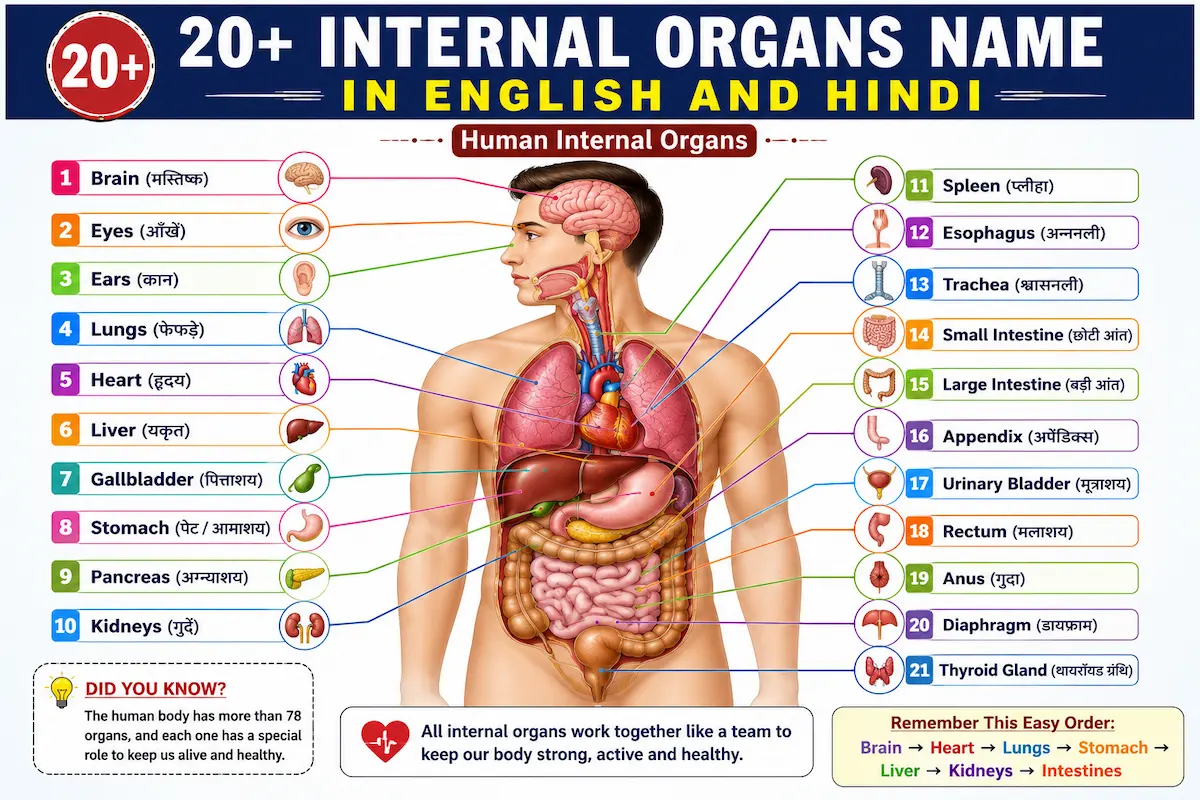
In this article, you'll learn 20+ Internal Organs Name in English and Hindi with Pictures, their functions, interesting facts, and easy examples. Whether you're a student, parent, teacher, or preparing for a competitive exam, this guide will help you understand the human body's internal organs in a simple and memorable way.
Checkout the kids, 🔠ABCD Chart (A to Z English Alphabet for Kids) – Easy Learning Guide with Pictures
👉 “📌 Also Learn different types of birds with pictures below” Also Read 🐦100 Pet Birds Name in English and Hindi | पालतू पक्षियों के नाम, Vegetables Name A to Z in English and Hindi
Table of Contents
- 🧠20+ Internal Organs Name in English and Hindi with Pictures
- 📋Introduction
- 🧠 What Are Internal Organs? (आंतरिक अंग क्या हैं?)
- 📋 Internal Organs Name in English and Hindi (आंतरिक अंगों के नाम)
- 💡 Quick Observation (जल्दी समझें)
- 🩺 Major Internal Organs and Their Functions (आंतरिक अंगों के नाम और उनके कार्य)
- 🧠 1. Brain (मस्तिष्क)
- ❤️ 2. Heart (हृदय)
- 🫁 3. Lungs (फेफड़े)
- 🍽️ 4. Stomach (पेट / आमाशय)
- 🟤 5. Liver (यकृत)
- 🫘 6. Kidneys (गुर्दे)
- 🌀 7. Small Intestine (छोटी आंत)
- 🔄 8. Large Intestine (बड़ी आंत)
- 🟡 9. Pancreas (अग्न्याशय)
- 🟢 10. Gallbladder (पित्ताशय)
- 🟣 11. Spleen (प्लीहा)
- 🚰 12. Urinary Bladder (मूत्राशय)
- 🌬️ 13. Trachea (श्वासनली)
- 🥣 14. Esophagus (अन्ननली)
- 🦋 15. Thyroid Gland (थायरॉयड ग्रंथि)
- 📎 16. Appendix (अपेंडिक्स)
- 🛡️ 17. Diaphragm (डायफ्राम)
- 🚪 18. Rectum (मलाशय)
- 🚻 19. Anus (गुदा)
- ⚖️ Internal Organs vs External Body Parts (आंतरिक अंग और बाहरी शरीर के अंग में अंतर)
- 📊 Difference Between Internal Organs and External Body Parts
- 👨👩👧 Easy Family Example
- 💡 Remember This Simple Rule
- 🔗 Related Articles
- 🌟 10 Interesting Facts About Internal Organs (आंतरिक अंगों के बारे में रोचक तथ्य)
- 🧠 1. The Brain Never Takes a Break
- ❤️ 2. Your Heart Beats Thousands of Times Every Day
- 🫁 3. We Breathe Without Thinking
- 🟤 4. The Liver Can Repair Itself
- 🫘 5. Your Kidneys Work Like Natural Filters
- 🍽️ 6. Digestion Is a Team Effort
- 🦠 7. Helpful Bacteria Live Inside Your Intestines
- 🛡️ 8. The Spleen Helps Protect Your Body
- 🌬️ 9. The Diaphragm Makes Breathing Easier
- 👶 10. Internal Organs Work Together Like a Team
- 👨👩👧 Everyday Family Example
- 💡 Did You Observe Today?
- 📌 Quick Summary (संक्षिप्त सार)
- 🧠 What We Learned
- 📋 Major Internal Organs at a Glance
- 💡 Easy Memory Trick (याद रखने की आसान ट्रिक)
- 👨👩👧 Everyday Family Reminder
- 📝 10 MCQ Quiz on Internal Organs (आंतरिक अंगों पर प्रश्नोत्तरी)
- 1. Which organ is known as the control center of the human body? (मानव शरीर का नियंत्रण केंद्र कौन-सा अंग है?)
- 2. Which internal organ pumps blood throughout the body? (पूरे शरीर में रक्त कौन-सा अंग पंप करता है?)
- 3. Which organ helps us breathe? (सांस लेने में कौन-सा अंग मदद करता है?)
- 4. Which organ digests the food we eat? (भोजन को पचाने का कार्य कौन-सा अंग करता है?)
- 5. Which organ filters blood and produces urine? (रक्त को छानकर मूत्र कौन-सा अंग बनाता है?)
- 6. Which internal organ produces bile to help digest fats? (वसा को पचाने के लिए पित्त कौन-सा अंग बनाता है?)
- 7. Which organ stores urine before it leaves the body? (शरीर से बाहर निकलने से पहले मूत्र कहाँ संग्रहित होता है?)
- 8. Which organ carries food from the mouth to the stomach? (मुंह से भोजन को पेट तक कौन-सा अंग पहुंचाता है?)
- 9. Which statement is correct? (सही कथन चुनिए।)
- 10. Which of the following is an internal organ? (निम्न में से कौन-सा आंतरिक अंग है?)
- 🏆 Score Card
- 💡 Learning Tip (सीखने की आसान टिप)
- 🔗 Related Articles
- ❓FAQs About Internal Organs (आंतरिक अंगों से जुड़े अक्सर पूछे जाने वाले प्रश्न)
- Q1. What are internal organs? (आंतरिक अंग क्या हैं?)
- Q2. What are the major internal organs of the human body? (मानव शरीर के प्रमुख आंतरिक अंग कौन-कौन से हैं?)
- Q3. Which is the largest internal organ in the human body? (मानव शरीर का सबसे बड़ा आंतरिक अंग कौन-सा है?)
- Q4. Which internal organ pumps blood throughout the body? (पूरे शरीर में रक्त कौन-सा अंग पंप करता है?)
- Q5. Which organ controls the entire body? (पूरे शरीर को कौन-सा अंग नियंत्रित करता है?)
- Q6. What is the function of the kidneys? (गुर्दों का कार्य क्या है?)
- Q7. What is the difference between internal organs and external body parts? (आंतरिक अंग और बाहरी शरीर के अंग में क्या अंतर है?)
- Q8. Which internal organ helps digest food? (भोजन पचाने में कौन-कौन से आंतरिक अंग मदद करते हैं?)
- Q9. Can a person live with one kidney? (क्या एक व्यक्ति एक ही गुर्दे के साथ जीवित रह सकता है?)
- Q10. Why are internal organs important? (आंतरिक अंग क्यों महत्वपूर्ण हैं?)
- 📚 Continue Learning at Monto Fact Jungle
🧠 What Are Internal Organs? (आंतरिक अंग क्या हैं?)
Internal organs (आंतरिक अंग) are the organs located inside the human body that perform essential functions to keep us alive and healthy. Unlike external body parts (बाहरी शरीर के अंग) such as the eyes, ears, nose, hands, and legs, internal organs are hidden inside the body and cannot be seen from the outside.
For example, the heart (हृदय) pumps blood throughout the body ❤️, the lungs (फेफड़े) help us breathe 🌬️, the brain (मस्तिष्क) controls our thoughts and body movements 🧠, and the stomach (पेट) digests the food we eat 🍎.
Together, these organs work as a team to help us breathe, digest food, circulate blood, remove waste, fight diseases, and perform many other important life processes.
💡 Did you know? The human body has many internal organs, but a few major organs—such as the brain, heart, lungs, liver, kidneys, and stomach—are essential for survival.
👨👩👧 Family Example
Imagine Charvi falls while playing and asks her father,
"Dad, I hurt my knee. Did my heart get hurt too?"
Her father smiles and says,
"No, beta. Your knee is an external body part that we can see. Your heart is an internal organ, safely protected inside your chest by your ribs."
This helps Charvi understand the difference between external body parts and internal organs.
👉 Want to learn all the external body parts? Explore our Body Parts Name in english and Hindi article.
👉 You can also check our 100 Body Parts Name List to learn more body parts in English and Hindi.
📋 Internal Organs Name in English and Hindi (आंतरिक अंगों के नाम)
Before explaining each organ, let's first look at the major internal organs (आंतरिक अंग) and their Hindi names in one easy table.
| 🧠 Internal Organ | 🇮🇳 Hindi Name | 📍 Location in the Body | ⭐ Main Function |
|---|---|---|---|
| 🧠 Brain | मस्तिष्क | Head | Controls the body and nervous system |
| ❤️ Heart | हृदय | Chest | Pumps blood throughout the body |
| 🫁 Lungs | फेफड़े | Chest | Help us breathe |
| 🍽️ Stomach | पेट (आमाशय) | Upper abdomen | Digests food |
| 🟤 Liver | यकृत | Right upper abdomen | Cleans blood and produces bile |
| 🫘 Kidneys | गुर्दे | Lower back | Filter blood and produce urine |
| 🌀 Small Intestine | छोटी आंत | Abdomen | Absorbs nutrients from food |
| 🔄 Large Intestine | बड़ी आंत | Abdomen | Absorbs water and forms stool |
| 🟡 Pancreas | अग्न्याशय | Behind the stomach | Produces digestive enzymes and insulin |
| 🟢 Gallbladder | पित्ताशय | Below the liver | Stores bile |
| 🟣 Spleen | प्लीहा | Left upper abdomen | Supports immunity and filters blood |
| 🚰 Urinary Bladder | मूत्राशय | Pelvis | Stores urine |
| 🥣 Esophagus | अन्ननली | Neck to stomach | Carries food to the stomach |
| 🌬️ Trachea | श्वासनली | Neck and chest | Carries air to the lungs |
| 🦋 Thyroid Gland | थायरॉयड ग्रंथि | Neck | Regulates metabolism |
| 📎 Appendix | अपेंडिक्स | Lower right abdomen | Small organ attached to the large intestine |
| 🛡️ Diaphragm | डायफ्राम | Below the lungs | Helps in breathing |
| 🚪 Rectum | मलाशय | Lower digestive tract | Stores stool before elimination |
| 🚻 Anus | गुदा | End of digestive tract | Removes solid waste from the body |
| 🧬 Reproductive Organs | प्रजनन अंग | Pelvic region | Help in reproduction |
💡 Quick Observation (जल्दी समझें)
✔️ Most internal organs (आंतरिक अंग) are protected by the rib cage (पसलियाँ), skull (खोपड़ी), and muscles (मांसपेशियाँ).
✔️ These organs work together every second to keep us alive, even while we are sleeping. 😴
Want to learn about all the visible body parts (शरीर के अंग)? Explore our Body Parts Name in english and Hindi articles. You can also check the 100 Body Parts Name List to learn more human body parts in English and Hindi.
🩺 Major Internal Organs and Their Functions (आंतरिक अंगों के नाम और उनके कार्य)
Our body has many internal organs (आंतरिक अंग), and each one performs a unique job. Together, they keep us healthy, active, and alive. Let's learn about the most important internal organs one by one.
🧠 1. Brain (मस्तिष्क)
The brain (मस्तिष्क) is the control center of the human body. It controls our thoughts, memory, emotions, movements, and senses. Every action—from walking and talking to solving a math problem—is controlled by the brain.
⭐ Function
- 🧠 Controls the entire body
- 💭 Helps us think and remember
- 👀 Processes information from the five sense organs
- 🚶 Controls body movements
- ❤️ Sends signals to different organs
👨👩👧 Everyday Example
When you touch a hot cup of tea ☕, your skin (त्वचा) sends a signal to the brain, and the brain quickly tells your hand to move away.
💡 Did you know? The brain works 24 hours a day—even while you're sleeping! 😴
🔗 Internal Link: Learn how the brain receives information from our Five Sense Organs Name in English and Hindi article.
❤️ 2. Heart (हृदय)
The heart (हृदय) is a strong muscular organ located inside the chest. It pumps blood throughout the body, supplying oxygen and nutrients to every organ.
⭐ Function
- ❤️ Pumps blood
- 🩸 Supplies oxygen and nutrients
- 🔄 Removes waste through blood circulation
- 💓 Beats continuously throughout life
👨👩👧 Everyday Example
When you run or play football ⚽, your heart beats faster to supply more oxygen-rich blood to your muscles.
💡 Did you know? An average human heart beats about 100,000 times every day.
🫁 3. Lungs (फेफड़े)
The lungs (फेफड़े) help us breathe by taking in oxygen and removing carbon dioxide from the body.
⭐ Function
- 🌬️ Help us breathe
- 💨 Take in oxygen
- ☁️ Remove carbon dioxide
- ❤️ Work closely with the heart
👨👩👧 Everyday Example
When you blow up a balloon 🎈 or climb stairs, your lungs work harder to provide more oxygen to your body.
💡 Did you know? Your left lung is slightly smaller than your right lung to make space for your heart.
🍽️ 4. Stomach (पेट / आमाशय)
The stomach (पेट) is a muscular organ that stores food and mixes it with digestive juices, beginning the digestion process.
⭐ Function
- 🍎 Stores food
- 🧪 Breaks down food using digestive juices
- 🥣 Helps prepare food for the intestines
👨👩👧 Everyday Example
After eating lunch 🍛, your stomach starts digesting the food so your body can use its nutrients for energy. Also check Five Sense Organs Name in English and Hindi (while explaining the brain)
💡 Did you know? The stomach produces strong acid that helps digest food but is safely contained by a protective lining.
🟤 5. Liver (यकृत)
The liver (यकृत) is the largest internal organ in the human body. It performs hundreds of important functions, including cleaning the blood, storing nutrients, and producing bile to help digest fats.
⭐ Function
- 🩸 Cleans harmful substances from the blood
- 🧪 Produces bile for digestion
- 🍚 Stores vitamins and minerals
- ⚡ Helps convert food into energy
👨👩👧 Everyday Example
After eating a meal containing butter 🧈 or oil, your liver produces bile, which helps your body digest fats efficiently.
💡 Did you know? The liver is the only major internal organ that can regenerate itself after losing part of its tissue.
🫘 6. Kidneys (गुर्दे)
The kidneys (गुर्दे) are two bean-shaped organs located on either side of the spine. They continuously filter the blood and remove waste by producing urine.
⭐ Function
- 💧 Filters blood
- 🚰 Produces urine
- ⚖️ Maintains water balance
- 🧂 Balances minerals in the body
👨👩👧 Everyday Example
When you drink plenty of water 🥤, your kidneys remove extra water and waste through urine, helping keep your body healthy.
💡 Did you know? Healthy kidneys filter around 180 liters of blood-derived fluid every day, returning most of it to the body while removing waste.
🌀 7. Small Intestine (छोटी आंत)
The small intestine (छोटी आंत) is a long tube where most digestion is completed and nutrients are absorbed into the bloodstream.
⭐ Function
- 🥗 Completes digestion
- 🥛 Absorbs nutrients
- ⚡ Supplies energy to the body
- 🩸 Passes nutrients into the blood
👨👩👧 Everyday Example
After eating fruits 🍎, vegetables 🥦, or rice 🍚, your small intestine absorbs vitamins and nutrients that help your body grow and stay healthy.
💡 Did you know? The small intestine is about 6–7 meters (20–23 feet) long in adults.
🔄 8. Large Intestine (बड़ी आंत)
The large intestine (बड़ी आंत) absorbs water from undigested food and forms solid waste before it leaves the body.
⭐ Function
- 💧 Absorbs water
- 🧫 Supports healthy gut bacteria
- 🚽 Forms and stores stool
- ♻️ Removes waste from the body
👨👩👧 Everyday Example
After your body absorbs nutrients, the large intestine removes extra water from the remaining food before waste is passed out.
💡 Did you know? The large intestine contains billions of helpful bacteria that support digestion and overall health.
🟡 9. Pancreas (अग्न्याशय)
The pancreas (अग्न्याशय) is an important organ that helps with digestion and regulates blood sugar by producing insulin.
⭐ Function
- 💉 Produces insulin
- 🍽️ Releases digestive enzymes
- 🍬 Helps control blood sugar levels
👨👩👧 Everyday Example
Whenever you eat sweets 🍰 or other foods, the pancreas releases insulin to help your body use sugar for energy.
💡 Did you know? The pancreas works as both a digestive organ and an endocrine gland, making it unique among internal organs.
You may also like Body Parts Name in english and Hindi article. You can also check the 100 Body Parts Name List , Five Sense Organs Name in English and Hindi to learn more human body parts in English and Hindi.
🟢 10. Gallbladder (पित्ताशय)
The gallbladder (पित्ताशय) is a small pear-shaped organ located below the liver. It stores bile produced by the liver and releases it into the small intestine to help digest fatty foods.
⭐ Function
- 🟢 Stores bile
- 🍟 Helps digest fats
- 🔄 Releases bile into the small intestine
👨👩👧 Everyday Example
When you eat fried foods 🍟 or cheese 🧀, the gallbladder releases bile to help your body digest fats more easily.
💡 Did you know? You can live without a gallbladder because the liver continues to produce bile.
🟣 11. Spleen (प्लीहा)
The spleen (प्लीहा) is an organ located on the left side of the abdomen. It helps filter blood and supports the body's immune system.
⭐ Function
- 🩸 Filters old blood cells
- 🛡️ Supports immunity
- ⚪ Helps fight infections
👨👩👧 Everyday Example
When germs enter your body, the spleen works with your immune system to help protect you from illness.
💡 Did you know? The spleen stores white blood cells that help fight infections.
🚰 12. Urinary Bladder (मूत्राशय)
The urinary bladder (मूत्राशय) is a hollow muscular organ that stores urine until it leaves the body.
⭐ Function
- 💧 Stores urine
- 🚻 Releases urine when needed
👨👩👧 Everyday Example
After drinking several glasses of water 🥤, your bladder stores urine until you visit the washroom.
💡 Did you know? A healthy adult bladder usually holds 300–500 milliliters of urine comfortably.
🌬️ 13. Trachea (श्वासनली)
The trachea (श्वासनली), also called the windpipe, is the tube that carries air from the nose and mouth to the lungs.
⭐ Function
- 🌬️ Carries air to the lungs
- 🫁 Helps us breathe
👨👩👧 Everyday Example
Every time you take a deep breath before running 🏃, air travels through your trachea into your lungs.
💡 Did you know? Tiny hair-like structures inside the trachea help trap dust and germs.
🥣 14. Esophagus (अन्ननली)
The esophagus (अन्ननली) is a muscular tube that carries food from the mouth to the stomach.
⭐ Function
- 🥄 Moves food to the stomach
- 🍽️ Helps in swallowing
👨👩👧 Everyday Example
When you swallow a bite of bread 🍞, it travels through the esophagus before reaching the stomach.
💡 Did you know? The esophagus uses rhythmic muscle movements called peristalsis to push food downward.
🦋 15. Thyroid Gland (थायरॉयड ग्रंथि)
The thyroid gland (थायरॉयड ग्रंथि) is a butterfly-shaped gland located in the front of the neck. It produces hormones that regulate the body's metabolism.
⭐ Function
- ⚡ Controls metabolism
- 🌡️ Helps regulate energy use
- 📈 Supports normal growth and development
👨👩👧 Everyday Example
The thyroid helps your body use the energy from the food you eat to support daily activities like walking, studying, and playing.
💡 Did you know? The thyroid gland needs iodine to produce its hormones.
📎 16. Appendix (अपेंडिक्स)
The appendix (अपेंडिक्स) is a small, finger-shaped pouch attached to the large intestine.
⭐ Function
- 📎 Attached to the large intestine
- 🦠 May support healthy gut bacteria (its exact role is still being studied)
👨👩👧 Everyday Example
Many people never notice their appendix unless it becomes inflamed, a condition known as appendicitis.
💡 Did you know? Doctors can remove the appendix if it becomes infected, and people can usually live healthy lives without it.
🛡️ 17. Diaphragm (डायफ्राम)
The diaphragm (डायफ्राम) is a large muscle located below the lungs. It plays an important role in breathing.
⭐ Function
- 🌬️ Helps the lungs expand and contract
- 🫁 Supports breathing
👨👩👧 Everyday Example
When you take a deep breath during exercise 🏃♂️, your diaphragm moves downward, allowing your lungs to fill with air.
💡 Did you know? Hiccups occur when the diaphragm contracts suddenly.
🚪 18. Rectum (मलाशय)
The rectum (मलाशय) is the final part of the large intestine. It temporarily stores stool before it leaves the body.
⭐ Function
- 🚪 Stores stool
- 🚽 Prepares waste for elimination
👨👩👧 Everyday Example
After digestion is complete, the rectum stores waste until you are ready to use the toilet.
💡 Did you know? The rectum works together with the anus to remove waste from the body.
🚻 19. Anus (गुदा)
The anus (गुदा) is the opening at the end of the digestive system through which solid waste leaves the body.
⭐ Function
- 🚽 Eliminates solid waste
- ♻️ Completes the digestion process
👨👩👧 Everyday Example
After the body has absorbed all the useful nutrients from food, the remaining waste is removed through the anus.
💡 Did you know? Proper digestion depends on all parts of the digestive system working together—from the mouth to the anus.
⚖️ Internal Organs vs External Body Parts (आंतरिक अंग और बाहरी शरीर के अंग में अंतर)
Many people think that internal organs (आंतरिक अंग) and external body parts (बाहरी शरीर के अंग) are the same. However, they are different in terms of location, visibility, and function.
Internal organs are hidden inside the body and perform essential life functions such as breathing, digestion, blood circulation, and waste removal. In contrast, external body parts are visible from the outside and help us perform daily activities like walking, writing, lifting, and communicating.
The table below makes the difference easy to understand.
📊 Difference Between Internal Organs and External Body Parts
| 🩺 Internal Organs | 🧍 External Body Parts |
|---|---|
| Located inside the body | Visible outside the body |
| Cannot be seen without medical imaging or surgery | Easily visible to everyone |
| Perform life-supporting functions | Help in movement and daily activities |
| Protected by bones and muscles | Directly exposed to the environment |
| Examples: Heart ❤️, Brain 🧠, Liver 🟤, Lungs 🫁 | Examples: Eyes 👀, Hands ✋, Legs 🦵, Nose 👃 |
👨👩👧 Easy Family Example
Imagine Vishnu asks his grandmother Sharada,
"Grandma, are my heart and my hands both body parts?"
She smiles and replies,
"Yes, both are parts of your body, but they are different. Your hands are external body parts because you can see them. Your heart is an internal organ because it stays safely inside your chest and works all the time to pump blood."
This simple example helps children understand the difference between what we can see and what works inside our body.
💡 Remember This Simple Rule
🧍 External Body Parts → Visible from outside
🩺 Internal Organs → Hidden inside the body
Both are equally important and work together to keep us healthy and active.
🔗 Related Articles
Want to learn the names of all visible body parts?
👉 Body Parts Name in Hindi and English – Learn the names of external body parts in English and Hindi.
👉 100 Body Parts Name List – Explore a complete list of human body parts with easy meanings.
👉 Five Sense Organs Name in English and Hindi – Discover how the eyes, ears, nose, tongue, and skin help us understand the world around us.
🌟 Did You Know?
The human body has 11 major organ systems, and every internal organ belongs to one or more of these systems. For example:
- ❤️ Heart → Circulatory System
- 🫁 Lungs → Respiratory System
- 🍽️ Stomach → Digestive System
- 🧠 Brain → Nervous System
- 🫘 Kidneys → Urinary System
Each system works together like members of a team to keep your body functioning properly.
🌟 10 Interesting Facts About Internal Organs (आंतरिक अंगों के बारे में रोचक तथ्य)
The human body is an amazing machine. Every internal organ (आंतरिक अंग) performs a special job to keep us alive and healthy. Here are some fascinating facts that are easy to remember.
🧠 1. The Brain Never Takes a Break
Your brain (मस्तिष्क) works 24 hours a day, even while you're sleeping. It controls your thoughts, memories, breathing, and body movements.
❤️ 2. Your Heart Beats Thousands of Times Every Day
The heart (हृदय) pumps blood continuously without stopping. It works every second to supply oxygen and nutrients to the entire body.
🫁 3. We Breathe Without Thinking
The lungs (फेफड़े) automatically take in oxygen and remove carbon dioxide, even when we are asleep.
🟤 4. The Liver Can Repair Itself
The liver (यकृत) is one of the few organs that can regenerate and replace damaged tissue, making it unique among human organs.
🫘 5. Your Kidneys Work Like Natural Filters
The kidneys (गुर्दे) continuously clean your blood by removing waste products and excess water, helping maintain a healthy balance inside the body.
🍽️ 6. Digestion Is a Team Effort
The stomach, liver, pancreas, and intestines work together to digest food and provide the nutrients your body needs for energy and growth.
🦠 7. Helpful Bacteria Live Inside Your Intestines
Your large intestine (बड़ी आंत) is home to billions of beneficial bacteria that help with digestion and support overall health.
🛡️ 8. The Spleen Helps Protect Your Body
The spleen (प्लीहा) supports the immune system by filtering blood and helping the body fight infections.
🌬️ 9. The Diaphragm Makes Breathing Easier
The diaphragm (डायफ्राम) is a powerful muscle that moves up and down every time you breathe, helping your lungs expand and contract.
👶 10. Internal Organs Work Together Like a Team
No internal organ works alone. The brain, heart, lungs, liver, kidneys, stomach, and other organs communicate and work together every second to keep your body functioning properly.
👨👩👧 Everyday Family Example
Imagine your body as a busy school 🏫.
- 🧠 The brain is the principal giving instructions.
- ❤️ The heart is the transport team delivering supplies.
- 🫁 The lungs bring fresh air into the school.
- 🍽️ The stomach is the kitchen preparing food.
- 🟤 The liver is the cleaning department.
- 🫘 The kidneys are the water purification system.
Just as every department in a school has an important role, every internal organ has a special job in keeping your body healthy.
💡 Did You Observe Today?
Take a moment to notice how your internal organs are working—even though you can't see them.
- ❤️ Can you feel your heartbeat after climbing stairs?
- 🌬️ Can you notice your lungs working as you take a deep breath?
- 🍽️ Did your stomach start digesting food after lunch?
- 🧠 Are you using your brain while reading this article?
😊 Even when we don't notice them, our internal organs work every second to keep us alive.
📌 Quick Summary (संक्षिप्त सार)
If you're revising this topic for school, competitive exams, or general knowledge, here's a quick recap of the most important points.
🧠 What We Learned
- 🩺 Internal organs (आंतरिक अंग) are located inside the human body and perform essential life functions.
- ❤️ They help us breathe, digest food, pump blood, remove waste, think, grow, and stay healthy.
- 🧠 Some of the most important internal organs are the brain, heart, lungs, liver, stomach, kidneys, intestines, and pancreas.
- 🛡️ Most internal organs are protected by the skull, rib cage, muscles, and other body structures.
- 🤝 Every internal organ works together as a team to keep the human body functioning properly.
📋 Major Internal Organs at a Glance
| 🩺 Internal Organ | 🇮🇳 Hindi Name | ⭐ Main Function |
|---|---|---|
| 🧠 Brain | मस्तिष्क | Controls the body |
| ❤️ Heart | हृदय | Pumps blood |
| 🫁 Lungs | फेफड़े | Help in breathing |
| 🍽️ Stomach | पेट / आमाशय | Digests food |
| 🟤 Liver | यकृत | Cleans blood and produces bile |
| 🫘 Kidneys | गुर्दे | Filter blood and produce urine |
| 🌀 Small Intestine | छोटी आंत | Absorbs nutrients |
| 🔄 Large Intestine | बड़ी आंत | Absorbs water |
| 🟡 Pancreas | अग्न्याशय | Produces insulin |
| 🚰 Urinary Bladder | मूत्राशय | Stores urine |
💡 Easy Memory Trick (याद रखने की आसान ट्रिक)
Remember these major organs in order:
🧠 Brain → ❤️ Heart → 🫁 Lungs → 🍽️ Stomach → 🟤 Liver → 🫘 Kidneys
Or simply remember:
Think ❤️ Breathe 🌬️ Eat 🍽️ Clean 🟤 Filter 💧
This simple sequence helps students quickly recall the most important internal organs.
👨👩👧 Everyday Family Reminder
Think about what happens after eating dinner 🍛.
- 👄 You chew the food.
- 🥣 The esophagus carries it to the stomach.
- 🍽️ The stomach starts digestion.
- 🟤 The liver and 🟡 pancreas help break down food.
- 🌀 The small intestine absorbs nutrients.
- 🔄 The large intestine absorbs water.
- ❤️ The heart carries nutrients through the blood.
- 🧠 The brain controls the entire process.
😊 Even though you cannot see them, your internal organs are working together every second.
🌟 Final Thought
Our internal organs may be hidden from view, but they are the body's true superheroes—working silently every moment to keep us alive, healthy, and active. 💙
📝 10 MCQ Quiz on Internal Organs (आंतरिक अंगों पर प्रश्नोत्तरी)
Test your knowledge about internal organs (आंतरिक अंग) with these simple multiple-choice questions. They are perfect for students, teachers, parents, and competitive exam preparation.
1. Which organ is known as the control center of the human body? (मानव शरीर का नियंत्रण केंद्र कौन-सा अंग है?)
A) Heart ❤️
B) Brain 🧠
C) Liver 🟤
D) Stomach 🍽️
✅ Answer: B) Brain (मस्तिष्क)
2. Which internal organ pumps blood throughout the body? (पूरे शरीर में रक्त कौन-सा अंग पंप करता है?)
A) Lungs 🫁
B) Kidneys 🫘
C) Heart ❤️
D) Liver 🟤
✅ Answer: C) Heart (हृदय)
3. Which organ helps us breathe? (सांस लेने में कौन-सा अंग मदद करता है?)
A) Liver 🟤
B) Lungs 🫁
C) Stomach 🍽️
D) Pancreas 🟡
✅ Answer: B) Lungs (फेफड़े)
4. Which organ digests the food we eat? (भोजन को पचाने का कार्य कौन-सा अंग करता है?)
A) Heart ❤️
B) Stomach 🍽️
C) Brain 🧠
D) Bladder 🚰
✅ Answer: B) Stomach (पेट / आमाशय)
5. Which organ filters blood and produces urine? (रक्त को छानकर मूत्र कौन-सा अंग बनाता है?)
A) Liver 🟤
B) Kidneys 🫘
C) Lungs 🫁
D) Heart ❤️
✅ Answer: B) Kidneys (गुर्दे)
6. Which internal organ produces bile to help digest fats? (वसा को पचाने के लिए पित्त कौन-सा अंग बनाता है?)
A) Gallbladder 🟢
B) Liver 🟤
C) Pancreas 🟡
D) Spleen 🟣
✅ Answer: B) Liver (यकृत)
7. Which organ stores urine before it leaves the body? (शरीर से बाहर निकलने से पहले मूत्र कहाँ संग्रहित होता है?)
A) Kidneys 🫘
B) Bladder 🚰
C) Stomach 🍽️
D) Liver 🟤
✅ Answer: B) Urinary Bladder (मूत्राशय)
8. Which organ carries food from the mouth to the stomach? (मुंह से भोजन को पेट तक कौन-सा अंग पहुंचाता है?)
A) Trachea 🌬️
B) Esophagus 🥣
C) Small Intestine 🌀
D) Pancreas 🟡
✅ Answer: B) Esophagus (अन्ननली)
9. Which statement is correct? (सही कथन चुनिए।)
A) Internal organs are visible from outside.
B) External body parts are hidden inside the body.
C) Internal organs work together to keep us alive.
D) The heart helps us hear sounds.
✅ Answer: C) Internal organs work together to keep us alive.
10. Which of the following is an internal organ? (निम्न में से कौन-सा आंतरिक अंग है?)
A) Hand ✋
B) Leg 🦵
C) Heart ❤️
D) Eye 👁️
✅ Answer: C) Heart (हृदय)
🏆 Score Card
| ✅ Correct Answers | 🎉 Performance |
|---|---|
| 9–10 | 🌟 Excellent! You know the major internal organs very well. |
| 7–8 | 👏 Very Good! Keep revising to strengthen your knowledge. |
| 5–6 | 👍 Good! Read the organ functions once again. |
| Below 5 | 📚 Practice the article and take the quiz again. |
💡 Learning Tip (सीखने की आसान टिप)
Don't just memorize the names of the internal organs (आंतरिक अंग). Try connecting each organ with its main function.
- 🧠 Brain → Think
- ❤️ Heart → Pump Blood
- 🫁 Lungs → Breathe
- 🍽️ Stomach → Digest Food
- 🟤 Liver → Clean Blood
- 🫘 Kidneys → Filter Waste
😊 When you relate each organ to its job, remembering them becomes much easier.
🔗 Related Articles
Want to learn the names of all visible body parts?
👉 Body Parts Name in Hindi and English – Learn the names of external body parts in English and Hindi.
👉 100 Body Parts Name List – Explore a complete list of human body parts with easy meanings.
👉 Five Sense Organs Name in English and Hindi – Discover how the eyes, ears, nose, tongue, and skin help us understand the world around us.
❓FAQs About Internal Organs (आंतरिक अंगों से जुड़े अक्सर पूछे जाने वाले प्रश्न)
Q1. What are internal organs? (आंतरिक अंग क्या हैं?)
Internal organs (आंतरिक अंग) are organs located inside the human body that perform essential functions such as breathing, digestion, blood circulation, waste removal, and controlling body activities. They are protected by bones, muscles, and other body tissues.
Q2. What are the major internal organs of the human body? (मानव शरीर के प्रमुख आंतरिक अंग कौन-कौन से हैं?)
The major internal organs include the brain (मस्तिष्क), heart (हृदय), lungs (फेफड़े), liver (यकृत), stomach (पेट), kidneys (गुर्दे), intestines (आंतें), pancreas (अग्न्याशय), spleen (प्लीहा), and urinary bladder (मूत्राशय).
Q3. Which is the largest internal organ in the human body? (मानव शरीर का सबसे बड़ा आंतरिक अंग कौन-सा है?)
The liver (यकृत) is the largest internal organ in the human body. It helps clean the blood, stores nutrients, and produces bile for digestion.
Q4. Which internal organ pumps blood throughout the body? (पूरे शरीर में रक्त कौन-सा अंग पंप करता है?)
The heart (हृदय) pumps blood continuously throughout the body, supplying oxygen and nutrients to every organ and tissue.
Q5. Which organ controls the entire body? (पूरे शरीर को कौन-सा अंग नियंत्रित करता है?)
The brain (मस्तिष्क) is the body's control center. It controls thinking, memory, emotions, body movements, and receives information from the five sense organs.
Q6. What is the function of the kidneys? (गुर्दों का कार्य क्या है?)
The kidneys (गुर्दे) filter waste products and extra water from the blood to produce urine. They also help maintain the body's fluid and mineral balance.
Q7. What is the difference between internal organs and external body parts? (आंतरिक अंग और बाहरी शरीर के अंग में क्या अंतर है?)
Internal organs are located inside the body and perform life-supporting functions, while external body parts are visible from outside and help with movement, communication, and everyday activities.
Q8. Which internal organ helps digest food? (भोजन पचाने में कौन-कौन से आंतरिक अंग मदद करते हैं?)
Several organs work together to digest food, including the stomach, liver, pancreas, small intestine, and large intestine.
Q9. Can a person live with one kidney? (क्या एक व्यक्ति एक ही गुर्दे के साथ जीवित रह सकता है?)
Yes. Many people can live healthy lives with one healthy kidney, provided it functions normally and they receive appropriate medical care when needed.
Q10. Why are internal organs important? (आंतरिक अंग क्यों महत्वपूर्ण हैं?)
Internal organs are essential because they help us breathe, think, digest food, circulate blood, remove waste, fight infections, and keep the body alive and healthy.
📚 Continue Learning at Monto Fact Jungle
Explore our most popular educational resources designed for students, parents, teachers, and lifelong learners.
🍎 Fruits Name in English and Hindi
🌸 Flowers Name in English and Hindi
🦁 Animals Kya Khate Hain List
⌨️ Keyboard Symbols Name in Hindi
📖 Meaning in Hindi with Examples
🦁 50 fruits name in hindi and english
Thank You So Much Meaning in Hindi Examples
🧠 100+ Body Parts Name in Hindi and English