
🐦Bird Nests: Types, Materials & How Birds Build Their Homes (पक्षियों के घोंसले)
🐦Bird Nests: Types, Materials & How Birds Build Their Homes (पक्षियों के घोंसले)
🌿 Warm Introduction
Have you ever looked up at a tree and wondered,
"How did that tiny bird build such a beautiful home without bricks, cement, or even hands?" 🪺 explore our 200 Birds Name in Hindi and English guide.
I still remember watching a sparrow (गौरैया) flying back and forth with tiny pieces of dry grass in its beak. At first, I thought it was simply collecting food. But after watching patiently for a few minutes, I realized something amazing—it was building a nest (घोंसला).
That simple moment made me appreciate how intelligent and hardworking birds really are.
A bird's nest (पक्षी का घोंसला) is much more than a place to sleep. It is a safe home where birds lay eggs (अंडे देते हैं), protect their chicks (चूजों), and raise the next generation. Every twig (टहनी), feather (पंख), and blade of grass (घास का तिनका) is placed carefully for a reason.
Some birds build neat cup-shaped nests (कटोरी जैसे घोंसले) on tree branches, while others dig burrows (बिल) in the ground or even make floating nests (तैरते हुए घोंसले) on water. Each nest is specially designed to match the bird's habitat (आवास), lifestyle, and environment.
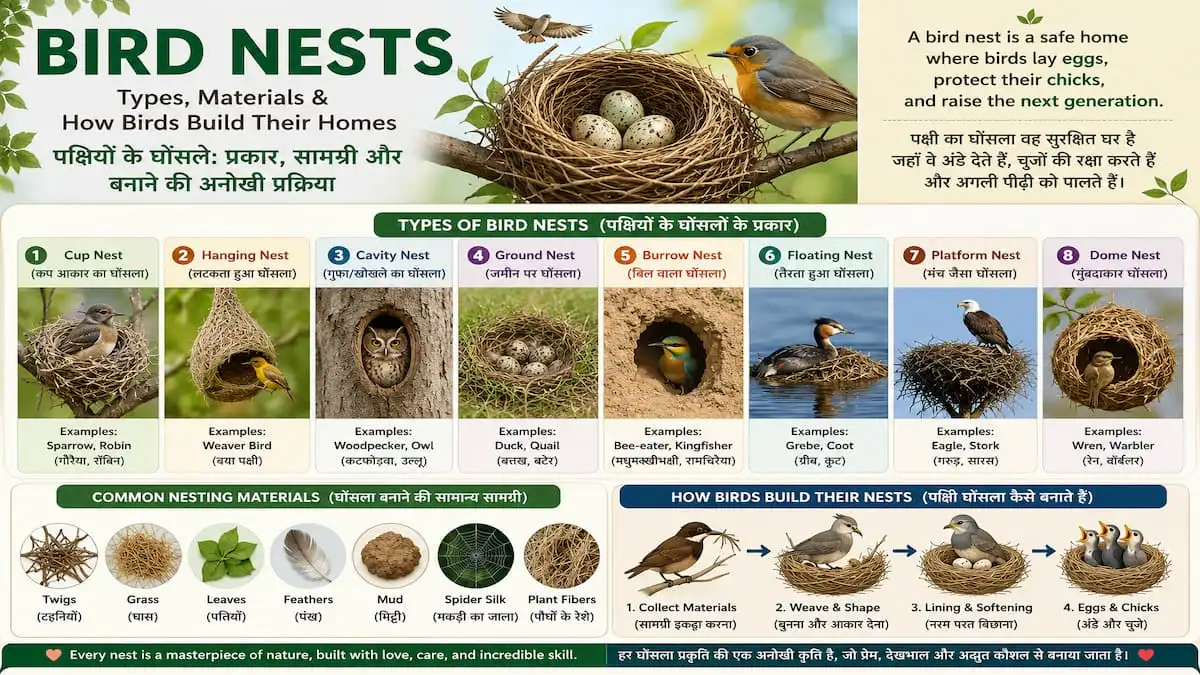
In this guide, we'll explore what bird nests are (पक्षियों के घोंसले क्या होते हैं), why birds build them, the different types of bird nests (घोंसलों के प्रकार), the materials birds use, and some of the most amazing nests found in nature.
By the end of this article, you'll not only understand how birds build their homes, but you'll also discover why every bird's nest (पक्षी का घोंसला) is a wonderful example of nature's creativity and intelligence. 🪺
🔠ABCD Chart (A to Z English Alphabet for Kids) – Easy Learning Guide with Pictures
👉 “📌 Learn different types of birds with pictures below” Also Read 🐦100 Pet Birds Name in English and Hindi | पालतू पक्षियों के नाम, Vegetables Name A to Z in English and Hindi
Table of Contents
- 🐦Bird Nests: Types, Materials & How Birds Build Their Homes (पक्षियों के घोंसले)
- 🌿 Warm Introduction
- 🪺 What is a Bird Nest? (पक्षी का घोंसला क्या है?)
- 📊 Bird Nest Overview (पक्षी के घोंसले का परिचय)
- 👨👩👧 A Real-Life Family Example
- 🏡 Why Do Birds Build Nests?
- 🌍 Did You Know?
- 👀 Next Time You're Outdoors... (अगली बार जब आप बाहर जाएँ...)
- 🏠 Types of Bird Nests (पक्षियों के घोंसलों के प्रकार)
- 🥣 1. Cup Nest (कटोरे के आकार का घोंसला)
- 🧺 2. Hanging Nest (लटकता हुआ घोंसला)
- 🌳 3. Cavity Nest (पेड़ के खोखले भाग में घोंसला)
- 🌍 4. Ground Nest (ज़मीन पर बना घोंसला)
- 🕳️ 5. Burrow Nest (बिल के अंदर घोंसला)
- 🌊 6. Floating Nest (पानी पर तैरता घोंसला)
- 🏕️ 7. Platform Nest (मंच जैसा घोंसला)
- 🏡 8. Dome Nest (गुंबदाकार घोंसला)
- 📊 Comparison of Different Bird Nests
- 🌿 What Materials Do Birds Use to Build Nests?
- 👀 Next Time You See a Nest...
- 🏗️ How Do Birds Build Their Nests? (पक्षी अपना घोंसला कैसे बनाते हैं?)
- 🌟 Nature's Master Architects
- 🧺 Weaver Bird
- 🪡 Tailorbird
- 🪵 Woodpecker
- 🦜 Hornbill
- 🦅 Eagle
- 🦩 Flamingo
- 🐧 Penguin
- 🐦 Swallow
- ⚖️ Bird Nests vs Human Houses
- 🤯 Amazing Bird Nest Facts
- 🔍 Observe Nature
- 📝 Quick Summary
- 🧠 Test Your Knowledge
- 🐦 What Did We Learn Today?
- ❓ Frequently Asked Questions (FAQs)
- 1. What is a Bird Nest? (पक्षी का घोंसला क्या है?)
- 2. Why Do Birds Build Nests? (पक्षी घोंसला क्यों बनाते हैं?)
- 3. What Materials Do Birds Use to Build Nests? (घोंसला बनाने के लिए पक्षी किन चीज़ों का उपयोग करते हैं?)
- 4. Which Bird Builds the Most Beautiful Nest? (सबसे सुंदर घोंसला कौन-सा पक्षी बनाता है?)
- 5. Which Bird Stitches Leaves Together to Make a Nest? (पत्तों को सिलकर घोंसला कौन-सा पक्षी बनाता है?)
- 6. Do All Birds Build Nests? (क्या सभी पक्षी घोंसला बनाते हैं?)
- 7. How Long Does It Take a Bird to Build a Nest? (पक्षी को घोंसला बनाने में कितना समय लगता है?)
- 8. Do Birds Reuse Their Nests? (क्या पक्षी अपने घोंसले दोबारा इस्तेमाल करते हैं?)
- 9. Can People Touch Bird Nests? (क्या हमें पक्षियों के घोंसलों को छूना चाहिए?)
- 10. Why Are Bird Nests Important? (पक्षियों के घोंसले क्यों महत्वपूर्ण हैं?)
- 📚 Continue Exploring the Bird World
- 📚 Continue Learning at Monto Fact Jungle
🪺 What is a Bird Nest? (पक्षी का घोंसला क्या है?)
A bird nest (पक्षी का घोंसला) is a structure built by a bird to lay eggs (अंडे देने), protect them, and raise its chicks (चूजों) safely.
In Hindi, a bird nest is called "पक्षी का घोंसला" or "पक्षियों का घोंसला."
Think of it as a bird's home during one of the most important stages of its life—becoming a parent (माता-पिता बनना).
Unlike human houses (मानव घर), bird nests are usually made from natural materials (प्राकृतिक सामग्री) that are easily available nearby. Birds don't visit a shop to buy building materials. Instead, they cleverly collect whatever nature (प्रकृति) provides.
Some common nesting materials (घोंसला बनाने की सामग्री) include:
🌿 Dry grass (सूखी घास)
🌳 Small twigs (छोटी टहनियाँ)
🍂 Leaves (पत्तियाँ)
🪶 Feathers (पंख)
🧵 Plant fibers (पौधों के रेशे)
🕸️ Spider silk (मकड़ी का जाला)
🪨 Mud (मिट्टी)
Every bird species (पक्षी की प्रजाति) builds its nest differently. A weaver bird (बया पक्षी) creates a beautifully woven hanging nest, a woodpecker (कठफोड़वा) makes a hole inside a tree trunk, while some penguins (पेंगुइन) simply arrange small stones on the ground to protect their eggs.
That's why bird nests (पक्षियों के घोंसले) are wonderful examples of adaptation (अनुकूलन), intelligence, and nature's amazing engineering.
Birds build different kinds of nests depending on their species. If you'd like to learn about hundreds of bird species, explore our Birds Name in Hindi and English guide.
📊 Bird Nest Overview (पक्षी के घोंसले का परिचय)
| Feature (विशेषता) | Details (विवरण) |
|---|---|
| 🪺 English Name | Bird Nest |
| 🇮🇳 Hindi Name | पक्षी का घोंसला (Singular) / पक्षियों के घोंसले (Plural) |
| 🐦 Built By (कौन बनाता है?) | Birds (पक्षी) |
| 🥚 Main Purpose (मुख्य उद्देश्य) | To lay eggs (अंडे देना) and raise chicks (चूजों का पालन-पोषण करना) |
| 🌿 Common Materials (सामान्य सामग्री) | Twigs (टहनियाँ), Dry Grass (सूखी घास), Leaves (पत्तियाँ), Mud (मिट्टी), Feathers (पंख), Spider Silk (मकड़ी का जाला) |
| 🌳 Common Locations (आम स्थान) | Trees (पेड़), Cliffs (चट्टानें), Ground (ज़मीन), Water (पानी), Buildings (इमारतें), Burrows (बिल) |
| ❤️ Importance (महत्त्व) | Protection (सुरक्षा), Warmth (गरमाहट), and Safety (सुरक्षित वातावरण) for eggs and chicks |
👨👩👧 A Real-Life Family Example
One evening, Vishnu noticed a sparrow flying to the same tree again and again with tiny pieces of grass in its beak.
He looked at me and asked,
"Papa, is the sparrow making a small house?" 🐦
I smiled and replied,
"Yes! Just like we build a home for our family, birds also build nests to protect their eggs and babies. The difference is that they use only what nature provides."
Sharada Amma added,
"देखो, इतनी छोटी चिड़िया भी कितनी मेहनत करती है। हर तिनका जोड़कर अपना घर बनाती है।"
That simple conversation reminded us that even the smallest birds show incredible patience, planning, and care for their families.
- Read our Morning Bird Calls and Pigeon Observation field note
🏡 Why Do Birds Build Nests?
If birds can fly freely from one place to another, why do they spend so much time building nests?
The answer is simple.
A nest gives birds a safe place to start and protect their family.
Let's understand the main reasons.
🥚 1. To Lay Eggs Safely
Bird eggs are delicate.
If they were laid directly on the ground or an open branch, they could easily roll away, break, or be eaten by predators.
A well-built nest keeps the eggs together and reduces the risk of damage.
🐣 2. To Raise Their Chicks
When baby birds hatch, they cannot fly or find food on their own.
The nest becomes their first home.
Here, the parents:
🍽️ Feed them
🌡️ Keep them warm
🛡️ Protect them
🪽 Care for them until they are ready to fly
Without a secure nest, the survival of many chicks would be much lower.
🌧️ 3. To Protect Against Weather
Nature is unpredictable.
Heavy rain, strong winds, and hot sunlight can be dangerous for eggs and young chicks.
Many nests are cleverly designed to provide:
☔ Shelter from rain
🌞 Shade from the sun
💨 Protection from strong winds
❄️ Warmth during cold weather
Some birds even line their nests with soft feathers to make them warmer and more comfortable.
🦊 4. To Stay Hidden from Predators
Birds face many natural enemies, including:
🐍 Snakes
🐒 Monkeys
🐈 Cats
🦅 Larger birds
🦊 Foxes
To protect their young, many birds build nests in places that are difficult to reach or easy to hide.
For example:
🌳 High tree branches
🪨 Rocky cliffs
🌾 Thick bushes
🕳️ Tree cavities
🌊 Floating vegetation
A hidden nest greatly increases the chances of survival.
❤️ 5. To Create a Safe Family Home
Perhaps the most touching reason is that a nest is where a bird begins its family.
Inside the nest, parent birds:
🥚 Incubate eggs
🐣 Welcome newly hatched chicks
🍽️ Feed them many times a day
🪽 Teach them to flap their wings
✈️ Prepare them for their first flight
For a few weeks, the nest becomes the center of a bird's world.
🌍 Did You Know?
💡 Not all birds build nests every year in the same place.
Some birds build a new nest every breeding season, while others return to repair and reuse an old nest if it is still safe.
👀 Next Time You're Outdoors... (अगली बार जब आप बाहर जाएँ...)
Agli baar jab aap park, garden, ya apni balcony mein birds ko dekhein, toh sirf unhe udte hue hi mat dekhiye.
Thoda dhyan se aas-paas ke trees aur bushes ko bhi observe kijiye. 🌳🪺
Ho sakta hai kisi branch ke beech ek chhota sa bird nest (घोंसला) chhupa hua ho. Kuch nests leaves ke peeche itni smartly hide hote hain ki pehli nazar mein dikhte hi nahi.
Lekin yaad rakhiye—bird nests ko kabhi touch ya disturb mat kijiye. Unhe hamesha safe distance se hi observe karein.
Jab aap dhyan se dekhna shuru karenge, tab aap samjhenge ki har nest ke peeche ek kahani hoti hai—hard work, patience aur apne family ke liye care ki kahani. ❤️
Nature hamari best classroom hai, aur har bird's nest (पक्षी का घोंसला) humein kuch na kuch naya zaroor sikhata hai.
🏠 Types of Bird Nests (पक्षियों के घोंसलों के प्रकार)
One of the most fascinating things I've learned about birds is that there is no single "standard" bird nest.
Just as humans live in apartments, villages, farmhouses, or high-rise buildings, birds also build different kinds of nests depending on:
🌳 Where they live
🥚 How many eggs they lay
🌦️ The local weather
🦊 The predators around them
🍽️ Their food habits
Let's explore some of the most common types of bird nests found around the world.
🥣 1. Cup Nest (कटोरे के आकार का घोंसला)
The cup nest is the most common type of bird nest.
As the name suggests, it looks like a small bowl or cup.
Birds build it by weaving together:
🌿 Dry grass
🪶 Soft feathers
🧵 Plant fibers
🍂 Small twigs
The inside is soft and comfortable, helping keep eggs warm and preventing them from rolling away.
Common Birds
🐦 Sparrow
🐦 Robin
🐦 Blackbird
🐦 Bulbul
Why it works:
The rounded shape provides excellent support for eggs and chicks while being easy to hide among branches.
🧺 2. Hanging Nest (लटकता हुआ घोंसला)
Some birds don't build nests on top of branches—they hang them from branches.
These nests look like woven baskets or small pouches.
The most famous builder is the weaver bird.
Its nest is made by carefully weaving long strips of grass together.
Common Birds
🟡 Weaver Bird
🐦 Orioles (some species)
🌴 Sunbirds (some species)
Why it works:
The hanging design makes it difficult for snakes and many predators to reach the eggs.
🌳 3. Cavity Nest (पेड़ के खोखले भाग में घोंसला)
Instead of building with twigs, some birds choose natural holes in trees.
Others create the holes themselves.
These nests are called cavity nests.
Common Birds
🪵 Woodpecker
🦉 Owl
🦜 Parrot
🐦 Some Kingfishers
Why it works:
Tree cavities protect birds from:
🌧️ Rain
💨 Strong winds
🦅 Many predators
🌍 4. Ground Nest (ज़मीन पर बना घोंसला)
Not every bird prefers trees.
Some species build nests directly on the ground.
They often use:
🌾 Dry grass
🍂 Leaves
🪨 Small stones
These nests are usually hidden among plants or rocks.
Common Birds
🐧 Penguin
🦆 Duck
🦃 Quail
🐦 Lapwing
Why it works:
Ground nests allow easy access to food, especially for birds living in open grasslands or cold regions.
🕳️ 5. Burrow Nest (बिल के अंदर घोंसला)
Some birds become excellent diggers.
Instead of building above the ground, they dig tunnels into:
Riverbanks
Sandy cliffs
Soft soil
At the end of the tunnel, they build a protected nesting chamber.
Common Birds
🐟 Kingfisher (certain species)
🐦 Bee-eater
🐦 Puffin
Why it works:
Burrows keep eggs safe from harsh weather and many predators.
🌊 6. Floating Nest (पानी पर तैरता घोंसला)
A few birds build nests that actually float on water.
These nests are made using:
🌿 Water plants
🍃 Reeds
🌱 Floating vegetation
The nests rise and fall with the water level.
Common Birds
🦆 Grebe
🦢 Coot
Why it works:
Floating nests help protect eggs from many land-based predators.
🏕️ 7. Platform Nest (मंच जैसा घोंसला)
Large birds often build huge, flat nests using thick sticks.
Some of these nests become so large that birds use and repair them for many years.
Common Birds
🦅 Eagle
🕊️ Stork
🦅 Osprey
Why it works:
The strong platform can safely support large birds and growing chicks.
🏡 8. Dome Nest (गुंबदाकार घोंसला)
Unlike an open cup nest, a dome nest has a roof with a small entrance.
This extra covering provides better protection.
Common Birds
🐦 Wren
🐦 Some Warblers
🐦 Tailorbird (certain nesting styles)
Why it works:
The roof helps hide eggs from predators and protects them from rain and direct sunlight.
📊 Comparison of Different Bird Nests
| 🪺 Nest Type (घोंसले का प्रकार) | Shape (आकार) | Common Birds (सामान्य पक्षी) | Best Feature (मुख्य विशेषता) |
|---|---|---|---|
| 🥣 Cup Nest (कटोरी जैसा घोंसला) | Bowl-shaped (कटोरी जैसा) | Sparrow (गौरैया), Robin (रॉबिन) | Keeps eggs (अंडों) secure and stable |
| 🧺 Hanging Nest (लटकता हुआ घोंसला) | Suspended (पेड़ से लटका हुआ) | Weaver Bird (बया पक्षी) | Difficult for predators (शिकारियों) to reach |
| 🌳 Cavity Nest (पेड़ के खोखले का घोंसला) | Inside a tree hollow (पेड़ के खोखले में) | Woodpecker (कठफोड़वा), Owl (उल्लू) | Excellent protection from weather and predators |
| 🌍 Ground Nest (ज़मीन पर बना घोंसला) | On land (ज़मीन पर) | Duck (बतख), Quail (बटेर) | Easy access to food and nearby habitat |
| 🕳️ Burrow Nest (बिलनुमा घोंसला) | Underground tunnel (भूमिगत सुरंग) | Bee-eater (मधुमक्खीभक्षी), Kingfisher (रामचिरैया) | Safe from heat, rain, and predators |
| 🌊 Floating Nest (तैरता हुआ घोंसला) | On water (पानी की सतह पर) | Grebe (ग्रीब), Coot (कूट) | Helps avoid many land predators |
| 🏕️ Platform Nest (मंच जैसा घोंसला) | Large and flat (बड़ा व समतल) | Eagle (गरुड़), Stork (सारस) | Strong enough to support large birds |
| 🏡 Dome Nest (गुंबदाकार घोंसला) | Covered (ढका हुआ) | Wren (रेन), Warbler (वार्बलर) | Provides extra shelter and warmth |
🌿 What Materials Do Birds Use to Build Nests?
Birds are surprisingly creative builders.
Instead of buying construction materials, they simply collect whatever nature offers nearby.
Some of the most common nesting materials include:
🌿 Dry grass
🌳 Small twigs
🍂 Leaves
🪶 Feathers
🕸️ Spider silk
🧵 Plant fibers
🪨 Mud
🌱 Moss
🐑 Animal wool (sometimes)
🧶 Cotton or soft fibers found in nature
Each material has a purpose.
For example:
Grass and twigs provide strength.
Mud helps hold the structure together.
Spider silk acts like natural glue.
Feathers and soft fibers keep eggs warm.
Nature provides everything a bird needs to become an expert builder.
👀 Next Time You See a Nest...
If you ever find an empty nest after the breeding season, don't just notice its shape.
Look closely at the tiny details.
You may discover woven grass, soft feathers, bits of moss, or even spider silk holding everything together.
It's amazing to think that such a small bird created all of this using only its beak and determination.
🏗️ How Do Birds Build Their Nests? (पक्षी अपना घोंसला कैसे बनाते हैं?)
Whenever I watch a bird carrying tiny twigs or dry grass, I always wonder,
"How can such a small bird build such a strong and beautiful home without any tools?" 🪺
The answer lies in instinct, patience, and practice.
Unlike humans, birds don't learn architecture in school. Most species are born with natural nest-building instincts. Over time, they also improve through experience, making each new nest stronger and better than the last.
Although every species builds its nest differently, the basic process is surprisingly similar.
Birds mainly use their beaks as natural building tools. Learn more about different Bird Beaks and how they help birds survive.
📍 Step 1: Choosing the Perfect Location
Before collecting even a single twig, a bird carefully selects a safe place.
It looks for a location that offers:
🌳 Protection from predators
🌧️ Shelter from rain and wind
🌞 Suitable sunlight or shade
🍽️ Easy access to food
🐣 A safe environment for raising chicks
Different birds choose different places.
For example:
Sparrows often nest near houses.
Eagles prefer tall trees or rocky cliffs.
Kingfishers dig tunnels along riverbanks.
Ducks usually build nests close to water.
Choosing the right location is one of the most important decisions a bird makes.
🌿 Step 2: Collecting Building Materials
Once the location is ready, the bird begins collecting materials.
Some birds travel hundreds of times before completing a single nest.
Common materials include:
🌿 Dry grass
🌳 Twigs
🍂 Leaves
🪶 Feathers
🕸️ Spider silk
🌱 Moss
🪨 Mud
🧵 Plant fibers
Every material has a purpose.
Twigs provide strength, grass adds flexibility, mud acts like natural cement, and feathers help keep the eggs warm.
🪺 Step 3: Building the Nest
Now comes the most impressive part.
Birds use their beaks as their primary building tool.
Some birds also use their feet to hold or position materials while building.
Depending on the species, they may:
🧺 Weave grass together
🪵 Drill holes into tree trunks
🪨 Arrange stones
🌿 Twist plant fibers
🪶 Line the nest with soft materials
Watching a weaver bird build its nest is like watching a skilled craftsperson at work.
🪶 Step 4: Making the Nest Comfortable
A strong nest is important, but comfort matters too.
Many birds line the inside of the nest with soft materials such as:
Feathers
Fine grass
Moss
Cotton-like plant fibers
This soft lining protects the eggs from damage and helps maintain the right temperature during incubation.
🥚 Step 5: Laying Eggs and Raising Chicks
Only after the nest is complete do most birds lay their eggs.
The nest then becomes the center of family life.
Parent birds:
🥚 Incubate the eggs
🍽️ Feed the chicks
🛡️ Protect them from danger
🪽 Teach them to fly
After the young birds become independent, many species leave the nest and begin the cycle again during the next breeding season.
🌟 Nature's Master Architects
Every bird builds a nest, but some species create homes so remarkable that they seem almost impossible.
Here are some of nature's finest builders.
🧺 Weaver Bird
The weaver bird is famous for creating beautifully woven hanging nests using long strips of grass.
Its nest hangs from tree branches, making it difficult for snakes and many predators to reach.
Many people consider it one of the greatest architects in the bird world.
🪡 Tailorbird
The tailorbird builds one of the most unique nests in nature.
Instead of weaving grass, it carefully stitches large leaves together using plant fibers or spider silk.
That's why it is called the Tailorbird.
🪵 Woodpecker
Unlike many birds, woodpeckers don't collect twigs.
They carve nesting holes inside tree trunks using their strong chisel-shaped beaks.
These cavity nests provide excellent protection from harsh weather and predators.
🦜 Hornbill
Hornbills have one of the most fascinating nesting habits.
After entering a tree cavity, the female seals herself inside using mud and fruit pulp, leaving only a narrow opening.
The male then feeds her and the chicks through this small gap until they are ready to leave.
🦅 Eagle
Eagles build enormous platform nests made from thick sticks.
Many eagle pairs return to the same nest every year, adding new material each season.
Over time, some nests become several meters wide and extremely heavy.
🦩 Flamingo
Flamingos build cone-shaped mud nests in shallow water.
The raised mound keeps the eggs above the water level and helps protect them from flooding.
🐧 Penguin
Some penguins build simple nests using small stones.
In icy regions where plants are scarce, stones become the perfect building material.
🐦 Swallow
Swallows create neat cup-shaped nests using mud mixed with grass.
They often build these nests under bridges, roofs, or building ledges, where they are protected from rain.
⚖️ Bird Nests vs Human Houses
Although bird nests and human houses serve the same basic purpose—providing shelter—they are very different in how they are built.
| Feature | 🪺 Bird Nest | 🏠 Human House |
|---|---|---|
| Builder | Birds | Humans |
| Building Tool | Beak and feet | Tools and machines |
| Materials | Grass, twigs, mud, feathers | Bricks, cement, steel, wood |
| Main Purpose | Protect eggs and chicks | Shelter for families |
| Construction Time | A few days to several weeks | Several months or years |
| Lifespan | Often temporary | Usually long-term |
Both homes reflect one important idea:
Every family needs a safe place to live. ❤️
🤯 Amazing Bird Nest Facts
🐦 Some birds build a brand-new nest every breeding season.
🧺 Weaver birds can weave hundreds of strands of grass into a single nest.
🦅 Some eagle nests are reused for many years and grow larger over time.
🪡 Tailorbirds "sew" leaves together using natural fibers.
🦩 Flamingos build mud towers to protect their eggs from water.
🐧 Penguins in rocky habitats often use stones instead of twigs.
🪵 Woodpeckers create new nesting holes almost every breeding season.
🕸️ Spider silk is one of nature's strongest natural building materials and helps hold some nests together.
🐣 Many chicks leave the nest within just a few weeks after hatching.
🌍 Every bird species builds a nest that matches its habitat, food, and way of life.
🔍 Observe Nature
The next time you visit a park, garden, or even your own balcony, try something different.
Instead of only looking at the birds, look for the places where they live.
Can you spot a nest hidden among leaves or under a roof?
Observe it from a safe distance without touching or disturbing it.
Notice:
🌿 What materials were used?
🌳 Where is the nest built?
🪺 What shape does it have?
🐦 Which bird might have built it?
Nature is one of the best classrooms, and every bird's nest has something to teach us.
If you observe carefully while travelling across parks, villages, or forests, you'll notice that different Birds in India build different types of nests depending on where they live.
📝 Quick Summary
🪺 A bird nest is a home where birds lay eggs and raise their chicks.
🌿 Birds use natural materials like grass, twigs, mud, feathers, and moss to build nests.
🏠 Different birds build different types of nests based on their habitat and lifestyle.
🧺 Weaver birds, tailorbirds, hornbills, and woodpeckers are among nature's most skilled nest builders.
🐣 Nests protect eggs and young birds from weather and predators.
🌍 Every nest is an excellent example of adaptation in nature.
🧠 Test Your Knowledge
1. What is the main purpose of a bird's nest?
A) Sleeping only
B) Protecting eggs and raising chicks ✅
C) Storing food
D) Playing
2. Which bird is famous for weaving hanging nests?
A) Eagle
B) Weaver Bird ✅
C) Duck
D) Penguin
3. Which bird stitches leaves together to build its nest?
A) Tailorbird ✅
B) Crow
C) Peacock
D) Owl
4. What material acts like natural glue in some bird nests?
A) Plastic
B) Spider silk ✅
C) Metal
D) Sand
5. Which bird builds platform nests using large sticks?
A) Eagle ✅
B) Sparrow
C) Pigeon
D) Kingfisher
🐦 What Did We Learn Today?
A bird's nest is much more than a bundle of twigs and leaves.
It is a carefully planned home where birds protect their eggs, care for their chicks, and prepare the next generation for life.
From the beautifully woven nest of the weaver bird to the simple stone nest of a penguin, every nest tells a story of patience, intelligence, and adaptation.
So, the next time you see a bird carrying a tiny twig, remember—
It isn't just building a nest. It's building a safe future for its family. 🪺❤️
❓ Frequently Asked Questions (FAQs)
1. What is a Bird Nest? (पक्षी का घोंसला क्या है?)
A bird nest (पक्षी का घोंसला) is a structure built by birds to lay eggs (अंडे देने), incubate them, and safely raise their chicks (चूजों). It protects them from predators and harsh weather.
2. Why Do Birds Build Nests? (पक्षी घोंसला क्यों बनाते हैं?)
Birds build nests (घोंसले) to keep their eggs (अंडों) and young chicks (चूजों) safe, warm, and protected. A nest also provides a secure place where parent birds can care for their babies until they are ready to fly.
3. What Materials Do Birds Use to Build Nests? (घोंसला बनाने के लिए पक्षी किन चीज़ों का उपयोग करते हैं?)
Birds use natural materials such as twigs (टहनियाँ), dry grass (सूखी घास), leaves (पत्तियाँ), feathers (पंख), mud (मिट्टी), moss (काई), spider silk (मकड़ी का जाला), plant fibers (पौधों के रेशे), and sometimes small stones (छोटे पत्थर) or animal hair (जानवरों के बाल).
4. Which Bird Builds the Most Beautiful Nest? (सबसे सुंदर घोंसला कौन-सा पक्षी बनाता है?)
The weaver bird (बया पक्षी) is widely known for building one of the most beautiful and complex woven nests using long strips of grass. Its hanging nests are considered masterpieces of natural engineering.
5. Which Bird Stitches Leaves Together to Make a Nest? (पत्तों को सिलकर घोंसला कौन-सा पक्षी बनाता है?)
The tailorbird (दर्जी पक्षी) stitches leaves together using plant fibers (पौधों के रेशे) or spider silk (मकड़ी का जाला) to create a safe and comfortable nest for its eggs.
6. Do All Birds Build Nests? (क्या सभी पक्षी घोंसला बनाते हैं?)
No. While most birds build nests (घोंसले), some species lay their eggs (अंडे) directly on the ground, rocky cliffs, sandy beaches, or other natural surfaces with little or no nest structure.
7. How Long Does It Take a Bird to Build a Nest? (पक्षी को घोंसला बनाने में कितना समय लगता है?)
It depends on the species. Some birds complete a nest in just a few days, while others may take several weeks to build a strong and secure home.
8. Do Birds Reuse Their Nests? (क्या पक्षी अपने घोंसले दोबारा इस्तेमाल करते हैं?)
Some birds build a new nest every breeding season (प्रजनन मौसम), while others, such as eagles (गरुड़) and storks (सारस), often repair and reuse the same nest for many years.
9. Can People Touch Bird Nests? (क्या हमें पक्षियों के घोंसलों को छूना चाहिए?)
No. It is best not to touch or disturb bird nests (घोंसलों को नहीं छूना चाहिए). Human interference can stress birds and may cause them to abandon their eggs (अंडे) or chicks (चूजे). Always observe nests from a safe distance.
10. Why Are Bird Nests Important? (पक्षियों के घोंसले क्यों महत्वपूर्ण हैं?)
Bird nests (पक्षियों के घोंसले) play an essential role in bird survival. They protect eggs (अंडों), provide shelter for chicks (चूजों), and help increase the chances of raising healthy young birds. Every nest is an important part of a bird's life cycle.
📚 Continue Exploring the Bird World
If you enjoyed learning about bird nests, you might also like these articles:
→ Bird Habitats
→ Bird Migration
📚 Continue Learning at Monto Fact Jungle
Explore our most popular educational resources designed for students, parents, teachers, and lifelong learners.
- 🥦 Vegetables Name in English and Hindi
- 🍎 Fruits Name in English and Hindi
- 🌶 Spices Name in English and Hindi
- 🌸 Flowers Name in English and Hindi
- 🦁 Animals Kya Khate Hain List
- ⌨️ Keyboard Symbols Name in Hindi
- 📖 Meaning in Hindi with Examples
- 🦁 50 fruits name in hindi and english
- 🦁 100 fruits name in hindi and english
- 🦁 Dry fruits name in hindi and english
- Thank You So Much Meaning in Hindi Examples
- 🧠 100+ Body Parts Name in Hindi and English
Learning about birds becomes even more interesting when you connect these topics together. Each article helps you understand another part of the amazing world of birds.
You should also read:
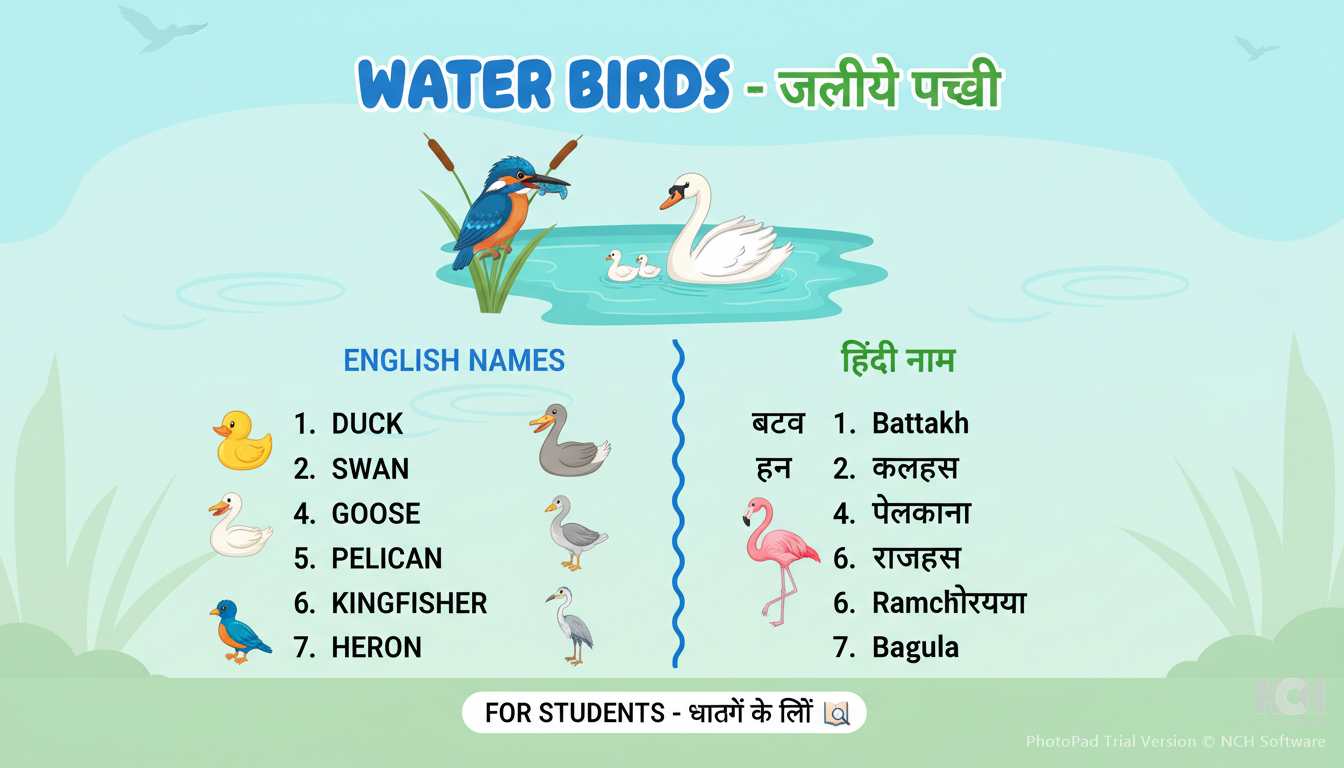
Water Birds Name in English and Hindi (पानी में रहने वाले पक्षियों के नाम)
🦆Water Birds Name in English and Hindi (पानी में रहने वाले पक्षियों के नाम) A goose (Anser cygnoides) is a water bird commonly found near lakes, rivers, wetlands, and coastal areas. A high-quality image of a Goose (Anser cygnoides), a water bird adapted to lakes,…
Continue reading...100 Birds Name in Hindi and English-पक्षियों के नाम हिंदी और अंग्रेज़ी में – आसान, मज़ेदार और पूरी सूची
100 पक्षियों के नाम हिंदी और अंग्रेज़ी में 🌿 Real-Life Example (Gaon Ki Kahani) Maan lo aap summer vacation me gaon gaye ho. Subah 5 baje murga "kukdukoo" karta hai. Thodi der baad ped par baithi koil ki "koo-koo" awaaz aati hai. Ghar ke aas-paas…
Continue reading...20 Birds Name in Hindi and English (20 पक्षियों के नाम) | For Students & Easy Pronunciation
20 Birds Name in Hindi and English Here is a fresh set of 20 birds: क्या आपने कभी notice किया है कि हम रोज़ कई birds देखते हैं, लेकिन उनके English ya Hindi names हमें हमेशा याद नहीं रहते? इसीलिए students अक्सर search करते हैं…
Continue reading...10 Birds Name in Hindi and English (With Easy Meaning & GK Use)
🐦10 Birds Name in Hindi and English Quick Answer: 10 Birds Name in Hindi and English are Hoopoe, Woodpecker, Goose, Dove, Kingfisher, Indian Roller, Bulbul, Lapwing, Penguin, and Kiwi. Kya aapko school homework ya GK preparation ke liye birds ke naam chahiye? Bahut baar students…
Continue reading...