
🦆50 Water Birds Name in English and Hindi | जल-चर पक्षियों के नाम
🌊 What Are Water Birds? (जल पक्षी क्या होते हैं?)
Quick Answer: What Are Water Birds?
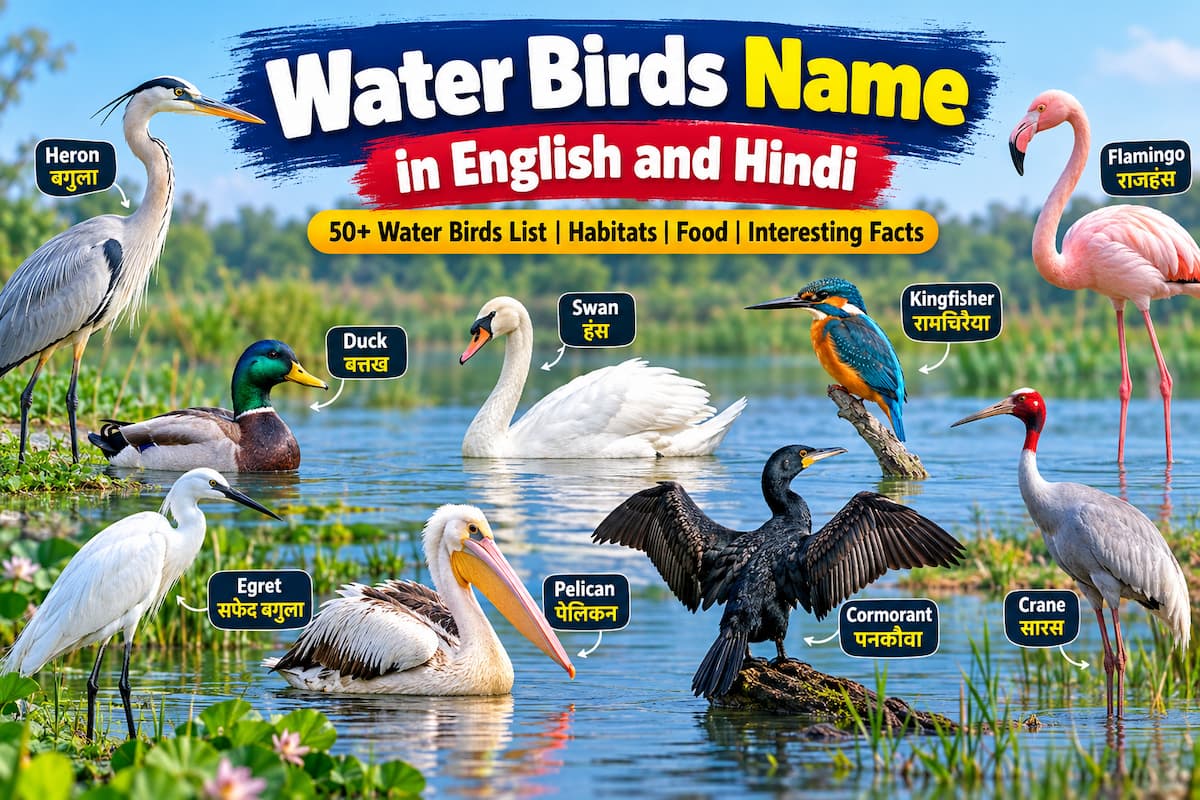
Water birds are birds that live in or around water bodies such as ponds, lakes, rivers, wetlands and seas. They are adapted to swim, dive, catch fish or find food in aquatic habitats. Common examples include ducks (बत्तख), swans (हंस), herons (बगुला), kingfishers (रामचिरैया), flamingos (राजहंस) and pelicans (पेलिकन). Some water birds live in one region throughout the year, while others migrate seasonally.
"Main Mohan hoon, aur jab bhi kisi lake ya park ke paas walk karta hoon, mujhe water birds ko dekhna bahut pasand hai. Kuch birds aaram se paani par tairte rehte hain, kuch achanak paani mein dive karke fish pakad lete hain, aur kuch ghanto tak ek jagah khade hokar apne shikaar ka wait karte hain. Tab mujhe samajh aaya ki har water bird ka apna alag lifestyle aur hunting style hota hai." 🦆🌊
Read 50 Common Water Birds in America
Table of Contents
- 🌊 What Are Water Birds? (जल पक्षी क्या होते हैं?)
- Common Water Birds Found in India
- 🌿 Types of Water Birds
- 🐟 What Do Water Birds Eat and Where Do They Live?
- 🔎 How to Identify Water Birds
- Water Birds in America: Common Species and Their Habitats
- 🌿 Interesting Facts About Water Birds(Hinglish)
- ✨ Interesting Facts About Water Birds In English
- 🌍 Why Are Water Birds Important?
- ❓ Frequently Asked Questions About Water Birds
- ⭐ Conclusion
Aap 200 pakshiyon ke naam angerzi mein aur english mein aap idhar pad sakhte hain.
Water birds वे पक्षी होते हैं जो पानी में या पानी के आसपास रहते हैं।
Water Birds ya Jal Pakshi woh birds hote hain jo apni life ka zyada hissa paani mein, paani ke upar ya paani ke aas-paas bitate hain. Inki body aur feet aise adapted hote hain ki ye aasani se swim kar sakein, fish pakad sakein ya wetlands mein survive kar sakein.
Agar aap ye bhi jaana chahte hain ki Penguin kya khata hai, to hamara detailed guide bhi zarur padhiye. 🐧
Iske saath connected Penguin Kya Khata Hai bhi kaafi useful hai. Whether you're searching for a water birds list, common water birds, water birds in India, or an easy water birds name list for school or general knowledge, this guide brings everything together in simple language. You'll also learn about popular aquatic birds in India, their habitats, and interesting facts that make bird identification easier.
50 Common Water Birds Name in English and Hindi (जल पक्षियों के नाम)
| 🔢 No. | 🐦 English Name | 🇮🇳 Hindi Name |
|---|---|---|
| 1 | 🦆 Duck | बत्तख |
| 2 | 🦢 Swan | हंस |
| 3 | 🪿 Goose | कलहंस |
| 4 | 🦩 Flamingo | राजहंस |
| 5 | 🐦 Kingfisher | रामचिरैया |
| 6 | 🪶 Heron | बगुला |
| 7 | 🤍 Egret | सफेद बगुला |
| 8 | 🐦 Pelican | पेलिकन |
| 9 | 🐦 Cormorant | पनकौवा |
| 10 | 🐦 Crane | सारस |
| 11 | 🐦 Stork | स्टॉर्क |
| 12 | 🐦 Ibis | आइबिस |
| 13 | 🐦 Grebe | ग्रीब |
| 14 | 🐦 Moorhen | जलमुर्गी |
| 15 | 🌊 Seagull | समुद्री चिड़िया |
| 16 | 🐦 Gull | गल |
| 17 | 🐦 Tern | टर्न |
| 18 | 🐧 Penguin | पेंगुइन |
| 19 | 🐦 Puffin | पफिन |
| 20 | 🐦 Albatross | अल्बाट्रॉस |
| 21 | 🦅 Osprey | मछलीमार चील |
| 22 | 🐦 Bittern | बिटर्न |
| 23 | 🥄 Spoonbill | चमचा चोंच पक्षी |
| 24 | 🐦 Avocet | एवोसेट |
| 25 | 🐦 Lapwing | टिटहरी |
| 26 | 🐦 Jacana | जैकाना |
| 27 | 🐦 Sandpiper | सैंडपाइपर |
| 28 | 🐦 Curlew | कर्ल्यू |
| 29 | 🐦 Snipe | स्नाइप |
| 30 | 🐦 Plover | प्लोवर |
| 31 | 🐦 Rail | रेल पक्षी |
| 32 | 🐦 Coot | कूट |
| 33 | 🐦 Darter | साँप पक्षी |
| 34 | 🐦 Gannet | गैनेट |
| 35 | 🐦 Frigatebird | फ्रिगेट पक्षी |
| 36 | 🐦 Skimmer | स्किमर |
| 37 | 🦆 Shelduck | शेलडक |
| 38 | 🦆 Teal | टील |
| 39 | 🦆 Wigeon | विजन |
| 40 | 🦆 Pintail Duck | पिंटेल बत्तख |
| 41 | 🦆 Shoveler Duck | शोवेलर बत्तख |
| 42 | 🦆 Gadwall | गैडवाल |
| 43 | 🦆 Mandarin Duck | मैंडरिन बत्तख |
| 44 | 🦆 Ruddy Shelduck | ब्राह्मणी बत्तख |
| 45 | 🦆 Whistling Duck | सीटी बजाने वाली बत्तख |
| 46 | 🐦 Black-necked Stork | काली गर्दन वाला स्टॉर्क |
| 47 | 🎨 Painted Stork | पेंटेड स्टॉर्क |
| 48 | 💜 Purple Heron | बैंगनी बगुला |
| 49 | 🤍 Little Egret | छोटा सफेद बगुला |
| 50 | 🐦 Great Cormorant | बड़ा पनकौवा |
Note: Some water birds, such as Duck, Goose, Kingfisher, Heron, Flamingo, Pelican, Cormorant, Crane, Stork, and Moorhen, are commonly found in India, while others are more common in different parts of the world. This list is prepared for educational purposes to help students, teachers, and bird lovers learn about different water bird species. Agar aap ko aur daily-use words samajhne hain, to humari complete list of English words meaning in Hindi zaroor dekhiye.
Common Water Birds Found in India
India has a wide range of wetlands, including village ponds, rivers, reservoirs, marshes, mangroves and coastal mudflats. Depending on the region and season, you may see resident birds as well as migratory visitors.
- Indian Spot-billed Duck: A duck often seen on freshwater lakes, ponds and marshes.
- Little Egret: A slender white bird that searches for small fish and insects in shallow water.
- Indian Pond Heron: A brownish bird that often stands still near ponds and flooded fields; it looks much whiter when it takes flight.
- Little Cormorant: A dark waterbird that dives underwater to catch fish and may perch with its wings spread to dry.
- Common Moorhen: A wetland bird often found among reeds and aquatic plants.
- Asian Openbill: A stork frequently associated with wetlands and feeding on aquatic snails.
- Painted Stork: A large wading bird that feeds in shallow water.
- Ruddy Shelduck: Often called Brahminy duck in India; it can be seen around rivers and lakes, including as a seasonal visitor in many areas.
- Black-winged Stilt: A long-legged wader commonly seen walking through shallow water and muddy margins.
- Pheasant-tailed Jacana: A wetland bird that walks over floating vegetation using its long toes.
Bird sightings depend on location, water levels and season. For example, many northern wetlands receive winter visitors, while other waterbirds can be present throughout the year.
🌿 Types of Water Birds
Water birds can be grouped by how they use aquatic habitats. These groups overlap, but they make bird identification easier.
1. Swimming birds
Ducks, geese and swans often swim on open water. Many have webbed feet that help them paddle.
2. Diving birds
Cormorants and grebes dive beneath the surface to catch fish or other aquatic prey. Penguins are also excellent divers, although they cannot fly.
3. Wading birds
Herons, egrets, storks, ibises and spoonbills often walk through shallow water with long legs while searching for food.
4. Shorebirds
Sandpipers, plovers, curlews and avocets feed along mudflats, sandy shores and the edges of wetlands, often probing mud for small animals.
5. Birds that hunt near water
Kingfishers and ospreys may perch or hover near water before diving or swooping to catch prey. They are strongly associated with aquatic food sources even though they do not spend all their time in water.
🐟 What Do Water Birds Eat and Where Do They Live?
The diet of a water bird depends on its species, beak shape, body size and habitat. There is no single food that all water birds eat.
- Fish eaters: Kingfishers, cormorants, ospreys and many pelicans catch fish.
- Plant eaters and mixed feeders: Many ducks eat aquatic plants, seeds and grains, along with insects or other small animals.
- Waders: Herons, egrets and storks may eat fish, frogs, insects and other small animals.
- Mudflat feeders: Sandpipers, plovers and curlews often feed on worms, insects, molluscs and small crustaceans.
- Filter feeders: Flamingos use specialised bills to filter tiny food items from water and mud.
Water birds live in different habitats, including freshwater ponds, lakes, rivers, marshes, reed beds, estuaries, mangroves and open coastlines. Some species use more than one habitat during the year.
🔎 How to Identify Water Birds
You do not need to know every species name to begin birdwatching. Start by observing a few visible features from a respectful distance.
- Look at the beak: A long pointed beak may help a heron catch fish, while a broad duck bill helps gather food from water.
- Check the legs: Long legs are common in wading birds; webbed feet help many swimming birds move through water.
- Notice the feeding style: Does the bird dive, swim, stand still, probe mud or walk through shallow water?
- Observe the habitat: A bird on open water may be a duck or grebe, while a bird on a muddy edge may be a sandpiper or plover.
- Consider the season: Some species migrate, so a bird may be common in one season and absent in another.
Water Birds in America: Common Species and Their Habitats
Water birds in America include a wide variety of ducks, geese, swans, herons, egrets, pelicans, loons and other birds that live in or around freshwater and coastal habitats. Some species stay in one region throughout the year, while others migrate seasonally.
Examples of Water Birds Found in America
- Mallard: A familiar duck found in ponds, lakes, wetlands and other water bodies.
- Canada Goose: A large goose commonly seen near lakes, rivers, parks and wetlands.
- Great Blue Heron: A tall wading bird that hunts fish and other prey in shallow water.
- American White Pelican: A large water bird with a long bill and expandable throat pouch.
- Common Loon: A diving bird associated with lakes, especially in northern North America.
- American Bittern: A secretive marsh bird that often blends into tall wetland vegetation.
- Wood Duck: A colorful duck associated with wooded wetlands and freshwater habitats.
- Double-crested Cormorant: A dark diving bird that catches fish underwater.
Where Do Water Birds Live in America?
American water birds live in freshwater lakes, rivers, marshes, coastal wetlands, estuaries and other aquatic habitats. The species people see vary by region and season. Migratory birds may travel long distances between breeding areas and wintering grounds.
To identify a water bird, observe its size, bill shape, leg length, feather patterns, feeding behavior and habitat. These features can help distinguish ducks from wading birds and diving birds.
Use more than one clue before deciding on a bird's identity. If you take photographs, avoid disturbing nests, chasing birds or entering sensitive wetland areas
🌿 Interesting Facts About Water Birds(Hinglish)
💙 Duck apne webbed feet ki madad se bahut achhi tarah tair sakti hai.
🐧 Penguin ud nahi sakta, lekin paani ke andar ek excellent swimmer hota hai.
🐟 Kingfisher kuch hi seconds mein paani mein dive karke fish pakad leta hai.
🦩 Flamingo ka pink color uske food mein maujood natural pigments ki wajah se hota hai.
🪶 Pelican ke gale ke neeche ek bada pouch hota hai jisse wo fish pakadne mein madad leta hai.
✨ Interesting Facts About Water Birds In English
- Ducks: Many ducks have webbed feet that help them paddle efficiently.
- Penguins: Penguins cannot fly, but their wings work like flippers when they swim.
- Kingfishers: Many kingfishers dive quickly to catch fish or other small prey.
- Flamingos: Their pink colour comes largely from pigments in the food they eat.
- Pelicans: Their expandable throat pouch helps them catch fish and drain water.
- Cormorants: They are skilled underwater hunters and are often seen resting after a dive.
- Jacanas: Their long toes help distribute their weight as they walk over floating vegetation.
- Migratory waterbirds: Some travel long distances between breeding grounds and wintering areas.
🌍 Why Are Water Birds Important?
Water birds sirf dekhne mein hi beautiful nahi hote, balki nature ke liye bhi bahut important hote hain.
✅ Wetlands ko healthy rakhne mein madad karte hain.
✅ Fish aur insects ki population ko balance karte hain.
✅ Ecosystem ki health ka indicator maane jaate hain.
✅ Bird watchers aur photographers ke favourite subjects hote hain. 📸
Water birds are an important part of wetland ecosystems. Their presence and behaviour can also help people learn about local biodiversity.
- Food-web balance: They feed on fish, insects, snails and other organisms, while some also become food for predators.
- Nutrient movement: Birds move nutrients between feeding, resting and nesting areas.
- Wetland health: Changes in bird numbers or species can provide useful clues for researchers monitoring habitats, although birds alone do not tell the whole story.
- Education and recreation: Birdwatching encourages people to learn about wildlife and protect natural spaces.
Wetlands face pressures such as pollution, habitat loss, disturbance and changes in water levels. Keeping lakes, rivers and marshes healthy benefits birds and many other living things.
❓ Frequently Asked Questions About Water Birds
1. What are water birds?
Water birds are birds that use water bodies or wet habitats for feeding, nesting, resting or shelter. Examples include ducks, herons, egrets, cormorants and kingfishers.
2. What are two examples of water birds?
Duck (बत्तख) and heron (बगुला) are two examples of water birds.
3. What are some common water birds in India?
Commonly seen waterbirds in many parts of India include ducks, egrets, pond herons, cormorants, moorhens, kingfishers and various waders. The species present depend on the region and season.
4. Can all water birds fly?
No. Most water birds can fly, but penguins cannot. Penguins are adapted for swimming and diving.
5. What do water birds eat?
Depending on the species, water birds may eat fish, insects, aquatic plants, seeds, frogs, worms, snails, crustaceans or other small animals.
6. Where do water birds live?
They live in habitats such as ponds, lakes, rivers, marshes, wetlands, mangroves, estuaries and coastal areas.
7. Why do some water birds have long legs?
Long legs help many wading birds walk through shallow water while keeping much of their bodies above the water as they search for food.
8. Are all water birds migratory?
No. Some water birds live in the same region throughout the year, while others migrate seasonally. A species' movements depend on its range, food availability and breeding cycle.
⭐ Conclusion
Water birds come in many shapes and sizes, from swimming ducks and diving cormorants to long-legged herons and shore-feeding sandpipers. This list of 50 water birds names in English and Hindi is a starting point for students, teachers and bird lovers who want to learn bird names, habitats and feeding habits.
When you visit a pond, lake or wetland, look carefully at the birds you see and give them plenty of space. Protecting their habitats helps water birds and other wildlife thrive.
Explore more bird guides from Monto Fact Jungle:
You should also read:
Pet Birds Name List in Hindi and English – घर में पाले जाने वाले पक्षियों के नाम
Pet Birds Kya Hote Hain?- Introduction Kabhi aapne kisi dost ke ghar me pinjre me baitha hua ek pyara sa तोता dekha hai? Ya kisi ne bola ho — “Mere ghar me ek Lovebird hai” — aur aap sochne lage ho, ye Lovebird hota kya…
Continue reading...
Water Birds Name in English and Hindi (पानी में रहने वाले पक्षियों के नाम)
🦆Water Birds Name in English and Hindi (पानी में रहने वाले पक्षियों के नाम) A goose (Anser cygnoides) is a water bird commonly found near lakes, rivers, wetlands, and coastal areas. A high-quality image of a Goose (Anser cygnoides), a water bird adapted to lakes,…
Continue reading...100 Birds Name in Hindi and English-पक्षियों के नाम हिंदी और अंग्रेज़ी में – आसान, मज़ेदार और पूरी सूची
100 पक्षियों के नाम हिंदी और अंग्रेज़ी में 🌿 Real-Life Example (Gaon Ki Kahani) Maan lo aap summer vacation me gaon gaye ho. Subah 5 baje murga "kukdukoo" karta hai. Thodi der baad ped par baithi koil ki "koo-koo" awaaz aati hai. Ghar ke aas-paas…
Continue reading...20 Birds Name in Hindi and English (20 पक्षियों के नाम) | For Students & Easy Pronunciation
20 Birds Name in Hindi and English Here is a fresh set of 20 birds: क्या आपने कभी notice किया है कि हम रोज़ कई birds देखते हैं, लेकिन उनके English ya Hindi names हमें हमेशा याद नहीं रहते? इसीलिए students अक्सर search करते हैं…
Continue reading...