
🐦Do Bird Feeders Attract Mice? (And How to Stop It)
Do Bird Feeders Attract Mice? (And How to Stop It)
Quick Answer
Yes — bird feeders can attract mice, mainly because of spilled seed on the ground beneath them. Birdseed provides an easy food source, especially when seeds are regularly scattered around the feeder. The feeder itself isn't necessarily the problem — the food waste underneath it usually is.
Why Mice Show Up Near Bird Feeders
1. Spilled Seed on the Ground
Birds can be messy eaters. As they feed, they scatter seeds, drop pieces of food, and knock seed onto the ground.
If this happens every day, the buildup can become an easy and reliable food source for mice.
2. Birdseed Provides an Attractive Food Source
Many common bird foods contain seeds and grains that mice can eat.
Sunflower seeds, corn, and other high-calorie foods can make a bird-feeding area worth investigating, particularly when food is easily accessible.
3. Easy Access
Some feeder setups make it easier for mice to reach the food.
Low-hanging feeders, open trays, and feeders placed close to walls, fences, woodpiles, or dense shrubs can give rodents easier access and cover.
The easier the food is to reach, the more attractive the feeding area can become.
How to Feed Birds Without Attracting Mice
You don't necessarily have to stop feeding birds. Instead, focus on reducing the amount of food that reaches the ground.
| Fix | Why It Helps |
|---|---|
| Switch to no-mess, shelled seed | Less waste and fewer discarded hulls reach the ground |
| Add a seed catcher tray | Catches some spilled seed before it reaches the ground |
| Clean up spilled seed regularly | Removes an easy food source for mice |
| Move feeders away from the house | Creates more distance between feeding activity and your home |
| Avoid placing feeders near fences, woodpiles, or dense shrubs | Reduces nearby cover and easy access |
| Store extra birdseed in a sealed container | Prevents mice from getting into your seed supply |
Some guidance also recommends placing feeders around 25–30 feet away from the house to reduce the chance of rodents moving directly from the feeding area toward the home.
Does This Mean I Should Stop Feeding Birds?
Not necessarily.
If you enjoy watching birds, you can usually start by changing how you manage the feeder rather than removing it completely.
Regularly clean spilled seed, choose less-messy food, and make the feeding area harder for mice to access.
If you're already seeing signs of mice inside your home, such as droppings, gnaw marks, or nesting material, treat that as a separate problem. The feeder may be contributing to the available food supply, but it isn't necessarily the only reason mice are present.
Quick Summary
Bird feeders can attract mice, but spilled birdseed is often the biggest issue.
Using no-mess seed, adding a seed catcher, cleaning the area regularly, and choosing a sensible feeder location can greatly reduce the amount of food available to mice.
You don't necessarily have to stop feeding birds — you just need to make the feeding area less attractive to rodents.
Frequently Asked Questions
Do bird feeders attract mice in the garden?
Yes. Bird feeders can attract mice when spilled seed and other bird food are easily available on the ground. Regular cleanup and a seed-catching tray can help reduce the attraction.
Do bird feeders attract rats too?
Yes. The same spilled-seed conditions that provide food for mice can also attract rats.
What bird food is least likely to attract rodents?
Shelled, no-mess seed such as sunflower hearts can reduce the amount of waste left beneath a feeder compared with some mixed seed products containing shells and hulls.
Will mice go away if I stop feeding birds?
Removing an accessible food source can reduce the attraction, but mice that are already established nearby may continue looking for food elsewhere.
Do bird feeders attract other animals besides mice?
Yes. Depending on where you live, bird feeders can also attract squirrels, rats, and other wildlife. The types of visitors vary by location and feeder setup.
Related Articles
You should also read:
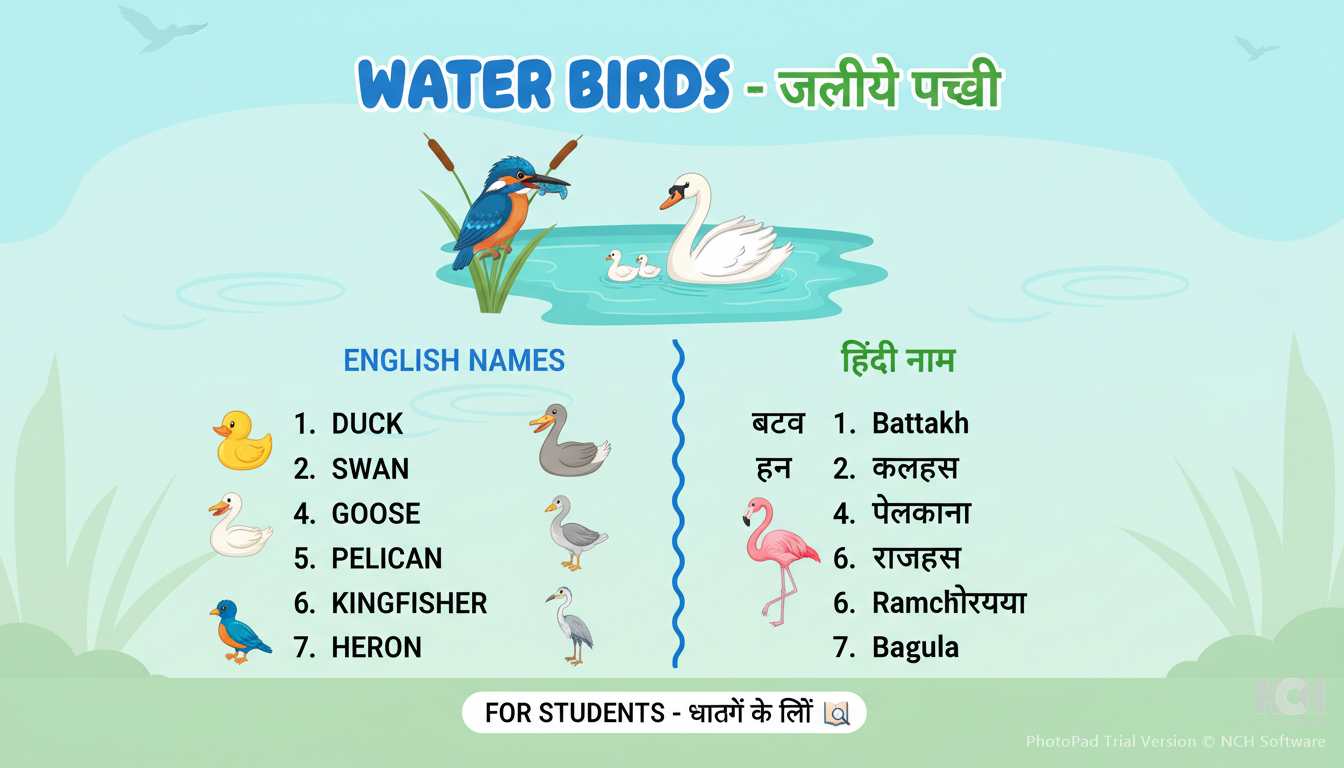
Water Birds Name in English and Hindi (पानी में रहने वाले पक्षियों के नाम)
🦆Water Birds Name in English and Hindi (पानी में रहने वाले पक्षियों के नाम) A goose (Anser cygnoides) is a water bird commonly found near lakes, rivers, wetlands, and coastal areas. A high-quality image of a Goose (Anser cygnoides), a water bird adapted to lakes,…
Continue reading...100 Birds Name in Hindi and English-पक्षियों के नाम हिंदी और अंग्रेज़ी में – आसान, मज़ेदार और पूरी सूची
100 पक्षियों के नाम हिंदी और अंग्रेज़ी में 🌿 Real-Life Example (Gaon Ki Kahani) Maan lo aap summer vacation me gaon gaye ho. Subah 5 baje murga "kukdukoo" karta hai. Thodi der baad ped par baithi koil ki "koo-koo" awaaz aati hai. Ghar ke aas-paas…
Continue reading...20 Birds Name in Hindi and English (20 पक्षियों के नाम) | For Students & Easy Pronunciation
20 Birds Name in Hindi and English Here is a fresh set of 20 birds: क्या आपने कभी notice किया है कि हम रोज़ कई birds देखते हैं, लेकिन उनके English ya Hindi names हमें हमेशा याद नहीं रहते? इसीलिए students अक्सर search करते हैं…
Continue reading...10 Birds Name in Hindi and English (With Easy Meaning & GK Use)
🐦10 Birds Name in Hindi and English Quick Answer: 10 Birds Name in Hindi and English are Hoopoe, Woodpecker, Goose, Dove, Kingfisher, Indian Roller, Bulbul, Lapwing, Penguin, and Kiwi. Kya aapko school homework ya GK preparation ke liye birds ke naam chahiye? Bahut baar students…
Continue reading...