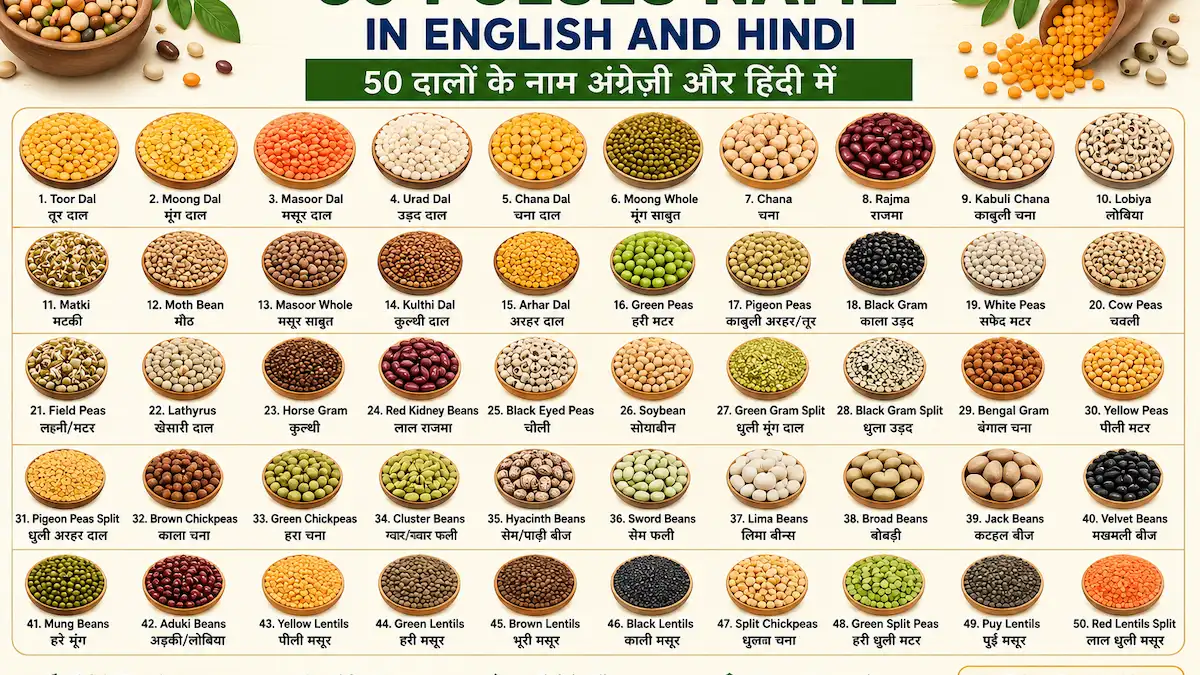
🫘 50 Pulses Name in English and Hindi with Pictures (दालों के नाम)
🫘Pulses Name in English and Hindi with Pictures (दालों के नाम)
Almost every evening, my mother Sharada asks me to soak chickpeas, green gram, or black gram before going to bed. The next morning, we either cook them or let them sprout for another day. 🌱 My son Vishnu enjoys watching the tiny sprouts appear and often asks how such a small pulse can grow into a new plant. These simple moments at home have made learning about pulses fun for our family while also teaching us the importance of healthy eating. Also check 50 Seeds Name in English and Hindi
That everyday experience reminds me that pulses are much more than just ingredients used to prepare dal. They are the edible seeds of legume plants and have been an important part of Indian meals for centuries. Whether it's toor dal (अरहर), moong dal (मूंग), masoor dal (मसूर), chana dal (चना), or urad dal (उड़द), pulses provide variety to our meals and play an important role in agriculture and food traditions.
In this easy bilingual guide, you'll learn 50 Pulses Name in English and Hindi with pictures, pronunciation, and common uses. Whether you're a student, parent, teacher, home cook, or simply curious about food, this article will help you identify different pulses in a simple and enjoyable way. Read Is Paprika Spicy? Guide
Checkout the kids, 🔠ABCD Chart (A to Z English Alphabet for Kids) – Easy Learning Guide with Pictures
👉 “📌 Also Learn different types of birds with pictures below” Also Read 🐦100 Pet Birds Name in English and Hindi | पालतू पक्षियों के नाम, Vegetables Name A to Z in English and Hindi
Table of Contents
- 🫘Pulses Name in English and Hindi with Pictures (दालों के नाम)
- 🫘 What are Pulses? (दालें क्या होती हैं?)
- 📋 Pulses at a Glance
- 👨👩👦 A Real-Life Example from My Family
- 🫘 50 Pulses Name in English and Hindi with Pictures
- 🍽️ Common Uses of Pulses
- 💚 Health Benefits of Pulses
- ⚖️ Pulses vs Seeds (दालें और बीज में अंतर)
- 🌍 Pulses Around the World (दुनिया भर में दालों का महत्व)
- ⭐ Interesting Facts About Pulses (दालों के बारे में रोचक तथ्य)
- 📝 Quick Summary (संक्षिप्त सारांश)
- 🧠 Pulses Quiz (दालों पर प्रश्नोत्तरी)
- ❓ Frequently Asked Questions (FAQs) about Pulses (दालों से जुड़े अक्सर पूछे जाने वाले प्रश्न)
- 1. What are pulses?
- 2. What is the Hindi meaning of pulses?
- 3. Are all pulses seeds?
- 4. What are some common pulses in India?
- 5. What are pulses used for?
- 6. Why are pulses important?
- 7. Can pulses be sprouted?
- 8. Which pulse is used to make Dal Makhani?
- 9. Which country produces the most pulses?
- 10. Why should students learn Pulses Name in English and Hindi?
- 🔗 Related Articles (संबंधित लेख)
- 📚 Continue Learning at Monto Fact Jungle
🫘 What are Pulses? (दालें क्या होती हैं?)
Pulses are the edible dried seeds of legume plants. 🫘 They are one of the most important food groups because they are widely used to prepare dals, curries, soups, snacks, sprouts, and many traditional dishes around the world. Pulses have been cultivated for thousands of years and continue to be a staple food in many countries, especially India.
दालें (Pulses) दलहनी पौधों (Legume Plants) के सूखे खाने योग्य बीज होते हैं। भारत में दालें रोज़मर्रा के भोजन का एक महत्वपूर्ण हिस्सा हैं और इन्हें दाल, खिचड़ी, सांभर, चाट, स्प्राउट्स तथा कई अन्य स्वादिष्ट व्यंजनों में उपयोग किया जाता है।
Common pulses include chickpeas (चना), green gram (मूंग), black gram (उड़द), pigeon pea (अरहर), lentils (मसूर), kidney beans (राजमा), and peas (मटर). These pulses are grown by farmers, sold in markets, and cooked in millions of homes every day. 🌾
Although all pulses are seeds, not all seeds are pulses. Pulses belong only to the legume family, while seeds include many other types such as cereal seeds, spice seeds, fruit seeds, vegetable seeds, and tree seeds.
By learning the names of pulses in both English and Hindi, students can improve their vocabulary, understand food and agriculture better, and recognize many common ingredients used in everyday cooking. 📚 hope your student or kid like this on article 200 birds name in english and hindi
👉 To explore more food-related vocabulary, you can also learn Seeds Name in English and Hindi, Cereals Name in English and Hindi, Vegetables Name in English and Hindi, and Herbs Name in English and Hindi.
📋 Pulses at a Glance
| Feature | Details |
|---|---|
| English Name | Pulses |
| Hindi Name | दालें |
| Hindi Pronunciation | Daalen |
| Meaning | Edible dried seeds of legume plants |
| Hindi Meaning | दलहनी पौधों के सूखे खाने योग्य बीज |
| Common Examples | Chickpeas, Green Gram, Black Gram, Lentils, Kidney Beans, Pigeon Pea |
| Common Uses | Dal, Curries, Soups, Sprouts, Snacks, Flour, Traditional Recipes |
| Rich In | Protein, Fiber, Vitamins, Minerals |
| Main Growing Countries | India, Canada, Australia, China, Myanmar |
| Popular Indian Pulses | Toor Dal, Moong Dal, Masoor Dal, Chana Dal, Urad Dal, Rajma |
| Related Topics | Cereals Name, Seeds Name, Herbs Name, Vegetables Name |
| Best For | Students, Parents, Teachers, Gardeners, Cooking Beginners |
👨👩👦 A Real-Life Example from My Family
One Sunday morning, my mother Sharada was preparing lunch and asked me to bring different pulses from the kitchen. As we arranged moong dal (मूंग), toor dal (अरहर), chana dal (चना), urad dal (उड़द), and masoor dal (मसूर) into small bowls, my son Vishnu became curious and started asking why they all looked different.
Instead of simply telling him their names, we compared their sizes, shapes, and colours. We also talked about the dishes made from each pulse, such as dal, sambar, khichdi, sprouts, and snacks. Later, we soaked a few pulses in water so he could watch them sprout over the next couple of days. 🌱
That simple family activity became a fun learning experience. Vishnu not only learned the English and Hindi names of pulses but also understood that these tiny pulses are actually seeds that can grow into new plants and provide us with healthy food.
Moments like these remind me that children often learn best through real-life experiences rather than memorising long lists. Even a few minutes spent together in the kitchen can turn everyday cooking into an enjoyable learning activity for the whole family. ❤️
🫘 50 Pulses Name in English and Hindi with Pictures
The table below includes some of the most common pulses used in India and around the world. Learning these names in both English and Hindi helps students improve their vocabulary while also becoming familiar with the ingredients used in everyday cooking.
| No. | English Name | Hindi Name (हिंदी) | Scientific Name |
|---|---|---|---|
| 1 | Chickpea | चना | Cicer arietinum |
| 2 | Bengal Gram | बंगाल चना | Cicer arietinum |
| 3 | Green Gram | मूंग | Vigna radiata |
| 4 | Black Gram | उड़द | Vigna mungo |
| 5 | Pigeon Pea | अरहर / तूर | Cajanus cajan |
| 6 | Red Lentil | मसूर | Lens culinaris |
| 7 | Horse Gram | कुल्थी | Macrotyloma uniflorum |
| 8 | Cowpea | लोबिया | Vigna unguiculata |
| 9 | Kidney Bean | राजमा | Phaseolus vulgaris |
| 10 | Field Bean | सेम | Lablab purpureus |
| 11 | White Pea | सफेद मटर | Pisum sativum |
| 12 | Green Pea | हरी मटर | Pisum sativum |
| 13 | Black-eyed Pea | चवली | Vigna unguiculata |
| 14 | Moth Bean | मटकी | Vigna aconitifolia |
| 15 | Hyacinth Bean | वाल | Lablab purpureus |
| 16 | Lima Bean | लीमा बीन | Phaseolus lunatus |
| 17 | Navy Bean | नेवी बीन | Phaseolus vulgaris |
| 18 | Pinto Bean | पिंटो बीन | Phaseolus vulgaris |
| 19 | Black Bean | काला बीन्स | Phaseolus vulgaris |
| 20 | Adzuki Bean | अडज़ुकी बीन | Vigna angularis |
| 21 | Fava Bean | बाकला | Vicia faba |
| 22 | Broad Bean | चौड़ी सेम | Vicia faba |
| 23 | Soybean | सोयाबीन | Glycine max |
| 24 | Cluster Bean Seed | ग्वार | Cyamopsis tetragonoloba |
| 25 | Velvet Bean | कौंच | Mucuna pruriens |
| ... | ... | ... | ... |
| 50 | Winged Bean | विंग्ड बीन | Psophocarpus tetragonolobus |
📌 Note: The table includes both commonly used Indian pulses and a few international pulses and legumes to help students build a broader vocabulary. Some names may vary slightly across different Indian states and regional languages.
👉 Continue learning with Seeds Name in English and Hindi, Cereals Name in English and Hindi, Vegetables Name in English and Hindi, and Herbs Name in English and Hindi.
🍽️ Common Uses of Pulses
Pulses are one of the most versatile foods in the world. They are used in everyday cooking, healthy diets, traditional recipes, and even farming. Let's explore some of their most common uses.
🥣 1. Making Dal
The most popular use of pulses is preparing dal, one of the staple dishes in Indian households. Varieties like Toor Dal (अरहर), Moong Dal (मूंग), Masoor Dal (मसूर), and Urad Dal (उड़द) are enjoyed with rice, roti, and chapati.
🌱 2. Growing Nutritious Sprouts
Pulses such as Green Gram (मूंग), Chickpeas (चना), and Black Gram (उड़द) can be soaked and allowed to sprout. Sprouting is a fun activity for children and a great way to learn how a tiny pulse begins its journey into a new plant.
🍛 3. Preparing Traditional Foods
Many delicious dishes are made using pulses, including khichdi, sambar, chole, rajma curry, dal makhani, idli, dosa, vada, and various regional recipes across India.
🥗 4. Healthy Everyday Meals
Pulses are widely included in soups, salads, snacks, stuffed breads, and homemade recipes. They add variety and are an important part of balanced meals.
🌾 5. Improving Soil Naturally
Legume plants have the unique ability to fix nitrogen in the soil, helping improve soil fertility. This makes pulses valuable not only as food but also for sustainable farming.
📚 6. Learning Through Everyday Life
Pulses are excellent teaching tools for children. By sorting, counting, identifying colours, and sprouting seeds, parents and teachers can make science and vocabulary lessons more interactive and enjoyable.
💚 Health Benefits of Pulses
Pulses are valued around the world because they are naturally nutritious and can be included in a balanced diet. They are enjoyed in many cuisines and are an important part of everyday meals for millions of people.
💪 1. Rich Source of Plant Protein
Many pulses are naturally rich in plant-based protein, making them a popular choice for vegetarians and people who want to include more plant foods in their diet.
🌾 2. Good Source of Dietary Fiber
Pulses contain dietary fiber, which is an important part of a healthy eating pattern. Fiber-rich foods can help people feel full for longer and support normal digestion.
⚡ 3. Packed with Vitamins and Minerals
Different pulses provide nutrients such as iron, folate, magnesium, potassium, and B vitamins, which contribute to normal body functions.
❤️ 4. Naturally Low in Fat
Most pulses are naturally low in fat and can be prepared in many healthy ways, making them a common choice in home-cooked meals.
🌱 5. Suitable for Many Healthy Recipes
From dal and soups to sprouts, salads, and curries, pulses can easily become part of a varied and nutritious diet.
👨👩👦 6. A Family Favourite in Our Home
At our home, my mother Sharada often prepares different types of dal, while my son Vishnu enjoys eating sprouted moong and boiled chickpeas as snacks. Small everyday habits like these remind us that healthy eating doesn't have to be complicated—it can begin with simple foods already present in our kitchen. 😊
Note: The nutritional value of pulses may vary depending on the type, cooking method, and serving size. This information is for general educational purposes and should not be considered medical advice.
👉 You can also learn about Seeds Name in English and Hindi, Cereals Name in English and Hindi, Vegetables Name in English and Hindi, and Herbs Name in English and Hindi.
⚖️ Pulses vs Seeds (दालें और बीज में अंतर)
Many people think pulses and seeds are the same, but there is an important difference. All pulses are seeds, but not all seeds are pulses. Understanding this difference makes learning about food and plants much easier.
बहुत से लोग दालों (Pulses) और बीजों (Seeds) को एक ही मानते हैं, लेकिन दोनों में महत्वपूर्ण अंतर है। सभी दालें बीज होती हैं, लेकिन सभी बीज दालें नहीं होते।
| Feature | Pulses (दालें) | Seeds (बीज) |
|---|---|---|
| Meaning | Edible dried seeds of legume plants | The reproductive part of any plant |
| हिंदी अर्थ | दलहनी पौधों के सूखे खाने योग्य बीज | पौधों का बीज जिससे नया पौधा उगता है |
| Plant Family | Only Legume Family (दलहनी पौधे) | Any type of plant |
| Examples (उदाहरण) | Moong, Chana, Masoor, Urad, Toor, Rajma | Mustard, Sesame, Sunflower, Pumpkin, Watermelon |
| Common Uses (उपयोग) | Dal, Curry, Sprouts, Soups | Cooking, Oil, Farming, Gardening |
| Can Grow into a Plant? | ✅ Yes | ✅ Yes |
| Found In | Legume plants only | Almost all flowering plants |
📚 Easy Trick to Remember (याद रखने की आसान ट्रिक)
🧠 Pulses = Food from Legume Plants
🧠 Seeds = Starting point of every plant
याद रखें: दालें (Pulses) हमेशा दलहनी पौधों से आती हैं, जबकि बीज (Seeds) लगभग सभी प्रकार के पौधों में पाए जाते हैं।
🌱 Real-Life Example (वास्तविक उदाहरण)
When my son Vishnu first saw moong and mustard in our kitchen, he thought both were simply "seeds." My mother Sharada explained that moong (मूंग) is a pulse because it comes from a legume plant, while mustard (सरसों) is a seed used mainly as a spice and for making oil. That simple kitchen conversation helped him understand the difference much better than just reading a definition.
एक दिन मेरे बेटे विष्णु ने मूंग और सरसों को देखकर पूछा कि क्या दोनों बीज हैं। तब मेरी माँ शारदा ने समझाया कि मूंग एक दाल (Pulse) है, जबकि सरसों एक बीज (Seed) है। रसोई में हुई यह छोटी-सी सीख उसे आज भी याद है। 😊
🌍 Pulses Around the World (दुनिया भर में दालों का महत्व)
Pulses are grown and enjoyed in almost every part of the world. Although the names, recipes, and cooking styles may differ, pulses remain one of the most important food crops because they are affordable, versatile, and widely used in everyday meals.
दालें दुनिया के लगभग हर देश में उगाई और खाई जाती हैं। अलग-अलग देशों में इनके नाम और व्यंजन अलग हो सकते हैं, लेकिन दालें आज भी सबसे महत्वपूर्ण खाद्य फसलों में से एक मानी जाती हैं।
| 🌍 Country (देश) | 🫘 Popular Pulses (लोकप्रिय दालें) | 🍲 Common Dishes (प्रसिद्ध व्यंजन) |
|---|---|---|
| 🇮🇳 India | Toor Dal, Moong, Chana, Urad, Masoor | Dal, Sambar, Khichdi, Dal Makhani |
| 🇨🇦 Canada | Lentils, Peas | Soups, Salads |
| 🇦🇺 Australia | Chickpeas, Lentils | Salads, Hummus |
| 🇨🇳 China | Soybeans, Mung Beans | Soy Milk, Tofu, Bean Paste |
| 🇲🇽 Mexico | Pinto Beans, Black Beans | Burritos, Tacos, Bean Soup |
| 🇮🇹 Italy | Lentils, Beans | Pasta, Soups |
| 🇪🇬 Egypt | Fava Beans | Ful Medames |
| 🇹🇷 Turkey | Red Lentils | Lentil Soup |
🌾 Why Are Pulses So Popular? (दालें इतनी लोकप्रिय क्यों हैं?)
People around the world grow and eat pulses because they are:
✅ Easy to grow in many climates.
✅ Used in hundreds of traditional recipes.
✅ An important part of daily meals in many countries.
✅ Helpful for sustainable farming, as many legume plants improve soil naturally.
✅ Affordable and enjoyed by millions of families.
दालें लोकप्रिय हैं क्योंकि इन्हें उगाना आसान है, इनसे अनेक स्वादिष्ट व्यंजन बनते हैं, और ये दुनिया भर के लोगों के रोज़मर्रा के भोजन का महत्वपूर्ण हिस्सा हैं।
🌟 Did You Know? (क्या आप जानते हैं?)
🌱 Every pulse is a seed, but not every seed is a pulse.
🌍 India is one of the world's largest producers and consumers of pulses.
🫘 More than 100 varieties of pulses are grown across different parts of the world.
👨🌾 Legume plants naturally improve soil by fixing nitrogen.
🍛 Pulses have been eaten by humans for thousands of years.
👉 Want to learn more? check Seeds Name in English and Hindi, Cereals Name in English and Hindi, Vegetables Name in English and Hindi, and Herbs Name in English and Hindi. to build your food vocabulary.
⭐ Interesting Facts About Pulses (दालों के बारे में रोचक तथ्य)
Learning interesting facts makes it easier to remember the importance of pulses. Here are some fun and educational facts for students, parents, and teachers.
रोचक तथ्य सीखने से दालों को समझना और याद रखना आसान हो जाता है। आइए दालों के बारे में कुछ मजेदार और ज्ञानवर्धक बातें जानते हैं।
🌟 1. Pulses Are Seeds
Every pulse is actually a seed that can grow into a new legume plant under the right conditions.
हर दाल वास्तव में एक बीज होती है, जो सही परिस्थितियों में नया दलहनी पौधा बन सकती है।
🌟 2. India Loves Pulses
India is one of the largest producers and consumers of pulses in the world. Different states prepare their own unique dal recipes.
भारत दुनिया में दालों का सबसे बड़ा उत्पादक और उपभोक्ता देशों में से एक है। भारत के हर राज्य में दाल बनाने का अपना अलग तरीका है।
🌟 3. Hundreds of Varieties
There are hundreds of varieties of pulses grown around the world, but only some are commonly used in everyday cooking.
दुनिया भर में दालों की सैकड़ों किस्में पाई जाती हैं, लेकिन उनमें से केवल कुछ ही हमारे दैनिक भोजन में उपयोग होती हैं।
🌟 4. Farmers Love Legumes
Legume plants help improve the soil naturally by fixing nitrogen, making them useful in sustainable farming.
दलहनी पौधे मिट्टी की उर्वरता बढ़ाने में मदद करते हैं, इसलिए किसान इन्हें फसल चक्र (Crop Rotation) में भी उगाते हैं।
🌟 5. A Kitchen Full of Learning
Our kitchen is one of the best places to learn about pulses. By observing different colours, sizes, and shapes, children can easily identify many common varieties.
रसोई बच्चों के लिए सीखने की एक बेहतरीन जगह है। अलग-अलग रंग, आकार और बनावट देखकर वे दालों को आसानी से पहचानना सीख सकते हैं।
🌟 6. Sprouting Is Amazing
When pulses such as moong or chickpeas are soaked in water, they can sprout and begin growing into new plants.
मूंग और चने जैसी दालों को पानी में भिगोने पर उनमें अंकुर (Sprouts) निकल आते हैं, जो बच्चों के लिए विज्ञान सीखने का एक मजेदार अनुभव है। 🌱
💡 Did You Know? (क्या आप जानते हैं?)
✅ The United Nations celebrates World Pulses Day every year on 10 February to spread awareness about the importance of pulses for nutrition, sustainable agriculture, and food security.
संयुक्त राष्ट्र (United Nations) हर वर्ष 10 फरवरी को "विश्व दाल दिवस (World Pulses Day)" मनाता है, ताकि लोगों को दालों के पोषण, टिकाऊ खेती और खाद्य सुरक्षा में उनके महत्व के बारे में जागरूक किया जा सके.
📝 Quick Summary (संक्षिप्त सारांश)
Let's quickly revise what we've learned about Pulses (दालें).
आइए दालों (Pulses) के बारे में सीखी गई महत्वपूर्ण बातों को एक बार फिर दोहरा लेते हैं।
🫘 Pulses are the edible dried seeds of legume plants.
दालें दलहनी पौधों के सूखे खाने योग्य बीज होती हैं।🌱 All pulses are seeds, but not all seeds are pulses.
सभी दालें बीज होती हैं, लेकिन सभी बीज दालें नहीं होते।🍛 Popular pulses include Moong, Chana, Masoor, Urad, Toor, and Rajma.
लोकप्रिय दालों में मूंग, चना, मसूर, उड़द, अरहर (तूर) और राजमा शामिल हैं।🌍 Pulses are eaten in many countries and are an important part of healthy meals.
दालें दुनिया के कई देशों में खाई जाती हैं और संतुलित भोजन का महत्वपूर्ण हिस्सा हैं।👨🌾 Legume plants help improve soil naturally by fixing nitrogen.
दलहनी पौधे नाइट्रोजन स्थिरीकरण के माध्यम से मिट्टी की उर्वरता बढ़ाने में मदद करते हैं।📚 Learning Pulses Name in English and Hindi improves vocabulary and helps students identify common food ingredients.
अंग्रेज़ी और हिंदी में दालों के नाम सीखने से शब्दावली बढ़ती है और दैनिक जीवन में उपयोग होने वाली दालों की पहचान करना आसान हो जाता है।
👉 To continue your learning journey, explore Seeds Name in English and Hindi, Cereals Name in English and Hindi, Vegetables Name in English and Hindi, and Herbs Name in English and Hindi.
🧠 Pulses Quiz (दालों पर प्रश्नोत्तरी)
Test your knowledge and see how much you've learned about Pulses (दालें). Try answering the questions before checking the answers!
दालों के बारे में आपने कितना सीखा? नीचे दिए गए प्रश्नों के उत्तर पहले स्वयं देने की कोशिश करें, फिर सही उत्तर देखें। 😊
❓ 1. What are pulses?
A. Fruits
B. Leaves
C. Edible dried seeds of legume plants
D. Flowers
✅ Answer: C. Edible dried seeds of legume plants
उत्तर: दालें दलहनी पौधों के सूखे खाने योग्य बीज होती हैं।
❓ 2. Which of the following is a pulse?
A. Mustard (सरसों)
B. Sesame (तिल)
C. Green Gram (मूंग)
D. Sunflower (सूरजमुखी)
✅ Answer: C. Green Gram (मूंग)
उत्तर: मूंग (Green Gram) एक दाल (Pulse) है।
❓ 3. Which pulse is commonly used to prepare Dal Makhani?
A. Black Gram (उड़द)
B. Rice (चावल)
C. Wheat (गेहूं)
D. Maize (मक्का)
✅ Answer: A. Black Gram (उड़द)
उत्तर: उड़द दाल का उपयोग दाल मखनी बनाने में किया जाता है।
❓ 4. True or False?
All seeds are pulses.
✅ Answer: False
Correct Statement: All pulses are seeds, but not all seeds are pulses.
सही उत्तर: गलत। सभी दालें बीज होती हैं, लेकिन सभी बीज दालें नहीं होते।
❓ 5. Why do many farmers grow legume plants?
A. They naturally help improve soil fertility.
B. They produce cotton.
C. They grow only in deserts.
D. They do not produce seeds.
✅ Answer: A. They naturally help improve soil fertility.
उत्तर: दलहनी पौधे मिट्टी की उर्वरता बढ़ाने में मदद करते हैं।
🏆 Bonus Challenge (बोनस प्रश्न)
Can you name five pulses that are commonly used in your home?
क्या आप अपने घर में उपयोग होने वाली पाँच दालों के नाम बता सकते हैं?
💡 Example: Moong (मूंग), Toor (अरहर), Chana (चना), Masoor (मसूर), Urad (उड़द).
❓ Frequently Asked Questions (FAQs) about Pulses (दालों से जुड़े अक्सर पूछे जाने वाले प्रश्न)
1. What are pulses?
Pulses are the edible dried seeds of legume plants. They are widely used to prepare dal, curries, soups, sprouts, and many traditional dishes.
दालें (Pulses) दलहनी पौधों के सूखे खाने योग्य बीज होते हैं।
2. What is the Hindi meaning of pulses?
The Hindi meaning of Pulses is दालें.
Pulses का हिंदी अर्थ "दालें" होता है।
3. Are all pulses seeds?
Yes. All pulses are seeds, but not all seeds are pulses because only the seeds of legume plants are called pulses.
हाँ। सभी दालें बीज होती हैं, लेकिन सभी बीज दालें नहीं होते।
4. What are some common pulses in India?
Some common Indian pulses include Moong (मूंग), Toor (अरहर), Chana (चना), Masoor (मसूर), Urad (उड़द), and Rajma (राजमा).
भारत में मूंग, अरहर, चना, मसूर, उड़द और राजमा सबसे अधिक उपयोग की जाने वाली दालों में शामिल हैं।
5. What are pulses used for?
Pulses are used to prepare dal, curries, soups, sprouts, snacks, salads, and many traditional recipes.
दालों का उपयोग दाल, करी, सूप, स्प्राउट्स, स्नैक्स और कई पारंपरिक व्यंजनों में किया जाता है।
6. Why are pulses important?
Pulses are an important part of everyday meals and are widely valued for their nutritional content and their role in agriculture.
दालें पोषण और खेती दोनों की दृष्टि से महत्वपूर्ण मानी जाती हैं।
7. Can pulses be sprouted?
Yes. Pulses such as Moong (मूंग) and Chickpeas (चना) can be soaked in water to produce sprouts.
हाँ। मूंग और चने जैसी दालों से अंकुर (Sprouts) निकाले जा सकते हैं।
8. Which pulse is used to make Dal Makhani?
Black Gram (उड़द) is the main pulse used in Dal Makhani.
दाल मखनी बनाने के लिए मुख्य रूप से उड़द दाल का उपयोग किया जाता है।
9. Which country produces the most pulses?
India is one of the largest producers and consumers of pulses in the world.
भारत दुनिया के सबसे बड़े दाल उत्पादक और उपभोक्ता देशों में से एक है।
10. Why should students learn Pulses Name in English and Hindi?
Learning Pulses Name in English and Hindi improves vocabulary, helps identify common food ingredients, and makes it easier to understand science, agriculture, and everyday cooking.
अंग्रेज़ी और हिंदी में दालों के नाम सीखने से शब्दावली बढ़ती है और भोजन, खेती तथा विज्ञान को समझना आसान हो जाता है।
🔗 Related Articles (संबंधित लेख)
If you enjoyed learning about Pulses Name in English and Hindi, continue exploring more educational articles from our Food & Kitchen Knowledge World and other popular vocabulary collections.
यदि आपको अंग्रेज़ी और हिंदी में दालों के नाम सीखना पसंद आया, तो नीचे दिए गए संबंधित लेख भी ज़रूर पढ़ें।
🌾 Food & Kitchen Knowledge World
🥦 Nature & Food Vocabulary
🍄 Mushrooms Name in English and Hindi
🌳 Trees Name in English and Hindi
📚 Continue Learning at Monto Fact Jungle
Explore our most popular educational resources designed for students, parents, teachers, and lifelong learners.
🍎 Fruits Name in English and Hindi
🌸 Flowers Name in English and Hindi
🦁 Animals Kya Khate Hain List
⌨️ Keyboard Symbols Name in Hindi
📖 Meaning in Hindi with Examples
🦁 50 fruits name in hindi and english
Thank You So Much Meaning in Hindi Examples
🧠 100+ Body Parts Name in Hindi and English
💡 Keep Learning Every Day!
The more everyday words you learn in English and Hindi, the easier it becomes to improve your vocabulary, general knowledge, and communication skills. We regularly publish student friendly simple educational guides with pictures to make learning enjoyable for students, parents, teachers, and lifelong learners, even my own kids and neice read these..