
🦆50 Common Water Birds in America: Names, Pictures & Identification
🦆50 Common Water Birds in America: Names, Pictures & Identification
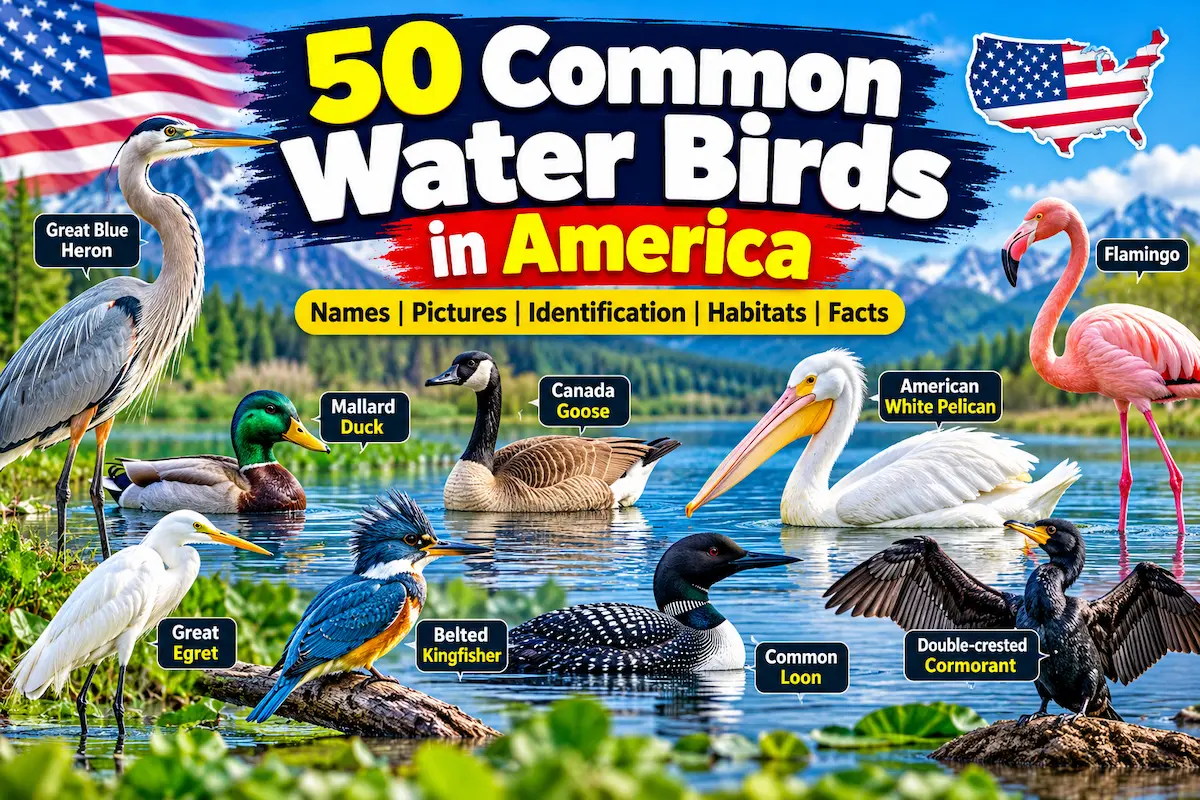
Discover 50 common water birds found across America, including ducks, geese, herons, egrets, pelicans, kingfishers, loons and cormorants. Learn their names, identifying features and habitats in this illustrated guide to North American water birds.
Water birds in America include some of the most fascinating birds found in lakes, rivers, marshes, wetlands, and coastal areas. From the familiar Mallard and Canada Goose to the striking Great Blue Heron and the remarkable Common Loon, these birds have developed unique adaptations for swimming, diving, wading, and catching food.</p>
Whether you enjoy birdwatching, photograph wildlife, are learning to identify birds in your backyard, or simply want to discover more about North American wildlife, this guide will introduce you to 50 water birds found across the United States and other parts of North America. 🐦🌊
You will learn their names, identifying features, habitats, diets, and interesting facts, along with tips for recognizing water birds in different regions and seasons. Read 🐦200+ Birds Name Guide
⚡ Quick Answer: What Are Common Water Birds in America?
Common water birds in America include the Mallard, Canada Goose, Wood Duck, American Coot, Great Blue Heron, Great Egret, Double-crested Cormorant, Common Loon, Pied-billed Grebe, American White Pelican, and Belted Kingfisher. These birds inhabit freshwater lakes, rivers, ponds, marshes, estuaries, and coastal waters. Their diets vary by species and may include fish, aquatic plants, insects, seeds, crustaceans, and other small animals.
🌊 What Are Water Birds?
Water birds are birds that depend on aquatic habitats for some or many of their essential activities, including feeding, nesting, resting, and raising their young.
Some water birds swim on the surface, while others dive beneath the water to catch fish. Wading birds use their long legs to walk through shallow water, searching for fish, frogs, insects, and other prey. Coastal water birds may feed along beaches, mudflats, estuaries, and ocean shorelines.
North America supports many types of water birds because the continent contains a wide range of aquatic habitats, from northern lakes and prairie wetlands to southern marshes and Pacific and Atlantic coastlines. Many migratory species also depend on these habitats during their seasonal journeys. 🌎
🐦 50 Common Water Birds in America
The following list includes familiar water birds and other aquatic species found in different parts of the United States and North America. Their abundance varies by location, habitat, and season.
🦆 1. Ducks, Geese, and Swans
These birds belong to the waterfowl group. Many have webbed feet that help them swim, and their bills are adapted to different feeding methods.
1. Mallard (Anas platyrhynchos)
The Mallard is one of the most familiar ducks in North America. Adult males usually have a glossy green head, a yellow bill, and a gray body, while females are generally mottled brown.
Habitat: Ponds, lakes, marshes, rivers, and urban parks.
Food: Aquatic plants, seeds, insects, and other small invertebrates.
Identification tip: Look for the male's green head and the blue-purple wing patch bordered by white.
2. Canada Goose (Branta canadensis)
The Canada Goose is a large waterfowl species recognized by its black head and neck, white cheek patches, and brownish body.
Habitat: Lakes, rivers, wetlands, grasslands, and parks.
Food: Grasses, aquatic plants, seeds, and grains.
Identification tip: Its long black neck and white cheek markings are distinctive.
3. Wood Duck (Aix sponsa)
The Wood Duck is a colorful North American duck. Males display an iridescent green and purple head, bold white markings, and a reddish breast.
Habitat: Wooded swamps, forested wetlands, and freshwater ponds.
Food: Seeds, acorns, aquatic plants, and insects.
Identification tip: Look for the male's colorful head and striking white facial lines.
4. American Wigeon (Mareca americana)
The American Wigeon is a medium-sized duck. Males typically have a grayish body, a green stripe behind the eye, and a pale crown.
Habitat: Lakes, marshes, ponds, and shallow wetlands.
Food: Aquatic vegetation, grasses, and seeds.
Identification tip: The pale forehead and green eye patch help identify the male.
5. Northern Shoveler (Spatula clypeata)
This duck has an unusually broad, spoon-shaped bill used to filter small food items from water.
Habitat: Shallow lakes, marshes, ponds, and wetlands.
Food: Aquatic invertebrates, seeds, and plant material.
Identification tip: Its oversized, spatula-shaped bill is the easiest feature to recognize.
6. Northern Pintail (Anas acuta)
The Northern Pintail is an elegant duck with a slender neck and, in breeding males, a long pointed tail.
Habitat: Wetlands, prairie potholes, lakes, and shallow marshes.
Food: Seeds, aquatic plants, and invertebrates.
Identification tip: Look for the male's chocolate-brown head, white neck stripe, and long tail feathers.
7. Green-winged Teal (Anas crecca)
This small dabbling duck is one of the smaller waterfowl species found in North America.
Habitat: Shallow wetlands, marshes, ponds, and flooded fields.
Food: Seeds, aquatic plants, and small invertebrates.
Identification tip: Breeding males have a chestnut head with a green patch around the eye.
8. Blue-winged Teal (Spatula discors)
The Blue-winged Teal is a small duck known for its blue-gray wing patches and seasonal movements across North America.
Habitat: Shallow freshwater wetlands and marshes.
Food: Seeds and small aquatic invertebrates.
Identification tip: Adult males often show a pale blue facial crescent and a dark head.
9. Bufflehead (Bucephala albeola)
The Bufflehead is a small diving duck. Breeding males have a striking white patch on the back of the head.
Habitat: Lakes, ponds, sheltered coastal waters, and bays.
Food: Aquatic insects, mollusks, and crustaceans.
Identification tip: Its compact body and oversized-looking head are useful clues.
10. Common Goldeneye (Bucephala clangula)
The Common Goldeneye is a diving duck with bright yellow eyes in adults.
Habitat: Lakes, rivers, and coastal waters.
Food: Aquatic insects, crustaceans, and mollusks.
Identification tip: Adult males have a dark greenish head and a round white facial spot.
11. Red-breasted Merganser (Mergus serrator)
This fish-eating duck has a slender bill with serrated edges that help it grip slippery prey.
Habitat: Coastal bays, estuaries, lakes, and rivers.
Food: Fish and other aquatic animals.
Identification tip: Look for the narrow bill and shaggy crest.
12. Hooded Merganser (Lophodytes cucullatus)
The Hooded Merganser is a small diving duck with a distinctive fan-shaped crest.
Habitat: Wooded wetlands, freshwater ponds, and forested rivers.
Food: Small fish, aquatic insects, and crustaceans.
Identification tip: The male's large black-and-white crest is especially noticeable.
13. Canada Goose's Smaller Relative: Cackling Goose (Branta hutchinsii)
The Cackling Goose resembles the Canada Goose but is generally smaller, with a shorter neck and a smaller bill.
Habitat: Tundra breeding grounds, wetlands, agricultural fields, and coastal areas.
Food: Grasses, seeds, grains, and other plant material.
Identification tip: Compare its compact body, short neck, and small bill with those of a Canada Goose.
14. Trumpeter Swan (Cygnus buccinator)
The Trumpeter Swan is a very large North American swan with entirely white plumage and a black bill.
Habitat: Lakes, marshes, rivers, and shallow wetlands.
Food: Aquatic vegetation, roots, and other plant material.
Identification tip: Its large size and black bill help distinguish it from many other waterfowl.
15. Tundra Swan (Cygnus columbianus)
The Tundra Swan breeds in Arctic regions and travels to more southerly areas during the colder months.
Habitat: Arctic wetlands, lakes, coastal estuaries, and wintering fields.
Food: Aquatic plants, roots, and grasses.
Identification tip: Look for the white body and black bill, sometimes with a small yellow marking near the eye.
🪶 2. Herons, Egrets, and Other Wading Birds
Wading birds often have long legs, long necks, and pointed bills. These features help many species hunt in shallow water.
16. Great Blue Heron (Ardea herodias)
The Great Blue Heron is a large blue-gray wading bird found across much of North America.
Habitat: Lakeshores, marshes, rivers, estuaries, and coastal wetlands.
Food: Fish, frogs, crustaceans, and other small animals.
Identification tip: Look for its long legs, long neck, and dagger-like bill.
17. Great Egret (Ardea alba)
The Great Egret is a tall, elegant white bird with a long neck and a yellow bill.
Habitat: Marshes, shallow ponds, rivers, and coastal wetlands.
Food: Fish, frogs, aquatic insects, and other small prey.
Identification tip: Its all-white plumage, yellow bill, and dark legs are characteristic.
18. Snowy Egret (Egretta thula)
The Snowy Egret is a smaller white egret known for its black bill, black legs, and bright yellow feet.
Habitat: Marshes, lagoons, estuaries, and shallow coastal waters.
Food: Small fish, crustaceans, and aquatic invertebrates.
Identification tip: The yellow feet provide a helpful clue when distinguishing it from other white egrets.
19. Black-crowned Night-Heron (Nycticorax nycticorax)
This stocky heron often feeds during the evening or at night.
Habitat: Marshes, ponds, wooded wetlands, and riverbanks.
Food: Fish, frogs, insects, and crustaceans.
Identification tip: Adults have a black crown, gray wings, and red eyes.
20. Green Heron (Butorides virescens)
The Green Heron is a relatively small, compact heron that often hunts from the edges of ponds and streams.
Habitat: Freshwater ponds, streams, marshes, and wooded shorelines.
Food: Small fish, insects, frogs, and crustaceans.
Identification tip: Look for its dark cap, chestnut neck, and compact shape.
21. American Bittern (Botaurus lentiginosus)
The American Bittern is a secretive marsh bird with brown and buff plumage that blends into tall reeds.
Habitat: Freshwater and brackish marshes with dense vegetation.
Food: Fish, amphibians, insects, and other small animals.
Identification tip: Its streaked brown body and upright, camouflage-like posture make it difficult to spot.
22. Least Bittern (Ixobrychus exilis)
The Least Bittern is a tiny heron that moves quietly through dense marsh vegetation.
Habitat: Cattail marshes and shallow freshwater wetlands.
Food: Small fish, insects, and amphibians.
Identification tip: Its small size, slender body, and chestnut-colored markings are useful clues.
23. American White Ibis (Eudocimus albus)
The American White Ibis is a wading bird with white plumage, black wingtips, and a long curved red bill.
Habitat: Coastal marshes, wetlands, lagoons, and shallow freshwater habitats.
Food: Crustaceans, worms, insects, and other small aquatic animals.
Identification tip: Its long, downcurved red bill is distinctive.
24. Roseate Spoonbill (Platalea ajaja)
The Roseate Spoonbill is a pink wading bird with a broad, spoon-shaped bill.
Habitat: Shallow coastal wetlands, estuaries, mangroves, and marshes.
Food: Small fish, crustaceans, and other aquatic organisms.
Identification tip: Its pink feathers and flattened bill make it easy to recognize.
25. Sandhill Crane (Antigone canadensis)
The Sandhill Crane is a tall bird with long legs, a long neck, and a red patch on the forehead.
Habitat: Wetlands, marshes, grasslands, and agricultural fields.
Food: Seeds, grains, roots, insects, and small animals.
Identification tip: Look for the gray body, red forehead patch, and long legs.
26. Whooping Crane (Grus americana)
The Whooping Crane is a rare North American crane with a white body, black wingtips, and a red-and-black face.
Habitat: Wetlands, marshes, and coastal wintering habitats.
Food: Crabs, fish, insects, plants, and other small animals.
Identification tip: Its very large size and white plumage with black wingtips are distinctive.
🐟 3. Diving Birds and Fish-Eating Birds
Diving birds are adapted to search for food underwater. Some use their feet for propulsion, while others rely on their wings.
27. Common Loon (Gavia immer)
The Common Loon is a striking diving bird associated with northern lakes. Breeding adults have a black-and-white patterned back and a dark head.
Habitat: Northern freshwater lakes and coastal waters during winter.
Food: Fish and other aquatic animals.
Identification tip: Look for its heavy, pointed bill and distinctive black-and-white breeding plumage.
28. Pied-billed Grebe (Podilymbus podiceps)
This small diving bird has a compact body, short neck, and thick bill.
Habitat: Ponds, marshes, shallow lakes, and freshwater wetlands.
Food: Small fish, aquatic insects, crustaceans, and other invertebrates.
Identification tip: Breeding adults have a dark band across the bill.
29. Western Grebe (Aechmophorus occidentalis)
The Western Grebe is a slender diving bird with a long neck and a pointed bill.
Habitat: Lakes and other large freshwater bodies, especially in western North America.
Food: Fish and aquatic invertebrates.
Identification tip: Look for the long white neck, dark cap, and narrow bill.
30. American Coot (Fulica americana)
The American Coot is a dark, chicken-like water bird with a white bill and a distinctive frontal shield.
Habitat: Ponds, lakes, marshes, and reservoirs.
Food: Aquatic plants, seeds, insects, and small aquatic animals.
Identification tip: Its white bill and lobed toes distinguish it from many ducks.
31. Double-crested Cormorant (Nannopterum auritum)
The Double-crested Cormorant is a dark, fish-eating bird that dives underwater to pursue prey.
Habitat: Lakes, rivers, reservoirs, estuaries, and coastal waters.
Food: Primarily fish.
Identification tip: Look for its long neck, hooked bill, and habit of spreading its wings to dry.
32. American White Pelican (Pelecanus erythrorhynchos)
The American White Pelican is a huge white water bird with black flight feathers and a large bill pouch.
Habitat: Lakes, shallow wetlands, rivers, and coastal lagoons.
Food: Fish and other aquatic prey.
Identification tip: Its enormous pale body and long bill are unmistakable.
33. Brown Pelican (Pelecanus occidentalis)
The Brown Pelican is a coastal water bird famous for diving into the water to catch fish.
Habitat: Coastal waters, bays, estuaries, and beaches.
Food: Fish.
Identification tip: Look for its brownish body, long bill, and expandable throat pouch.
34. Belted Kingfisher (Megaceryle alcyon)
The Belted Kingfisher is a stocky bird with a large head, shaggy crest, and long pointed bill.
Habitat: Rivers, lakes, ponds, and coastal shorelines.
Food: Small fish and aquatic animals.
Identification tip: Watch for its blue-gray crest and its habit of hovering or perching above water before diving.
35. Osprey (Pandion haliaetus)
The Osprey is a fish-eating bird of prey frequently seen around North American water bodies.
Habitat: Lakes, rivers, reservoirs, estuaries, and coastal waters.
Food: Primarily live fish.
Identification tip: Look for long, angled wings, a white head with a dark eye stripe, and powerful feet.
🌊 4. Shorebirds and Coastal Water Birds
Shorebirds often search for food along beaches, mudflats, shallow estuaries, and the edges of wetlands.
36. Killdeer (Charadrius vociferus)
The Killdeer is a plover frequently found near water but also in open fields, lawns, and gravel areas.
Habitat: Mudflats, shorelines, fields, and open ground.
Food: Insects, worms, and other small invertebrates.
Identification tip: Look for its two dark breast bands and its loud, repeated call.
37. Spotted Sandpiper (Actitis macularius)
The Spotted Sandpiper is a small shorebird that often bobs its tail while walking along the water's edge.
Habitat: Riverbanks, lakeshores, ponds, and streams.
Food: Insects, worms, and small aquatic invertebrates.
Identification tip: Watch for its characteristic tail-bobbing movement; breeding adults have dark spots on the breast.
38. Killdeer's Coastal Relative: Semipalmated Plover (Charadrius semipalmatus)
This small shorebird has a compact body, short bill, and a dark band across the breast.
Habitat: Beaches, mudflats, and coastal estuaries.
Food: Small invertebrates.
Identification tip: Its single dark breast band and small size help distinguish it from larger plovers.
39. Sanderling (Calidris alba)
The Sanderling is a small, active shorebird often seen running back and forth along ocean beaches.
Habitat: Sandy beaches and coastal shorelines.
Food: Small crustaceans, worms, and other beach invertebrates.
Identification tip: Watch it chase receding waves in search of food.
40. American Avocet (Recurvirostra americana)
The American Avocet has long legs, a slender upturned bill, and striking black-and-white wings.
Habitat: Shallow wetlands, saline lakes, mudflats, and estuaries.
Food: Aquatic invertebrates and small crustaceans.
Identification tip: Its upturned bill is the clearest identifying feature.
41. Black-necked Stilt (Himantopus mexicanus)
The Black-necked Stilt is a slender shorebird with extremely long pink legs and a long, thin bill.
Habitat: Shallow wetlands, marshes, mudflats, and salt ponds.
Food: Aquatic insects, crustaceans, and other small invertebrates.
Identification tip: Its long pink legs and contrasting black-and-white body are easy to spot.
42. Greater Yellowlegs (Tringa melanoleuca)
This tall shorebird has long yellow legs and a straight, slightly upturned-looking bill.
Habitat: Marshes, ponds, mudflats, and coastal wetlands.
Food: Fish, insects, crustaceans, and other aquatic invertebrates.
Identification tip: Look for its bright yellow legs and relatively long bill.
43. Willet (Tringa semipalmata)
The Willet is a sturdy shorebird commonly associated with coastal habitats, although it also uses inland wetlands.
Habitat: Salt marshes, beaches, estuaries, and shallow wetlands.
Food: Crustaceans, worms, mollusks, and insects.
Identification tip: Its broad black-and-white wing pattern is especially noticeable in flight.
44. American Oystercatcher (Haematopus palliatus)
The American Oystercatcher is a coastal bird with a black head, dark body markings, and a long orange-red bill.
Habitat: Beaches, barrier islands, tidal flats, and coastal estuaries.
Food: Mollusks and other shellfish.
Identification tip: Its bright orange-red bill and bold black-and-white plumage stand out.
45. Ring-billed Gull (Larus delawarensis)
The Ring-billed Gull is a familiar gull found around lakes, rivers, coastlines, and urban areas.
Habitat: Lakeshores, beaches, reservoirs, and coastal areas.
Food: Fish, insects, aquatic invertebrates, and various other food sources.
Identification tip: Adult birds have a pale body, gray wings, and a yellow bill with a dark ring.
🐧 5. More Water Birds of North America
These species use different combinations of freshwater, marsh, river, and coastal habitats.
46. Great Black-backed Gull (Larus marinus)
This large gull is particularly associated with the North Atlantic coast.
Habitat: Rocky coastlines, beaches, estuaries, and islands.
Food: Fish, shellfish, carrion, and other available prey.
Identification tip: Adults have a very dark back and large, powerful bill.
47. Forster's Tern (Sterna forsteri)
Forster's Tern is a graceful bird that often hovers over water before plunging to catch fish.
Habitat: Marshes, lakes, estuaries, and coastal lagoons.
Food: Small fish and aquatic invertebrates.
Identification tip: Look for its pointed wings, slender bill, and buoyant flight.
48. Common Gallinule (Gallinula galeata)
The Common Gallinule is a marsh bird with dark plumage, long toes, and a red bill with a yellow tip.
Habitat: Freshwater marshes, ponds, and vegetated wetlands.
Food: Aquatic plants, seeds, insects, and small animals.
Identification tip: Its red-and-yellow bill and white flank markings help identify it.
49. Virginia Rail (Rallus limicola)
The Virginia Rail is a secretive marsh bird that often stays hidden in dense vegetation.
Habitat: Freshwater marshes and wetlands with thick reeds.
Food: Insects, worms, crustaceans, and other small invertebrates.
Identification tip: It has a long, slender bill, a rusty-colored body, and a relatively short tail.
50. Black Skimmer (Rynchops niger)
The Black Skimmer is a distinctive coastal bird with a long bill whose lower mandible extends beyond the upper one.
Habitat: Sandy beaches, coastal lagoons, estuaries, and sandbars.
Food: Small fish and other aquatic prey.
Identification tip: Its unusual bill and low flight over the water make it easy to recognize.
A note about this list: These 50 species are found in different parts of North America, but they are not equally common everywhere in the United States. Some are widespread, while others are regional, coastal, or seasonal visitors.
🗺️ Where Do Water Birds Live in America?
Water birds occupy many different habitats across the continent. The species you encounter depend on the local climate, water conditions, vegetation, and season.
1. Lakes and Ponds 🏞️
Lakes and ponds support Mallards, Canada Geese, American Coots, Common Loons, and many other water birds.
Ducks may feed on aquatic plants and seeds, while diving birds search underwater for fish and invertebrates. Herons often hunt around the edges in shallow water.
2. Marshes and Wetlands 🌾
Wetlands provide feeding, nesting, and resting areas for many aquatic birds. American Bitterns, Least Bitterns, herons, egrets, rails, and gallinules are among the birds associated with marsh habitats.
Wetlands also act as important stopover areas for migrating birds. Protecting these habitats helps maintain bird populations and supports the wider ecosystem.
3. Rivers and Streams 💧
Rivers and streams support Belted Kingfishers, Spotted Sandpipers, cormorants, ducks, and other species.
Fast-flowing water, quiet pools, gravel banks, and vegetated river edges provide different feeding opportunities.
4. Coastal Areas and Estuaries 🌊
Coastal habitats support gulls, terns, pelicans, oystercatchers, sandpipers, and many other birds.
Estuaries, where freshwater mixes with seawater, are particularly productive environments. Their mudflats and shallow waters provide food for fish-eating birds and shorebirds.
5. Northern Lakes and Arctic Wetlands ❄️
Northern North America provides important breeding habitat for Common Loons, many ducks and geese, and other migratory birds.
As seasons change, many species move south to find suitable food and more favorable winter conditions.
🔎 How to Identify Water Birds in America
You do not need to be an expert ornithologist to begin identifying water birds. A few simple observations can make the process much easier.
1. Look at the size and shape. Large birds with long legs may be herons or egrets. Compact birds with rounded bodies may be ducks or grebes.
2. Examine the bill. Broad bills are common in many ducks, while long pointed bills help kingfishers and herons catch prey. Spoonbills have flattened, spoon-shaped bills.
3. Observe the feet and legs. Webbed feet help many ducks swim. Lobed toes are characteristic of coots, while long legs are useful for many wading birds.
4. Notice the feeding behavior. Some birds dive underwater, some skim the surface, and others stand still before striking at prey.
5. Check the habitat. A bird on an ocean beach may be a shorebird or gull, while a bird in a wooded freshwater swamp could be a Wood Duck or Green Heron.
6. Consider the season. A species may be common in one state during winter but absent during summer. Seasonal range is an important clue.
📸 Photography tip: When photographing a water bird, try to capture its bill, feet, wing markings, and overall body shape. These details can help you identify the species later.
For additional identification guidance, the Florida Fish and Wildlife Conservation Commission's waterfowl identification resources provide useful examples of North American waterfowl and their distinguishing features.
🐟 What Do Water Birds in America Eat?
Water birds have different diets depending on their species and habitat.
| Food Type | Examples of Birds | How They Find Food |
|---|---|---|
| Fish | Osprey, cormorants, pelicans | Diving, plunging, or catching fish near the surface |
| Aquatic plants | Mallards, American Coots, swans | Grazing, dabbling, or pulling vegetation |
| Insects | Grebes, herons, some shorebirds | Picking prey from water or vegetation |
| Crustaceans | Roseate Spoonbills, some shorebirds | Probing or sweeping through shallow water |
| Seeds and grains | Ducks, geese, swans | Grazing or feeding on the water surface |
| Worms and mollusks | Shorebirds, gulls, oystercatchers | Probing mud or searching along shorelines |
| Frogs and small animals | Herons, egrets, bitterns | Stalking and striking at prey |
Some species eat a wide variety of foods, while others are more specialized. Their feeding habits help determine which habitats they use.
🧭 Are Water Birds in America Migratory?
Yes, many water birds in North America migrate, but not all species do so in the same way.
Some birds remain in the same general region throughout the year if food and suitable habitat are available. Others travel hundreds or thousands of miles between breeding and wintering areas.
For example, many ducks and geese move south during colder months, while some northern water birds travel to freshwater lakes to breed in spring and summer.
Migration is influenced by temperature, food availability, breeding cycles, and habitat conditions. Some species also make shorter regional movements rather than long-distance migrations.
The U.S. Fish and Wildlife Service works with partners to monitor and conserve migratory bird populations and the wetlands they depend on.
🌿 Why Are Water Birds Important?
Water birds play several important roles in aquatic ecosystems.
Food-web balance: Fish-eating birds and other predators help regulate populations of aquatic animals.
Nutrient movement: Their feeding, nesting, and movements can transport nutrients between habitats.
Wetland health: Changes in bird populations can provide clues about environmental conditions.
Biodiversity: Water birds are an important part of the natural diversity of lakes, rivers, marshes, and coastal areas.
Education and recreation: Birdwatching and wildlife photography help people learn about and appreciate nature.
Healthy wetlands also provide important benefits to people, including water-quality support, flood reduction, and habitat for fish and other wildlife. Conservation programs across the United States, Canada, and Mexico work to protect wetland habitats used by waterfowl and other migratory birds.
🤯 Interesting Facts About American Water Birds
🦆 Mallards can feed in different ways. They often tip forward in shallow water to reach food below the surface without fully diving.
🪶 Cormorants are excellent divers. They pursue fish underwater and are frequently seen resting with their wings spread.
🎣 Ospreys specialize in fish. Their feet and talons are adapted to help them grasp slippery prey.
🌸 Roseate Spoonbills get their pink color from their diet. Pigments in their food contribute to their distinctive coloration.
🦩 Not every water bird is a swimmer. Herons and egrets often hunt by walking slowly through shallow water or standing still while waiting for prey.
🧭 Migration connects distant habitats. A bird may depend on wetlands in several different countries during its annual journey.
🛡️ Wetland protection benefits many species at once. Conserving one wetland can support water birds, fish, amphibians, insects, and plants.
❓ Frequently Asked Questions About Water Birds in America
1. What are the most common water birds in America?
Commonly seen North American water birds include Mallards, Canada Geese, Great Blue Herons, Great Egrets, American Coots, Double-crested Cormorants, and various gulls and shorebirds. The species present depend on the region and season.
2. What are 10 water birds found in America?
Ten examples are the Mallard, Canada Goose, Wood Duck, Great Blue Heron, Great Egret, American Coot, Common Loon, Double-crested Cormorant, American White Pelican, and Belted Kingfisher.
3. What is the most common water bird in America?
There is no single answer for every region or habitat. Mallards and Canada Geese are familiar and widely encountered waterfowl in many parts of the United States, but local abundance varies.
4. What are small water birds in America?
Examples include the Bufflehead, Green-winged Teal, Blue-winged Teal, Least Bittern, Pied-billed Grebe, and Spotted Sandpiper. Some are small ducks, while others are diving birds or shorebirds.
5. What is the largest water bird in North America?
The Trumpeter Swan is one of the largest native waterfowl species in North America. The American White Pelican is also a very large aquatic bird. The answer depends on which group of water birds is being compared and how size is measured.
6. Where can I see water birds in America?
You can look for water birds around lakes, ponds, rivers, marshes, estuaries, beaches, and wildlife refuges. Local parks and wetlands may offer good birdwatching opportunities, especially during seasonal migration.
7. What do water birds eat?
Water birds may eat fish, aquatic plants, seeds, insects, frogs, worms, mollusks, crustaceans, and other small animals. Their diet depends on their species and habitat.
8. Why do some water birds have long legs?
Long legs help many wading birds move through shallow water while keeping much of their bodies above the surface. They can then search for food without having to swim.
9. Do all water birds migrate?
No. Some water birds stay in the same region throughout the year, while others migrate seasonally. Migration patterns vary by species, location, breeding cycle, and food availability.
10. What is the difference between waterfowl and wading birds?
Waterfowl, such as ducks, geese, and swans, are adapted for swimming and often have webbed feet. Wading birds, such as herons and egrets, typically have long legs and search for prey in shallow water. These groups have different feeding strategies and body adaptations.
💚 Conclusion
Water birds in America include an impressive variety of ducks, geese, swans, herons, egrets, diving birds, shorebirds, and coastal species. Each group has unique adaptations that help it survive in different aquatic environments.
Learning to recognize these birds becomes easier when you pay attention to their size, bill shape, leg length, feather patterns, feeding habits, and habitat. Whether you are watching Mallards in a local pond, spotting a Great Blue Heron along a river, or observing shorebirds on a beach, there is always something new to discover. 🐦🌎
Protecting wetlands and other aquatic habitats is essential for the birds that depend on them. By observing wildlife responsibly and supporting habitat conservation, we can help ensure that future generations continue to enjoy North America's remarkable water birds.
If you also want to learn the Hindi names of common aquatic birds, explore our guide on Water Birds Name in Hindi (पक्षियों के नाम)
Keep exploring, keep learning, and let nature surprise you! 🌿
You should also read:
Water Birds Name in English and Hindi (पानी में रहने वाले पक्षियों के नाम)
🦆Water Birds Name in English and Hindi (पानी में रहने वाले पक्षियों के नाम) A goose (Anser cygnoides) is a water bird commonly found near lakes, rivers, wetlands, and coastal areas. A high-quality image of a Goose (Anser cygnoides), a water bird adapted to lakes,…
Continue reading...100 Birds Name in Hindi and English-पक्षियों के नाम हिंदी और अंग्रेज़ी में – आसान, मज़ेदार और पूरी सूची
100 पक्षियों के नाम हिंदी और अंग्रेज़ी में 🌿 Real-Life Example (Gaon Ki Kahani) Maan lo aap summer vacation me gaon gaye ho. Subah 5 baje murga "kukdukoo" karta hai. Thodi der baad ped par baithi koil ki "koo-koo" awaaz aati hai. Ghar ke aas-paas…
Continue reading...20 Birds Name in Hindi and English (20 पक्षियों के नाम) | For Students & Easy Pronunciation
20 Birds Name in Hindi and English Here is a fresh set of 20 birds: क्या आपने कभी notice किया है कि हम रोज़ कई birds देखते हैं, लेकिन उनके English ya Hindi names हमें हमेशा याद नहीं रहते? इसीलिए students अक्सर search करते हैं…
Continue reading...10 Birds Name in Hindi and English (With Easy Meaning & GK Use)
🐦10 Birds Name in Hindi and English Quick Answer: 10 Birds Name in Hindi and English are Hoopoe, Woodpecker, Goose, Dove, Kingfisher, Indian Roller, Bulbul, Lapwing, Penguin, and Kiwi. Kya aapko school homework ya GK preparation ke liye birds ke naam chahiye? Bahut baar students…
Continue reading...