
💧Do Birds Pee? The Surprising Science Behind Bird Poop
Quick Answer
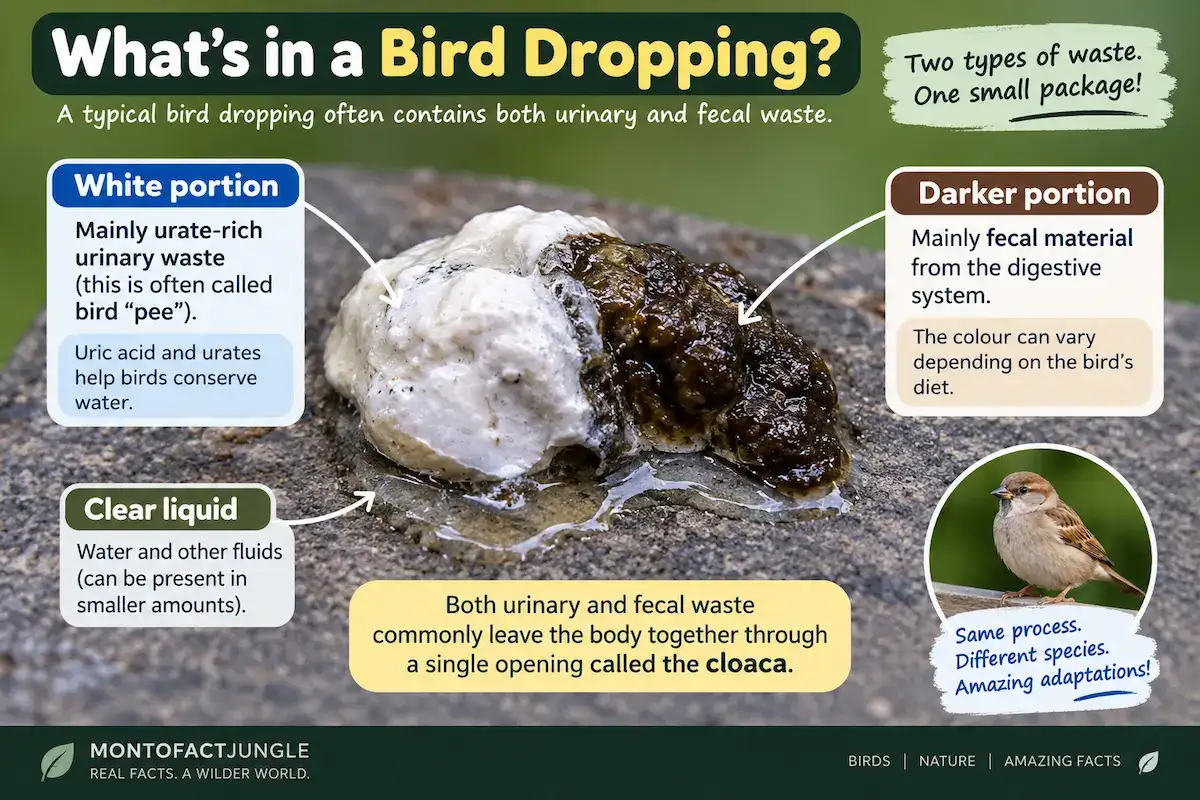
Yes, birds pee — just not the way mammals do. Instead of storing liquid urine in a bladder, birds convert nitrogenous waste into uric acid and excrete it as a thick, paste-like material, usually released together with feces through a single opening called the cloaca.
That's why a typical bird dropping has two parts: a white portion (urinary waste) and a darker portion (feces) — two separate waste systems, released together.
Explore How Do Birds Keep Their Heads Still?
Quick Table On Do Birds Pee and Poop?
| Question | Quick Answer |
|---|---|
| Do birds pee? | Yes, but not like humans |
| What is bird “pee”? | Mainly urate-rich urinary waste |
| Is bird pee liquid? | Usually highly concentrated rather than watery |
| Do birds have a bladder? | Most birds do not |
| Where does waste leave? | Through the cloaca |
| Do birds pee and poop together? | Usually, yes |
| What is the white part? | Mainly urinary waste (urates) |
| What is the dark part? | Mainly fecal waste |
| Why use uric acid? | It helps birds conserve water |
Table of Contents
- Quick Answer
- Quick Table On Do Birds Pee and Poop?
- Do Birds Pee? The Surprising Science Behind Bird Poop
- 🐦 Do Birds Pee or Poop at the Same Time?
- 💧 Do Birds Urinate?
- ⚪ What Is the White Stuff in Bird Poop?
- 🧪 Why Is Bird Poop White?
- 🚽 What Is the Cloaca?
- 🐦 Do Birds Have Bladders?
- 🆚 Bird Pee vs Human Pee
- ✈️ Can Birds Pee While Flying?
- 🤔 Can Birds Pee Without Pooping?
- 🐦 Do All Birds Pee the Same Way?
- 🦅 Why Do Vultures Pee on Their Legs?
- 🔬 Did Scientists Discover Something Unexpected About Bird Pee?
- 🌿 Why Do Birds Use Uric Acid?
- 🧠 Do Birds Actually Have Urine Inside Their Bodies?
- 👦 Do Birds Pee? A Simple Explanation for Kids
- ⚡ Quick Summary
- ❓ Frequently Asked Questions About Bird Pee
- 🐦 Related Bird Anatomy Articles
Do Birds Pee? The Surprising Science Behind Bird Poop
Have you ever wondered whether birds pee like humans do?
Yes, birds produce urine—but they do not pee the same way humans and other mammals do.
Birds normally excrete nitrogenous waste mainly as uric acid and urates, which are concentrated into a thick, paste-like material rather than being released as a large amount of watery urine.
That is one reason bird droppings usually have a white part and a darker part.
The white material is mainly urinary waste (urates), while the darker material is fecal waste.
And here is the surprising part: birds usually release their urinary and fecal waste through the same opening, called the cloaca. Explore 100 interesting facts about birds, 100 Common birds in usa with pictures
🐦 Do Birds Pee or Poop at the Same Time?
Usually, yes.
Birds have a cloaca, a common chamber and opening through which the digestive and urinary systems empty.
Unlike humans, birds generally do not have a separate opening for urine and feces.
Their kidneys produce urine, which travels through the ureters to the cloaca. Before it leaves the body, water and other substances can be reabsorbed, helping birds conserve water.
As a result, the white urate-rich material and darker fecal material are commonly expelled together.
So when you see a bird dropping on a sidewalk, car, or balcony, you are usually seeing both fecal and urinary waste.
💧 Do Birds Urinate?
Yes.
Birds have kidneys and produce urine.
However, their urinary system works differently from the familiar human system.
Birds generally do not store urine in a urinary bladder. Instead, urine travels from the kidneys through the ureters toward the cloaca, where it undergoes further processing before being excreted.
Birds are especially adapted to conserve water. Their major nitrogenous waste product is uric acid, which requires less water for excretion than the urea-based waste produced by humans.
This helps birds avoid losing large amounts of water while removing nitrogenous waste from their bodies.
⚪ What Is the White Stuff in Bird Poop?
That white material is primarily urate-rich urinary waste.
It is easy to mistake it for bird poop because it is mixed together with the fecal material.
A typical bird dropping can therefore contain:
| Part of dropping | What it mainly represents |
|---|---|
| White portion | Urates and other urinary waste |
| Darker portion | Fecal material |
| Clear liquid | Water and other fluid |
The exact appearance can vary depending on the bird species, diet, hydration, and other factors.
So the common statement that “the white part of bird poop is pee” is useful as a simple explanation, but scientifically it is more accurate to call it urinary waste or urates.
🧪 Why Is Bird Poop White?
Birds primarily use uric acid to get rid of excess nitrogen.
Uric acid is poorly soluble in water, so birds can eliminate it in a concentrated form without needing to produce large volumes of watery urine.
After processing through the urinary and digestive systems, the resulting urate-rich material appears white or whitish.
That is why bird droppings often look very different from mammal feces.
A simple way to remember it
White = mostly urinary waste
Dark = mostly fecal waste
Both can be released together.
🐦 Real-Life Example: Bird Dropping on Your Balcony
Imagine you are cleaning your balcony in the morning and notice a fresh bird dropping on the railing.
You might see a dark green, brown, or blackish part surrounded by a white paste-like material.
At first, you may think, “The bird pooped and also peed here.”
Actually, that is pretty close—but birds handle waste differently from humans.
The darker portion is mainly fecal waste, while the white portion is mainly urate-rich urinary waste. Both commonly pass out through the bird's cloaca, a common opening for digestive and urinary waste.
So that little dropping on your balcony is a simple real-life example of how a bird can eliminate its urinary and digestive waste together.
In simple words:
🟤 Dark part = mostly poop
⚪ White part = mostly urinary waste
🐦 Both commonly leave through the cloaca
🚽 What Is the Cloaca?
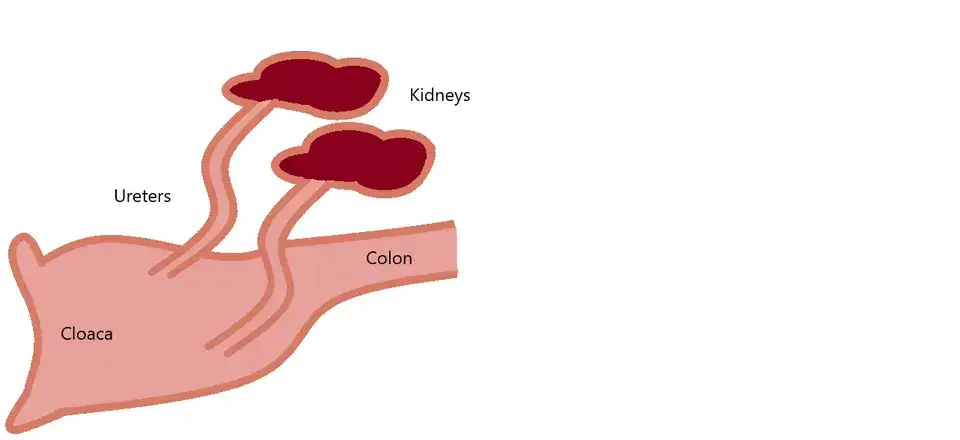
The cloaca is a chamber and opening at the rear of a bird's body.
It is involved in several important functions, including the elimination of digestive and urinary waste and reproduction.
For waste removal, the cloaca acts as a common exit rather than birds having separate external openings like humans have for urine and feces.
This is why bird droppings can contain both fecal material and urinary waste.
🐦 Do Birds Have Bladders?
Most birds do not have a urinary bladder.
Instead, urine travels from the kidneys through the ureters to the cloaca.
The absence of a conventional urinary bladder is part of a broader set of adaptations in birds involving water conservation and body design.
However, it is better not to think of this simply as “birds got rid of their bladder because they need to fly.”
Bird urinary systems are more complicated than that. Water reabsorption and post-renal processing also play important roles in how birds conserve water.
🆚 Bird Pee vs Human Pee
| Feature | Humans | Birds |
|---|---|---|
| Main nitrogenous waste | Urea | Mainly uric acid/urates |
| Urinary bladder | Present | Generally absent |
| Urinary waste | Mostly liquid urine | Concentrated urate-rich waste |
| Waste exit | Separate urinary and digestive exits | Common cloacal opening |
| Water conservation | Uses more water to eliminate urea | Uric acid excretion helps conserve water |
| Visible white urate portion | No | Commonly visible in droppings |
✈️ Can Birds Pee While Flying?
Birds can eliminate waste while flying.
Because birds normally release fecal and urinary waste through the cloaca, a bird does not necessarily need to land just to eliminate waste.
You may even have experienced the result yourself if a bird has flown overhead at exactly the wrong moment!
However, the timing and frequency of waste elimination can vary between species and circumstances.
🤔 Can Birds Pee Without Pooping?
This question is a little more complicated than it sounds.
Birds have separate digestive and urinary pathways internally, but both ultimately connect with the cloaca.
Because the cloaca is a common chamber, urinary and fecal waste are commonly expelled together.
The exact appearance and timing of excretion can vary depending on the species and the state of the digestive tract.
So it is better to say birds commonly eliminate urinary and fecal waste together rather than claiming that they can never pass one without the other.
🐦 Do All Birds Pee the Same Way?
Not necessarily.
Bird species differ in their anatomy, diet, habitat, and waste-handling strategies.
Most birds follow the general pattern of producing uric acid/urate-rich nitrogenous waste and eliminating it through the cloaca.
But there are interesting exceptions and variations among different groups of birds.
For example, some birds in the ratite group have unusual urinary anatomy compared with many other birds.
So when learning about bird biology, “most birds” is often more accurate than “all birds.”
🦅 Why Do Vultures Pee on Their Legs?
Some vultures, especially species such as turkey vultures, are famous for a strange-looking behavior: they may defecate and urinate on their own legs.
It may look unpleasant, but it can have a useful biological purpose.
Evaporation from the wet material can help cool the bird in hot conditions. This is known as urohidrosis.
So even bird waste can have a role in temperature regulation!
🔬 Did Scientists Discover Something Unexpected About Bird Pee?
There is an interesting piece of research from 2019 that is worth knowing about.
Researchers associated with the University of Texas at Austin studied excretions from six bird species and reported that their X-ray diffraction analysis did not show the expected pattern for uric acid in the collected excreted material.
Instead, they identified compounds including ammonium urate and struvite, along with other compounds that were not identified.
The researchers suggested that microbial activity could help transform uric acid before or around the time it is excreted.
This is an interesting detail about the chemistry of bird droppings—but it should not be interpreted as meaning that the established understanding of avian nitrogen metabolism has simply been overturned.
Bird biology research continues to investigate exactly how nitrogenous waste is processed and modified in the lower digestive and urinary systems.
🌿 Why Do Birds Use Uric Acid?
One major advantage is water conservation.
Nitrogen is produced when proteins and other molecules are broken down. Animals need to remove excess nitrogen because it can be harmful to the body.
Humans mainly convert this nitrogenous waste into urea and eliminate it in watery urine.
Birds primarily use a different strategy: they convert nitrogenous waste into uric acid, which can be eliminated using relatively little water.
For birds, this is useful because conserving water can be important for survival.
It also allows them to carry less water in their bodies than would be necessary if they had to eliminate large quantities of watery urine.
🧠 Do Birds Actually Have Urine Inside Their Bodies?
Yes.
This is an important distinction.
It is not accurate to imagine that birds simply produce no urine at all.
Their kidneys filter the blood and produce urine. The urine then passes through the ureters and undergoes further processing before the final waste is excreted.
So the easiest way to explain it is:
Birds do produce urine, but they don't eliminate it in the same way humans do.
Their final urinary waste is highly concentrated and commonly appears as the white portion of their droppings.
👦 Do Birds Pee? A Simple Explanation for Kids
Yes, birds do pee—but not like people do.
People usually produce watery urine that is stored in the bladder before leaving the body.
Birds usually don't have a urinary bladder.
Instead, their kidneys produce urine and their bodies turn nitrogenous waste mainly into uric acid. The waste becomes concentrated and is usually released through an opening called the cloaca.
That's why bird poop often has:
⚪ White urinary waste + 🟤 darker fecal waste
So the next time you see a bird dropping, remember: it is usually a mixture of two kinds of waste.
⚡ Quick Summary
Yes, birds produce urine.
Birds do not pee like humans and other mammals.
Most birds do not have a urinary bladder.
Birds primarily eliminate nitrogenous waste as uric acid/urates.
The white part of a typical bird dropping is mainly urate-rich urinary waste.
The darker part is mainly fecal material.
Both are commonly released through the cloaca.
Birds can eliminate waste while flying.
Water conservation is an important advantage of their uric-acid-based waste system.
Different bird species can have different adaptations.
❓ Frequently Asked Questions About Bird Pee
Do birds pee?
Yes. Birds produce urine, but their urinary waste is usually concentrated into urate-rich material rather than being released like the watery urine produced by humans.
Is the white part of bird poop pee?
The white portion is mainly urate-rich urinary waste. Calling it “bird pee” is a simple way to explain it, although “urates” or “urinary waste” is more scientifically precise.
Do birds pee and poop at the same time?
Most birds commonly eliminate urinary and fecal waste together because both pass through the cloaca.
Do birds have a bladder?
Most birds do not have a urinary bladder. Their ureters carry urine from the kidneys toward the cloaca.
Do birds urinate?
Yes. Birds have kidneys and produce urine. Their urinary system is adapted to conserve water.
What is a cloaca?
A cloaca is a chamber and opening used by birds for the elimination of digestive and urinary waste and for reproduction.
Can birds pee while flying?
Yes. Birds can eliminate waste while flying, so they do not necessarily need to land before passing waste.
Why is bird poop white?
The white material is mainly urate-rich urinary waste. It is associated with the way birds eliminate nitrogenous waste as uric acid/urates.
Why don't birds pee like humans?
Birds have a different waste-removal system. Their bodies primarily convert nitrogenous waste into uric acid, which can be eliminated with much less water than urea.
Do all birds pee the same way?
No. There are differences among bird groups, although the general avian pattern involves uric acid/urate-rich waste and a cloacal opening.
🐦 Related Bird Anatomy Articles
Want to discover more about how birds are built?
Final Thought
Birds may seem very different from us, but their bodies solve many of the same biological problems in fascinating ways.
They need to remove waste, conserve water, and survive in environments where carrying extra water can be costly.
So, do birds pee?
Yes—but their version of “peeing” is very different from ours.
The next time you see that familiar white-and-dark bird dropping, you'll know that you're looking at the result of a surprisingly sophisticated waste-removal system.
📚 References & Further Reading
- Natural History Museum — Do birds pee? — Clear explanation of uric acid, urates, the cloaca, and why birds commonly release urinary and fecal waste together.
- PubMed — Adaptive strategies for post-renal handling of urine in birds — Peer-reviewed review covering avian urine processing, uric acid and the absence of a urinary bladder.
- Cornell University — What Wildlife Workers Should Know About Avian Anatomy — Useful anatomy reference explaining the cloaca, ureters, urates and feces.
- PubMed — Postrenal modification of urine in birds — Research on how the cloaca and lower intestine modify urine and reabsorb water and electrolytes.
- PubMed — Integration of renal and gastrointestinal function — Review explaining how avian urine enters the cloaca and undergoes further processing.
You should also read:
Water Birds Name in English and Hindi (पानी में रहने वाले पक्षियों के नाम)
🦆Water Birds Name in English and Hindi (पानी में रहने वाले पक्षियों के नाम) A goose (Anser cygnoides) is a water bird commonly found near lakes, rivers, wetlands, and coastal areas. A high-quality image of a Goose (Anser cygnoides), a water bird adapted to lakes,…
Continue reading...100 Birds Name in Hindi and English-पक्षियों के नाम हिंदी और अंग्रेज़ी में – आसान, मज़ेदार और पूरी सूची
100 पक्षियों के नाम हिंदी और अंग्रेज़ी में 🌿 Real-Life Example (Gaon Ki Kahani) Maan lo aap summer vacation me gaon gaye ho. Subah 5 baje murga "kukdukoo" karta hai. Thodi der baad ped par baithi koil ki "koo-koo" awaaz aati hai. Ghar ke aas-paas…
Continue reading...20 Birds Name in Hindi and English (20 पक्षियों के नाम) | For Students & Easy Pronunciation
20 Birds Name in Hindi and English Here is a fresh set of 20 birds: क्या आपने कभी notice किया है कि हम रोज़ कई birds देखते हैं, लेकिन उनके English ya Hindi names हमें हमेशा याद नहीं रहते? इसीलिए students अक्सर search करते हैं…
Continue reading...10 Birds Name in Hindi and English (With Easy Meaning & GK Use)
🐦10 Birds Name in Hindi and English Quick Answer: 10 Birds Name in Hindi and English are Hoopoe, Woodpecker, Goose, Dove, Kingfisher, Indian Roller, Bulbul, Lapwing, Penguin, and Kiwi. Kya aapko school homework ya GK preparation ke liye birds ke naam chahiye? Bahut baar students…
Continue reading...