
🦴Human Skeleton Parts Name in English and Hindi with Pictures (मानव कंकाल के भागों के नाम)
✨ Story-Based Introduction
One evening, my nephew Aarav and my son Vishnu were watching an X-ray report after one of his friends injured his arm while playing football. ⚽ They looked surprised and Aarav asked me, "Uncle, what are all these white parts inside our body?"
Before I could answer, my mother Sharada smiled and said, "Those white parts are your skeleton. Just like a building needs strong pillars, our body needs a strong skeleton to stand, walk, and protect important organs." 🦴
Aarav immediately stood up and touched his shoulders, chest, and knees. He was amazed to learn that every movement—walking, running, jumping, and even sitting—is supported by the human skeleton working together with muscles and joints.
That simple family conversation inspired this article. Understanding the human skeleton helps us appreciate how our body stays strong, balanced, and protected every single day.
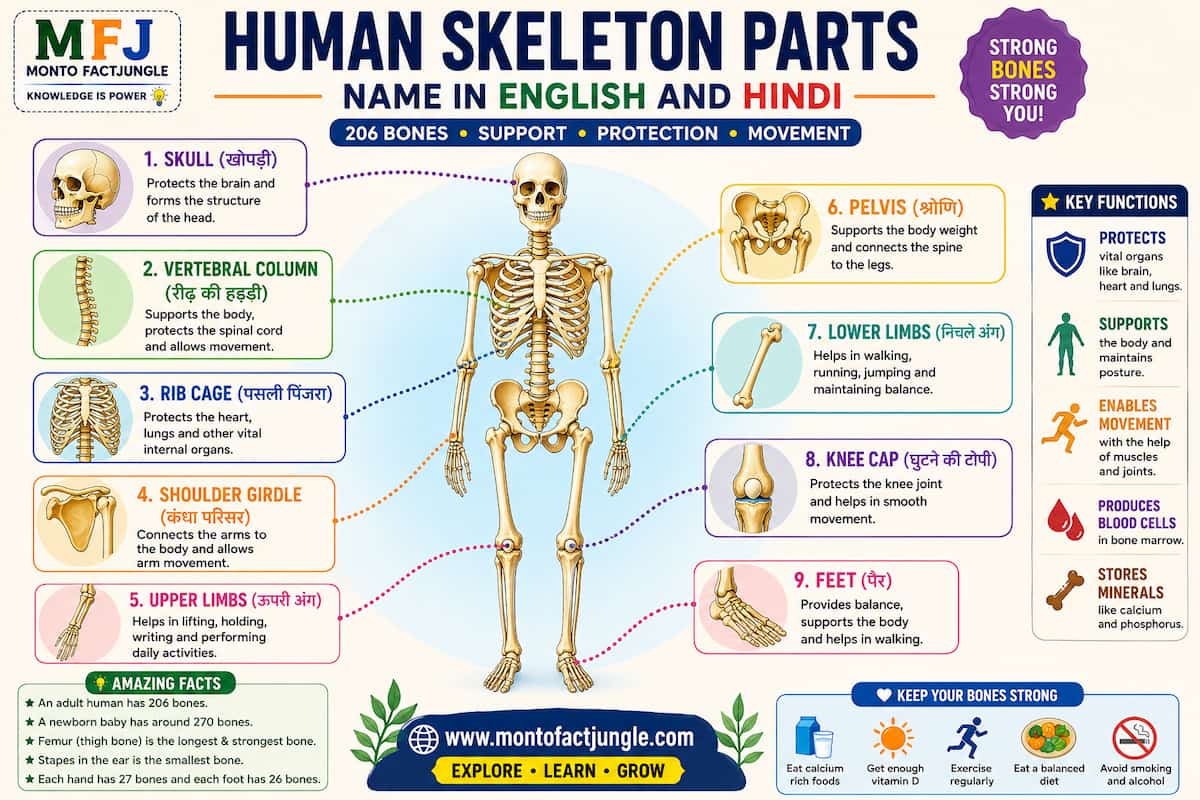
In this guide, you'll learn the Human Skeleton Parts Name in English and Hindi, their locations, functions, and interesting facts with easy-to-understand explanations and pictures. Whether you're a student, teacher, parent, or preparing for competitive exams, this article will make learning the human skeleton simple and enjoyable. 🦴📚
📖 Meaning of Human Skeleton
The human skeleton is the internal framework of the human body made up of 206 bones connected by joints, cartilage, and ligaments. It gives the body its shape, supports movement, protects internal organs, and works together with muscles to help us perform everyday activities. do u know about muscles in our body, check this article if you wanto know about muscles-💪Muscles Name in English and Hindi with Pictures
🇮🇳 Human Skeleton Meaning in Hindi
Human Skeleton को हिंदी में मानव कंकाल कहा जाता है। यह 206 हड्डियों से मिलकर बना शरीर का ढांचा (Framework) है, जो शरीर को आकार देता है, सहारा प्रदान करता है, आंतरिक अंगों की रक्षा करता है और मांसपेशियों के साथ मिलकर शरीर को चलने-फिरने में सहायता करता है।
Checkout the kids, 🔠ABCD Chart (A to Z English Alphabet for Kids) – Easy Learning Guide with Pictures
👉 “📌 Also Learn different types of birds with pictures below” Also Read 🐦100 Pet Birds Name in English and Hindi | पालतू पक्षियों के नाम, Vegetables Name A to Z in English and Hindi
💡 Real-Life Example
Imagine trying to stand without bones—it would be impossible! 🏠 Just as a house needs a strong frame to remain standing, our body depends on the human skeleton for support. When you walk 🚶, climb stairs 🪜, play cricket 🏏, or carry a school bag 🎒, your skeleton works together with muscles and joints to make every movement possible.
🌟 Interesting Fact
Did you know? 🤔
👶 A newborn baby has around 270 bones, but as the child grows, several bones gradually fuse together. By adulthood, the human skeleton consists of 206 bones, forming a strong yet flexible framework that supports the entire body. 🦴
📋 Human Skeleton Overview
The human skeleton is the strong internal framework of the body. It consists of 206 bones in adults and supports the body, protects vital organs, enables movement, stores minerals, and produces blood cells. Working together with muscles and joints, the skeleton helps us perform every activity—from walking and running to writing and lifting objects. 🦴
If you enjoyed Human Skeleton Overview about the Human Skeleton, you will like these related MFJ articles:
- 👤 Body Parts Name in English and Hindi
- ❤️ Internal Organs Name in English and Hindi
- 🦴 Bones Name in English and Hindi
- 💪 Muscles Name in English and Hindi
- 👀 Five Sense Organs Name in English and Hindi
📊 Human Skeleton Overview Table
| 🏷️ Feature | 📖 Details |
|---|---|
| English Name | Human Skeleton |
| Hindi Name | मानव कंकाल |
| Scientific System | Skeletal System |
| Total Bones (Adult) | 206 Bones |
| Total Bones (Newborn) | Around 270 Bones |
| Main Function | Supports the body, protects organs, enables movement, and produces blood cells |
| Works With | Muscles, Joints, Cartilage, Tendons, and Ligaments |
| Largest Bone | Femur (Thigh Bone) 🦵 |
| Smallest Bone | Stapes (Middle Ear) 👂 |
| Strongest Bone | Femur 💪 |
| Body System | Skeletal System |
| Main Divisions | Axial Skeleton & Appendicular Skeleton |
🦴 Main Parts of the Human Skeleton
The human skeleton is divided into two major parts, each performing different functions.
| 🦴 Skeleton Division | 🇮🇳 Hindi Name | 📍 Includes | 🎯 Main Function |
|---|---|---|---|
| Axial Skeleton | अक्षीय कंकाल | Skull, Vertebral Column, Rib Cage | Supports the body's central axis and protects the brain, spinal cord, heart, and lungs |
| Appendicular Skeleton | उपांगीय कंकाल | Shoulder Girdle, Arms, Pelvis, Legs | Helps in body movement and connects the limbs to the body |
⭐ Functions of the Human Skeleton
The skeleton performs several important functions that keep our body strong and healthy.
| 💡 Function | 📝 Explanation |
|---|---|
| 🏗️ Support | Gives the body its shape and keeps us standing upright. |
| 🛡️ Protection | Protects vital organs like the brain, heart, lungs, and spinal cord. |
| 🚶 Movement | Works with muscles and joints to help us move. |
| 🩸 Blood Cell Production | Bone marrow produces red blood cells, white blood cells, and platelets. |
| 🧂 Mineral Storage | Stores minerals such as calcium and phosphorus. |
| ⚖️ Balance | Helps maintain body posture and balance. |
👨👩👧👦 Family Example
One weekend, Aarav helped his grandfather carry a few books from the study room. 📚 While lifting the books, his skeleton provided the body's framework, muscles generated the force, and joints allowed smooth movement. My mother Sharada explained, "Without the skeleton, your muscles would have nothing to pull on, and your body couldn't stand or move." That simple activity helped Aarav understand why the skeleton is often called the framework of the human body. 🦴
🌟 Interesting Fact
Did you know? 🤔
Although bones look hard and lifeless, they are actually living tissues. 🦴 They constantly repair themselves, store essential minerals, and contain bone marrow, which produces millions of new blood cells every day. This is why the human skeleton is much more than just a collection of bones—it is a living, active system!
🦴 Human Skeleton Parts Name in English and Hindi
Now that we understand what the human skeleton is, let's learn about its major parts. The human skeleton is divided into different sections, and each section has a unique role in supporting the body, protecting organs, and enabling movement.
💀 1. Skull (Head Bones)
The skull forms the head and is one of the most important parts of the human skeleton. It protects the brain and supports the eyes, nose, ears, and mouth.
| 🦴 English Name | 🇮🇳 Hindi Name | 📍 Location | 🎯 Function |
|---|---|---|---|
| Skull | खोपड़ी / कपाल | Head | Protects the brain |
| Cranium | कपाल | Upper Skull | Covers and protects the brain |
| Mandible | निचला जबड़ा | Lower Jaw | Helps in chewing and speaking |
| Maxilla | ऊपरी जबड़ा | Upper Jaw | Supports upper teeth and face |
| Nasal Bone | नासिका अस्थि | Nose | Forms the bridge of the nose |
| Zygomatic Bone | गाल की हड्डी | Cheek | Gives shape to the cheeks |
| Frontal Bone | ललाट अस्थि | Forehead | Forms the forehead |
| Parietal Bone | पार्श्विका अस्थि | Top of Skull | Protects the upper brain |
| Temporal Bone | कनपटी की अस्थि | Side of Skull | Protects hearing organs |
| Occipital Bone | पश्चकपाल अस्थि | Back of Skull | Protects the back of the brain |
🦴 2. Vertebral Column (Spine)
The vertebral column, commonly called the spine or backbone, is the body's central support structure. It helps us stand upright, bend, twist, and protects the spinal cord.
| 🦴 English Name | 🇮🇳 Hindi Name | 📍 Location | 🎯 Function |
|---|---|---|---|
| Vertebral Column | रीढ़ की हड्डी | Back | Supports the body |
| Cervical Vertebrae | गर्दन की कशेरुकाएँ | Neck | Supports the head |
| Thoracic Vertebrae | वक्षीय कशेरुकाएँ | Upper Back | Connects with ribs |
| Lumbar Vertebrae | कटि कशेरुकाएँ | Lower Back | Bears body weight |
| Sacrum | त्रिकास्थि | Pelvis | Connects the spine to the pelvis |
| Coccyx | पुच्छास्थि | Tailbone | Provides muscle attachment |
🫁 3. Rib Cage (Chest Bones)
The rib cage surrounds the chest and protects vital organs like the heart and lungs while also helping in breathing.
| 🦴 English Name | 🇮🇳 Hindi Name | 📍 Location | 🎯 Function |
|---|---|---|---|
| Rib Cage | पसली पिंजरा | Chest | Protects the heart and lungs |
| Ribs | पसलियाँ | Chest | Protect internal organs |
| Sternum | उरोस्थि | Center of Chest | Connects ribs in front |
🦾 4. Shoulder Girdle
The shoulder girdle connects the arms to the main skeleton and allows a wide range of arm movements.
| 🦴 English Name | 🇮🇳 Hindi Name | 📍 Location | 🎯 Function |
|---|---|---|---|
| Clavicle | कॉलर बोन / हंसली | Shoulder | Connects arm to chest |
| Scapula | कंधे की हड्डी | Upper Back | Supports shoulder movement |
🌟 Quick Facts
- 💀 The skull contains 22 bones, most of which are fused together.
- 🦴 The spine has 33 vertebrae at birth, with some fusing to form 26 bones in adults.
- 🫁 Humans usually have 12 pairs of ribs (24 ribs total).
- 🦾 The clavicle (collarbone) is one of the most commonly fractured bones in the body.
If you enjoyed Quick facts about the Human Skeleton, you will like these related MFJ articles:
- 👤 Body Parts Name in English and Hindi
- ❤️ Internal Organs Name in English and Hindi
- 🦴 Bones Name in English and Hindi
- 💪 Muscles Name in English and Hindi
- 👀 Five Sense Organs Name in English and Hindi
👨👩👧👦 Family Example
One afternoon, Aarav accidentally bumped his forehead against a door while running. He quickly recovered with only a small bump because his skull protected his brain. Later, when he lifted his school bag onto his shoulder, his collarbone (clavicle) and shoulder blade (scapula) worked together to support the movement. My mother Sharada explained that every major part of the skeleton has a specific job, and together they keep our body strong, balanced, and protected. 🦴✨