
🩸Blood Composition and Function: Components of Blood Explained
🩸 Blood Composition and Function: Understanding the Four Main Components
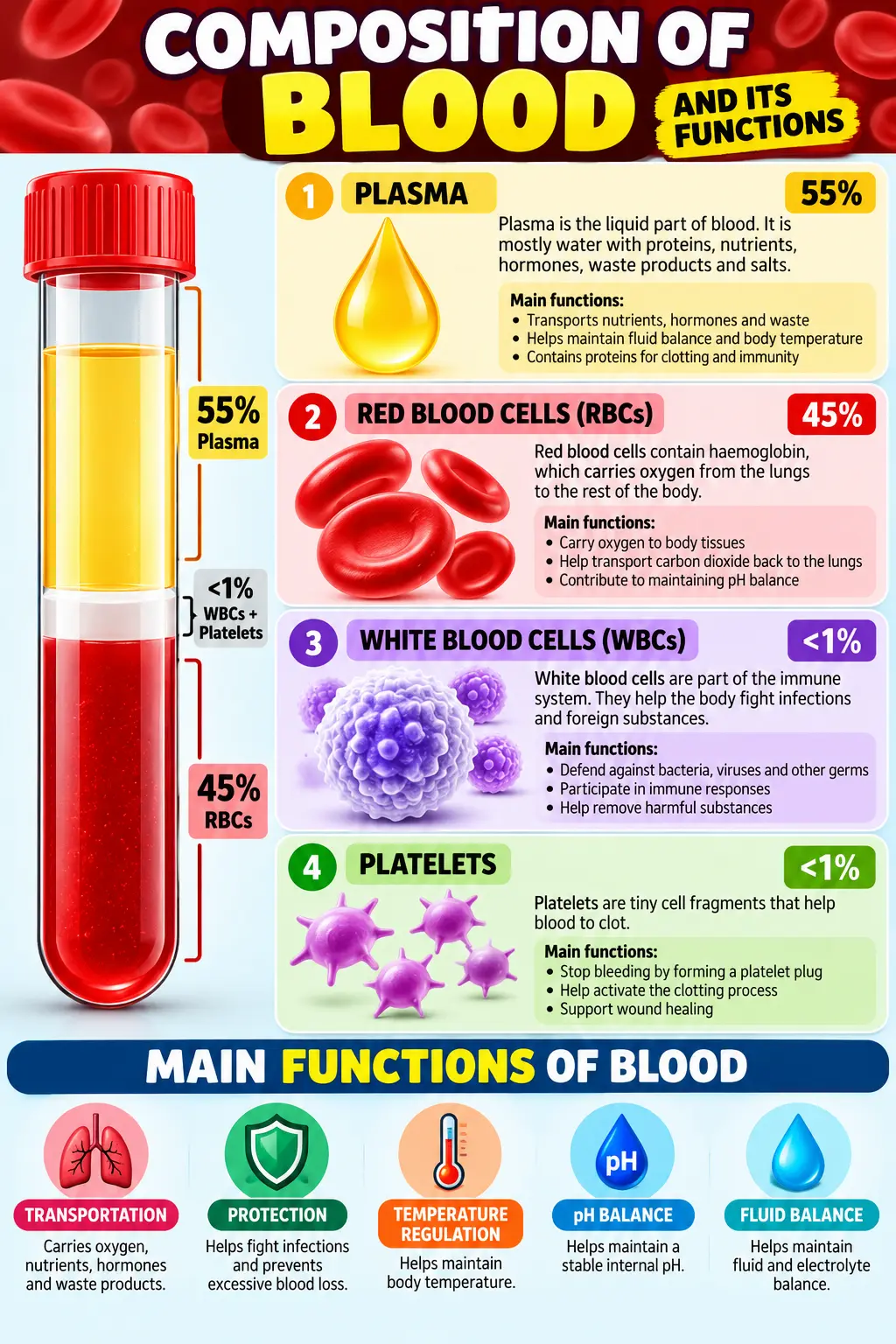
Imagine a small cut on your finger. Within moments, blood appears. When you run, play, study, exercise, or even sleep, your blood continues working inside your body without asking for a break.
But have you ever wondered what blood is made of, why it is red, or how it carries oxygen to different parts of your body?
Blood is much more than a red liquid. It is a specialised fluid connective tissue that transports essential substances, protects us against infections, and helps maintain a stable internal environment.
Whether you are a school student, a college learner, a teacher, a competitive-exam aspirant, or simply curious about the human body, this guide will help you understand blood composition and function in simple language. ❤️
Explore 100+ Body Parts and Their Names guide
What Is Blood?
Blood is a fluid connective tissue that circulates throughout the body through blood vessels. It connects different organs and tissues by transporting oxygen, nutrients, hormones, and waste products.
In simple words, blood works like a delivery and protection system inside your body.
For example, when you eat food, your digestive system breaks it down into nutrients. Blood carries many of these nutrients to the cells that need them. Similarly, oxygen enters the blood through the lungs and travels to tissues throughout the body.
Blood also contains cells and cell fragments that help fight infections and stop bleeding.
Hindi meaning: Blood को हिंदी में रक्त या खून कहते हैं। यह शरीर के अलग-अलग हिस्सों तक ऑक्सीजन और पोषक तत्व पहुँचाता है तथा शरीर को संक्रमण से बचाने और रक्तस्राव रोकने में मदद करता है।
What Is the Composition of Blood? 🧪
Blood has two major components:
Plasma: The liquid portion of blood.
Formed elements: Red blood cells, white blood cells, and platelets.
In a typical healthy adult, plasma accounts for approximately 55% of blood volume, while formed elements make up approximately 45%. These proportions are approximate and can vary.
| Component | Approximate proportion | Main function |
|---|---|---|
| Plasma | 55% | Transports dissolved substances and supports fluid balance |
| Red blood cells (RBCs) | About 44–45% | Carry oxygen |
| White blood cells (WBCs) | Less than 1% combined with platelets | Help defend against infections |
| Platelets | Less than 1% combined with WBCs | Help blood clot |
Remember: White blood cells and platelets together normally account for less than 1% of blood volume. Their individual proportions are much smaller than those of red blood cells.
1. Plasma: The Liquid Part of Blood 💛
Plasma is the pale-yellow liquid in which blood cells and platelets are suspended. It makes up approximately 55% of blood volume.
Plasma consists mainly of water, along with proteins, electrolytes, nutrients, hormones, dissolved gases, and waste products.
Important plasma proteins include:
Albumin: Helps maintain fluid balance between blood and surrounding tissues.
Globulins: Include proteins involved in immunity and transport.
Fibrinogen: Helps form blood clots.
Main functions of plasma
Transports nutrients and hormones.
Carries waste products towards organs that remove them.
Helps distribute heat throughout the body.
Maintains fluid balance.
Carries proteins involved in blood clotting and immunity.
Everyday example: After a meal, nutrients absorbed from the digestive tract enter the circulation. Plasma helps transport many of these nutrients to different tissues.
2. Red Blood Cells (RBCs): The Oxygen Carriers 🔴
Red blood cells, also called erythrocytes, are the most abundant formed elements in blood.
They contain haemoglobin, an iron-containing protein that binds oxygen. In humans, mature red blood cells normally lack a nucleus, leaving more space for haemoglobin.
Their distinctive biconcave disc shape helps them exchange gases efficiently and pass through narrow capillaries.
Main functions of red blood cells
Carry oxygen from the lungs to body tissues.
Help transport carbon dioxide from tissues towards the lungs.
Contribute to maintaining the body's acid–base balance.
How does it work?
When you breathe in, oxygen enters the lungs and passes into the blood. Haemoglobin in red blood cells binds much of this oxygen. As blood circulates, the oxygen is released to tissues that need it.
Some carbon dioxide also travels back towards the lungs in association with haemoglobin, but much of it is transported in the blood as bicarbonate.
Did you know? The iron in haemoglobin plays a crucial role in oxygen transport. A shortage of healthy red blood cells or haemoglobin can reduce the blood's oxygen-carrying capacity.
3. White Blood Cells (WBCs): The Body's Defence Team 🛡️
White blood cells, also called leukocytes, are essential parts of the immune system.
Unlike mature human red blood cells, white blood cells contain nuclei. They are less numerous but perform important protective functions.
Main functions of white blood cells
Help defend the body against bacteria, viruses, and other harmful agents.
Recognise and respond to foreign substances.
Participate in inflammation and immune responses.
Help coordinate the body's defence mechanisms.
There are five major types of white blood cells commonly identified in a differential blood count:
| Type | Main role |
|---|---|
| Neutrophils | Respond rapidly to many bacterial and fungal infections |
| Lymphocytes | Include B cells, T cells, and natural killer cells involved in immunity |
| Monocytes | Can develop into macrophages and other specialised cells in tissues |
| Eosinophils | Help defend against certain parasites and participate in allergic responses |
| Basophils | Release substances involved in allergic and inflammatory reactions |
Everyday example: When harmful microorganisms enter your body, immune cells help recognise and fight them. White blood cells are important members of this defence system.
However, immunity is a team effort. Antibodies, immune organs, signalling molecules, and other cells also play important roles.
4. Platelets: The Tiny Blood-Clotting Helpers 🩹
Platelets, also called thrombocytes, are small cell fragments produced from large cells in the bone marrow known as megakaryocytes.
Although platelets are much smaller than red blood cells, they perform an essential job: helping control bleeding.
Main functions of platelets
Gather at damaged blood vessels.
Form an initial platelet plug.
Help activate the clotting process.
Support wound healing.
What happens when you get a cut?
When a blood vessel is damaged, platelets become activated and gather at the injured area. They form an initial plug, while clotting proteins help produce a more stable clot.
This process reduces blood loss and allows healing to begin.
Remember: Platelets are not complete cells in the same way as red and white blood cells. They are cell fragments, but they are still essential components of blood.
What Are the Main Functions of Blood? ❤️
Blood performs several vital functions that help the body survive and work properly.
1. Transportation 🚚
Blood transports substances from one part of the body to another.
Oxygen: From the lungs to body tissues.
Nutrients: From the digestive tract to cells.
Hormones: From endocrine glands to target organs and tissues.
Waste products: Towards organs such as the kidneys and lungs for removal.
Carbon dioxide: From tissues towards the lungs for exhalation.
For example, after you eat breakfast, absorbed nutrients travel through the circulation to support energy production, growth, and tissue repair.
2. Protection Against Infections 🛡️
Blood contains white blood cells, antibodies, and other immune components that help protect the body.
These components recognise and respond to harmful microorganisms and foreign substances.
The immune system is complex, and not every infection is eliminated by white blood cells alone. Nevertheless, blood is a major pathway through which immune defence operates.
3. Prevention of Excessive Blood Loss 🩹
When a blood vessel is damaged, platelets and clotting proteins work together to form a clot.
This process is known as haemostasis.
Haemostasis helps control bleeding and creates conditions that support tissue repair. Without effective clotting, even relatively small injuries can cause excessive bleeding.
4. Regulation of Body Temperature 🌡️
Blood absorbs and distributes heat generated by tissues and organs.
When your body becomes warm, changes in blood flow near the skin help release heat. When you are cold, reduced blood flow near the skin helps conserve heat.
Blood therefore contributes to temperature regulation, although sweating, shivering, and other mechanisms also play important roles.
5. Maintenance of pH and Fluid Balance ⚖️
Blood helps maintain a relatively stable internal environment.
Buffer systems, including bicarbonate, help regulate blood pH. In healthy adults, arterial blood pH is normally around 7.35–7.45.
Plasma proteins and electrolytes also contribute to fluid balance and the distribution of water between blood and tissues.
The lungs and kidneys work closely with blood to regulate carbon dioxide, acid–base balance, and fluid and electrolyte levels.
Blood Composition vs Blood Functions
These two terms are related, but they answer different questions.
| Blood composition | Blood functions |
|---|---|
| Explains what blood contains | Explains what blood does |
| Includes plasma and formed elements | Includes transport, protection, and regulation |
| Describes the parts of blood | Describes the jobs performed by blood |
| Example: red blood cells | Example: carrying oxygen |
In simple words, composition tells us what blood is made of, while function tells us why blood is important.
Both concepts are essential for understanding the human circulatory system.
How Does Blood Travel Through the Body? 🫀
Blood circulates through a network of blood vessels powered by the heart.
The three main types of blood vessels are:
Arteries: Carry blood away from the heart.
Veins: Carry blood towards the heart.
Capillaries: Tiny vessels where substances are exchanged between blood and tissues.
In the pulmonary circulation, blood travels between the heart and lungs for gas exchange. In the systemic circulation, blood travels between the heart and the rest of the body.
The lungs add oxygen to the blood and remove carbon dioxide. The heart then pumps blood through the circulation, allowing oxygen and nutrients to reach tissues throughout the body.
To explore this topic further, see MFJ's related article on the human circulatory system.
Where Are Blood Cells Produced? 🦴
Most blood cells are produced in the bone marrow, the soft tissue found inside certain bones.
This process is called haematopoiesis.
Red blood cells, many white blood cells, and platelets develop from blood-forming stem cells through different stages of maturation.
Bone marrow therefore connects two important topics in human biology: the skeletal system and the circulatory system.
Learn more in MFJ's article on bones of the human body.
Amazing Facts About Blood 🔬
🩸 Blood is a fluid connective tissue.
💛 Plasma is the liquid portion of blood.
🔴 Haemoglobin gives red blood cells their colour and helps transport oxygen.
🛡️ White blood cells play important roles in immune defence.
🩹 Platelets help stop bleeding by participating in clot formation.
🫀 The heart pumps blood through pulmonary and systemic circulation.
🦴 Bone marrow produces most of the body's blood cells.
🌡️ Blood helps distribute heat and maintain a stable internal environment.
These facts show how different components work together to support life.
Quick Revision: Blood Composition and Function 📚
Here is a simple summary for school revision, homework, and general knowledge.
| Component or process | Key point to remember |
|---|---|
| Plasma | Liquid part of blood; transports dissolved substances |
| Red blood cells | Carry oxygen using haemoglobin |
| White blood cells | Help defend against infections |
| Platelets | Help blood clot |
| Transportation | Moves oxygen, nutrients, hormones, and waste |
| Protection | Supports immunity and prevents excessive blood loss |
| Regulation | Helps control temperature, pH, and fluid balance |
Easy memory trick: 🔴 RBCs carry oxygen, ⚪ WBCs fight infections, 🩹 platelets help stop bleeding, and 💛 plasma carries dissolved substances.
Together, these components help maintain the normal functioning of the human body.
Test Your Knowledge: 5 Quick MCQs 🎯
1. Which component makes up approximately 55% of blood volume?
A. Red blood cells
B. Plasma
C. Platelets
D. White blood cells
Answer: B. Plasma
2. Which component contains haemoglobin?
A. Red blood cells
B. Platelets
C. Plasma proteins
D. White blood cells
Answer: A. Red blood cells
3. Which blood component helps fight infections?
A. Red blood cells
B. Platelets
C. White blood cells
D. Fibrinogen alone
Answer: C. White blood cells
4. What is the main role of platelets?
A. Carrying oxygen
B. Helping blood clot
C. Producing hormones
D. Digesting food
Answer: B. Helping blood clot
5. Where are most blood cells produced?
A. Stomach
B. Lungs
C. Bone marrow
D. Skin
Answer: C. Bone marrow
Frequently Asked Questions About Blood Composition and Function
1. What is the composition of blood?
Blood consists of plasma and formed elements. Plasma makes up approximately 55% of blood volume, while formed elements account for approximately 45%. Formed elements include red blood cells, white blood cells, and platelets.
2. What are the four main components of blood?
The four main components are plasma, red blood cells, white blood cells, and platelets. Plasma is the liquid portion, red blood cells transport oxygen, white blood cells help defend against infections, and platelets help blood clot.
3. What are the main functions of blood?
Blood transports oxygen, nutrients, hormones, and waste products. It also supports immune defence, prevents excessive blood loss through clotting, regulates body temperature, and helps maintain pH and fluid balance.
4. What is the function of plasma?
Plasma transports dissolved substances such as nutrients, hormones, electrolytes, proteins, and waste products. It also contains proteins involved in immunity and clotting and helps maintain fluid balance.
5. What is the difference between RBCs and WBCs?
Red blood cells primarily transport oxygen using haemoglobin. White blood cells help protect the body against infections and participate in immune responses.
6. Why is blood red?
Blood is red because red blood cells contain haemoglobin, an iron-containing protein. Oxygen-rich blood is generally bright red, while oxygen-poor blood is darker red.
7. Are platelets cells?
Platelets are small cell fragments formed from megakaryocytes in the bone marrow. They help form platelet plugs and support the clotting process.
8. Is blood a tissue or a liquid?
Blood is classified as a fluid connective tissue. Its liquid matrix is called plasma, and it contains cells and cell fragments that perform specialised functions.
9. Where are blood cells formed?
Most blood cells are formed in the bone marrow through a process called haematopoiesis.
10. How is blood connected to the circulatory system?
Blood is the circulating fluid of the cardiovascular system. The heart pumps it through arteries, capillaries, and veins, allowing substances to travel between organs and tissues.
Final Thoughts ❤️
Blood is one of the most remarkable parts of the human body. Its different components work together every second to transport oxygen, deliver nutrients, fight infections, control bleeding, and maintain the body's internal balance.
Understanding blood composition and function also helps us understand how the heart, lungs, bones, and other organs work together as one interconnected system.
At MFJ, our goal is to make learning about the human body simple, interesting, and accessible to everyone — from young students taking their first biology lesson to adults who want to understand their bodies better.
Keep asking questions, stay curious, and keep learning. Every small discovery brings you one step closer to understanding the incredible human body. 🌟
Continue exploring with MFJ: Discover more about human body parts and their names, internal organs, the heart, and the lungs.
Educational note: This article is intended for general educational purposes and is not a substitute for professional medical advice.
References
Best for the four components of blood, plasma, red blood cells, white blood cells, platelets, and their functions.
Useful for blood composition, circulation, blood-cell production, and the main functions of blood.
A US National Library of Medicine resource covering plasma, blood cells, platelets, and bone marrow.
Helpful for accurate information about red blood cells, white blood cells, platelets, haemoglobin, and haematocrit.
You should also read:
💳40 Common Bank Fees and Charges Explained (With Examples)
💳 40 Common Bank Fees and Charges Explained (With Examples) A colorful educational illustration explaining 40 common bank fees and charges, with a bank building, ATM, credit card, mobile banking screen, bank statement, coins, and money-saving tips. Designed to help readers understand common banking costs…
Continue reading...🐦Why Do Birds Puff Up Their Feathers? 4 Real Reasons Explained
Why Do Birds Puff Up Their Feathers? 4 Real Reasons Explained blue jay sitting on a deck Quick Answer Birds puff up their feathers mainly to trap air close to their skin for insulation — the same principle as a down jacket. But fluffing has…
Continue reading...
🐦Bird Beaks: Types, Functions & Different Shapes Explained
🐦 Bird Beaks: Types, Functions & Different Shapes Explained (पक्षियों की चोंच के प्रकार) 🌿 Introduction Have you ever looked at an eagle (ईगल) and wondered why its beak is so sharp? Or noticed that a duck (बतख) has a flat beak while a parrot (तोता)…
Continue reading...