
💵What Are the 3 Main Budget Categories? (50/30/20 Rule)
💵What Are the 3 Main Budget Categories? Needs, Wants & Savings Explained
Quick Answer:
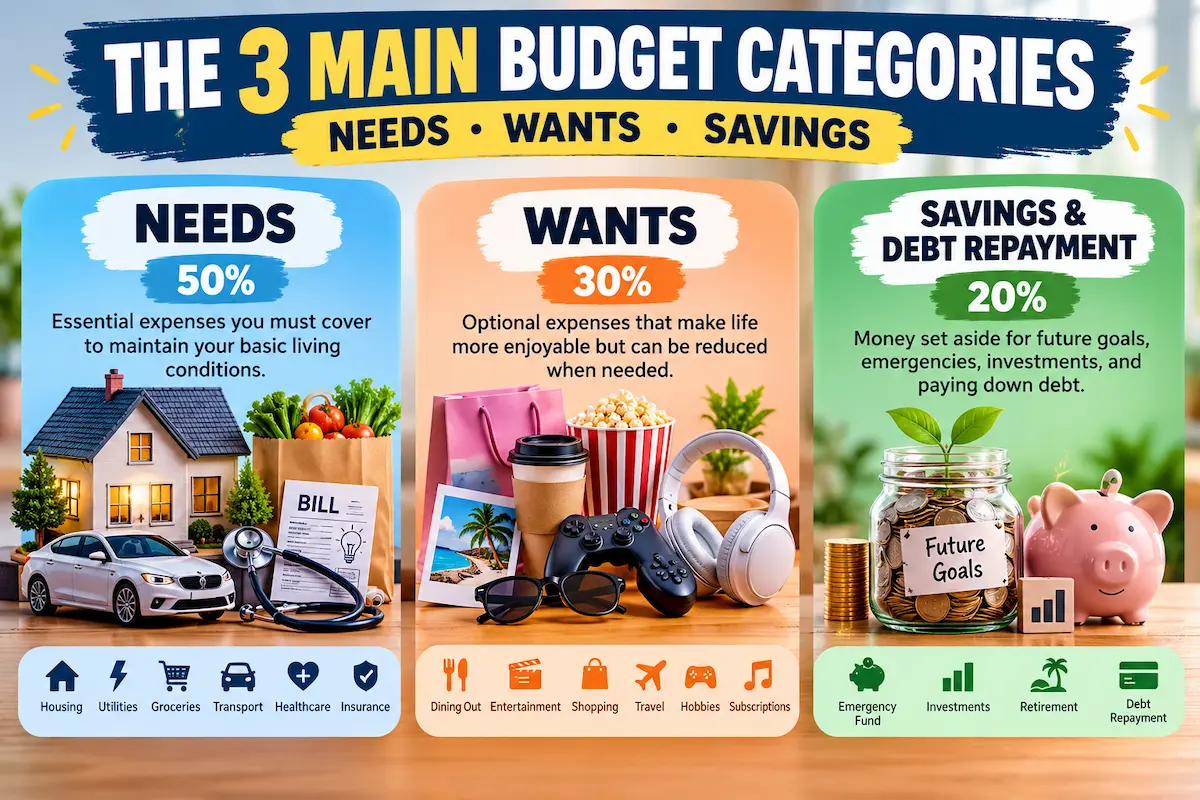
The three main budget categories are needs, wants, and savings and debt repayment.
Needs cover essential expenses such as housing, groceries, and utilities. Wants include non-essential spending such as dining out and entertainment. Savings and debt repayment help you prepare for future expenses, build financial security, and reduce what you owe. The 50/30/20 rule is a popular starting point for dividing your take-home income among these three categories.
Creating a budget doesn't have to mean tracking every dollar across dozens of expense categories. You can start with just three main groups and build a clear picture of where your money goes.
Whether you're managing household expenses, trying to save more, or simply wondering where your paycheck disappears each month, understanding these three categories can make budgeting easier.
In this guide, you'll learn what each category includes, how the 50/30/20 rule works, and how to use the three categories to create a practical monthly budget.
💵What Are the 3 Main Budget Categories?
The three main budget categories are:
Needs: Essential expenses you must cover to maintain your basic standard of living.
Wants: Optional expenses that improve your lifestyle but can be reduced when money is tight.
Savings and debt repayment: Money set aside for future goals, emergencies, investments, and paying down debt.
These categories help you organize your money by purpose rather than treating every expense the same way.
For example, rent and groceries belong under needs, a restaurant meal may fall under wants, and a contribution to an emergency fund belongs under savings.
Once you understand these three groups, you can organize smaller expenses into more detailed categories as needed.
1. Needs: Essential Expenses
Needs are expenses you must pay to maintain your basic living conditions, meet essential responsibilities, and stay financially secure.
These expenses usually receive priority when you create a monthly budget because missing them can affect your housing, health, safety, or ability to work.
Examples of budget needs
Common needs include:
Housing: Rent, mortgage payments, and essential home expenses.
Utilities: Electricity, water, heating, and basic household services.
Groceries: Food and essential household supplies.
Transportation: Necessary fuel, public transportation, or vehicle expenses required for work and everyday responsibilities.
Healthcare: Essential medical care and health-related expenses.
Insurance: Necessary health, vehicle, home, or other applicable insurance.
Minimum debt payments: Required payments on loans and credit cards.
Childcare: Essential childcare expenses that allow parents to work or meet other responsibilities.
Not every expense fits neatly into one category. For example, a phone plan may be a need if you rely on it for work, while a premium entertainment subscription is generally a want.
The key question is whether the expense is necessary for your circumstances.
How much of your income should go toward needs?
The popular 50/30/20 budgeting rule suggests allocating approximately 50% of your take-home income to needs.
However, this is a guideline, not a strict requirement. Housing costs, family responsibilities, location, and income can make it difficult to stay within that percentage.
If your essential expenses consume more than half your income, review your budget to identify realistic adjustments. Avoid cutting necessary healthcare, insurance, or other essential costs simply to meet a percentage target.
2. Wants: Non-Essential Expenses
Wants are expenses that make life more enjoyable but are not essential to meeting your basic needs.
These purchases are not automatically bad. Entertainment, hobbies, travel, and occasional treats can all have a place in a healthy budget.
The important thing is to understand how much you spend on them and whether that spending supports your financial priorities.
Examples of budget wants
Common wants include:
Dining out: Restaurant meals, takeout, and food delivery beyond essential food needs.
Entertainment: Movies, concerts, games, and recreational activities.
Subscriptions: Optional streaming services and premium memberships.
Shopping: Non-essential clothing, accessories, and personal purchases.
Travel: Vacations and leisure trips.
Hobbies: Equipment, supplies, and activities for personal interests.
Premium upgrades: More expensive versions of products when a basic alternative would meet your needs.
Lifestyle spending: Optional purchases that improve comfort or convenience.
Some expenses can fall into either category depending on your situation. Basic clothing is a need, for example, while buying another pair of shoes when you already have suitable footwear may be a want.
How much should you spend on wants?
The 50/30/20 rule suggests allocating approximately 30% of your take-home income to wants.
If your income is limited or you're working toward an important financial goal, you may decide to spend less.
A useful approach is to review your recent transactions and identify purchases that provide little value relative to their cost.
You don't have to eliminate every enjoyable expense. Instead, focus on spending intentionally and keeping optional purchases within an amount you can comfortably afford.
3. Savings and Debt Repayment: Building Your Financial Future
The third category covers money you set aside for future needs and financial goals, along with payments that reduce your outstanding debt.
This category matters because a budget should do more than help you pay today's bills. It should also prepare you for unexpected expenses and help you make progress toward the future you want.
Examples of savings and debt repayment
This category may include:
Emergency savings: Money reserved for unexpected expenses or income disruptions.
Short-term savings: Money for planned purchases, upcoming bills, or other near-term goals.
Long-term savings: Money set aside for future financial needs.
Retirement contributions: Contributions to applicable retirement accounts.
Investment contributions: Money allocated to investments according to your financial goals and risk tolerance.
Extra debt payments: Payments above required minimums that help reduce outstanding balances.
Goal-based savings: Money reserved for education, a home purchase, a vehicle, or another important goal.
Regular minimum debt payments are generally classified as needs in the 50/30/20 framework. Extra payments toward reducing debt are usually included in the 20% savings and debt repayment allocation.
This distinction helps you understand which payments are essential obligations and which represent additional progress toward your financial goals.
How much should you save?
The 50/30/20 rule suggests directing approximately 20% of your take-home income toward savings and debt repayment combined.
You can adjust the allocation depending on your circumstances. For example, someone building an emergency fund or trying to reduce expensive debt may prioritize those goals over other financial objectives.
If you cannot save 20% immediately, start with an amount you can sustain. Consistency is more useful than setting an ambitious target that forces you to borrow money to cover ordinary expenses.
Understanding the 50/30/20 Budget Rule
The 50/30/20 rule is a simple way to put the three main budget categories into practice.
It divides your take-home income into three suggested allocations:
| Budget category | Suggested allocation |
|---|---|
| Needs | 50% |
| Wants | 30% |
| Savings and debt repayment | 20% |
| Total | 100% |
The percentages are starting points rather than universal spending limits. You may need to adjust them based on your cost of living, income, financial obligations, and goals.
Example: How to divide a $4,000 monthly income
Suppose your monthly take-home income is $4,000.
Using the 50/30/20 rule, your suggested allocations would be:
| Budget category | Percentage | Monthly amount |
|---|---|---|
| Needs | 50% | $2,000 |
| Wants | 30% | $1,200 |
| Savings and debt repayment | 20% | $800 |
| Total | 100% | $4,000 |
In this example, you would plan to spend up to $2,000 on essential expenses, $1,200 on optional spending, and direct $800 toward savings and debt repayment.
These amounts illustrate how the rule works; they are not recommended limits for every household.
What if your essential expenses exceed 50%?
Imagine your housing, groceries, utilities, transportation, and other essential expenses total $2,600 per month.
That is 65% of your $4,000 take-home income.
You don't need to abandon your budget because the percentages don't match the guideline. Instead, calculate what remains after essential expenses, set a realistic limit for wants, and direct any available money toward savings and debt repayment.
You can also examine whether there are practical ways to reduce recurring costs over time.
The purpose of budgeting is to make informed decisions with the money you have, not to force every household into the same financial formula.
How to Create a Simple Budget Using the Three Categories
You can create a basic budget without a complicated spreadsheet or specialized software.
Follow these five steps.
Step 1: Calculate your monthly take-home income
Start with the money you actually receive after applicable payroll deductions.
If your income varies from month to month, use a conservative estimate based on your earnings and financial circumstances.
Step 2: List your essential expenses
Write down your regular needs, including housing, utilities, groceries, transportation, healthcare, insurance, and minimum debt payments.
Use recent bank statements, bills, and transaction records to estimate realistic amounts.
Step 3: Set a limit for wants
Review optional expenses such as dining out, subscriptions, shopping, entertainment, and travel.
Decide how much you can comfortably spend after accounting for essential expenses and your financial goals.
Step 4: Assign money to savings and debt repayment
Choose a realistic amount for your emergency fund, other savings goals, and additional debt payments.
If you are just starting, even a small recurring contribution can help you build the habit.
Step 5: Track your spending and review the budget
During the month, compare your actual spending with your planned amounts.
At the end of the month, look for patterns. Did you spend more than expected on food delivery? Were utility bills higher than usual? Did you manage to save the amount you planned?
Use what you learn to adjust the next month's budget.
For a more detailed walkthrough, read our guide on how to make a monthly budget.
How Do the Three Main Budget Categories Fit Into a Detailed Budget?
The three-category method is a starting point. Each main category can contain several smaller budget categories.
For example:
| Main category | Possible subcategories |
|---|---|
| Needs | Housing, utilities, groceries, transportation, healthcare, insurance |
| Wants | Dining out, entertainment, subscriptions, hobbies, shopping, leisure travel |
| Savings and debt repayment | Emergency fund, long-term savings, retirement contributions, investments, extra debt payments |
You can add or remove subcategories depending on your needs.
If you want a more detailed breakdown, explore our guide to 12 essential budget categories or browse our comprehensive list of 100 budget categories.
These guides can help you organize individual expenses without losing sight of the three main groups.
Common Mistakes to Avoid When Using the Three Budget Categories
Even a simple budget can become less useful if you don't apply the categories consistently.
1. Treating every purchase as a need. Convenience and preference can make optional expenses feel essential. Consider whether a lower-cost alternative would meet the same basic requirement.
2. Eliminating every want. A budget should be sustainable. Allowing room for reasonable enjoyment can make it easier to stick with your plan.
3. Ignoring savings until the end of the month. If possible, plan your savings contribution alongside your other financial obligations rather than relying entirely on whatever remains.
4. Forgetting irregular expenses. Annual bills, vehicle repairs, gifts, and other occasional costs can disrupt a budget if you don't plan for them.
5. Following the 50/30/20 rule too rigidly. Your essential costs may be higher or lower than the suggested allocation. Adapt the framework to your actual circumstances.
6. Counting the same expense twice. If you record individual credit card purchases in their relevant categories, avoid counting those same purchases again when you pay the credit card bill.
The best budgeting system is one that reflects your real financial life and helps you make better decisions consistently.
Frequently Asked Questions
1. What are the three main categories of a budget?
The three main categories are needs, wants, and savings and debt repayment. Needs cover essential expenses, wants cover optional spending, and the third category helps you prepare for the future and reduce outstanding debt.
2. What is the 50/30/20 budget rule?
The 50/30/20 rule suggests allocating 50% of take-home income to needs, 30% to wants, and 20% to savings and debt repayment. It is a guideline that can be adjusted to suit individual circumstances.
3. Are groceries a need or a want?
Essential groceries are generally a need. However, premium products, specialty treats, or unnecessary purchases may fall into the wants category depending on your circumstances.
4. Is paying off debt a savings category?
Extra debt payments are commonly grouped with savings and other financial goals in the 50/30/20 framework. Required minimum debt payments are generally treated as needs.
5. Should an emergency fund be included in a budget?
Yes. An emergency fund is an important savings goal because it can help you handle unexpected expenses without relying entirely on borrowing.
6. What if I cannot save 20% of my income?
Start with an amount you can afford after covering essential expenses and required payments. Increase your savings contribution when your income or expenses allow it.
7. Can I use the three-category method for a family budget?
Yes. Families can use the same three main groups and add subcategories for childcare, education, transportation, healthcare, and other household expenses.
8. Are the three main budget categories enough?
They can be enough for a simple overview of your finances. If you want to track individual expenses more closely, add subcategories under each main group.
Final Thoughts
The three main budget categories—needs, wants, and savings and debt repayment—give you a straightforward way to organize your money.
Start by understanding your essential expenses, set reasonable limits for optional spending, and make room for your future financial goals.
You don't have to get every percentage right on the first attempt. Review your spending, make adjustments, and build a budget that works for your circumstances.
A good budget isn't about restricting every dollar. It's about knowing where your money goes and deciding where you want it to go next.
This article is for educational purposes only and does not constitute individualized financial, tax, legal, or investment advice.