🌱 What Is Fertilization in Plants? Process, Diagram & Examples
🌱 What Is Fertilization in Plants? Process, Diagram & Examples
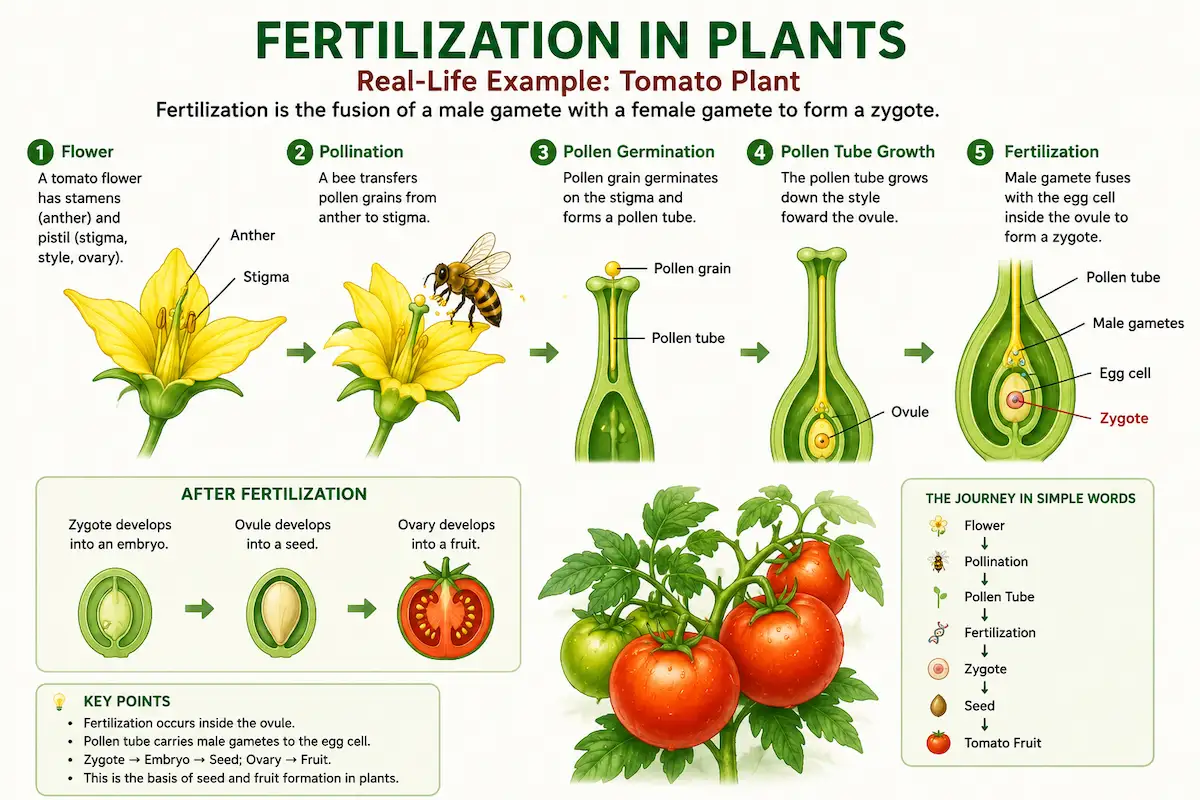
Educational diagram showing fertilization in plants using a tomato plant example. The infographic illustrates pollination, pollen germination, pollen tube growth, fusion of the male gamete with the egg cell, zygote formation, and the development of the ovule into a seed and the ovary into a tomato fruit.⚡ Quick Answer
Fertilization in plants is the process in which a male gamete fuses with a female gamete (egg cell) to form a zygote. In flowering plants, fertilization occurs inside the ovule after pollination. The pollen grain germinates on the stigma and grows a pollen tube, which carries the male gametes toward the egg cell.
Simple sequence:
🌾 Pollen → 📍 Stigma → 🌱 Pollen tube → 🧬 Male gamete + 🥚 Egg → 🧬 Zygote
📋 Fertilization in Plants — Quick Table
| 🌱 Point | 🧬 Answer |
|---|---|
| What is fertilization? | Fusion of a male gamete and female gamete |
| Where does it occur? | Inside the ovule |
| When does it occur? | After successful pollination |
| What carries male gametes? | Pollen tube |
| Female gamete | Egg cell |
| Male gamete + egg cell | Forms a zygote |
| Zygote develops into | Embryo |
| Ovule develops into | Seed 🌰 |
| Ovary generally develops into | Fruit 🍎 |
| Special feature of flowering plants | Double fertilization 🌸 |
Table of Contents
- 🌱 What Is Fertilization in Plants? Process, Diagram & Examples
- ⚡ Quick Answer
- 📋 Fertilization in Plants — Quick Table
- 🧬 What Is Fertilization in Plants?
- 🌺 Real-Life Example: How Fertilization Helps a Tomato Plant Make Seeds
- 📍 Where Does Fertilization Occur in a Flower?
- 🔬 How Does Fertilization Happen in Plants?
- 🧭 Fertilization in Plants: Simple Process Diagram
- 🧪 What Is a Pollen Tube?
- 🧬 What Is a Zygote in Plants?
- 🌟 What Is Double Fertilization?
- 🌰 What Happens to the Ovule After Fertilization?
- 🍎 What Happens to the Ovary After Fertilization?
- 🐝 Pollination vs Fertilization
- 🌱 What Happens After Fertilization?
- 🌍 Why Is Fertilization Important in Plants?
- 🧒 Fertilization in Plants for Class 4–8
- ⚠️ Common Mistakes About Fertilization
- 🧠 Easy Memory Tricks
- 🔎 Interesting Facts About Fertilization in Plants
- 📚 Quick Revision: Fertilization in Plants
- 📝 Quiz: Test Your Knowledge
- 1. What is fertilization?
- 2. Where does fertilization occur in a flowering plant?
- 3. What is formed when the male gamete fuses with the egg?
- 4. What grows from a germinating pollen grain?
- 5. What does the ovule generally develop into?
- 6. What does the ovary generally develop into?
- 7. What is special about double fertilization?
- 8. Put these events in the correct order:
- ❓ Frequently Asked Questions About Fertilization in Plants
- What is fertilization in plants?
- How does fertilization happen in plants?
- What is the difference between pollination and fertilization?
- Where does fertilization occur in a flower?
- What is formed after fertilization?
- What happens to the zygote?
- What happens to the ovule after fertilization?
- What happens to the ovary after fertilization?
- What is double fertilization?
- Is fertilization the same as sexual reproduction?
- 🔗 How Pollination and Fertilization Connect
- 📖 Related Articles
- 🌸 The Complete Flower Reproduction Story
- 📚 References
🧬 What Is Fertilization in Plants?
Fertilization in plants is the process in which a male gamete fuses with a female gamete to form a zygote. In flowering plants, this happens after successful pollination and the growth of a pollen tube toward the female reproductive structure.
In simple words:
🌸 Pollination brings the pollen to the right place. Fertilization is when the male and female gametes actually unite.
This is an important step in the sexual reproduction of flowering plants.
🌱 A simple example
Imagine a flower as a tiny reproduction system.
A bee may carry pollen from the anther to the stigma. That is pollination.
After the pollen lands on a suitable stigma, it can germinate and produce a pollen tube. The tube grows toward an ovule and delivers the male gametes.
When a male gamete fuses with the egg cell, a zygote is formed.
That zygote can then develop into the embryo of a new plant. 🌱
🌺 Real-Life Example: How Fertilization Helps a Tomato Plant Make Seeds
Imagine you have a tomato plant growing in a garden. 🍅🌱
A flower opens, and its anthers produce pollen. A bee visits the flower and carries pollen to a suitable stigma. This is pollination. 🐝
After the pollen reaches the stigma, the pollen grain can germinate and grow a pollen tube down through the style. The pollen tube provides a pathway for the male gametes to reach the ovule.
When a male gamete fuses with the egg cell inside the ovule, fertilization occurs and a zygote is formed. 🧬
The zygote develops into an embryo, while the ovule develops into a seed. The ovary develops into the tomato fruit. 🍅🌱
So the journey is:
🌼 Flower → 🐝 Pollination → 🌱 Pollen Tube → 🧬 Fertilization → 🧬 Zygote → 🌰 Seed → 🍅 Tomato Fruit
🧠 Easy way to remember
Pollination brings the pollen.
Fertilization brings the gametes together.
The result begins the formation of a new plant. 🌱
📍 Where Does Fertilization Occur in a Flower?
In flowering plants, fertilization takes place inside the ovule, which is located inside the ovary of the flower.
Remember the location chain:
🌸 Flower → Ovary → Ovule → Egg cell
The stigma is where pollen is received, but fertilization does not normally happen on the stigma.
Instead, the pollen grain germinates on the stigma and produces a pollen tube that grows through the style toward the ovule. Research on flowering plants describes pollen tubes as the structures that transport the male gametes toward the egg cell in the embryo sac. Explore 100 Flowers name
🔬 How Does Fertilization Happen in Plants?
Fertilization is not an instant event immediately after pollen lands on a flower. Several steps occur first.
1️⃣ Pollen reaches the stigma
The process begins with pollination.
Pollen from an anther reaches a compatible stigma, often with help from insects, wind, birds, bats, or other pollination agents.
Pollination = transfer of pollen to the stigma.
It is important to remember that pollination and fertilization are not the same thing.
2️⃣ The pollen grain germinates
When a suitable pollen grain reaches the stigma, it can germinate.
A tube begins to grow from the pollen grain.
This structure is called the pollen tube. Fertilization therefore follows pollination rather than occurring at the moment pollen first reaches the stigma.
3️⃣ The pollen tube grows through the style
The pollen tube grows from the stigma down through the style toward the ovary.
Think of it as a tiny biological pathway. 🛣️🌱
Its job is to provide a route for the male gametes toward the female reproductive cells inside the ovule.
4️⃣ Male gametes travel through the pollen tube
The pollen grain gives rise to the male reproductive cells, which are transported through the pollen tube.
In flowering plants, pollen tubes deliver male gametes toward the egg cell inside the embryo sac.
So avoid remembering:
❌ Pollen = sperm
A better way to remember it is:
✅ Pollen helps deliver the male gametes.
5️⃣ The male gamete reaches the egg cell
The pollen tube eventually reaches the female reproductive structure inside the ovule.
One male gamete reaches the egg cell.
The egg cell is the female gamete involved in the formation of the zygote.
6️⃣ The gametes fuse
Now the key event happens. 🧬
A male gamete fuses with the egg cell.
This fusion is called fertilization.
The result is a zygote.
Male gamete + Egg cell → Zygote
The basic definition of plant fertilization is the union of male and female reproductive cells or gametes to produce a zygote.
🧭 Fertilization in Plants: Simple Process Diagram
You can remember the entire process like this:
🌼 Anther
↓
🌾 Pollen grain
↓
📍 Stigma
↓
🌱 Pollen tube
↓
🥚 Ovule / egg cell
↓
🧬 Male gamete + Egg cell
↓
🧬 Zygote
↓
🌱 Embryo
↓
🌰 Seed
↓
🌿 New plant
⭐ The shortest version
Pollination → Pollen tube → Male gamete → Egg cell → Fertilization → Zygote
🧪 What Is a Pollen Tube?
A pollen tube is a tube that grows from a germinating pollen grain on the stigma toward the ovule.
Its main role is to provide a pathway for the male gametes to reach the female reproductive cells.
You can think of it as a tiny delivery tube inside the flower. 📦🌱
Why is the pollen tube important?
Without the pollen tube, the male gametes would not have the normal pathway needed to reach the egg cell inside the ovule.
So the sequence is:
Pollen grain → Pollen tube → Male gametes → Egg cell
Research literature on flowering-plant reproduction specifically describes pollen grains germinating to form pollen tubes that transport male gametes toward the egg cell.
🧬 What Is a Zygote in Plants?
A zygote is the first cell formed when the male and female gametes fuse during fertilization.
In simple terms:
Male gamete + Female gamete = Zygote
The zygote can divide and develop into an embryo, which eventually becomes part of a developing seed. 🌱
Easy memory trick
Zygote = the starting cell of the new plant embryo.
🌟 What Is Double Fertilization?
Here comes the interesting part of flowering-plant reproduction. 🌸🧬
Double fertilization is a special feature of flowering plants in which two fertilization-related fusion events occur within the same ovule.
One male gamete fuses with the egg cell to form the zygote.
The other male gamete participates in fusion with the polar nuclei, leading to the formation of the endosperm, which provides nourishment for the developing embryo.
So, in simplified form:
Male gamete + Egg → 🧬 Zygote
Male gamete + Polar nuclei → 🌾 Endosperm
This is why it is called double fertilization.
The research material specifically identifies double fertilization as a process involving two male gametes and the formation of the zygote and endosperm.
🎓 Advanced term: Triple fusion
The fusion involving one male gamete and the two polar nuclei is commonly called triple fusion because three nuclei participate.
Therefore:
Syngamy → Zygote
Triple fusion → Endosperm
You do not need to memorize these terms for a basic understanding, but they are useful for advanced biology students.
🌰 What Happens to the Ovule After Fertilization?
After successful fertilization, the ovule develops into a seed in flowering plants.
A useful memory rule is:
🌱 Ovule → Seed
Inside the developing seed, the zygote develops into an embryo.
So the sequence becomes:
Fertilization → Zygote → Embryo → Seed
🍎 What Happens to the Ovary After Fertilization?
The ovary generally develops into the fruit after successful fertilization.
The ovules inside it develop into seeds.
Remember:
🌸 Ovary → Fruit
🌱 Ovule → Seed
This is one of the most important relationships to learn when studying flower reproduction.
Example
In a tomato:
The ovary develops into the tomato fruit.
The ovules develop into the seeds.
The exact development can vary among plants, so it is better to remember this as the normal flowering-plant pattern rather than an absolute rule.
🐝 Pollination vs Fertilization
These two terms are often confused, but they describe different events.
| Pollination 🐝 | Fertilization 🧬 |
|---|---|
| Transfer of pollen | Fusion of male and female gametes |
| Pollen moves to the stigma | Male gamete fuses with the egg |
| Happens first | Happens after successful pollen germination and tube growth |
| Does not itself form a zygote | Produces a zygote |
| Can involve wind, insects, birds and other agents | Takes place inside the reproductive structure of the flower |
Easy way to remember
🐝 Pollination = pollen moves
🧬 Fertilization = gametes fuse
That one distinction can prevent a lot of exam mistakes.
🌱 What Happens After Fertilization?
Fertilization is the beginning of the next stage of development.
The simplified sequence is:
🧬 Fertilization
↓
Zygote
↓
Embryo
↓
Seed
↓
Germination
↓
🌱 New plant
At the same time, in the usual flowering-plant pattern:
Ovary → Fruit
and
Ovule → Seed
So the whole flower-to-fruit story can be remembered as:
🌸 Flower → 🐝 Pollination → 🧬 Fertilization → 🌱 Embryo → 🌰 Seed → 🍎 Fruit → 🌿 New plant
🌍 Why Is Fertilization Important in Plants?
Fertilization is important because it brings together male and female genetic contributions and starts the development of a new plant embryo.
It also connects several stages of plant reproduction:
Pollination → Fertilization → Zygote → Embryo → Seed → New plant
In flowering plants, fertilization therefore plays a central role in producing the next generation.
For successful reproduction, fertilization must involve compatible male and female gametes; research from the Indian Academy of Sciences notes the importance of fertilization between gametes of the same species in maintaining species identity.
🧒 Fertilization in Plants for Class 4–8
What is fertilization in plants?
Fertilization is the fusion of a male gamete and a female gamete to form a zygote.
Where does fertilization occur in flowering plants?
It occurs inside the ovule, which is located inside the ovary.
What is a zygote?
A zygote is the cell formed after the male and female gametes fuse.
What happens to the ovule after fertilization?
The ovule develops into a seed.
What happens to the ovary?
The ovary generally develops into a fruit.
What carries the male gametes toward the egg?
The pollen tube provides the pathway.
Does fertilization happen before pollination?
No.
The usual sequence is:
Pollination → Pollen tube growth → Fertilization
The research source also explicitly describes fertilization as following pollination.
⚠️ Common Mistakes About Fertilization
❌ Pollination and fertilization are the same
They are not.
Pollination = pollen transfer
Fertilization = gamete fusion
❌ Fertilization happens on the stigma
The stigma receives pollen, but fertilization occurs deeper inside the flower, within the ovule.
❌ Pollen is the male gamete
A pollen grain is not simply the same thing as a male gamete.
Pollen is involved in delivering the male reproductive cells.
❌ The ovule becomes the fruit
Remember:
Ovule → Seed
Ovary → Fruit
❌ Fertilization immediately produces a seed
The immediate product of the fusion of the male gamete and egg is the zygote.
The zygote then develops into an embryo, and the ovule develops into a seed.
🧠 Easy Memory Tricks
Trick 1: Move → Fuse
Pollination = MOVE
Pollen moves from anther to stigma.
Fertilization = FUSE
Male and female gametes fuse.
Trick 2: Ovule and Ovary
Ovule → Outcome is seed 🌱
Ovary → Outcome is fruit 🍎
Trick 3: Remember the reproduction chain
🐝 Pollen → 🌱 Tube → 🧬 Fusion → 🌱 Zygote → 🌰 Seed → 🍎 Fruit
🔎 Interesting Facts About Fertilization in Plants
🌸 Fertilization normally follows successful pollination in flowering plants.
🌱 A pollen grain can germinate and produce a pollen tube.
🛣️ The pollen tube provides a pathway for male gametes.
🧬 Fusion of a male gamete with the egg produces a zygote.
🌟 Flowering plants have a special process called double fertilization.
🌾 One fusion event in double fertilization contributes to zygote formation, while the other contributes to endosperm formation.
🌰 The ovule develops into a seed.
🍎 The ovary generally develops into a fruit.
📚 Quick Revision: Fertilization in Plants
Remember these six points:
1. 🐝 Pollination
Pollen reaches the stigma.
2. 🌱 Germination
The pollen grain germinates.
3. 🛣️ Pollen tube
A pollen tube grows toward the ovule.
4. 🧬 Gamete delivery
Male gametes travel through the pollen tube.
5. 🥚 Fusion
A male gamete fuses with the egg.
6. 🌱 Zygote
A zygote is formed and can develop into an embryo.
One-line revision
Pollination gets the pollen there; fertilization brings the gametes together.
📝 Quiz: Test Your Knowledge
1. What is fertilization?
A. Transfer of pollen to the stigma
B. Fusion of male and female gametes
C. Growth of a seed
D. Formation of a flower
Answer: B
2. Where does fertilization occur in a flowering plant?
A. Petal
B. Anther
C. Ovule
D. Stigma
Answer: C
3. What is formed when the male gamete fuses with the egg?
A. Pollen
B. Fruit
C. Zygote
D. Petal
Answer: C
4. What grows from a germinating pollen grain?
A. Root
B. Pollen tube
C. Seed coat
D. Fruit
Answer: B
5. What does the ovule generally develop into?
A. Fruit
B. Leaf
C. Seed
D. Stem
Answer: C
6. What does the ovary generally develop into?
A. Fruit
B. Pollen
C. Root
D. Seed coat
Answer: A
7. What is special about double fertilization?
A. Two flowers are required
B. Two pollen grains always fuse together
C. Two fertilization-related fusion events occur in the ovule
D. Fertilization happens twice on the stigma
Answer: C
8. Put these events in the correct order:
Zygote → Pollination → Pollen tube → Fertilization
Correct order:
Pollination → Pollen tube → Fertilization → Zygote
❓ Frequently Asked Questions About Fertilization in Plants
What is fertilization in plants?
Fertilization is the fusion of a male gamete with a female gamete to form a zygote.
How does fertilization happen in plants?
After pollination, a pollen grain can germinate on the stigma and form a pollen tube. The pollen tube grows toward the ovule and delivers male gametes. One male gamete fuses with the egg cell, forming a zygote.
What is the difference between pollination and fertilization?
Pollination is the transfer of pollen to the stigma, while fertilization is the fusion of male and female gametes.
Where does fertilization occur in a flower?
In flowering plants, fertilization occurs inside the ovule, which is located inside the ovary.
What is formed after fertilization?
The fusion of the male gamete and egg produces a zygote.
What happens to the zygote?
The zygote develops into an embryo, which becomes part of the developing seed.
What happens to the ovule after fertilization?
The ovule generally develops into a seed.
What happens to the ovary after fertilization?
The ovary generally develops into a fruit.
What is double fertilization?
Double fertilization is a characteristic feature of flowering plants in which two male gametes participate in two fusion events within the ovule, producing a zygote and contributing to endosperm formation.
Is fertilization the same as sexual reproduction?
No. Fertilization is an important part of sexual reproduction. It is the specific event in which compatible male and female gametes fuse.
🔗 How Pollination and Fertilization Connect
If you have just learned about pollination, the connection is simple:
🐝 Pollination
Pollen reaches the stigma.
↓
🌱 Pollen germination
The pollen tube begins to grow.
↓
🛣️ Pollen tube growth
The tube reaches toward the ovule.
↓
🧬 Fertilization
Male gamete fuses with the egg.
↓
🌱 Zygote
The first cell of the developing embryo is formed.
↓
🌰 Seed
The ovule develops into a seed.
↓
🍎 Fruit
The ovary generally develops into a fruit.
So remember:
Pollen must first reach the right place before the gametes can meet.
📖 Related Articles
Continue learning about flower reproduction:
🌸 Parts of a Flower and Their Functions — Learn about the stigma, style, ovary, ovule, anther, filament, petals and other flower parts.
🐝 What Is Pollination? — Learn how pollen moves from the anther to the stigma and what happens afterward.
- 100 fruits name
- 100 Seeds name
🌸 The Complete Flower Reproduction Story
A flower's reproductive journey can be remembered as one connected story:
🌸 Flower
↓
🌾 Pollen is produced
↓
🐝 Pollination
↓
🌱 Pollen tube grows
↓
🧬 Fertilization
↓
🧬 Zygote forms
↓
🌱 Embryo develops
↓
🌰 Seed forms
↓
🍎 Fruit develops
↓
🌿 A new plant can grow
That is the bigger picture:
🌸 Flower → 🌾 Pollen → 🐝 Pollination → 🌱 Pollen Tube → 🧬 Fertilization → 🧬 Zygote → 🌰 Seed → 🍎 Fruit → 🌿 New Plant
📚 References
Indian Academy of Sciences — Fertilization in Flowering Plants — detailed scientific discussion of fertilization and compatibility between male and female gametes.
National Institutes of Health (PubMed) — The mechanisms of pollination and fertilization in plants — covers pollen germination, pollen-tube growth, and delivery of male gametes to the egg cell.
CK-12 Foundation — Fertilization of Flowering Plants — explains that fertilization follows pollination and describes the pollen-tube process.
Science Facts — Fertilization in Plants – Definition, Process, Types, & Diagram — supporting reference for the basic definition and process.