🌸 Parts of a Flower and Their Functions: Diagram + Easy Guide for Kids and Students)
Parts of a Flower and Their Functions - Diagram, Names & Meaning (Flower Anatomy)
🖼️ Parts of a Flower Diagram — Labeled Flower Diagram Diagram Explains Flower Anatomy showing the pistil, stigma, style, ovary, stamen
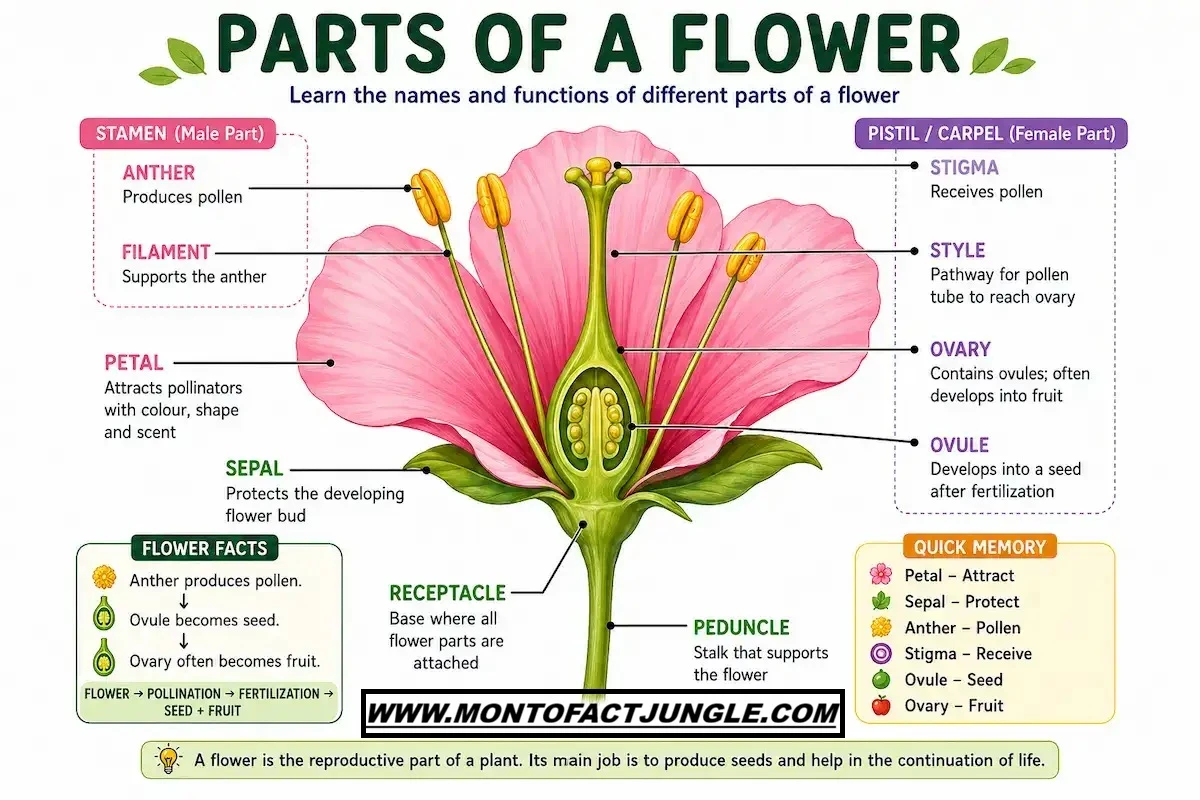
A labeled educational flower parts diagram showing its main parts and functions, including petals, sepals, stamen, anther, filament, pistil or carpel, stigma, style, ovary, ovule, receptacle and peduncle. The diagram also explains how pollination and fertilization lead to seed and fruit formation.
🎁 What's Inside This Lesson:
> 📖 Simple Science:Easy-to-understand breakdowns of flower anatomy.
> 🎮Interactive Game:** A fun, built-in quiz at the bottom to test your child's skills!
> 🖨️Free Printable Worksheet:** A copy-and-paste classroom matching activity for home or school study.
🔍 How to Read the Diagram
Think of the flower from outside to inside and top to bottom:
Petals + Sepals
↓
Stamen + Pistil/Carpel
↓
Anther + Filament / Stigma + Style + Ovary
↓
Ovules inside the ovary
↓
Receptacle + Peduncle at the base
📌 Quick Answer: What Are the Parts of a Flower?
A typical flower has four main parts: sepals, petals, stamens (male reproductive structures), and carpels or pistils (female reproductive structures).
🌸 Petals — often attract pollinators with their colour, shape, scent or patterns.
🍃 Sepals — protect the developing flower bud.
🟡 Stamen — the male reproductive structure; it consists of the anther and filament.
🟣 Pistil/Carpel — the female reproductive structure; it includes the stigma, style and ovary.
Inside the ovary are ovules. After successful fertilization, an ovule develops into a seed, while the ovary often develops into a fruit. Read The Ultimate Snake Plant Care Guide
In simple words:
🌸 Flower → Pollination → Fertilization → Seed + Fruit
Together, these parts allow a flower to attract pollinators, get pollinated, and produce seeds and fruit.
Explore our What Is Pollination? How Does Pollination Work in Plants?, 100 Flowers Name guide
Table of Contents
- Parts of a Flower and Their Functions - Diagram, Names & Meaning (Flower Anatomy)
- 📌 Quick Answer: What Are the Parts of a Flower?
- 🌸 Parts of a Flower — MFJ Flower Check
- 🔎 Real-Life Example: Look Closely at a Hibiscus Flower
- 🌼 What Is a Flower?
- 🌺 The 4 Main Parts of a Flower
- 🌸 1. Petal
- 🍃 2. Sepal
- 🟡 3. Stamen — Male Reproductive Part
- 🟣 4. Pistil or Carpel — Female Reproductive Structure
- 🎯 Stigma
- 🛣️ Style
- 🏠 Ovary
- 🌱 Ovule
- 🌸 Reproductive and Accessory Parts of a Flower
- 📊 Complete Parts of a Flower and Their Functions
- 🧑🤝🧑 Male vs Female Parts of a Flower
- 🌺 Perfect vs Imperfect Flowers
- 🐝 How Do Flower Parts Work Together?
- ⚠️ Pollination vs Fertilization — Don't Mix Them Up!
- 🌱 How Does a Flower Become a Seed?
- 🍎 How Does a Flower Become a Fruit?
- ❌ Common Mistakes About Flower Parts
- 🧠 Flower Parts Memory Tricks
- 🔬 Be a Flower Detective
- 🤩 Interesting Facts About Flowers
- 📝 Quick Revision: Parts of a Flower
- 🎯 One-Minute Flower Revision
- 🧠 Quiz: How Much Did You Learn?
- 1. What are the four main parts of a typical flower?
- 2. Which part produces pollen?
- 3. Which part supports the anther?
- 4. Which part receives pollen?
- 5. What does the ovary contain?
- 6. What does an ovule develop into after fertilization?
- 7. What does the ovary often develop into?
- 8. What is pollination?
- 9. Which structure is part of the stamen?
- 10. Which statement is correct?
- 🧠 Test Your Skills: The Interactive "Label the Flower" Game
- 🖨️ Printable Parts of a Flower Practice Worksheet
- ❓ Frequently Asked Questions About Parts of a Flower
- 1. What are the four main parts of a flower?
- 2. What is the male part of a flower?
- 3. What is the female part of a flower?
- 4. What does the anther do?
- 5. What is the function of the stigma?
- 6. What is inside the ovary?
- 7. What does an ovule become?
- 8. What does the ovary become?
- 9. What is the difference between pollination and fertilization?
- 10. Do all flowers have exactly the same parts?
- 11. What is the difference between a pistil and a carpel?
- 12. Why are petals colourful?
- 🌱 From Flower to Fruit to Seed
- 📚 References
- 🔗 Continue Learning — Related Articles at Monto Fact Jungle
🌸 Parts of a Flower — MFJ Flower Check
Before we go deeper, here's the Monto Fact Jungle Flower Check — a super-fast way to remember what each part does.
| Flower Part | MFJ Flower Check |
|---|---|
| 🌸 Petal | ✅ Helps attract pollinators |
| 🍃 Sepal | 🛡️ Protects the developing bud |
| 🟡 Anther | 🧪 Produces pollen |
| 🟢 Filament | 🔗 Supports the anther |
| 🟣 Stigma | 🎯 Receives pollen |
| 🟢 Style | 🛣️ Provides the pathway for the pollen tube |
| 🟠 Ovary | 🏠 Contains ovules |
| 🌱 Ovule | 🌱 Develops into a seed after fertilization |
| 🌿 Receptacle | 🏗️ Supports and holds the flower parts |
| 🌱 Peduncle | 🌿 Supports the flower as its stalk |
Explore - Plant Life Cycle: 5 Stages
🔎 Real-Life Example: Look Closely at a Hibiscus Flower
Take a hibiscus flower and look at it closely.
At first, you may notice only its large, colourful petals. But look toward the centre and you'll find several different flower parts working together.
🌸 The petals make the flower noticeable and can help attract pollinators.
🟡 The anthers produce pollen. In hibiscus, the anthers can be seen along the staminal structure surrounding the style.
🎯 At the tip of the female reproductive structure is the stigma, which receives pollen.
🟢 The style connects the stigma to the ovary.
🏠 Inside the ovary are ovules, which can develop into seeds after fertilization.
So, a flower is not just one structure. It is made up of several specialized parts, each with an important role. Read What is Fertilization In Plants , 100 Fruits Name in English
🌸 Try It Yourself
If you have access to a hibiscus or another flower, observe it without plucking it unnecessarily.
Can you find:
Petal → Sepal → Anther → Filament → Stigma → Style → Ovary
This simple observation can make a parts of a flower diagram much easier to understand because you are seeing the structures in a real flower.
🌼 What Is a Flower?
A flower is the reproductive structure of a flowering plant.
Flowering plants use flowers to help with reproduction. The flower contains structures that can produce pollen, receive pollen and, in many flowers, contain ovules. Different flowers can have very different shapes, colours and structures. Some flowers are bright and colourful, while others are small, pale or adapted for wind pollination.
🌺 The 4 Main Parts of a Flower
Let's understand the four main parts one by one.
🌸 1. Petal
Petals are often the colourful parts of a flower.
Their colour, pattern, shape and sometimes scent can help attract pollinators such as bees, butterflies, birds and other animals.
Main Function of Petals
🌸 Help attract pollinators
👀 Make the flower noticeable
🐝 Can provide visual or scent cues to pollinators
🎯 In some flowers, patterns help guide pollinators toward the centre
🧠 Easy Memory Trick
Petal = Attract
🍃 2. Sepal
Sepals are usually found below the petals.
Together, the sepals are called the calyx.
They are often green and leaf-like, although their appearance varies between plants.
Main Function of Sepals
Their major role is to protect the developing flower bud before it opens.
Think of the sepal as a protective cover around a young flower.
🧠 Easy Memory Trick
Sepal = Protect
🟡 3. Stamen — Male Reproductive Part Of A Flower
The stamen is the male reproductive structure of a typical flower.
It has two main parts:
🟡 Anther
🟢 Filament
🟡 Anther
The anther is usually found at the top of the filament.
It produces and releases pollen, which carries the male reproductive cells involved in plant reproduction.
🟢 Filament
The filament is the stalk that supports the anther.
🧠 Easy Memory Trick
Anther = Pollen
Filament = Holds the anther
So:
Stamen = Anther + Filament
🟣 4. Pistil or Carpel — Female Reproductive Part Of A Flower Structure
The female reproductive structure is commonly called the pistil.
A carpel is an individual female reproductive unit, and a pistil may consist of one carpel or several carpels.
For Class 4–7 learning, remember the basic structure:
Pistil = Stigma + Style + Ovary
Let's understand each part.
🎯 Stigma
The stigma is at the top of the pistil.
It receives pollen during pollination.
It is often sticky or textured, helping pollen grains attach to it.
🧠 Remember:
Stigma = Receives pollen
🛣️ Style
The style connects the stigma to the ovary.
After compatible pollen lands on the stigma, a pollen tube can grow through the style toward an ovule.
🧠 Remember:
Style = Pathway
🏠 Ovary
The ovary is at the base of the pistil.
It contains one or more ovules.
After fertilization, the ovary often develops into a fruit.
🧠 Remember:
Ovary = Holds ovules
🌱 Ovule
The ovules are located inside the ovary.
After fertilization, an ovule develops into a seed.
This is one of the most important relationships to remember:
🌱 Ovule → Seed
🍎 Ovary → Fruit
Not every fruit develops in exactly the same way, but in many flowering plants the ovary contributes to the fruit.
🌸 Reproductive and Accessory Parts of a Flower
A flower can be understood through two broad groups of structures:
🟡 Reproductive parts of a flower — the stamen and pistil/carpel, which are directly involved in sexual reproduction.
🌸 Accessory/supporting parts — structures such as petals, sepals, receptacle and peduncle, which support, protect or help the reproductive process.
🌸 Petals — Attract Pollinators
Petals are often colourful and may have patterns or scents that help attract pollinators such as bees, butterflies and birds.
Remember:
🌸 Petal = Attract
🍃 Sepals — Protect the Flower Bud
Sepals are usually found below the petals. Together, they form the calyx.
Their main function is to protect the developing flower bud before it opens.
Remember:
🍃 Sepal = Protect
🌿 Receptacle — Flower's Supporting Base
The receptacle is the base of the flower where the floral parts are attached.
Think of it as the flower's supporting platform.
Remember:
🌿 Receptacle = Base
🌱 Peduncle — Flower Stalk
The peduncle is the stalk that supports a flower or, in some plants, a flower cluster.
Remember:
🌱 Peduncle = Stalk
⚡ Quick Difference
Petal → attracts
Sepal → protects
Receptacle → supports the flower parts
Peduncle → supports the flower/flower cluster
📊 Complete Parts of a Flower and Their Functions
| Flower Part | Where Is It? | Main Function |
|---|---|---|
| 🌸 Petal | Around the centre | Helps attract pollinators |
| 🍃 Sepal | Below petals | Protects developing bud |
| 🟡 Anther | Top of stamen | Produces pollen |
| 🟢 Filament | Below anther | Supports anther |
| 🟣 Stigma | Top of pistil | Receives pollen |
| 🟢 Style | Between stigma and ovary | Pollen-tube pathway |
| 🟠 Ovary | Base of pistil | Contains ovules; often develops into fruit |
| 🌱 Ovule | Inside ovary | Develops into a seed after fertilization |
| 🌿 Receptacle | Flower base | Supports/holds flower parts |
| 🌱 Peduncle | Flower stalk | Supports the flower or flower cluster |
🧑🤝🧑 Male vs Female Parts of a Flower
| Male Reproductive Structure | Female Reproductive Structure |
|---|---|
| 🟡 Stamen | 🟣 Pistil/Carpel |
| Anther + Filament | Stigma + Style + Ovary |
| Produces pollen | Receives pollen |
| Pollen carries male reproductive cells | Ovary contains ovules |
🌺 Perfect vs Imperfect Flowers
You may also hear the terms perfect flower and imperfect flower in plant science.
🌸 What Is a Perfect Flower?
A perfect flower has both stamens and carpels/pistils in the same flower.
So it has both:
🟡 Male reproductive structure → Stamen
and
🟣 Female reproductive structure → Carpel/Pistil
A perfect flower is also commonly described as bisexual.
🌼 What Is an Imperfect Flower?
An imperfect flower has only one type of reproductive structure:
🟡 Staminate flower → has stamens but no functional carpels
🟣 Carpellate/Pistillate flower → has carpels but no functional stamens
These flowers are called unisexual.
📊 Perfect vs Imperfect Flower
| Feature | 🌸 Perfect Flower | 🌼 Imperfect Flower |
|---|---|---|
| Stamen | ✅ Present | ✅ or ❌ |
| Carpel/Pistil | ✅ Present | ✅ or ❌ |
| Male + female structures in same flower | ✅ Yes | ❌ No |
| Also called | Bisexual | Unisexual |
📌 Diagram Tip for Students
If your homework asks for a “parts of a flower diagram”, the most important labels to know are:
Petal, Sepal, Anther, Filament, Stigma, Style, Ovary and Ovule.
Knowing these eight labels will cover most basic school-level flower diagrams.
School tip: If your teacher asks you to draw and label a flower, make sure you can identify at least petal, sepal, anther, filament, stigma, style, ovary and ovule.
🧠 Easy Memory Trick
Perfect = both
Imperfect = one
Important: “Perfect” and “imperfect” describe the reproductive structures present in a flower. They do not mean that one flower is better or more complete than another.
🌸 Can a Flower Have Both?
Yes.
A flower that has both stamens and carpels is commonly called a bisexual flower.
A flower with only male or only female reproductive structures is called unisexual.
🐝 How Do Flower Parts Work Together?
Now comes the most important part.
The flower parts aren't working separately. They form a connected reproductive system.
🌸 Step 1: Pollen Is Produced
The anther produces pollen.
↓
🐝 Step 2: Pollination
Pollen is transferred from anther to a suitable stigma.
This may happen through:
🐝 Insects
🐦 Birds
🌬️ Wind
🦋 Other animals
🌱 Human-assisted pollination in some situations
↓
🎯 Step 3: Pollen Reaches the Stigma
The stigma receives the pollen.
↓
🛣️ Step 4: Pollen Tube Grows
A pollen tube can grow from the pollen grain through the style toward an ovule.
↓
✨ Step 5: Fertilization
The male reproductive cell reaches the female reproductive cell associated with the ovule and fertilization occurs.
↓
🌱 Step 6: Seed Formation
The fertilized ovule develops into a seed.
↓
🍎 Step 7: Fruit Formation
The ovary often develops into a fruit.
The whole journey:
Anther → Pollen → Stigma → Style → Ovule → Fertilization → Seed
and
Ovary → Fruit
⚠️ Pollination vs Fertilization — Don't Mix Them Up!
This is one of the most common school mistakes.
| Pollination | Fertilization |
|---|---|
| Transfer of pollen to the stigma | Fusion of male and female reproductive cells |
| Happens first | Happens later |
| Involves pollen transfer | Involves reproductive-cell fusion |
| Anther → Stigma | Male cell → Female cell |
🌸 What is self-pollination?
Self-pollination is the transfer of pollen from the anther to the stigma of the same flower or another flower on the same plant.
In simple words:
Pollen goes from the male part (anther) to the female part (stigma) of the same plant.
🌱 Example
Imagine a pea plant with several flowers.
- The anther produces pollen.
- The pollen reaches the stigma of the same flower → self-pollination.
- It can also reach the stigma of another flower on the same plant → this is also generally considered self-pollination.
🔄 Self-pollination vs cross-pollination
| Self-pollination | Cross-pollination |
|---|---|
| Pollen moves within the same plant | Pollen moves between different plants of the same species |
| Anther → stigma of same flower/plant | Anther → stigma of another plant |
| Pea, wheat, rice are common examples | Maize, sunflower, apple commonly show cross-pollination |
🧠 Easy memory trick
SELF = SAME PLANT 🌱
CROSS = DIFFERENT PLANT 🌱 ↔️ 🌱
🧠 Easy Memory Trick
Pollination = Pollen reaches the stigma
Fertilization = Reproductive cells fuse
So:
Pollination ≠ Fertilization
🌱 How Does a Flower Become a Seed?
This is the simple sequence:
Flower → Pollination → Fertilization → Ovule → Seed
The ovule is located inside the ovary.
After fertilization, the ovule develops into a seed containing the young plant embryo and other structures needed for development.
That tiny seed can eventually grow into a new plant when suitable conditions are available.
👉 Learn more about seeds in our 50 Seeds Name in English .
🍎 How Does a Flower Become a Fruit?
Here's another important connection:
Flower → Fertilization → Ovary develops → Fruit
In many flowering plants, the ovary develops into the fruit after fertilization.
That means the fruit on your plate has a fascinating connection to a flower that existed earlier.
For example, when you eat an apple, mango or guava, you're eating a structure that developed from a flower's reproductive system.
❌ Common Mistakes About Flower Parts
❌ “Ovary is the seed.”
Wrong.
The ovary contains ovules. After fertilization, the ovules develop into seeds.
❌ “Anther and stamen are the same.”
Wrong.
The anther is one part of the stamen.
Stamen = Anther + Filament
❌ “Every flower has bright colourful petals.”
Wrong.
Some flowers are small or less colourful, especially flowers adapted to wind pollination.
❌ “Every flower has both male and female parts.”
Wrong.
Some flowers are unisexual.
❌ “Pollination and fertilization are the same.”
Wrong.
Pollination is pollen transfer to the stigma. Fertilization is the later fusion of reproductive cells.
🧠 Flower Parts Memory Tricks
Here are five quick tricks for revision.
🌸 Petal = Attract
Think:
Pretty petals → attract pollinators
🍃 Sepal = Protect
Think:
Sepals protect the baby flower bud.
🟡 Anther = Pollen
Think:
Anther → pollen
🎯 Stigma = Receive
Think:
Stigma catches/receives pollen.
🌱 Ovule = Seed
This is the big one:
Ovule → Seed
And:
Ovary → Fruit
🔬 Be a Flower Detective
You don't always need a textbook to learn plant science.
Find a flower near your home, garden or park — but don't pluck it unnecessarily.
Try to observe:
☐ Petals
☐ Sepals
☐ Anther
☐ Filament
☐ Stigma
☐ Style
☐ Flower stalk
Then ask yourself:
🌸 What colour are the petals?
🐝 Are any insects visiting the flower?
👃 Does it have a noticeable smell?
🟡 Can you see pollen?
🎯 Can you find the stigma?
✏️ Can you draw the flower and label its parts?
🎒 Mini School Activity
Draw a flower in your notebook and label:
Petal → Sepal → Anther → Filament → Stigma → Style → Ovary → Ovule
This turns a normal flower into a small science lesson.
🤩 Interesting Facts About Flowers
🌸 1. Not all flowers look alike
Flowers can be tiny, huge, brightly coloured, pale, scented or almost unnoticed.
🐝 2. Pollinators are diverse
Bees and butterflies are famous pollinators, but birds, bats and other animals can also pollinate flowers.
🌬️ 3. Some flowers use wind
Not every flower needs insects or animals for pollination. Some plants rely on wind to move pollen.
🍎 4. Fruit can begin with a flower
In many flowering plants, the ovary develops into the fruit.
🌱 5. Seeds can begin inside a flower
Ovules are found inside the ovary, and after fertilization they develop into seeds.
🌺 6. Flowers can be bisexual or unisexual
Some flowers contain both stamens and carpels, while others have only male or only female reproductive structures.
📝 Quick Revision: Parts of a Flower
| Part | Remember This |
|---|---|
| 🌸 Petal | Attracts |
| 🍃 Sepal | Protects |
| 🟡 Anther | Produces pollen |
| 🟢 Filament | Supports anther |
| 🎯 Stigma | Receives pollen |
| 🛣️ Style | Pollen-tube pathway |
| 🟠 Ovary | Contains ovules → often fruit |
| 🌱 Ovule | Seed after fertilization |
| 🌿 Receptacle | Flower base |
| 🌱 Peduncle | Flower stalk |
🎯 One-Minute Flower Revision
If you have only one minute before your test, remember this:
🌸 Petal → Attract
🍃 Sepal → Protect
🟡 Stamen → Male reproductive structure
🟡 Anther → Pollen
🟢 Filament → Supports anther
🟣 Pistil/Carpel → Female reproductive structure
🎯 Stigma → Receives pollen
🛣️ Style → Pollen-tube pathway
🟠 Ovary → Contains ovules
🌱 Ovule → Seed
🍎 Ovary → Often fruit
🐝 Pollination → Pollen reaches stigma
✨ Fertilization → Male and female reproductive cells fuse
🧠 Quiz: How Much Did You Learn?
1. What are the four main parts of a typical flower?
A. Root, stem, leaf, fruit
B. Petal, sepal, stamen, pistil
C. Seed, root, stem, leaf
D. Anther, ovule, root, leaf
Answer: B
2. Which part produces pollen?
A. Stigma
B. Ovary
C. Anther
D. Sepal
Answer: C — Anther
3. Which part supports the anther?
A. Filament
B. Style
C. Ovule
D. Petal
Answer: A — Filament
4. Which part receives pollen?
A. Ovary
B. Stigma
C. Sepal
D. Receptacle
Answer: B — Stigma
5. What does the ovary contain?
A. Petals
B. Stamens
C. Ovules
D. Pollen only
Answer: C — Ovules
6. What does an ovule develop into after fertilization?
A. Leaf
B. Seed
C. Petal
D. Root
Answer: B — Seed
7. What does the ovary often develop into?
A. Fruit
B. Leaf
C. Pollen
D. Root
Answer: A — Fruit
8. What is pollination?
A. Fusion of reproductive cells
B. Growth of a root
C. Transfer of pollen to a stigma
D. Formation of leaves
Answer: C
9. Which structure is part of the stamen?
A. Stigma
B. Ovary
C. Anther
D. Ovule
Answer: C — Anther
10. Which statement is correct?
A. Pollination and fertilization are the same
B. Every flower has both male and female parts
C. Ovules are found inside the ovary
D. Anther is the entire stamen
Answer: C
🧠 Test Your Skills: The Interactive "Label the Flower" Game
Monto Fact Jungle Challenge time! 🌸 Now that you've read about how flowers work, let's see if you can become a certified Jungle Botanist.Use the interactive game below to test your skills. Read the mystery clue about each plant part, then tap the correct name before the timer runs out. Can you get a perfect 5 out of 5 score? Let's play! 👇
🌱 Label the Flower Game
Read the clue, match the correct plant part, and test your botanical knowledge!
Name: ___________________________ Date: ___________________Directions: Draw a line matching the plant part on the left to its correct job description on the right.
- 1. Petal ⚫ ⚫ A. The sticky top surface that catches flying pollen grains.
- 2. Stamen ⚫ ⚫ B. The green, protective outer cup that guards a young flower bud.
- 3. Stigma ⚫ ⚫ C. The bright, colorful shield that invites butterflies to land.
- 4. Sepal ⚫ ⚫ D. The tiny room at the base where seeds grow safely.
- 5. Ovary ⚫ ⚫ E. The male stem that builds and holds yellow pollen dust.
📋 Monto Fact Jungle Activity Room: Walk out into your garden or a local park. Find one open flower. Look closely inside its center without picking it. Can you spot the yellow pollen dust on the stamens?Can you count how many petals it has? _______________
- What color are the petals? ___________________________
❓ Frequently Asked Questions About Parts of a Flower
1. What are the four main parts of a flower?
The four main parts of a typical flower are petals, sepals, stamens and pistils/carpels.
2. What is the male part of a flower?
The stamen is the male reproductive structure. It consists mainly of the anther and filament.
3. What is the female part of a flower?
The pistil/carpel is the female reproductive structure. It includes the stigma, style and ovary.
4. What does the anther do?
The anther produces and releases pollen.
5. What is the function of the stigma?
The stigma receives pollen during pollination.
6. What is inside the ovary?
The ovary contains one or more ovules.
7. What does an ovule become?
After fertilization, an ovule develops into a seed.
8. What does the ovary become?
In many flowering plants, the ovary develops into a fruit.
9. What is the difference between pollination and fertilization?
Pollination is the transfer of pollen to the stigma.
Fertilization is the fusion of male and female reproductive cells.
10. Do all flowers have exactly the same parts?
No. Flower structures vary among plants, and some flowers may lack or modify some of the typical parts.
11. What is the difference between a pistil and a carpel?
A carpel is an individual female reproductive unit. A pistil may consist of one carpel or several carpels.
12. Why are petals colourful?
In many flowers, petal colour, patterns and scent help attract pollinators.
🌱 From Flower to Fruit to Seed
Now you know something really amazing:
A flower isn't just something beautiful.
It can be the beginning of a whole new generation of plants.
🌸 Flower
↓
🟡 Pollen
↓
🐝 Pollination
↓
🎯 Stigma
↓
🛣️ Pollen Tube
↓
✨ Fertilization
↓
🌱 Ovule → Seed
↓
🍎 Ovary → Fruit
So the next time you see a flower, look closely.
You may be looking at the beginning of a fruit, a seed and eventually a new plant. 🌱🌸
Students looking for a quick visual introduction can also explore CK-12's [Flower Structure: A Visual Identification Guide] and Flower Structure: A Visual Identification Guide | OER Commons.
🌿 Plants Around Us
Plants are all around us — in gardens, parks, farms, balconies, and even small pots at home. Learning how seeds germinate, plants grow, flowers develop, and new seeds are produced helps children understand the plant life cycle they can observe in everyday life.
Plant School at Monto Fact Jungle brings these topics together so learners can explore plant science step by step.
📚 References
This article was written and fact-checked using information from trusted botanical and educational sources:
- American Museum of Natural History — Parts of a Flower: An Illustrated Guide
- Royal Horticultural Society (RHS) — Science Focus: Parts of Flowering Plants
- University of Florida IFAS Extension — Parts of a Flower – Gardening Solutions
Simplified and explained for students by Monto Fact Jungle.