🐝 What Is Pollination? How Does Pollination Work in Plants?
What Is Pollination? How Does Pollination Work in Plants?
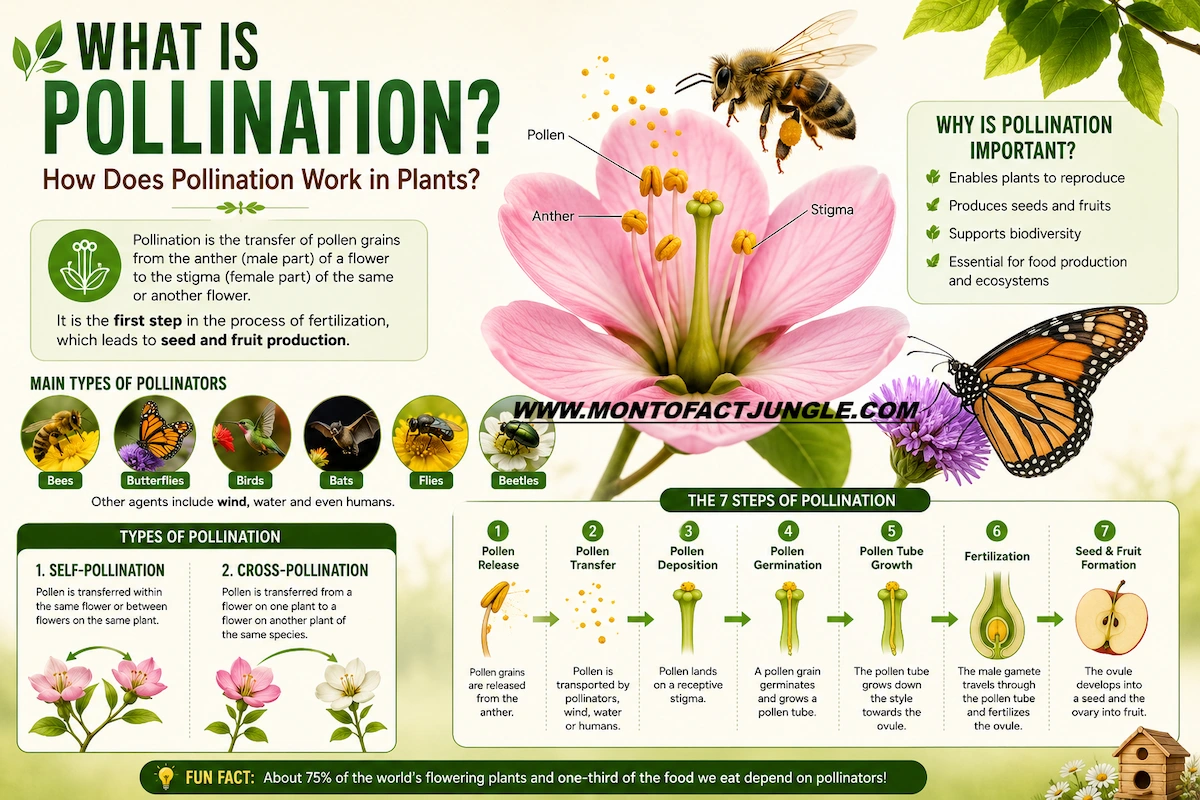
An educational pollination infographic showing how pollen moves from the anther to the stigma, the main pollinators and pollination agents, self-pollination and cross-pollination, and the stages from pollen transfer through fertilization to seed and fruit development.
🎥 Watch :Video Explaining What Is Pollination?
🔍 How to Read the Pollination Diagram
If you are looking at a pollination diagram, follow the pollen's journey:
🟡 Anther — part of the stamen where pollen is produced
🟡 Pollen — tiny grains released from the anther
🐝 Pollinator — an animal that can carry pollen between flowers
🌬️ Wind / 💧 Water — non-animal ways pollen can be transported in some plants
🟣 Stigma — the receptive part of the female reproductive structure where pollen lands
🟢 Style — connects the stigma to the ovary
🟢 Ovary — contains ovules
🟢 Ovule — can develop into a seed after successful fertilization
Exam tip
If you need a one-line answer:
Pollination is the transfer of pollen grains from the anther to the stigma of a flower.
🌸 Quick Answer: What Is Pollination?
Pollination is the transfer of pollen grains from the anther to the stigma of a flower.
It is an important step in the reproduction of flowering plants. Successful pollination can allow fertilization to occur, which may lead to seed formation and, in many flowering plants, fruit development.
Simple formula
🌼 Anther → Pollen → Stigma → Pollination
The important thing to remember is:
Pollination = pollen reaches the stigma.
🐝 MFJ Pollination Check
| Term | What It Means |
|---|---|
| Pollination | Pollen moves from anther to stigma |
| Pollinator | Animal that carries pollen between flowers |
| Self-Pollination | Pollen stays within the same plant |
| Cross-Pollination | Pollen moves between different plants of the same species |
| Wind Pollination | Wind carries the pollen (also called anemophily) |
| Fertilization | Male and female gametes fuse — happens after pollination |
| Result | Ovule → Seed · Ovary → Fruit |
🌱 Flower Parts You Need to Know
Before learning pollination, it helps to know the main parts of a flower.
| Flower Part | What It Does |
|---|---|
| Anther | Produces pollen |
| Filament | Supports the anther |
| Stigma | Receives pollen |
| Style | Connects the stigma to the ovary and provides a pathway for the pollen tube |
| Ovary | Contains ovules |
| Ovule | Can develop into a seed after fertilization |
👉 For a complete explanation, see our Parts of a Flower and Their Functions, 100 Flowers Name, What is Fertilization In Plants guide.
Table of Contents
- What Is Pollination? How Does Pollination Work in Plants?
- 🎥 Watch :Video Explaining What Is Pollination?
- 🔍 How to Read the Pollination Diagram
- 🌸 Quick Answer: What Is Pollination?
- 🐝 MFJ Pollination Check
- 🌱 Flower Parts You Need to Know
- 🌸 What Is Pollination?
- 🌻 A Real-Life Example: Pollination in an Apple Orchard
- 🔄 How Does Pollination Work? Step by Step
- 🐝 What Is a Pollinator?
- 🌬️ Pollinators vs Pollination Agents
- 🌼 What Are the Main Pollination Agents?
- 🌼 What Are the Two Main Types of Pollination?
- 1. 🌼 Self-Pollination
- 2. 🌼 Cross-Pollination
- 🌸 Self-Pollination vs Cross-Pollination
- 🌬️ What Is Wind Pollination?
- 🐝 How Do Bees Pollinate Flowers?
- 🐦 Can Birds and Bats Pollinate Flowers?
- 🖐️ Can Humans Pollinate Plants?
- 🌱 Do Flowers Need Pollination?
- 🌱 Why Is Pollination Important?
- 🧬 Pollination vs Fertilization
- 🍎 What Happens After Pollination?
- 🏡 How Can You Help Pollinators in a Garden?
- 🔬 Flower Detective Activity
- ⚠️ Common Mistakes About Pollination
- 📚 Pollination Vocabulary
- 🧠 Easy Memory Tricks
- 🌟 Interesting Facts About Pollination
- 📝 What Is Pollination? Class 3–8 Answers
- ⚡ One-Minute Pollination Revision
- 🧠 Quick Quiz: Test Yourself
- 1. Which part of a flower produces pollen?
- 2. Which part receives pollen?
- 3. What is pollination?
- 4. What are the two main types of pollination?
- 5. Which can be a pollinator?
- 6. Is pollination the same as fertilization?
- 7. What can an ovule develop into after successful fertilization?
- 8. Can humans pollinate plants by hand?
- ❓ Frequently Asked Questions
- What is pollination in biology?
- What are the two types of pollination?
- What is self-pollination?
- What is cross-pollination?
- What is a pollinator?
- What is wind pollination?
- Can plants be pollinated by humans?
- What happens after pollination?
- Why is pollination important?
- Where does pollination happen?
- What is air pollination?
- Can flowers be pollinated without bees?
- Can humans pollinate a flower by hand?
- Do flowers need pollination?
- 📚 References
- 🌱 Related Articles
- 🌸 From Flower to Fruit and Seed
🌸 What Is Pollination?
Pollination is a process in which pollen grains move from an anther to a receptive stigma.
The pollen may reach:
The same flower
Another flower on the same plant
A flower on a different plant of the same species
The first two can be forms of self-pollination, while transfer between different plants of the same species is cross-pollination.
Pollination usually happens before fertilization. It is therefore important to distinguish these two processes: pollination moves pollen; fertilization involves the fusion of male and female gametes.
🌻 A Real-Life Example: Pollination in an Apple Orchard
Picture a small apple orchard in spring. Rows of apple trees are covered in white blossoms, and honeybees move steadily from flower to flower.
As a bee lands on one blossom to feed on nectar, pollen from that flower's anthers sticks to the hairs on its body. When the bee flies to the next tree and lands on another blossom, some of that pollen brushes off onto the stigma — completing pollination.
This is exactly why orchard growers often keep beehives nearby, or hire beekeepers to bring in hives during flowering season. Many apple varieties are self-incompatible, meaning a single tree usually cannot pollinate its own flowers — it needs pollen from a different apple variety flowering at the same time. Without enough bee activity moving pollen between varieties, far fewer flowers get pollinated, and the orchard produces a much smaller apple harvest.
This single, ordinary scene — a bee moving between blossoms — is the same basic process behind most of the fruit in a grocery store.
🔄 How Does Pollination Work? Step by Step
Pollination itself is the transfer of pollen to the stigma. The later steps explain what can happen after successful pollination.
Step 1 — The anther produces pollen
The anther, part of the stamen, produces pollen grains.
🟡 Anther → Pollen
Step 2 — Pollen leaves the anther
Pollen can be transported by different pollination agents, including:
🐝 Bees
🦋 Butterflies and moths
🪲 Beetles
🪰 Some flies
🐦 Birds
🦇 Bats
🌬️ Wind
💧 Water
🖐️ Humans through hand pollination
Step 3 — Pollen reaches the stigma
When compatible pollen lands on a receptive stigma, pollination has occurred.
🟡 Pollen → 🟣 Stigma
Step 4 — The pollen grain may germinate
If the pollen is compatible with the flower, it can germinate on the stigma and form a pollen tube.
Step 5 — The pollen tube grows
The pollen tube grows down through the style toward an ovule inside the ovary.
Step 6 — Fertilization may occur
A male gamete delivered through the pollen tube can fuse with a female gamete.
This is fertilization, not pollination.
Step 7 — Seed development follows successful fertilization
After successful fertilization, the ovule can develop into a seed. In many flowering plants, the ovary develops into a fruit. Explore 100 Fruits Name and 100 Seeds Name
🌸 The complete journey
Anther → Pollen → Stigma → Pollen Tube → Ovule → Fertilization → Seed
And often:
Ovary → Fruit
🐝 What Is a Pollinator?
A pollinator is a living animal that helps transfer pollen from one flower to another.
Common pollinators include:
🐝 Bees
🦋 Butterflies
🦋 Moths
🪲 Beetles
🪰 Flies
🐦 Birds
🦇 Bats
Many pollinators visit flowers to obtain nectar, pollen, or other food. During these visits, pollen can stick to their bodies and later be transferred to another flower.
Bees are particularly important pollen movers, but they are certainly not the only pollinators.
🌬️ Pollinators vs Pollination Agents
These terms are easy to confuse.
| Term | Meaning |
|---|---|
| Pollination | Transfer of pollen to a stigma |
| Pollinator | A living animal that helps transfer pollen |
| Pollination agent | Something that helps move pollen, including animals, wind, or water |
Easy example
🐝 Bee = pollinator
🌬️ Wind = pollination agent
💧 Water = pollination agent
So, technically, wind and water are not pollinators because they are not living organisms.
🌼 What Are the Main Pollination Agents?
Pollen can be transported in several ways.
| Pollination helper | Example | How pollen moves |
|---|---|---|
| 🐝 Bees | Honey bees, other bees | Pollen sticks to their bodies |
| 🦋 Butterflies & moths | Flower-visiting species | Pollen is carried during flower visits |
| 🪲 Beetles | Flower-visiting beetles | Pollen can stick to their bodies |
| 🪰 Flies | Some flower-visiting flies | Transfer pollen between flowers |
| 🐦 Birds | Flower-visiting birds | Pollen can attach to feathers or body parts |
| 🦇 Bats | Some nectar-feeding bats | Transfer pollen while visiting flowers |
| 🌬️ Wind | Many grasses and cereals | Air currents carry pollen |
| 💧 Water | Some aquatic plants | Water transports pollen |
| 🖐️ Humans | Hand pollination | People deliberately transfer pollen |
Plants have different adaptations depending on how their pollen is transported. Insect-pollinated flowers may use scent, colour and nectar rewards, while wind-pollinated plants often produce large quantities of lightweight pollen.
🌼 What Are the Two Main Types of Pollination?
The two main types are:
Self-pollination
Cross-pollination
1. 🌼 Self-Pollination
Self-pollination is the transfer of pollen to the stigma within the same flower or between flowers on the same plant.
Simple memory trick:
SELF = SAME PLANT
Self-pollination can allow a plant to produce seeds without pollen coming from a different plant.
Examples of plants that can self-fertilise include beans and tomatoes, although reproductive biology can vary between species and varieties.
2. 🌼 Cross-Pollination
Cross-pollination is the transfer of pollen from a flower on one plant to a flower on another plant of the same species.
Simple memory trick:
CROSS = DIFFERENT PLANTS OF THE SAME SPECIES
Cross-pollination can increase genetic diversity in plant populations.
Some plants require or strongly benefit from pollen from another compatible plant. For example, some apple and pear cultivars require compatible partners for reliable fruit production.
🌸 Self-Pollination vs Cross-Pollination
| Feature | Self-Pollination | Cross-Pollination |
|---|---|---|
| Where does pollen go? | Within the same plant | To another plant of the same species |
| Same flower possible? | Yes | No |
| Different plant required? | No | Yes |
| Pollinator required? | Not always | Often involved |
| Genetic diversity | Usually lower | Usually greater |
| Memory trick | SELF = SAME PLANT | CROSS = DIFFERENT PLANTS |
🌬️ What Is Wind Pollination?
Wind pollination is pollination in which wind carries pollen from anther to stigma. It is also called anemophily.
Many wind-pollinated plants, including grasses and cereal crops, produce large amounts of lightweight pollen that can be carried by air currents. Their flowers often do not need the strong colours, scents or nectar rewards used to attract animal pollinators.
Easy memory trick
Wind pollination = pollen travels through the air.
🐝 How Do Bees Pollinate Flowers?
Imagine a bee moving from flower to flower:
🐝 The bee visits a flower for nectar or pollen.
🟡 Pollen from the anther sticks to the bee.
🐝 The bee flies to another flower.
🟣 Some pollen contacts the stigma.
🌸 Pollination occurs.
Simple journey
Flower → Bee → Flower
Plants can attract pollinators using features such as flower colour, scent and nectar rewards.
🐦 Can Birds and Bats Pollinate Flowers?
Yes.
Some flowering plants are pollinated by birds, while others are pollinated by bats.
When an animal visits a flower, pollen can attach to its body. When it visits another suitable flower, some of that pollen may reach the stigma.
So pollination is not limited to bees.
🖐️ Can Humans Pollinate Plants?
Yes. Some plants can be pollinated by hand.
Hand pollination involves deliberately transferring pollen from an anther to a suitable stigma.
It can be used in:
Gardening
Plant breeding
Agriculture
Controlled experiments
Simple example
A grower can collect pollen from one flower and carefully place it on the stigma of another compatible flower.
This is called hand pollination or manual pollination.
🌱 Do Flowers Need Pollination?
Many flowering plants depend on successful pollination for sexual reproduction and seed production.
However, plants differ in their reproductive systems. Some can self-pollinate, some depend mainly on cross-pollination, and some are pollinated by wind or other mechanisms.
The important chain is:
Pollination → Fertilization → Seed development
And in many flowering plants:
Ovary → Fruit
🌱 Why Is Pollination Important?
Pollination is important because it enables pollen to reach the female reproductive structure of a flower.
Successful pollination can ultimately contribute to:
🌱 Seed production
🍎 Fruit development
🌾 Crop production
🌳 Plant reproduction
🐝 Healthy relationships between plants and pollinators
🌍 Biodiversity and ecosystems
Pollinators are also important to food production. Many fruits, vegetables and nuts depend on animal pollination to produce abundant crops.
🧬 Pollination vs Fertilization
These two words are often confused.
| Pollination | Fertilization |
|---|---|
| Transfer of pollen | Fusion of male and female gametes |
| Anther → Stigma | Male gamete → Female gamete |
| Happens before fertilization | Follows successful pollination |
| Does not itself form a seed | Leads to formation of a zygote and subsequent seed development |
🧠 Easy memory trick
Pollination = Pollen arrives
Fertilization = Gametes fuse
🍎 What Happens After Pollination?
Pollination does not immediately mean that a fruit or seed has formed.
After compatible pollen reaches the stigma:
Pollen grain → Pollen tube → Male gamete reaches ovule → Fertilization → Seed development
In many flowering plants:
Ovule → Seed
Ovary → Fruit
The complete flower-to-fruit journey
🌸 Flower → 🟡 Pollen → 🐝 Pollination → 🧬 Fertilization → 🌱 Seed → 🍎 Fruit
🏡 How Can You Help Pollinators in a Garden?
A pollinator-friendly garden can provide food and habitat for bees, butterflies, moths, flies, beetles and other pollinating animals.
You can help by:
🌸 Growing a variety of flowering plants.
🐝 Providing plants that offer nectar and/or pollen.
🌿 Providing suitable shelter and habitat.
💧 Providing access to water where appropriate.
🌼 Choosing plants that flower at different times where possible.
🐛 Avoiding unnecessary disturbance of visiting pollinators.
🧴 Using pesticides carefully and according to their directions.
Pollinators need more than flowers: suitable habitat can also provide food, water, shelter and space.
🔬 Flower Detective Activity
You need:
One flowering plant
A notebook
A pencil
What to do:
Find a flower.
Identify the anther and stigma if they are visible.
Watch for visiting insects or birds.
Record which visitors come to the flower.
Notice whether they move between flowers.
Challenge
Can you explain how a visiting insect could carry pollen from one flower to another?
Remember: observe quietly rather than catching or disturbing the animals.
⚠️ Common Mistakes About Pollination
❌ “Pollination and fertilization are the same.”
No.
Pollination is pollen transfer. Fertilization is the fusion of male and female gametes.
❌ “Only bees pollinate flowers.”
No.
Bees are important pollinators, but butterflies, moths, beetles, flies, birds and bats can also pollinate flowers. Wind and water can transport pollen in some plants.
❌ “Every flower needs an insect.”
No.
Some plants are wind-pollinated, while others use different mechanisms.
❌ “Pollen becomes the seed.”
No.
Pollen carries male reproductive cells. After successful fertilization, the ovule can develop into a seed.
❌ “Pollination always produces fruit.”
No.
Pollination enables the reproductive process, but successful fruit and seed development depends on the plant and other conditions.
📚 Pollination Vocabulary
| Word | Meaning |
|---|---|
| Pollen | Tiny grains produced by the anther |
| Anther | Part of the stamen that produces pollen |
| Stigma | Receptive part of the female reproductive structure |
| Pollination | Transfer of pollen to a stigma |
| Pollinator | Living animal that helps transfer pollen |
| Self-pollination | Pollen transfer within the same plant |
| Cross-pollination | Pollen transfer between different plants of the same species |
| Pollen tube | Tube that grows from a compatible pollen grain toward an ovule |
| Fertilization | Fusion of male and female gametes |
| Ovule | Structure that can develop into a seed after fertilization |
| Ovary | Structure containing ovules and often developing into fruit |
🧠 Easy Memory Tricks
Anther = makes pollen
Stigma = receives pollen
Pollen moves = Pollination
Gametes fuse = Fertilization
Ovule → Seed
Ovary → Fruit
SELF = SAME PLANT
CROSS = DIFFERENT PLANTS OF THE SAME SPECIES
🌟 Interesting Facts About Pollination
🐝 Bees are not the only pollinators.
🦋 Butterflies and moths can transfer pollen between flowers.
🪲 Beetles and 🪰 some flies also act as pollinators.
🐦 Some birds pollinate flowers.
🦇 Some bats pollinate flowers, especially certain night-blooming plants.
🌬️ Wind pollinates many grasses and cereal crops.
💧 Water can transfer pollen in some aquatic plants.
🌸 Flowers can use colour, scent and nectar to attract pollinators.
🖐️ Humans can deliberately pollinate some plants by hand.
🌱 Successful pollination can ultimately contribute to seed and fruit production.
🧬 Cross-pollination can increase genetic diversity.
🍎 Pollination is especially important for the production of many fruits, vegetables and nuts.
📝 What Is Pollination? Class 3–8 Answers
Class 3 — Very Short Answer
Pollination is the transfer of pollen from the anther to the stigma of a flower.
Class 4 — Simple Answer
Pollination is the process in which pollen moves from the anther to the stigma of a flower.
Class 5 — Short Answer
Pollination is the transfer of pollen from anther to stigma. It helps flowering plants reproduce and form seeds.
Class 6 — Answer
Pollination is the transfer of pollen grains from anther to stigma. It can occur within the same plant or between different plants of the same species.
Class 7–8 — Fuller Answer
Pollination is the transfer of pollen grains from the anther to a receptive stigma. It may be self-pollination or cross-pollination. Successful pollination can be followed by fertilization and seed development.
⚡ One-Minute Pollination Revision
What is pollination?
→ Transfer of pollen from anther to stigma.
What produces pollen?
→ Anther.
What receives pollen?
→ Stigma.
What is a pollinator?
→ A living animal that helps transfer pollen.
What are the two main types?
→ Self-pollination and cross-pollination.
What is wind pollination?
→ Pollination in which wind carries pollen.
What happens after successful pollination?
→ A compatible pollen grain may germinate and form a pollen tube, allowing fertilization to occur.
What does the ovule become?
→ A seed after successful fertilization.
What does the ovary often become?
→ Fruit.
🧠 Quick Quiz: Test Yourself
1. Which part of a flower produces pollen?
A. Stigma
B. Anther
C. Ovary
D. Petal
Answer: B. Anther
2. Which part receives pollen?
A. Stigma
B. Filament
C. Sepal
D. Ovule
Answer: A. Stigma
3. What is pollination?
A. Formation of a fruit
B. Fusion of gametes
C. Transfer of pollen to a stigma
D. Formation of leaves
Answer: C. Transfer of pollen to a stigma
4. What are the two main types of pollination?
A. Wind and water
B. Self and cross
C. Flower and fruit
D. Seed and pollen
Answer: B. Self and cross
5. Which can be a pollinator?
A. Bee
B. Butterfly
C. Bird
D. All of these
Answer: D. All of these
6. Is pollination the same as fertilization?
Answer: No. Pollination is pollen transfer, while fertilization is the fusion of male and female gametes.
7. What can an ovule develop into after successful fertilization?
Answer: A seed.
8. Can humans pollinate plants by hand?
Answer: Yes. Humans can manually transfer pollen in some plants.
❓ Frequently Asked Questions
What is pollination in biology?
Pollination is the transfer of pollen grains from anther to stigma. It is an important part of reproduction in flowering plants.
What are the two types of pollination?
The two main types are self-pollination and cross-pollination.
What is self-pollination?
Self-pollination is pollen transfer within the same flower or between flowers on the same plant.
What is cross-pollination?
Cross-pollination is pollen transfer from a flower on one plant to a flower on another plant of the same species.
What is a pollinator?
A pollinator is a living animal that helps transfer pollen between flowers. Examples include bees, butterflies, moths, beetles, flies, birds and bats.
What is wind pollination?
Wind pollination is pollination in which wind carries pollen from anther to stigma. It is also called anemophily.
Can plants be pollinated by humans?
Yes. Humans can manually transfer pollen from anther to a suitable stigma. This is called hand or manual pollination.
What happens after pollination?
A compatible pollen grain may germinate on the stigma and produce a pollen tube. The male gamete can then reach an ovule, where fertilization may occur. After successful fertilization, the ovule can develop into a seed.
Why is pollination important?
Pollination enables pollen to reach the female reproductive structure of a flower, allowing the reproductive process to continue. Successful pollination can ultimately contribute to seed and fruit production.
Where does pollination happen?
Pollination occurs when pollen reaches a receptive stigma. It may happen within the same flower, between flowers on the same plant, or between different plants of the same species.
What is air pollination?
Air pollination generally refers to wind pollination, in which air currents carry pollen between flowers.
Can flowers be pollinated without bees?
Yes. Flowers can be pollinated by other animals, such as butterflies, moths, beetles, flies, birds and bats. Some plants rely on wind or water instead.
Can humans pollinate a flower by hand?
Yes. A person can transfer pollen from an anther to a suitable stigma by hand.
Do flowers need pollination?
Many flowering plants require successful pollination for seed production, but reproductive strategies differ among plants.
📚 References
This article was fact-checked using trusted scientific and educational resources, including:
Royal Horticultural Society (RHS) — How Plants Reproduce — plant reproduction, pollination, self/cross-fertilisation, and wind/insect pollination.
Penn State Extension — Pollination and Pollinators — pollination, pollinators, self/cross-pollination, and the role of insects.
Royal Horticultural Society (RHS) — How Plants Reproduce — examples of self-fertilising and cross-fertilising plants and different pollination mechanisms.
Penn State Extension — Pollinator Habitat and Landscape — food, water, shelter, and habitat considerations for pollinators.
🌱 Related Articles
- Parts of a Flower and Their Functions
- 100 Flowers Name in English and Hindi
- 50 Seeds Name in English and Hindi with Pictures
- 100 Fruits Name in English and Hindi
- 100 Vegetables Name in English and Hindi
- 100 Spices Name in English and Hindi
🌸 From Flower to Fruit and Seed
Pollination is only one part of a much larger plant story.
🌸 Flower → 🟡 Pollen → 🐝 Pollination → 🧬 Fertilization → 🌱 Seed → 🍎 Fruit
The next time you see a bee moving between flowers, look closely. You may be watching one of nature's most important relationships in action. 🐝🌸🌱