🌱Plant Life Cycle: 5 Stages, Diagram & Simple Explanation for Kids
Plant Life Cycle: 5 Stages, Diagram & Simple Explanation for Kids
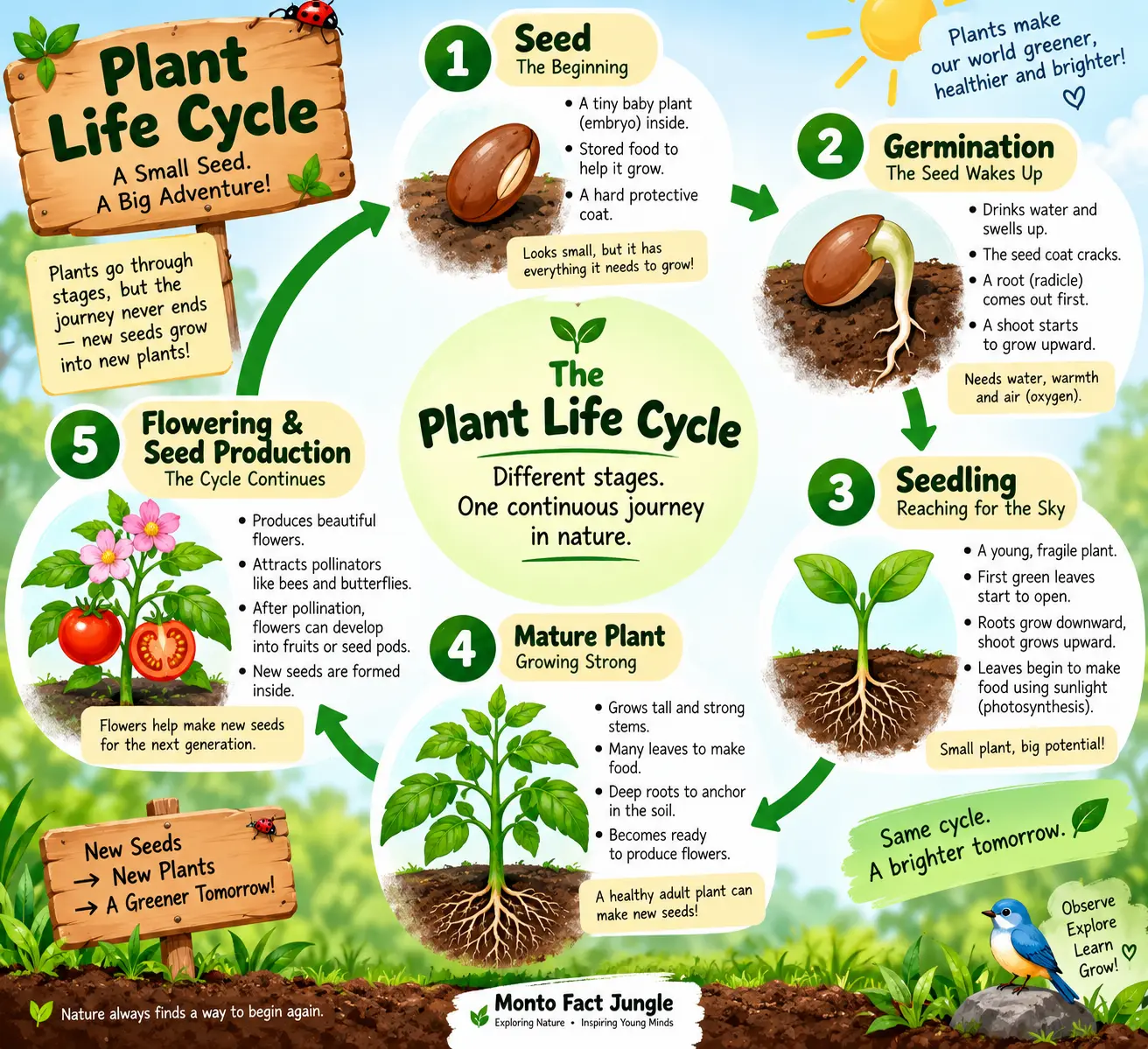
The plant life cycle in five simple stages, from seed to a mature flowering plant and new seeds.Have you ever wondered how a tiny seed becomes a big plant with leaves, flowers, fruits, and new seeds?
A plant goes through a series of stages during its life. This process is called the plant life cycle.
📌 Quick Answer: What Is the Plant Life Cycle?
The plant life cycle is the series of stages a plant goes through as it grows, matures, produces new seeds, and begins the cycle again.
Plant Life Cycle in Simple Words:
Seed → Germination → Seedling → Mature Plant → Flowering & Seed Production → New Seeds
The cycle then starts again when the new seeds grow into new plants.
The plant life cycle can be shown in 4, 5, or more stages depending on how the stages are grouped. A simple school-level version uses 5 stages: seed, germination, seedling, mature plant, and flowering/seed production.
🌱 MFJ Life Cycle Check
| Stage | What Happens |
|---|---|
| Seed | Contains a dormant embryo and stored food |
| Germination | Seed absorbs water; root and shoot emerge |
| Seedling | Young plant with first leaves; photosynthesis begins |
| Mature Plant | Full root, stem, and leaf growth; ready to flower |
| Flowering & Seed Production | Pollination and fertilization lead to new seeds |
👉 Related guides: Parts of a Flower
🔍 How to Read the Diagram
- Outer ring: the five stages in order, moving clockwise
- Arrow back to Seed: shows this is a cycle, not a straight line — new seeds restart the process
- Flowering stage: This is the reproductive stage in flowering plants, when pollination and, if successful, fertilization can lead to new seeds.
Table of Contents
- Plant Life Cycle: 5 Stages, Diagram & Simple Explanation for Kids
- 📌 Quick Answer: What Is the Plant Life Cycle?
- 🌱 MFJ Life Cycle Check
- 🔍 How to Read the Diagram
- What Is the Plant Life Cycle?
- 🌻 A Real-Life Example: Watching a Sunflower Complete Its Cycle
- 🌿 5 Stages of the Plant Life Cycle
- 🔄 Plant Life Cycle in Order
- ❓ Why Do Some Diagrams Show 4 Stages and Others Show 5?
- 🧒 Grade-Level Explanations
- 🌸 How Flowers Fit Into the Plant Life Cycle
- 🐝 How Does Pollination Fit Into the Plant Life Cycle?
- 🫘 Easy Plant Life Cycle Experiment: Grow a Bean Seed
- 📊 Plant Growth Observation Chart
- 🌱 What Happens During Germination?
- 🌞 Why Do Plants Need Sunlight?
- 🍎 What Happens to the Flower After Pollination?
- 🌻 More Real-Life Examples of Plant Life Cycles
- 🧠 Quick Plant Life Cycle Quiz
- ⚡ Quick Summary
- ❓ Frequently Asked Questions
- 📚 References
- 🌱 Explore More Plant Science
What Is the Plant Life Cycle?
The plant life cycle is the series of changes a plant goes through as it grows, develops, reproduces, and produces new seeds.
For many flowering plants, the cycle begins with a seed. When the seed gets the right conditions, it germinates and produces a young plant. The young plant grows into a mature plant. When the mature plant produces flowers, pollination and fertilization can eventually lead to the formation of new seeds — which can grow into new plants. That is why we call it a life cycle.
🌻 A Real-Life Example: Watching a Sunflower Complete Its Cycle
Picture a sunflower seed planted in a garden bed in early spring.
Within about a week, the seed absorbs moisture from the soil and a small root pushes downward, followed by a shoot breaking through the surface — germination is complete. Over the next few weeks, that seedling grows its first true leaves and begins making its own food through photosynthesis.
By midsummer, the plant has become a tall mature sunflower with a thick stem and broad leaves. At its peak, it produces a single large flower head — technically hundreds of tiny individual flowers packed together. Bees visiting for nectar carry pollen between these flowers, triggering pollination and, later, fertilization.
By early autumn, the flower head droops and dries, and each fertilized ovule has become a sunflower seed packed inside the head. Some of those seeds fall to the ground, and if conditions are right the following spring, the entire cycle begins again from a single seed.
🌿 5 Stages of the Plant Life Cycle
1. Seed – The Beginning
The life cycle begins with a seed. A seed contains a tiny developing plant called an embryo, along with stored food that supports the young plant during early development.
What does a seed need to germinate? 💧 Water · 🌡️ A suitable temperature · 🌬️ Oxygen
Example: A bean seed can remain dry for a period of time and begin growing when it receives enough moisture and suitable warmth.
2. Germination – The Seed Starts Growing
Germination is the process in which a seed begins to grow. When a seed gets enough water and suitable conditions, it absorbs water and the embryo becomes active. One of the first visible changes is usually the emergence of a young root called the radicle, followed by the shoot growing upward.
Simple sequence: Seed absorbs water → Seed coat opens → Root emerges → Shoot begins to grow
3. Seedling – A Young Plant
After germination, the young plant becomes a seedling, with a developing root system and shoot. Its first leaves begin to develop and help the plant make food through photosynthesis. The roots absorb water and minerals from the soil, while the leaves use light, water, and carbon dioxide to make food.
🌰 Seed → 🌱 Tiny root and shoot → 🌿 Young seedling
4. Mature Plant – The Plant Grows Up
As the seedling continues to grow, it develops more roots, stems, leaves, and branches. Eventually, the plant reaches maturity. A mature flowering plant can produce flowers and take part in reproduction — this is the stage where the plant is capable of continuing the life cycle.
Example: A small bean seedling can grow into a mature bean plant with many leaves and flowers.
5. Flowering & Seed Production – The Cycle Continues
For flowering plants, reproduction often begins when the mature plant produces flowers. During pollination, pollen is transferred from anthers to a stigma. After pollination, fertilization can occur, leading to the development of seeds. In many flowering plants, the ovary develops into a fruit that contains or surrounds the seeds.
The cycle becomes: Mature Plant → Flower → Pollination → Fertilization → Seed Development → New Seeds → New Plant
🔄 Plant Life Cycle in Order
If your teacher asks you to write the stages in order:
Seed → Germination → Seedling → Mature Plant → Flowering & Seed Production
For a more detailed version:
Seed → Germination → Seedling → Vegetative Growth → Flowering → Pollination → Fertilization → Seed Formation
Both versions describe the same general process, but the second separates some events into more detailed stages.
❓ Why Do Some Diagrams Show 4 Stages and Others Show 5?
You may find plant life-cycle diagrams showing 4, 5, 6, or more stages — that does not mean one diagram is wrong. Different textbooks and educational resources group biological events differently.
Simple 4-stage model: Seed & Germination → Seedling → Mature Plant → Flowering & Seed Production
Simple 5-stage model: Seed → Germination → Seedling → Mature Plant → Flowering & Seed Production
More detailed model: Seed → Germination → Seedling → Vegetative Growth → Flowering → Pollination → Seed Formation
For elementary students, the 5-stage version is easiest, since it separates the seed, germination, young plant, mature plant, and reproductive stage.
🧒 Grade-Level Explanations
Grades 2–3 (simple answer): A plant starts its life as a seed. The seed germinates and grows into a seedling. The seedling becomes a mature plant. The mature plant produces flowers and new seeds, which can grow into new plants.
Grades 4–5 (fuller answer): A seed contains an embryo. Under suitable conditions, it germinates and produces a young root and shoot. The seedling develops leaves and continues growing. As the plant becomes mature, it may produce flowers. In flowering plants, pollination transfers pollen to the stigma, and fertilization may then occur, leading to seed development. The new seeds can later germinate and produce another generation of plants.
Sequence: Seed → Germination → Seedling → Mature Plant → Flowering → Pollination → Fertilization → Seed Formation
🌸 How Flowers Fit Into the Plant Life Cycle
Flowers contain the reproductive structures of flowering plants:
- Stamen — the male reproductive part
- Anther — produces pollen
- Pistil/Carpel — the female reproductive structure
- Stigma — receives pollen
- Ovary — contains ovules
👉 Learn more: Parts of a Flower and Their Functions
🐝 How Does Pollination Fit Into the Plant Life Cycle?
Pollination is the transfer of pollen from anther to stigma. In many plants, insects such as bees and butterflies help transfer pollen. After successful pollination, fertilization may occur, which can lead to the development of seeds. Pollination connects the flowering stage with the production of the next generation of seeds.
👉 Learn more: What Is Pollination?
🫘 Easy Plant Life Cycle Experiment: Grow a Bean Seed
You do not need a laboratory to observe a plant life cycle — a transparent cup is enough.
You need: 1–2 bean seeds · a transparent cup · cotton or paper towel · water · a bright place
Steps:
- Place some damp cotton or paper towel inside the cup.
- Put the bean seed between the cotton and the side of the transparent cup.
- Keep the cotton moist, but do not completely soak it.
- Place the cup somewhere suitable for observing the seed.
- Check the seed every day and record what changes you see.
What might you observe: Seed → Swollen Seed → Root → Shoot → Seedling → Growing Plant
📊 Plant Growth Observation Chart
| Observation | What You May See |
|---|---|
| Day 1 | Dry seed |
| Day 2 | Seed absorbs water and becomes swollen |
| Day 3 | Seed coat may begin to split |
| Day 4 | Young root may appear |
| Day 5 | Shoot begins developing |
| Following days | Seedling continues growing |
Important: Timing is only an example — seeds do not all germinate at exactly the same speed. Temperature, moisture, seed condition, and plant species all affect growth speed.
🌱 What Happens During Germination?
A seed absorbs water and begins to become active. The seed coat may split, and the young root emerges to help the developing plant absorb water and minerals and anchor itself. The shoot grows upward and eventually develops into the stem and leaves.
🧠 Remember: Root grows down. Shoot grows up.
🌞 Why Do Plants Need Sunlight?
After germination, the young plant needs light to support photosynthesis — the process by which green plants use light energy to make food from carbon dioxide and water.
- Seed: Stored food supports early development.
- Seedling: Roots, leaves, and photosynthesis become increasingly important.
- Mature plant: The plant grows, produces flowers, and may reproduce.
🍎 What Happens to the Flower After Pollination?
After successful pollination and fertilization, the ovules can develop into seeds, and in many flowering plants the ovary develops into a fruit.
Flower → Pollination → Fertilization → Fruit & Seed Development
🌻 More Real-Life Examples of Plant Life Cycles
🌱 Bean: Seed → Germination → Seedling → Mature Bean Plant → Flowers → New Seeds
🌱 Pea: Seed → Germination → Seedling → Mature Plant → Flowers → Pods & Seeds
The exact timing and details vary from plant to plant, though the basic pattern stays the same.
🧠 Quick Plant Life Cycle Quiz
1. What is the first stage of the simple plant life cycle? A. Flower B. Seed C. Mature plant D. Fruit Answer: B
2. What is germination? A. When a flower produces pollen B. When a seed begins to grow C. When a fruit becomes ripe D. When a leaf falls Answer: B
3. What do we call a young developing plant? A. Seedling B. Fruit C. Pollen D. Flower Answer: A
4. Which part of a flowering plant produces pollen? A. Stigma B. Ovary C. Anther D. Root Answer: C
5. What can develop from an ovule after fertilization? A. Leaf B. Root C. Seed D. Stem Answer: C
6. Put these stages in order: Mature Plant – Seedling – Seed – Germination Answer: Seed → Germination → Seedling → Mature Plant
⚡ Quick Summary
Remember these 5 stages:
🌰 Seed — the plant begins here 💧 Germination — the seed begins to grow 🌱 Seedling — a young plant develops 🌿 Mature Plant — the plant grows larger and becomes capable of reproduction 🌸 Flowering & Seed Production — the plant produces flowers and eventually new seeds
The complete cycle: Seed → Germination → Seedling → Mature Plant → Flowering → New Seeds → New Plant
The plant life cycle is the series of stages through which a plant grows from a seed into a mature plant, produces new seeds, and begins the cycle again.
❓ Frequently Asked Questions
What are the 5 stages of the plant life cycle? Seed, germination, seedling, mature plant, and flowering & seed production.
What are the 4 stages of a plant life cycle? A simplified model combines seed and germination into one stage: seed & germination, seedling, mature plant, and flowering & seed production.
What is the first stage of the plant life cycle? The simple plant life cycle begins with a seed.
What happens during germination? A seed begins to grow under suitable conditions; the young root usually emerges first, followed by the shoot.
What is a seedling? A young developing plant that has grown from a seed.
What happens after a plant becomes mature? A mature flowering plant may produce flowers. Pollination and fertilization can then lead to new seeds.
What is the role of pollination in the plant life cycle? Pollination transfers pollen to the stigma. In flowering plants, successful pollination can be followed by fertilization and seed development.
How does the plant life cycle start again? New seeds produced by the mature plant can germinate under suitable conditions and grow into new plants.
Do all plants have exactly five stages? No. Different educational diagrams divide or combine stages differently — some show four stages, others a more detailed sequence with six or more.
How long does a plant life cycle take? It depends on the species. Some plants complete their life cycle within weeks or months, while trees may take years.
📚 References
- USDA Forest Service — What Is Pollination?
- University of Illinois Extension — Plant Parts: Flowers and Seeds
🌱 Explore More Plant Science
- Parts of a Flower and Their Functions
- What Is Fertilization in Plants?
- 100 Flowers Name in English and Hindi
- 50 Seeds Name in English and Hindi with Pictures
🌿 Plants Around Us
Plants are all around us — in gardens, parks, farms, balconies, and even small pots at home. Learning how seeds germinate, plants grow, flowers develop, and new seeds are produced helps children understand the plant life cycle they can observe in everyday life.