
Why Do Birds Wipe Their Beaks?
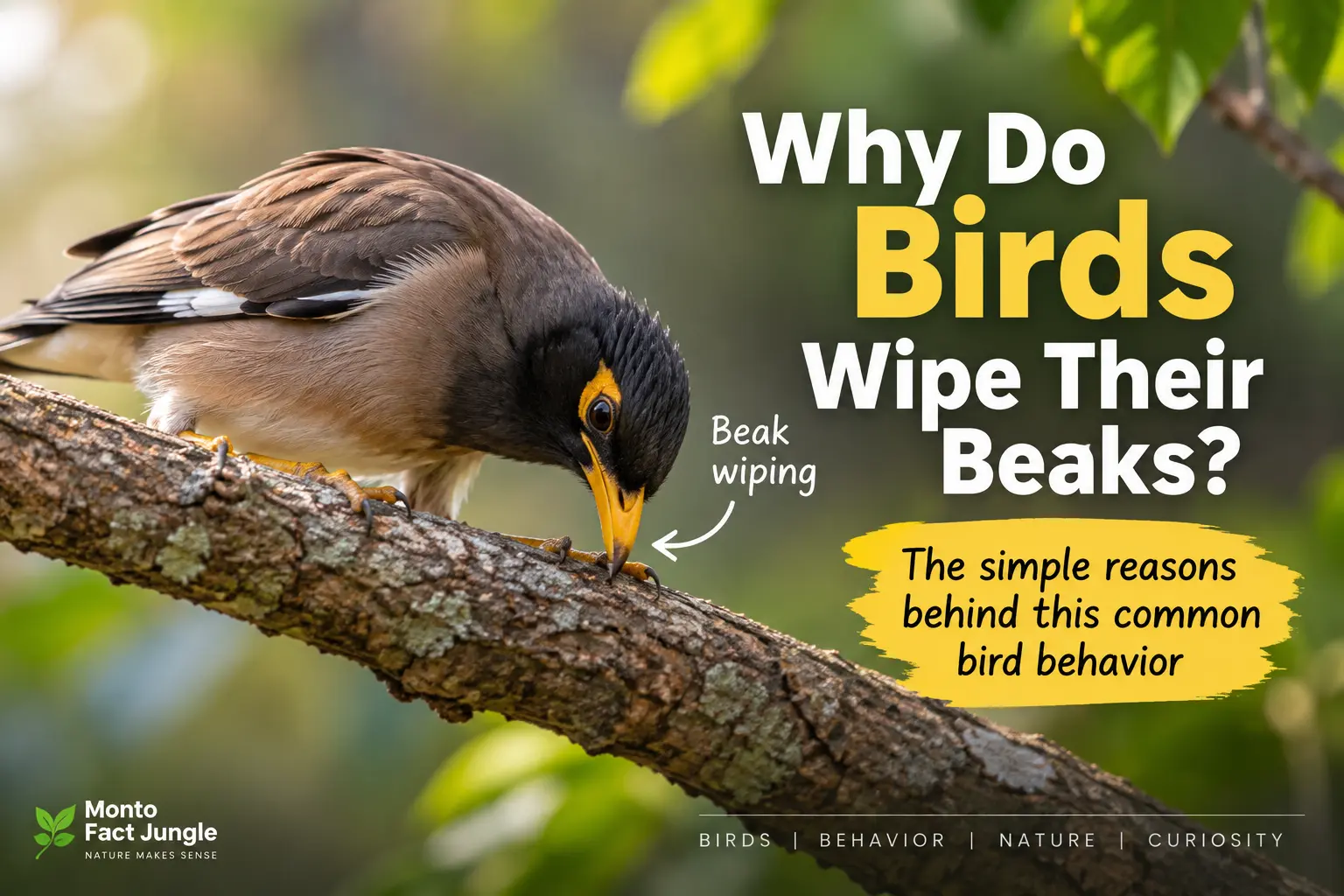
A bird rubbing its beak against a branch, showing the common behavior known as beak wiping or beak rubbing.Quick Answer
Birds wipe or rub their beaks mainly to remove leftover food and other material. They may rub their beaks against branches, perches, wires, or other rough surfaces. This behavior, sometimes called feaking, can also help with normal beak maintenance.
Quick Table
| Bird behavior | Why it happens |
|---|---|
| 🐦 Wipes beak after eating | Removes leftover food |
| 🌿 Rubs beak on a branch | Cleans the beak |
| 🪵 Scrapes beak on a rough surface | Helps remove material |
| 🦜 Repeated beak rubbing | May be part of normal beak maintenance |
Have you ever seen a bird rub its beak against a branch, perch, wire, or another rough surface?
This behavior is often called beak wiping or beak rubbing. Birds commonly do it after feeding to remove leftover food and other material from their beaks. Read Why Do Birds Shake Their Feathers?
Explore Do birds have feathers? ,Do Birds have ears?
Why Do Birds Wipe Their Beaks?
1. To clean their beaks
After eating juicy fruits, seeds, insects, or other foods, bits of food can remain around a bird's beak. Rubbing the beak against a rough surface helps scrape some of this material away.
2. To maintain their beak
A bird's beak is constantly being used for feeding and other everyday activities. Rubbing it against a suitable surface may also help maintain its edges and surface.
3. After eating messy food
Beak wiping can be especially noticeable after a bird eats something sticky or messy. A branch, perch, fence, or other surface can work like a natural "napkin."
What Do Birds Rub Their Beaks On?
Depending on where they are, birds may rub their beaks against:
Tree branches
Twigs
Perches
Fence posts
Wires
Other rough surfaces
- Read Do Birds Pee?
What Is "Feaking" in Birds?
Bird behavior experts sometimes use the term feaking for this kind of beak-rubbing behavior.
The exact reason can vary with the bird and situation. Cleaning and maintaining the beak are common explanations, while the behavior can sometimes occur in other social or behavioral contexts. Read Why Do Birds Suddenly Fly Away?
A Simple Bird-Watching Example
Imagine a pigeon eating food on the ground. After feeding, you may see it rub one side of its beak against a nearby surface.
It may look like the bird is simply "wiping its mouth"—and in many situations, cleaning leftover food is exactly what is happening.
Is Beak Wiping Normal?
Yes. Beak wiping is generally a normal behavior seen in many birds.
The next time you see a bird rubbing its beak on a branch or perch, watch what happened immediately beforehand. If it has just finished eating, the behavior may simply be part of its routine beak care.
Quick Summary
Birds wipe or rub their beaks mainly to remove food and other material and to help maintain their beaks. This behavior is sometimes called feaking.
Explore 100 Common Birds in the USA
FAQs
Why do birds rub their beaks on branches?
Branches provide a convenient rough surface for birds to wipe away food residue and other material from their beaks.
Do birds wipe their beaks after eating?
Yes. Beak wiping is often noticed after birds have eaten, particularly when the food leaves material on the beak.
What is feaking in birds?
Feaking is a term used for the behavior of rubbing or wiping the beak against a surface.
Do all birds wipe their beaks?
Many birds show beak-rubbing behavior, but how often they do it and why they do it can vary between species and situations.
Related: 200 birds name, Do Birds Eat Meat
References
- National Audubon Society — Here’s Why Birds Rub Their Beaks on Stuff
Covers beak wiping, cleaning after messy foods, beak maintenance, and other possible functions.
Read the Audubon article - National Audubon Society — Pecking Order
Provides background on bird beaks, including how they continually change and are shaped by use.
Learn more about bird beaks
You should also read:
Water Birds Name in English and Hindi (पानी में रहने वाले पक्षियों के नाम)
🦆Water Birds Name in English and Hindi (पानी में रहने वाले पक्षियों के नाम) A goose (Anser cygnoides) is a water bird commonly found near lakes, rivers, wetlands, and coastal areas. A high-quality image of a Goose (Anser cygnoides), a water bird adapted to lakes,…
Continue reading...100 Birds Name in Hindi and English-पक्षियों के नाम हिंदी और अंग्रेज़ी में – आसान, मज़ेदार और पूरी सूची
100 पक्षियों के नाम हिंदी और अंग्रेज़ी में 🌿 Real-Life Example (Gaon Ki Kahani) Maan lo aap summer vacation me gaon gaye ho. Subah 5 baje murga "kukdukoo" karta hai. Thodi der baad ped par baithi koil ki "koo-koo" awaaz aati hai. Ghar ke aas-paas…
Continue reading...20 Birds Name in Hindi and English (20 पक्षियों के नाम) | For Students & Easy Pronunciation
20 Birds Name in Hindi and English Here is a fresh set of 20 birds: क्या आपने कभी notice किया है कि हम रोज़ कई birds देखते हैं, लेकिन उनके English ya Hindi names हमें हमेशा याद नहीं रहते? इसीलिए students अक्सर search करते हैं…
Continue reading...10 Birds Name in Hindi and English (With Easy Meaning & GK Use)
🐦10 Birds Name in Hindi and English Quick Answer: 10 Birds Name in Hindi and English are Hoopoe, Woodpecker, Goose, Dove, Kingfisher, Indian Roller, Bulbul, Lapwing, Penguin, and Kiwi. Kya aapko school homework ya GK preparation ke liye birds ke naam chahiye? Bahut baar students…
Continue reading...