
🐦Do Birds Have Lips? Here's What Birds Have Instead
Do Birds Have Lips? Here's What Birds Have Instead
Quick Answer
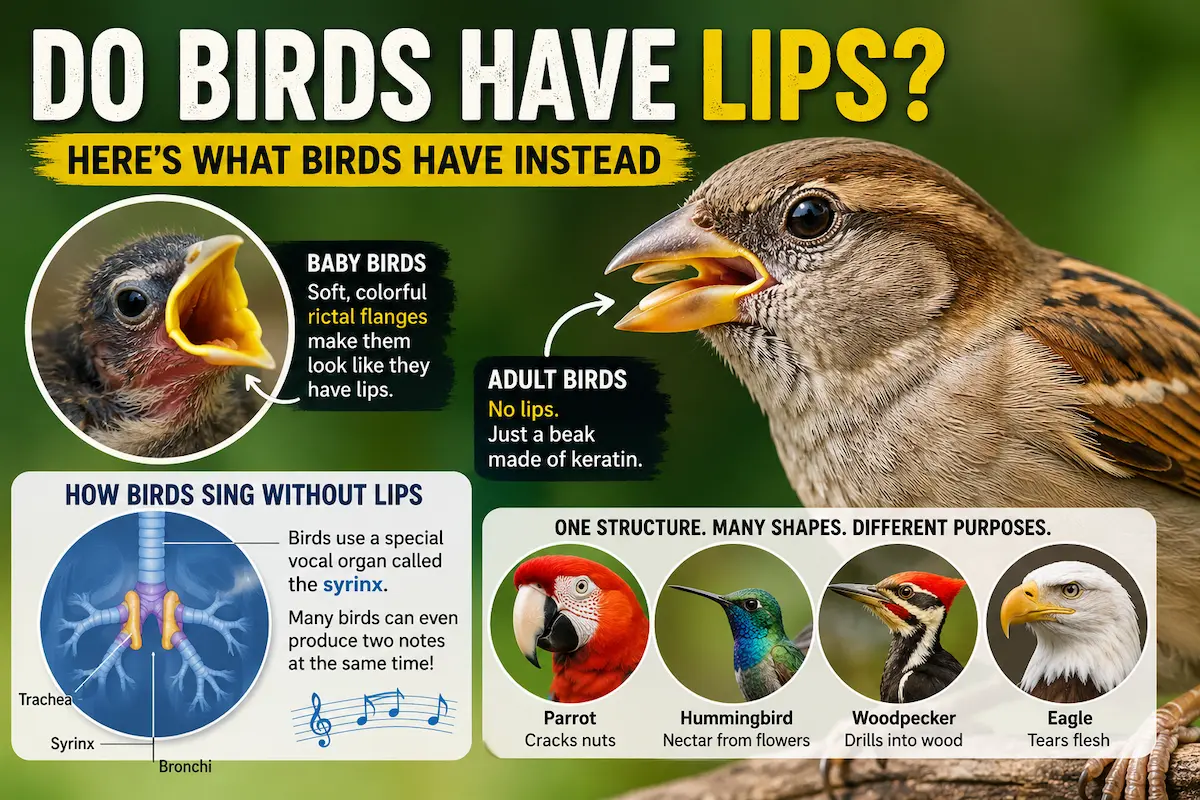
No, birds do not have true lips like humans and other mammals. Birds have beaks instead. Baby birds may appear to have lips because of soft, often colorful gape flanges around their mouths, but these are not true lips.
Look closely at a bird and you'll notice something interesting: no true lips like ours—just a beak surrounding the mouth.
Birds don't have true, muscular lips like humans and other mammals. Instead, their mouths are surrounded by a beak, also called a bill, made largely of keratin. The beak is a completely different structure, adapted to do many of the jobs birds need for feeding, grooming, carrying, and defense.
There's one interesting case worth knowing about: baby birds can look as if they have lips because of soft, fleshy structures around their mouths called gape flanges. But these aren't true lips, and they become much less noticeable as the bird matures.
Explore 100 interesting facts about birds, Do birds have ears, do birds have teeth, and do birds have tongues
Remember it this way
Humans → lips
Birds → beaks
Baby birds → rictal flanges can look like lips
Bird sounds → syrinx
What Are Lips?
Lips are soft, movable folds of tissue around the opening of the mouth.
In humans and many other mammals, lips help with eating, drinking and forming certain sounds. They can also play an important role in facial expression and communication.
Birds did not evolve this same kind of fleshy, muscular lip structure.
Instead, the front of a bird's mouth is adapted into a beak. Read do birds have teeth
🏠 A Simple Real-Life Example
Imagine a child watching a sparrow pick up a piece of food.
The child might ask:
"Where are the bird's lips?"
The answer is: there aren't any true lips to look for.
The sparrow uses its beak to pick up the food, position it in its mouth and swallow it.
So the next time you see a bird eating, look closely at its beak.
That's the bird's specialized feeding tool — not a pair of hidden lips.
Read Do Birds Pee?
Lips vs. Beak: Two Different Systems
A bird's beak is not simply a hard cover placed over a normal mammal-like mouth. It is a specialized structure that has evolved to suit the bird's way of life.
The outer part of the beak is made largely of keratin, the same structural protein found in human fingernails and hair.
| Feature | Birds | Humans |
|---|---|---|
| True muscular lips | No | Yes |
| Beak | Yes | No |
| Main feeding structures | Beak, tongue and mouth | Lips, teeth, tongue and mouth |
| Main vocal organ | Syrinx | Larynx |
| Babies nurse with milk | No | Yes |
What does a bird use its beak for?
A bird's beak can be used to:
Pick up food
Crack seeds and nuts
Tear food or prey
Catch insects
Drink
Groom feathers
Carry nesting material
Manipulate objects
Defend itself
And beaks can look dramatically different from one bird to another.
A parrot has a short, powerful, curved beak suited to cracking hard foods.
A hummingbird has a long, slender bill that helps it reach nectar inside flowers.
A woodpecker has a strong, chisel-like bill adapted for working into wood.
Same basic structure.
Completely different tools.
Why Don't Birds Have Lips?
Birds evolved a very different feeding system from mammals.
Mammal lips are fleshy, mobile structures that perform several functions, including helping young mammals nurse. Birds hatch from eggs and do not nurse their young with milk.
Instead, birds evolved beaks that can perform many important functions involved in feeding and interacting with their environment.
So birds aren't missing something that mammals have.
They simply evolved a different solution.
That's an important idea in biology: different animals can solve similar problems using completely different body structures.
🐣 Do Baby Birds Have Lips?
This is where bird anatomy gets interesting.
Baby birds do not have true lips, but some can certainly look as though they do.
Many nestling birds have soft structures around the edges and corners of their mouths called rictal flanges. These structures can be swollen and brightly colored, making a chick's open mouth look surprisingly lip-like.
In some species, these mouth structures also play a role in begging and parental feeding. Their color and appearance can provide visual information to parents when chicks are competing for food.
Why are rictal flanges useful?
For a long time, researchers emphasized their visibility as a possible aid for parents locating a chick's mouth.
Research has also shown that the appearance of these flanges can act as a visual signal of a nestling's condition and hunger in some species.
In other words, the colorful mouth of a hungry chick isn't just a strange-looking feature.
It can be part of the communication system between parent and offspring.
As the chick grows, the soft juvenile mouth structures become much less noticeable and the bird develops its familiar adult appearance.
🐣 Baby Bird vs. Adult Bird
| Feature | Baby bird | Adult bird |
|---|---|---|
| Mouth appearance | Often looks soft and fleshy | More strongly defined by the beak |
| Rictal flanges | More prominent | Much less noticeable |
| True lips | No | No |
| Feeding | Parents provide food | Bird obtains and handles food itself |
🍽️ Can Birds Eat Without Lips?
Yes. Birds can eat perfectly well without lips.
Their beaks are adapted to the food and lifestyle of each species.
For example:
A finch can use its strong beak to handle seeds.
An eagle can use its hooked bill to tear flesh.
A hummingbird can reach nectar with its slender bill.
A woodpecker can use its bill to work into wood.
A parrot can crack hard nuts with its powerful beak.
The beak therefore does far more than simply surround the mouth.
It is one of the bird's most important tools.
🎵 How Do Birds Make Sounds Without Lips?
If birds don't have lips like humans, how can they sing?
The answer is one of the most fascinating parts of bird anatomy:
Birds use a special vocal organ called the syrinx.
The syrinx is located low in the respiratory system, near the point where the trachea divides into two branches leading toward the lungs.
Humans produce vocal sounds primarily using the larynx, but birds use the syrinx.
And the syrinx is remarkably specialized.
In many songbirds, the two sides of the syrinx can be controlled independently. This allows some birds to produce different sounds from each side at the same time.
That helps explain how certain birds can produce remarkably complex songs.
The syrinx is also extremely old in evolutionary terms. The oldest known fossil syrinx was found in the remains of a bird from Antarctica that lived roughly 66–69 million years ago, near the end of the age of dinosaurs.
So birds don't need lips to sing.
They have their own specialized sound-making system.
🎵 Where Does a Bird's Song Come From?
When a bird sings, the sound isn't coming from its beak.
And surprisingly, it isn't being made in the same kind of voice box that humans use either.
Hidden deep inside a bird's body is a remarkable little organ called the syrinx. It sits at the point where the windpipe, or trachea, divides into two tubes leading to the lungs.
Think of it as a bird's built-in musical instrument.
As air moves through the syrinx, specialized tissues vibrate and create sound. The bird can then control those sounds with remarkable precision, turning simple airflow into calls, songs, whistles and other vocalizations.
🐦 Does Every Bird Have a Syrinx?
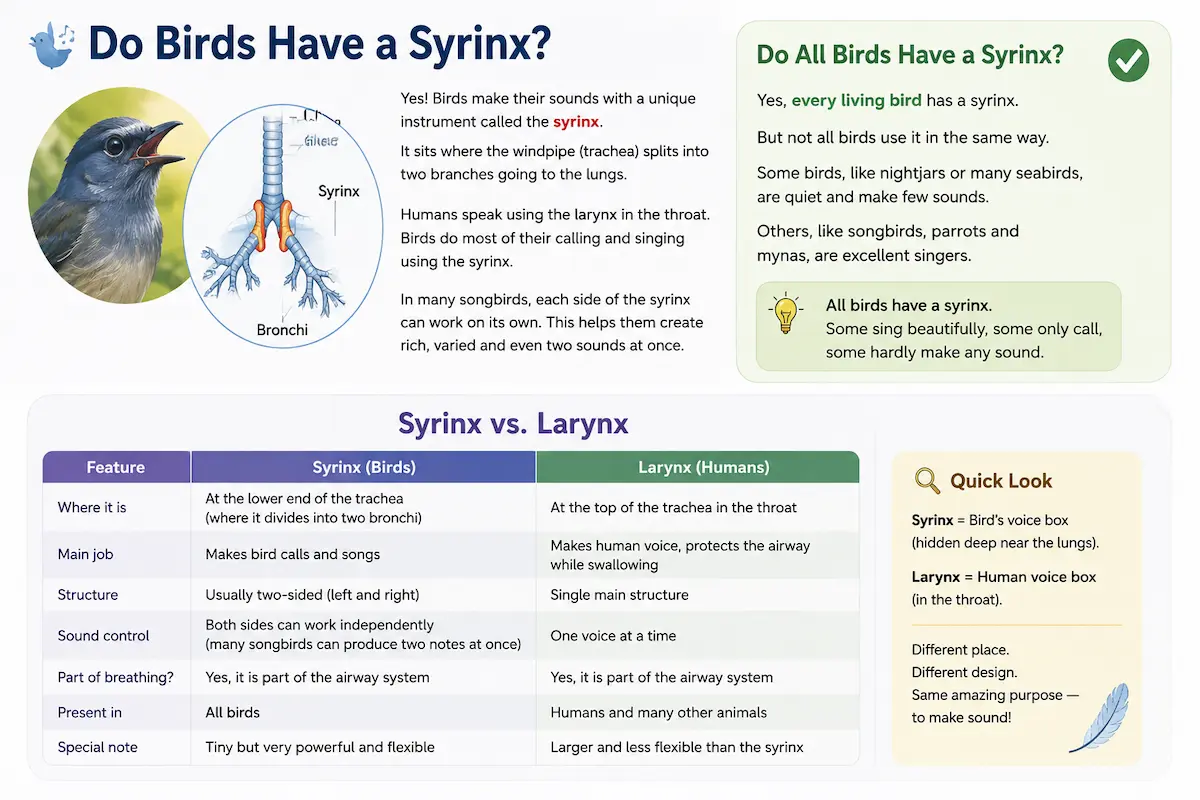
Yes. Every living bird has a syrinx.
But having the same basic instrument doesn't mean every bird uses it in the same way.
A nightingale can turn its syrinx into an astonishingly complicated musical system. A crow has a very different repertoire of sounds. Some birds mainly produce short calls, while others are capable of elaborate songs and vocal imitation.
In many songbirds, the two sides of the syrinx can also work independently. This gives them an unusual level of control over sound and allows some species to produce remarkably complex vocalizations.
So the interesting question isn't really “Which birds have a syrinx?”
They all do.
The better question is:
“What can each bird do with its syrinx?”
And that's where the diversity of bird sounds really begins.
🗣️ Syrinx vs. Larynx
Both the syrinx and larynx are involved in the respiratory and vocal systems, but they are not the same structure.
| Feature | Syrinx | Larynx |
|---|---|---|
| Found in | Birds | Humans and other vertebrates |
| Main role in birds/humans | Produces bird sounds | Produces human voice and protects the airway |
| Location | Where the trachea divides into the two bronchi | Upper part of the throat |
| Main sound-producing organ | Yes in birds | Yes in humans |
| Can produce complex sounds | Yes | Yes |
| Two-sided sound control | Possible in many birds | No equivalent two-sided system |
| Used for breathing | Part of the airway | Protects and controls the airway |
The easiest way to remember
Humans → Larynx → Voice
Birds → Syrinx → Calls and songs
And here's the really cool part: birds still have a larynx. They simply don't rely on it as their primary sound-producing organ the way humans do.
🧠 MFJ Quick Check
Can you remember where the syrinx is?
👉 Follow a bird's windpipe downward. Near the point where the trachea splits into two branches leading to the lungs, you'll find the syrinx.
Trachea → Syrinx → Two bronchi → Lungs
That's the bird's remarkable sound-making system.
🦷 Do Birds Have Teeth?
Most living birds do not have teeth.
Instead, their beaks and mouths perform many of the jobs involved in handling food.
But birds have an interesting evolutionary history.
Some ancient bird relatives had teeth, while modern birds are generally toothless.
That makes bird teeth another fascinating part of the same anatomy story.
👉 Read next: Do Birds Have Teeth?
🐦 Bird Mouth vs. Human Mouth
| Part or function | Birds | Humans |
|---|---|---|
| Lips | No true lips | Yes |
| Beak | Yes | No |
| Teeth | Generally absent | Yes |
| Tongue | Yes | Yes |
| Main vocal organ | Syrinx | Larynx |
| Milk nursing | No | Yes |
🤔 Why Do Birds Sometimes Look Like They Have Lips?
There are two common reasons a bird's mouth may appear slightly lip-like.
1. Baby birds
Their soft rictal flanges can make the edges of the mouth look fleshy and swollen.
2. The soft tissue around the beak
When viewed closely, the boundary between the beak and the surrounding mouth tissues can sometimes give the appearance of a lip.
But neither is a true mammalian-style lip.
🌎 Birds Aren't "Missing" Lips
It's easy to look at an animal and compare every part of it with our own body.
But evolution doesn't work from a checklist.
A bird doesn't need to have lips simply because humans do.
Birds evolved a different toolkit:
Beak → handling food and objects
Tongue → moving and manipulating food
Rictal flanges → juvenile visual/begging signals in many nestlings
Syrinx → producing sounds
Each structure fits the bird's way of life.
So "birds don't have lips" doesn't mean birds are missing something.
It means birds evolved a different design.
👀 Try This the Next Time You See a Bird
The next time you see a pigeon, sparrow or crow eating, watch its beak carefully.
Notice how it:
Picks up the food.
Moves or positions it.
Opens and closes the bill.
Swallows.
May even use the same beak later for grooming.
There are no true lips like the lips around a human mouth—the beak does the work.
The beak does the work.
💡 Did You Know?
A duck's broad bill, an eagle's hooked bill and a hummingbird's slender bill may look completely different, but they are all specialized versions of the same basic bird structure.
Their shapes reflect different diets and lifestyles.
One structure. Many designs.
🔍 MFJ Bird Lip Check
Can you spot a bird's lips?
The next time you see a pigeon, sparrow, crow, or any other bird, take a close look at its mouth.
Look for:
- A hard beak or bill surrounding the mouth
- The soft edge of the mouth where the beak meets the face
- Whether you can see any true, movable lips like yours
What will you notice?
You won't find a pair of true muscular lips like the ones around a human mouth. Instead, you'll see the bird's beak and the soft tissues around its mouth.
🐣 Try the same observation with a baby bird: its mouth may look much more lip-like because of the soft, often colorful rictal flanges. But remember — those aren't true lips.
MFJ Observation:
Adult bird → beak, not lips.
Baby bird → rictal flanges can make the mouth look lip-like.
🧠 Quick Quiz
1. Do birds have true lips like humans?
A. Yes
B. No
C. Only large birds
D. Only baby birds
Answer: B. No
2. What are the soft structures around many baby birds' mouths called?
A. Teeth
B. Syrinx
C. Rictal flanges
D. Scales
Answer: C. Rictal flanges
3. What organ do birds use to produce sounds?
A. Lips
B. Syrinx
C. Teeth
D. Beak
Answer: B. Syrinx
4. What makes many bird beaks different from one another?
A. Their diet and lifestyle
B. Their age only
C. Their feathers
D. Their ability to fly
Answer: A. Their diet and lifestyle
5. Do most living birds have teeth?
A. Yes
B. No
C. Only baby birds
D. Only birds that eat meat
Answer: B. No
❓ Frequently Asked Questions
Do birds have lips like humans?
No. Birds do not have true, muscular lips like humans and other mammals. Instead, they have beaks surrounding their mouths.
What do birds have instead of lips?
Birds have a specialized beak, or bill, that helps them eat, groom, carry objects and perform many other tasks.
Do baby birds have lips?
No. However, many baby birds have soft rictal flanges around their mouths that can make them look as though they have lips.
Why do baby birds have rictal flanges?
Rictal flanges can contribute to the visual signals chicks use when begging for food. In some species, their color and appearance provide information to parents during feeding.
Can birds eat without lips?
Yes. Birds use their beaks, tongues and mouths to pick up, manipulate and eat food.
How do birds sing without lips?
Birds use a specialized vocal organ called the syrinx, located near where the trachea divides toward the lungs.
Can birds make two sounds at once?
Some birds, especially certain songbirds, can independently control the two sides of the syrinx and produce different sounds simultaneously.
Do birds have teeth?
Most living birds do not have teeth, although some ancient bird relatives had them.
Do all birds have the same type of beak?
No. Beak shapes vary greatly because different birds have different diets and lifestyles.
📌 Quick Summary
Birds do not have true lips like humans and other mammals. Instead, they have specialized beaks that help them eat, groom, carry objects and interact with their environment.
Baby birds can sometimes look as though they have lips because of their soft rictal flanges, but these are not true lips.
Birds also don't need lips to sing. They use a specialized vocal organ called the syrinx, which allows many species to produce remarkably complex sounds.
The easiest way to remember:
Humans → lips
Birds → beaks
Baby birds → rictal flanges
Bird songs → syrinx
The absence of lips isn't a missing feature.
It's simply another example of how evolution can build different solutions to the same biological problems.
🔗 Explore More Bird Questions
Sources
You should also read:
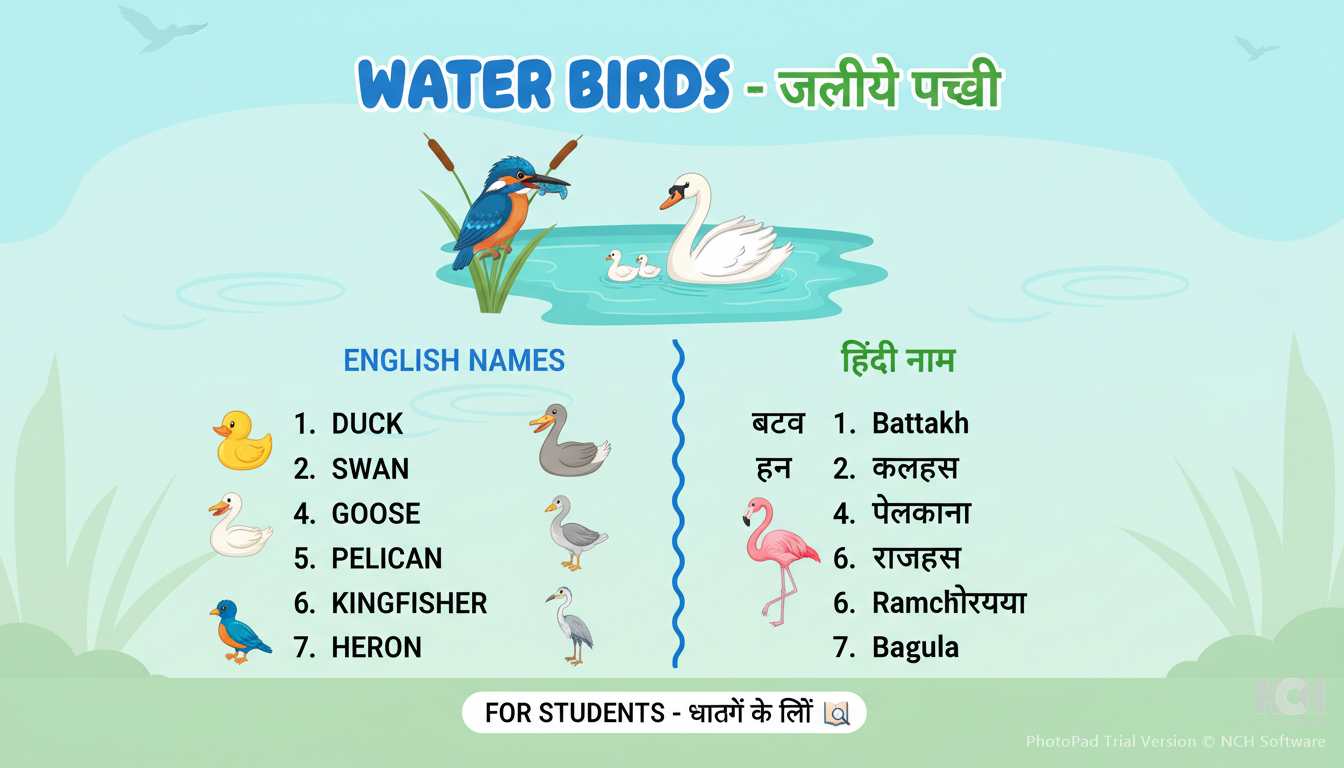
Water Birds Name in English and Hindi (पानी में रहने वाले पक्षियों के नाम)
🦆Water Birds Name in English and Hindi (पानी में रहने वाले पक्षियों के नाम) A goose (Anser cygnoides) is a water bird commonly found near lakes, rivers, wetlands, and coastal areas. A high-quality image of a Goose (Anser cygnoides), a water bird adapted to lakes,…
Continue reading...100 Birds Name in Hindi and English-पक्षियों के नाम हिंदी और अंग्रेज़ी में – आसान, मज़ेदार और पूरी सूची
100 पक्षियों के नाम हिंदी और अंग्रेज़ी में 🌿 Real-Life Example (Gaon Ki Kahani) Maan lo aap summer vacation me gaon gaye ho. Subah 5 baje murga "kukdukoo" karta hai. Thodi der baad ped par baithi koil ki "koo-koo" awaaz aati hai. Ghar ke aas-paas…
Continue reading...20 Birds Name in Hindi and English (20 पक्षियों के नाम) | For Students & Easy Pronunciation
20 Birds Name in Hindi and English Here is a fresh set of 20 birds: क्या आपने कभी notice किया है कि हम रोज़ कई birds देखते हैं, लेकिन उनके English ya Hindi names हमें हमेशा याद नहीं रहते? इसीलिए students अक्सर search करते हैं…
Continue reading...10 Birds Name in Hindi and English (With Easy Meaning & GK Use)
🐦10 Birds Name in Hindi and English Quick Answer: 10 Birds Name in Hindi and English are Hoopoe, Woodpecker, Goose, Dove, Kingfisher, Indian Roller, Bulbul, Lapwing, Penguin, and Kiwi. Kya aapko school homework ya GK preparation ke liye birds ke naam chahiye? Bahut baar students…
Continue reading...