
💰 Fixed vs. Variable Expenses: 100 Examples for a Household Budget
💰 Fixed vs. Variable Expenses: 100 Examples for a Household Budget
Copy description
Have you ever wondered why some bills stay almost the same every month while others keep changing? 🤔
Your rent might remain $1,500 every month, but your grocery bill could be $450 one month and $600 the next. Your internet plan might cost the same every month, while your electricity bill rises during summer.
These are examples of fixed expenses and variable expenses.
Understanding the difference can help you create a realistic household budget, track your spending, and identify where you may be able to save money.
In this guide, you'll discover 100 examples of fixed and variable expenses, learn how to categorize common household costs, and see how to use these expenses in a monthly budget.
👉 New to budgeting? Start with our guide on How to Make a Monthly Budget: A Simple Step-by-Step Guide.
⚡ Quick Answer: What Are Fixed and Variable Expenses?
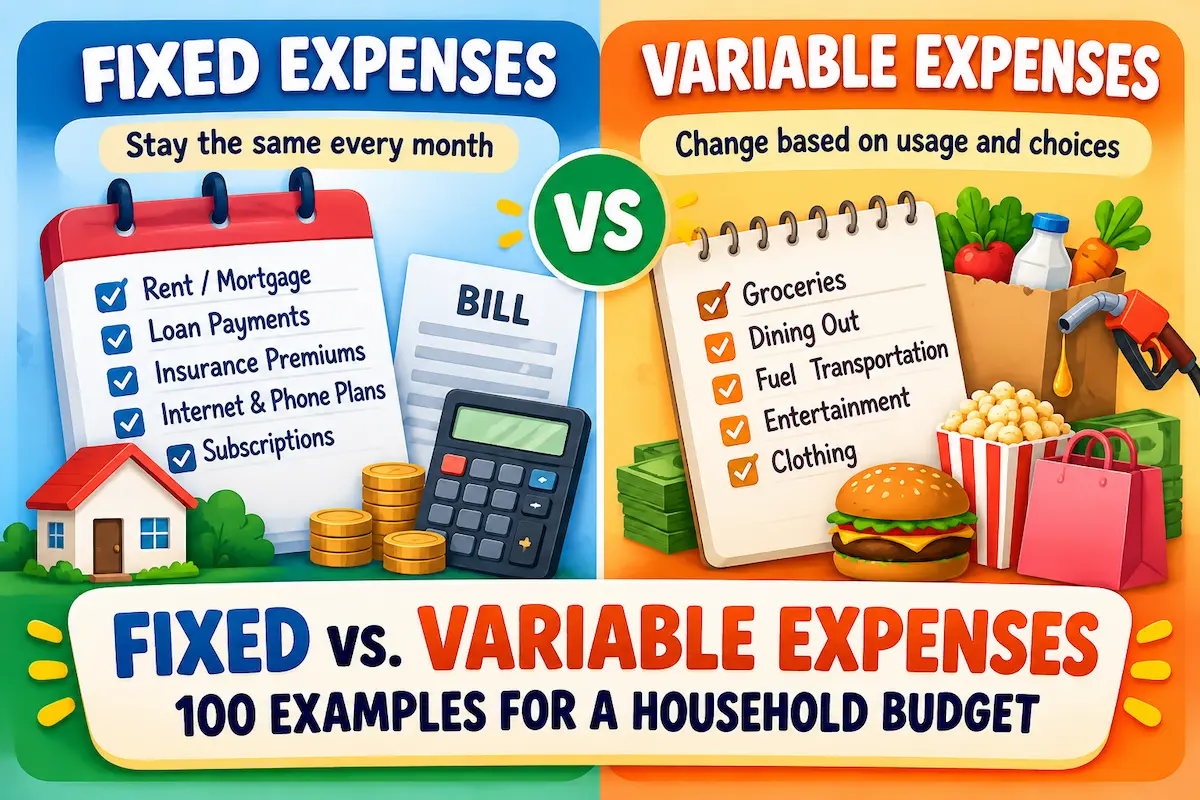
Fixed expenses are costs that generally stay the same or follow a predictable payment schedule, such as rent, insurance premiums, and loan payments.
Variable expenses are costs that change according to your usage, choices, needs, or market prices, such as groceries, fuel, dining out, and entertainment.
| Expense type | Simple meaning | Examples |
|---|---|---|
| Fixed expenses | Costs that are generally predictable | Rent, car payments, insurance |
| Variable expenses | Costs that fluctuate | Groceries, fuel, clothing |
| Occasional expenses | Costs that arise periodically or unexpectedly | Home repairs, gifts, annual fees |
| Mixed expenses | Costs containing fixed and usage-based components | Electricity, phone bills, water |
💡 Remember: Fixed does not always mean permanently unchanged, and variable does not always mean optional. Some expenses can also contain both fixed and variable components.
📘 What Are Fixed Expenses?
Fixed expenses are costs that generally remain consistent in amount or follow a predictable payment schedule.
They are often easier to plan for because you usually know when the payment is due and approximately how much you need to pay.
For example, if your monthly rent is $1,500 under your current lease, you can include $1,500 in your monthly budget.
Common fixed expenses include:
Rent or mortgage payments
Car loan payments
Insurance premiums
Internet subscriptions
Student loan payments
Gym memberships with a fixed monthly fee
Streaming subscriptions
Some fixed expenses are paid monthly, while others are paid annually, quarterly, or according to another schedule.
For budgeting purposes, you can estimate a monthly amount for predictable annual costs.
🏠 Example of Fixed Expenses
Imagine a household has the following monthly bills:
| Expense | Monthly amount |
|---|---|
| Rent | $1,500 |
| Car payment | $350 |
| Internet plan | $60 |
| Insurance premium | $150 |
| Streaming subscriptions | $25 |
| Total | $2,085 |
The household can plan for these costs in advance, assuming the amounts remain unchanged during the month.
📗 What Are Variable Expenses?
Variable expenses are costs that change depending on how much you use, purchase, consume, or choose to spend.
Unlike many fixed expenses, their monthly totals may fluctuate considerably.
For example, you might spend $400 on groceries in one month and $520 in another because of changing food prices, household needs, or shopping choices.
Common variable expenses include:
Groceries
Restaurant meals
Gasoline
Public transportation fares
Clothing
Entertainment
Household supplies
Personal care products
Some variable expenses are necessary, while others are discretionary.
You need to distinguish between the two before deciding which costs to reduce.
🛒 Example of Variable Expenses
Imagine the same household spends:
| Expense | Monthly amount |
|---|---|
| Groceries | $450 |
| Gasoline | $180 |
| Dining out | $120 |
| Entertainment | $80 |
| Household supplies | $70 |
| Total | $900 |
These amounts may change next month. Reviewing past spending can help the household estimate a realistic budget.
🆚 Fixed Expenses vs. Variable Expenses: Key Differences
| Feature | Fixed expenses | Variable expenses |
|---|---|---|
| Monthly amount | Usually predictable | Often changes |
| Payment schedule | Often regular | Can be regular or irregular |
| Planning | Usually straightforward | Requires estimates |
| Examples | Rent, loan payments | Groceries, fuel |
| Control over cost | May be difficult to change immediately | Some categories offer more flexibility |
| Budgeting method | Use current bills or contracts | Review past spending and expected usage |
| Common challenge | Forgetting renewals or rate changes | Underestimating fluctuating costs |
Which is easier to budget for?
Fixed expenses are often easier to estimate because the amounts are more predictable. Variable expenses require more attention because your actual spending can differ from your planned amount.
However, both types are important. A budget that includes only fixed expenses will miss a substantial portion of everyday spending.
🏠 50 Examples of Fixed Expenses
Here are 50 examples of expenses that may be fixed or predictable for a household. The classification depends on the actual contract, payment arrangement, and circumstances.
| No. | Fixed expense | Simple explanation |
|---|---|---|
| 1 | Rent | Regular payment for a rented home |
| 2 | Fixed-rate mortgage payment | Scheduled home-loan payment under the current terms |
| 3 | Homeowners association (HOA) dues | Regular fee charged by a homeowners association |
| 4 | Property tax installment | A scheduled property-tax payment, where applicable |
| 5 | Car loan payment | Regular installment for a vehicle loan |
| 6 | Car lease payment | Contractual payment for a leased vehicle |
| 7 | Student loan payment | Scheduled repayment under the current loan terms |
| 8 | Personal loan payment | Regular installment on a personal loan |
| 9 | Fixed-rate debt payment | Payment due under an agreed repayment schedule |
| 10 | Life insurance premium | Regular payment for life insurance |
| 11 | Health insurance premium | Scheduled payment for health coverage |
| 12 | Auto insurance premium | Payment for vehicle insurance |
| 13 | Homeowners insurance premium | Payment for home insurance |
| 14 | Renters insurance premium | Payment for renters insurance |
| 15 | Disability insurance premium | Payment for disability coverage |
| 16 | Fixed-rate internet plan | Regular fee for home internet |
| 17 | Basic phone plan | Fixed monthly mobile service fee |
| 18 | Landline subscription | Regular fee for landline service |
| 19 | Cable TV package | Subscription fee for a cable package |
| 20 | Streaming subscription | Monthly fee for a streaming service |
| 21 | Music subscription | Regular fee for a music service |
| 22 | Cloud storage subscription | Monthly fee for online storage |
| 23 | Software subscription | Recurring fee for software access |
| 24 | Gym membership | Contractual monthly membership fee |
| 25 | Fitness app subscription | Regular fee for an app membership |
| 26 | Newspaper subscription | Recurring newspaper subscription |
| 27 | Magazine subscription | Regular magazine subscription fee |
| 28 | Professional membership | Dues paid to a professional organization |
| 29 | Security monitoring subscription | Regular home-security service fee |
| 30 | Pest-control service contract | Scheduled payment under a service agreement |
| 31 | Lawn-care contract | Regular payment for contracted lawn maintenance |
| 32 | Childcare tuition | Agreed recurring childcare fee |
| 33 | Private school tuition installment | Scheduled school-fee payment |
| 34 | College tuition installment | Scheduled payment under a tuition plan |
| 35 | After-school program fee | Regular payment for a contracted program |
| 36 | Piano lesson package | Fixed recurring fee for scheduled lessons |
| 37 | Storage unit rental | Regular fee for a rented storage space |
| 38 | Parking space rental | Monthly payment for a reserved parking space |
| 39 | Pet insurance premium | Regular payment for pet coverage |
| 40 | Pet daycare membership | Contractual recurring pet-care fee |
| 41 | Home warranty plan | Recurring fee for a home warranty |
| 42 | Appliance protection plan | Regular payment for an appliance service plan |
| 43 | Water delivery subscription | Fixed fee under a regular delivery plan |
| 44 | Meal subscription plan | Fixed subscription fee, excluding additional purchases |
| 45 | Newspaper delivery plan | Regular fee for home newspaper delivery |
| 46 | Membership club dues | Scheduled membership payment |
| 47 | Fixed monthly charitable pledge | A recurring donation of an agreed amount |
| 48 | Installment purchase payment | Scheduled payment for a financed purchase |
| 49 | Annual membership fee | A recurring annual membership cost |
| 50 | Annual software license | A recurring annual software payment |
💡 Budgeting tip: An annual expense can be converted into a monthly planning amount. For example, a $600 annual membership costs an average of $50 per month when spread across 12 months.
That doesn't mean you pay $50 each month; it means you can set aside that amount to prepare for the annual payment.
🛒 50 Examples of Variable Expenses
Variable expenses change with usage, purchasing decisions, circumstances, or prices.
Some are essential living costs, while others are optional purchases.
| No. | Variable expense | Simple explanation |
|---|---|---|
| 1 | Groceries | Food and household shopping costs |
| 2 | Restaurant meals | Spending on meals away from home |
| 3 | Takeout orders | Food ordered for delivery or pickup |
| 4 | Coffee shop purchases | Coffee, tea, and other cafe purchases |
| 5 | Bottled water | Spending on purchased drinking water |
| 6 | Snacks | Packaged snacks and other small food purchases |
| 7 | Bakery items | Bread, cakes, and pastries |
| 8 | Fresh produce | Fruits and vegetables |
| 9 | Meat and seafood | Purchases of meat, fish, and seafood |
| 10 | Household cleaning products | Detergents and cleaning supplies |
| 11 | Paper products | Paper towels, tissues, and similar items |
| 12 | Laundry supplies | Detergent and other laundry products |
| 13 | Toiletries | Soap, shampoo, and personal hygiene products |
| 14 | Clothing | New clothes and seasonal purchases |
| 15 | Shoes | Footwear purchases |
| 16 | Haircuts | Personal grooming services |
| 17 | Cosmetics | Makeup and beauty products |
| 18 | Skincare products | Creams, cleansers, and other skincare items |
| 19 | Toiletry replacements | Replacement personal-care items |
| 20 | Prescription copayments | Patient payments under the applicable health plan |
| 21 | Medical appointments | Out-of-pocket costs for visits |
| 22 | Dental treatment | Dental costs not covered by insurance |
| 23 | Eye care | Out-of-pocket vision-related expenses |
| 24 | Over-the-counter medicine | Nonprescription medicines |
| 25 | Pet food | Food purchased for pets |
| 26 | Pet grooming | Grooming services for pets |
| 27 | Pet supplies | Toys, litter, and other pet items |
| 28 | Gasoline | Fuel purchased for a vehicle |
| 29 | Public transit fares | Bus, train, or subway fares |
| 30 | Ride-hailing services | Payments for rides booked through apps |
| 31 | Taxi fares | Taxi trips |
| 32 | Parking fees | Payments for parking as needed |
| 33 | Tolls | Road and bridge tolls |
| 34 | Bicycle maintenance | Repairs and supplies for a bicycle |
| 35 | Vehicle maintenance | Routine service and maintenance costs |
| 36 | Vehicle repairs | Repairs when something needs fixing |
| 37 | Electricity usage | Electricity charges that vary with consumption |
| 38 | Water usage | Water charges that vary with consumption |
| 39 | Natural gas usage | Gas charges based on consumption |
| 40 | Laundry services | Payments for laundromats or dry cleaning |
| 41 | Movie tickets | Spending on cinema visits |
| 42 | Concert tickets | Spending on live entertainment |
| 43 | Hobby supplies | Materials for personal hobbies |
| 44 | Books | Books purchased for reading or study |
| 45 | Video games | Game purchases and eligible add-ons |
| 46 | Gifts | Purchases for birthdays and other occasions |
| 47 | Holiday decorations | Seasonal decorations and supplies |
| 48 | Vacation activities | Attractions, tours, and other trip activities |
| 49 | Home decor | Decorative items for the home |
| 50 | Impulse purchases | Unplanned purchases that vary with behavior |
These examples are intended for personal household budgeting. Some costs may be fixed for one household and variable for another.
For example, a household may spend a fixed amount on groceries through a subscription arrangement, while another household's grocery spending fluctuates every week.
🔄 Expenses That Can Be Both Fixed and Variable
Some expenses do not fit neatly into one category. Their classification depends on how the service is priced and how you use it.
| Expense | Fixed component | Variable component |
|---|---|---|
| Electricity | Basic service charge | Electricity consumed |
| Water | Monthly service charge | Water usage |
| Phone bill | Fixed plan fee | Extra data or usage charges |
| Internet | Monthly subscription | Extra data or equipment charges, where applicable |
| Transportation | Monthly transit pass | Additional trips or rides |
| Healthcare | Insurance premium | Copayments and uncovered care |
| Childcare | Contracted monthly fee | Extra hours or occasional care |
| Home maintenance | Contracted service plan | Repairs outside the plan |
| Pet care | Monthly wellness plan | Additional treatments or services |
| Vehicle ownership | Loan payment | Fuel, maintenance, and repairs |
For example, your electricity bill might contain a basic monthly charge plus a charge based on the electricity you use.
The basic charge may be fixed, while the usage component varies.
This is why checking the actual bill is more reliable than classifying an expense based only on its name.
🧠 What Is the Difference Between Fixed, Variable, and Occasional Expenses?
Occasional expenses are costs that do not necessarily occur every month. They can be predictable, such as annual insurance renewals, or unexpected, such as emergency repairs.
| Expense category | Example | How to plan |
|---|---|---|
| Fixed | Monthly rent | Use the scheduled payment amount |
| Variable | Groceries | Estimate using previous spending |
| Occasional and predictable | Annual insurance payment | Set aside money over time |
| Unexpected | Emergency home repair | Build an emergency fund where possible |
An expense does not need to happen every month to belong in your budget.
For example, if you expect a $1,200 annual bill, you can plan to set aside an average of $100 per month. The actual payment will still be due according to the bill's schedule.
👉 For more ways to organize expenses, see our guide to 100 Budget Categories to Organize Your Monthly Budget.
📊 Monthly Budget Example: Fixed vs. Variable Expenses
Let's look at a hypothetical household with $4,500 in monthly take-home income.
| Expense | Type | Monthly amount |
|---|---|---|
| Rent | Fixed | $1,400 |
| Car payment | Fixed | $350 |
| Insurance premiums | Fixed | $200 |
| Internet and subscriptions | Fixed | $90 |
| Groceries | Variable | $500 |
| Gasoline and transportation | Variable | $250 |
| Electricity and water | Variable or mixed | $180 |
| Dining out | Variable | $150 |
| Clothing and personal care | Variable | $100 |
| Entertainment | Variable | $80 |
| Household supplies | Variable | $100 |
| Total expenses | $3,400 | |
| Income remaining | $1,100 |
These figures are illustrative, not recommended spending limits. Actual costs depend on location, household size, income, and personal circumstances.
In this example:
Fixed expenses total $2,040.
Variable and mixed expenses total $1,360.
Total listed expenses equal $3,400.
The remaining $1,100 can be assigned to savings, debt repayment, upcoming costs, or other priorities.
The remaining money should not automatically be considered disposable income. A household may still need to account for taxes not already deducted, irregular expenses, additional debt payments, or other obligations.
👨👩👧 A Simple Family Example
Imagine a family of four planning its monthly expenses.
Their rent and car payment stay the same, but their grocery spending changes depending on school schedules, food prices, and family activities.
In January, they spend $450 on groceries. In February, the total reaches $560 because they host relatives and buy more food.
Rather than assuming groceries will always cost $450, the family reviews several months of spending and chooses a realistic budget amount.
They also set aside money for predictable annual costs, such as insurance renewals and school expenses.
This approach helps them prepare for both regular bills and changing costs without expecting every month to look identical.
The lesson is simple: use known amounts for predictable bills, realistic estimates for fluctuating costs, and separate planning for occasional expenses.
💡 How to Manage Fixed and Variable Expenses
Understanding expense categories is useful only when you apply them to your budget.
Here are six practical steps.
1. List all your regular bills
Start with rent, loan payments, insurance, subscriptions, and other predictable costs.
Use actual bills or account statements rather than relying entirely on memory.
2. Track your variable spending
Review grocery purchases, fuel, restaurant spending, personal care, and entertainment over several months.
This helps you identify normal spending patterns and unusually expensive months.
3. Separate essential and discretionary expenses
Groceries, necessary transportation, and healthcare can be essential variable expenses.
Dining out, hobbies, and entertainment may be more flexible, depending on your circumstances.
Do not assume that every variable expense can be eliminated.
4. Prepare for occasional costs
List predictable expenses that occur quarterly, annually, or at irregular intervals.
Estimate their cost and decide how much you can set aside in advance.
5. Review subscriptions and recurring payments
Check whether you still use each subscription and whether a lower-cost plan would meet your needs.
A recurring payment is easy to overlook because it may not change every month.
6. Compare planned spending with actual spending
At the end of each month, review where you spent more or less than expected.
Adjust future estimates based on actual experience rather than treating your original budget as permanent.
👉 Need help getting started? Read 12 Essential Budget Categories to Organize Your Money for a simple way to group your expenses.
📝 Fixed vs. Variable Expenses Checklist
Use this checklist when creating or reviewing your monthly budget.
List rent or mortgage payments.
Record loan payments and insurance premiums.
Add internet, phone, and subscription fees.
Estimate groceries and household supplies.
Track transportation and fuel.
Review utility bills.
Include healthcare and personal care costs.
Estimate dining out and entertainment.
Plan for annual and occasional expenses.
Compare your planned spending with actual spending.
Adjust your estimates when your circumstances change.
You can adapt this checklist to your own household and remove categories that do not apply.
🌟 Interesting Facts About Fixed and Variable Expenses
Fixed expenses can still change. Rent may increase at renewal, insurance premiums may rise, and loan payments may change under certain terms.
Variable expenses are not always optional. Groceries, fuel for commuting, and some medical expenses can fluctuate even when they are necessary.
Annual bills can be budgeted monthly. Setting aside an estimated portion each month can make a large future payment easier to prepare for.
One expense can have two components. Utility bills often include both basic service charges and usage-based charges.
A lower bill is not always a saving. If an essential expense is lower because a payment was delayed, the obligation may still remain.
Tracking improves estimates. Several months of actual spending can give you a more useful starting point than a guess.
🎯 Quick Quiz: Test Your Knowledge
Choose the correct answer for each question.
1. Which is usually a fixed expense?
A. Restaurant meals
B. Rent under an unchanged lease
C. Groceries
D. Gasoline
2. Which is usually a variable expense?
A. Fixed-rate car payment
B. Monthly gym contract
C. Grocery shopping
D. Fixed internet subscription
3. Why can an electricity bill be considered a mixed expense?
A. It is always the same amount.
B. It may contain a fixed service fee and a usage-based charge.
C. It is never included in a budget.
D. It is always optional.
4. How can you plan for an annual bill?
A. Ignore it until it arrives.
B. Treat it as a weekly expense.
C. Estimate its cost and set aside money over time.
D. Assume it will disappear next year.
5. What is the best way to estimate variable expenses?
A. Guess the lowest possible amount.
B. Review past spending and expected needs.
C. Copy another household's budget exactly.
D. Exclude variable expenses from your budget.
Answers: 1-B, 2-C, 3-B, 4-C, 5-B.
❓ Frequently Asked Questions
What are variable expenses?
Variable expenses are costs that change according to usage, consumption, choices, circumstances, or prices. Common examples include groceries, fuel, restaurant meals, clothing, and entertainment.
What are fixed expenses?
Fixed expenses are costs that generally remain consistent or follow a predictable payment schedule. Examples include rent, fixed loan payments, insurance premiums, and recurring subscriptions.
What are five examples of variable expenses?
Five common examples are groceries, gasoline, dining out, clothing, and entertainment. Their amounts may change from month to month.
What are five examples of fixed expenses?
Five common examples are rent, a fixed-rate mortgage payment, a scheduled car loan payment, insurance premiums, and a fixed monthly internet plan.
Is rent a fixed expense?
Rent is generally considered a fixed expense when the amount stays the same during the current rental period. It may change when the lease is renewed or revised.
Are groceries fixed or variable expenses?
Groceries are generally variable expenses because the total depends on food prices, household needs, and shopping choices. Some households may use a fixed grocery allowance for budgeting, but actual spending can still fluctuate.
Is electricity a fixed or variable expense?
Electricity is often a variable or mixed expense. Some bills include a fixed service charge, while the amount charged for electricity usage changes with consumption and applicable rates.
Is gas a fixed or variable expense?
Gasoline for a car is generally a variable expense because the total depends on driving distance, fuel prices, and vehicle efficiency. A fixed monthly gas-service charge, where applicable, is a different type of cost.
Are insurance premiums fixed expenses?
Insurance premiums are usually treated as predictable expenses during the policy period. However, the premium may change at renewal, and deductibles or out-of-pocket medical costs are separate expenses.
Can variable expenses be reduced?
Some variable expenses can be reduced by changing purchasing choices, comparing prices, planning meals, or adjusting discretionary spending. However, necessary expenses such as groceries, healthcare, and transportation cannot always be reduced substantially.
Why is it important to know the difference between fixed and variable expenses?
The distinction helps you plan predictable bills, estimate fluctuating costs, identify spending patterns, and prepare for upcoming payments. It can also help you decide which budget categories need closer monitoring.
What is the difference between fixed expenses and fixed costs?
In personal budgeting, fixed expenses usually refer to household costs that are predictable or recurring. In business accounting, fixed costs are costs that generally do not change in total with short-term changes in production volume, within a relevant operating range. The terms overlap, but their use depends on the context.
🧾 Final Summary
Fixed and variable expenses are two important parts of a household budget.
Fixed expenses are generally predictable, such as rent, loan payments, and insurance premiums.
Variable expenses fluctuate, such as groceries, fuel, and dining out.
Mixed expenses contain fixed and variable components.
Occasional expenses may occur less frequently but still need to be planned for.
Reviewing actual spending helps you build more realistic estimates and adjust your budget over time.
You don't need to track every dollar perfectly on the first day. Start by listing your regular bills, estimate your variable spending, and review the results at the end of each month.
For the next step, explore our guides to 12 Essential Budget Categories and 100 Budget Categories to organize your expenses into a system that works for you.
💡 The goal isn't to make every month identical. It's to understand your expenses well enough to plan for them.
Related Money and Budgeting Guides
Explore these practical guides to manage your money, plan household expenses, and make informed financial decisions.
💳40 Common Bank Fees and Charges Explained (With Examples)
How to Make a Monthly Budget — Learn how to plan monthly income, track expenses, and manage your spending.
12 Essential Budget Categories — Discover the main categories to include when organizing your household budget.
100 Budget Categories — Explore a detailed list of budget categories to help track everyday expenses and financial commitments.
Best Zero Balance Savings Accounts in India — Explore our Money & Budgeting section for more guidance on savings accounts and managing bank-related costs.
📚 References and Further Reading
The following resources provide additional information about household budgeting and expense tracking:
Consumer.gov — Making a Budget: https://consumer.gov/managing-your-money/making-budget
Consumer Financial Protection Bureau — Your Money, Your Goals: https://www.consumerfinance.gov/consumer-tools/educator-tools/your-money-your-goals/
Oregon Division of Financial Regulation — Personal Budgeting: https://dfr.oregon.gov/financial/manage/Pages/budgeting.aspx
These references support general budgeting and expense-tracking practices. The examples in this article are illustrative; actual expenses and classifications depend on individual circumstances.
👨💻 About the Author
Mohan R — Founder and Editor, Monto Fact Jungle
Monto Fact Jungle publishes beginner-friendly educational guides, vocabulary lists, and practical reference articles to help readers understand everyday topics more easily.
Our Money & Budgeting series aims to explain personal-finance concepts in clear language, with practical examples, organized tables, and links to useful resources.
Last reviewed: October 9, 2026.
Disclaimer: This article is for general educational purposes only. It does not provide personalized financial advice. Actual expenses, contracts, fees, and payment schedules vary by household and location.