
💳40 Common Bank Fees and Charges Explained (With Examples)
💳 40 Common Bank Fees and Charges Explained (With Examples)
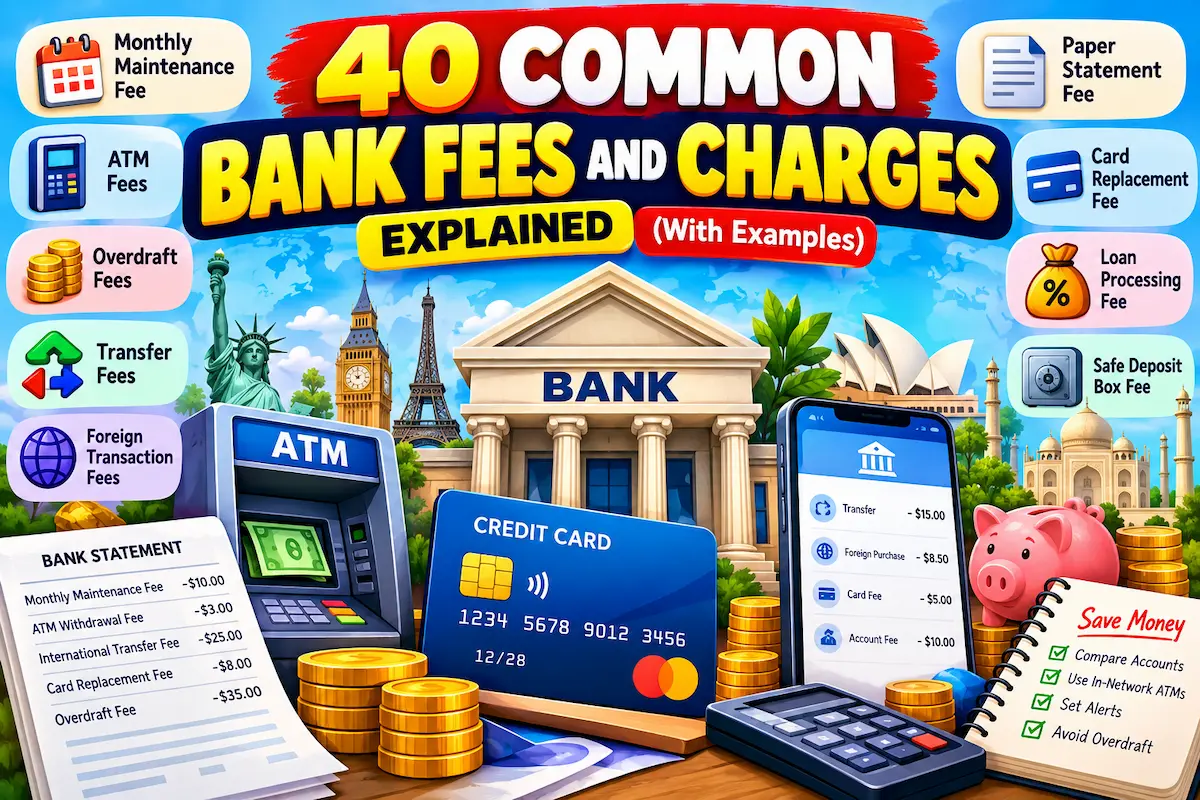
A colorful educational illustration explaining 40 common bank fees and charges, with a bank building, ATM, credit card, mobile banking screen, bank statement, coins, and money-saving tips. Designed to help readers understand common banking costs and manage their finances.
Have you ever checked your bank statement and noticed a deduction you didn't expect? 🤔
It might be a monthly account fee, an ATM withdrawal charge, a card replacement fee, or a charge for transferring money.
Banks and financial institutions may charge fees for maintaining accounts, processing transactions, providing additional services, or handling certain situations. However, not every bank charges the same fees, and some services may be free depending on your account, country, and banking plan.
In this guide, we'll explore 40 common bank fees and charges, explain why they occur, and share practical ways to avoid unnecessary costs.
Whether you use a checking account in the United States, a current account in the United Kingdom, a bank account in India, or an everyday transaction account in Australia, this guide will help you understand the terminology.
👉 New to budgeting? Start with our guide on How to Make a Monthly Budget: A Simple Step-by-Step Guide.
⚡ Quick Answer: What Are Bank Fees and Charges?
Bank fees are amounts a financial institution charges for particular services, transactions, account features, or account-related events.
Common examples include:
Monthly account maintenance fees
ATM withdrawal fees
Overdraft fees
Wire transfer charges
Foreign transaction fees
Card replacement fees
Account closure fees
Some fees are recurring, while others apply only when you use a particular service or meet specific conditions.
Important: A fee that applies to one account may not apply to another. Always check your bank's current fee schedule and account terms before assuming a charge is applicable. Read 100 Budget Categories Guide
🏦 40 Common Bank Fees and Charges: Complete List
Here is a quick-reference list of 40 bank fees you may encounter across different banking systems.
| No. | Bank fee or charge | What it means |
|---|---|---|
| 1 | Monthly maintenance fee | A recurring fee for maintaining an account |
| 2 | Minimum balance fee | A charge for failing to meet an applicable balance requirement |
| 3 | ATM withdrawal fee | A fee for withdrawing cash from certain ATMs |
| 4 | Out-of-network ATM fee | A charge for using an ATM outside an eligible network |
| 5 | ATM operator surcharge | A fee charged by the ATM owner or operator |
| 6 | Overdraft fee | A charge that may apply when a transaction overdraws an account |
| 7 | Insufficient funds fee | A possible charge when a payment cannot be completed because funds are insufficient |
| 8 | Returned payment fee | A charge associated with a returned or rejected payment, where applicable |
| 9 | Wire transfer fee | A fee for sending or receiving certain wire transfers |
| 10 | International transfer fee | A fee for sending or receiving money across countries |
| 11 | Foreign transaction fee | A charge that may apply to purchases processed in a foreign currency |
| 12 | Currency conversion fee | A charge associated with converting one currency into another |
| 13 | Paper statement fee | A fee for printed account statements |
| 14 | Checkbook fee | A charge for ordering checks |
| 15 | Stop-payment fee | A possible fee for requesting that a payment or check be stopped |
| 16 | Cashier's check fee | A charge for issuing a bank-issued check |
| 17 | Money order fee | A fee for purchasing a money order |
| 18 | Bank draft fee | A charge for issuing a bank draft |
| 19 | Replacement debit card fee | A fee for replacing a lost or damaged debit card |
| 20 | Expedited card delivery fee | A charge for faster card delivery |
| 21 | Account closure fee | A possible fee for closing an account under specified conditions |
| 22 | Dormant account fee | A charge that may apply to certain inactive accounts where permitted |
| 23 | Excess transaction fee | A charge for exceeding a specified transaction allowance, if applicable |
| 24 | Cash deposit fee | A possible charge for certain cash deposits |
| 25 | Cash handling fee | A charge for handling particular cash transactions |
| 26 | Cheque deposit fee | A possible fee for depositing certain cheques |
| 27 | Cheque clearing fee | A charge associated with processing certain cheques |
| 28 | Loan processing fee | A fee for processing a loan application or loan facility |
| 29 | Loan late-payment fee | A charge that may apply when a loan payment is overdue |
| 30 | Loan prepayment fee | A possible charge for repaying a loan early, depending on the contract and local rules |
| 31 | Loan account administration fee | A charge for administering certain loan accounts |
| 32 | Credit card annual fee | A recurring fee for holding a particular credit card |
| 33 | Credit card late-payment fee | A charge that may apply when a credit card payment is late |
| 34 | Credit card cash advance fee | A charge for obtaining cash using a credit card |
| 35 | Credit card balance transfer fee | A fee for transferring a credit card balance |
| 36 | Returned direct debit fee | A possible charge associated with a failed or returned direct debit |
| 37 | Stop-transfer or cancellation fee | A possible fee for cancelling or stopping an eligible transfer |
| 38 | Bank cheque cancellation fee | A charge that may apply when cancelling a bank-issued cheque |
| 39 | Safe deposit box fee | A fee for renting a safe deposit box |
| 40 | Bank reference letter fee | A charge for issuing certain bank reference or account confirmation letters |
💡 This is a global reference list, not a list of fees charged by every bank. Some entries relate to deposit accounts, while others apply to transfers, loans, or credit cards. A particular fee may be unavailable, prohibited, waived, or named differently in your country.
💰 1. Account Maintenance and Balance Fees
These charges relate to keeping a bank account open or meeting the conditions of a particular account plan.
| Fee | Why it may apply | How to check or reduce it |
|---|---|---|
| Monthly maintenance fee | The account has a recurring service charge | Compare account plans and available fee waivers |
| Minimum balance fee | The account falls below a required balance | Check the balance rules or consider an eligible no-minimum-balance account |
| Dormant account fee | An account has remained inactive under applicable terms | Check inactivity rules and contact your bank if the account is unused |
| Excess transaction fee | The account exceeds a specified transaction allowance | Review the account's transaction limits and alternatives |
| Account closure fee | The account is closed under conditions that permit a charge | Check closure terms before closing the account |
Not all accounts have monthly maintenance fees or minimum balance requirements. Some basic or entry-level accounts have no such charges, while other accounts offer waivers if specific conditions are met.
If you're comparing accounts in India, explore our Best Zero Balance Savings Accounts in India category for related account-comparison content.
🏧 2. ATM and Cash Withdrawal Fees
ATM charges can depend on the ATM network, the account type, the number of withdrawals, and the country.
| Fee | What it means | Practical tip |
|---|---|---|
| ATM withdrawal fee | A charge for a particular cash withdrawal | Check your account's free-withdrawal allowance |
| Out-of-network ATM fee | A fee for using an ATM outside an eligible network | Use an eligible ATM network when convenient |
| ATM operator surcharge | An additional charge imposed by an ATM operator | Review the on-screen fee notice before proceeding |
| Cash handling fee | A charge for particular cash services | Check whether your account has free cash-service allowances |
| Cash deposit fee | A possible charge for certain cash deposits | Review deposit methods and account conditions |
For example, an ATM withdrawal might involve a fee from your own bank, a fee from the ATM operator, or both. Some accounts reimburse eligible ATM charges, while others provide free withdrawals only under specific conditions.
In India, ATM transaction rules and charges are subject to applicable RBI requirements and the bank's current terms. Do not assume that a charge used in another country applies to Indian accounts.
⚠️ 3. Overdraft, Insufficient Funds, and Payment Fees
These charges relate to payments that exceed available funds, are returned, or cannot be completed.
| Fee | Meaning | What to do |
|---|---|---|
| Overdraft fee | A possible charge when the bank covers an eligible transaction despite insufficient funds | Check overdraft terms and available protections |
| Insufficient funds fee | A possible charge when a transaction is declined or cannot be completed | Maintain a balance buffer and enable alerts |
| Returned payment fee | A charge associated with a returned payment | Check the reason for the return and applicable fee terms |
| Returned direct debit fee | A possible charge for a failed direct debit | Keep sufficient funds available before the payment date |
| Stop-payment fee | A possible charge for stopping an eligible payment | Ask about the process and fee before submitting a request |
These terms are related, but they are not interchangeable.
An overdraft occurs when a transaction takes an account below its available balance. An insufficient-funds situation may result in a payment being declined or returned. Whether a fee is permitted or charged depends on the bank, transaction, account terms, and applicable law.
A useful habit is to enable low-balance alerts and review upcoming automatic payments.
🌍 4. International Transfer and Currency Fees
International transactions can involve several separate costs. Understanding the difference can help you compare the total cost of sending or spending money abroad.
| Fee | What it means | What to check |
|---|---|---|
| Wire transfer fee | A charge for sending or receiving certain wire transfers | Outgoing and incoming transfer fees |
| International transfer fee | A fee for a cross-border money transfer | Whether intermediary or recipient-bank fees may apply |
| Foreign transaction fee | A charge that may apply to a foreign-currency purchase | Card terms and foreign transaction policies |
| Currency conversion fee | A cost associated with converting currencies | The exchange rate and any separately disclosed markup |
| Bank draft fee | A charge for issuing a bank draft | Issuance, delivery, and cancellation terms |
💱 Example: Understanding the total cost
Suppose you send money from one country to another. The total cost could include:
A fee charged by the sending institution
A fee from an intermediary institution
A receiving-bank fee
A currency conversion cost
Not every transfer includes all these charges.
Compare the total amount the recipient is expected to receive, rather than comparing only the advertised transfer fee.
For international purchases, check whether your card issuer charges a foreign transaction fee and whether the merchant offers currency conversion. The conversion option can affect the final amount you pay.
🧾 5. Paperwork, Cheques, and Card Fees
Some banks charge for optional services, replacement items, or particular payment instruments.
| Fee | Why it may apply | How to manage it |
|---|---|---|
| Paper statement fee | Printed statements cost money to produce and deliver | Consider paperless statements if suitable |
| Checkbook fee | A bank charges for issuing checks | Check standard ordering costs |
| Cheque deposit fee | Certain cheque deposits incur a charge | Review deposit conditions |
| Cheque clearing fee | A charge applies to particular cheque-processing services | Check the bank's fee schedule |
| Cashier's check fee | The bank issues a cashier's check | Compare issuance and delivery fees |
| Money order fee | A money order is purchased | Compare available payment methods |
| Bank draft fee | A bank draft is issued | Check the total issuance cost |
| Replacement debit card fee | A card must be replaced | Check standard replacement terms |
| Expedited card delivery fee | Faster delivery is requested | Compare the urgent-delivery cost |
| Bank reference letter fee | A formal reference letter is requested | Ask whether a free alternative is available |
The availability and terminology of these services vary across countries. For example, cheque-related services may be more relevant to some banking systems than others.
Paperless statements may reduce paper-related costs where such fees exist, but they are not guaranteed to be cheaper in every account.
💳 6. Loan and Credit Card Fees
Banks and other financial institutions may charge fees for lending services and particular credit card transactions.
| Fee | What it means | What to check |
|---|---|---|
| Loan processing fee | A charge for processing a loan application or facility | The total cost of borrowing |
| Loan late-payment fee | A possible charge for overdue loan payments | Payment deadlines and late-payment terms |
| Loan prepayment fee | A possible charge for early repayment | Whether the fee is permitted and applies to your loan |
| Loan administration fee | A charge for administering a loan | The loan agreement and fee schedule |
| Credit card annual fee | A recurring fee for a particular card | Benefits, waiver conditions, and total annual cost |
| Credit card late-payment fee | A charge that may apply when payment is late | Due dates and applicable fee limits |
| Credit card cash advance fee | A charge for obtaining cash using a credit card | Fees, interest rates, and when interest starts |
| Credit card balance transfer fee | A charge for transferring a balance | Transfer fee, promotional rate, and repayment period |
Before accepting a loan or credit card, compare the overall cost rather than focusing only on the headline interest rate or annual fee.
A card with an annual fee may offer benefits that are useful to some users, while a no-annual-fee card may be more appropriate for others. The right comparison depends on how the account is used and the complete terms.
🏦 7. Other Bank Service Charges
Additional fees may apply to particular services, transactions, or account arrangements.
| Fee | What it covers | What to check |
|---|---|---|
| Bank cheque cancellation fee | Cancelling a bank-issued cheque | Whether cancellation is possible and what it costs |
| Transfer cancellation fee | Stopping an eligible transfer | Whether the transfer can still be cancelled |
| Safe deposit box fee | Renting a secure storage box | Annual rent, access conditions, and other terms |
| Bank reference letter fee | Obtaining an official bank reference | The document's purpose and applicable charge |
| Cash deposit fee | Depositing cash under conditions that attract a fee | Free deposit allowances and account restrictions |
These services are not offered by every institution. A fee may also be waived or unavailable under a particular account agreement.
🌎 Do Bank Fees Differ by Country?
Yes. Banks operate under different laws, payment systems, account structures, and fee policies. The same banking service may have a different name or cost in another country.
| Country | Banking terminology and examples | What readers should check |
|---|---|---|
| United States 🇺🇸 | Checking accounts, overdraft fees, wire transfers | Account disclosures, fee schedules, and applicable consumer protections |
| United Kingdom 🇬🇧 | Current accounts, overdrafts, Faster Payments | Account terms and applicable UK banking rules |
| Canada 🇨🇦 | Chequing accounts, Interac e-Transfer, account packages | Monthly account plans, transaction allowances, and transfer terms |
| Australia 🇦🇺 | Transaction accounts, international transfers, card fees | Account fees, ATM conditions, and card terms |
| India 🇮🇳 | Savings accounts, NEFT, RTGS, IMPS, UPI | Applicable RBI requirements and the bank's current service-charge schedule |
These are examples of banking terminology and services, not a claim that each service attracts a fee.
For example, a bank may offer a transfer service without a separate transaction charge, while another service or account may have different terms. Some fees are restricted by law or regulation.
Always verify country-specific fees using the relevant bank's official schedule and applicable regulator guidance.
🛡️ 10 Practical Ways to Avoid Unnecessary Bank Fees
You cannot always avoid every bank fee, but you can reduce the risk of paying charges that are unnecessary for your circumstances.
1. Compare account plans
Look at monthly fees, transaction limits, ATM access, and waiver conditions before opening an account.
2. Check minimum balance requirements
If your account has a balance requirement, understand how the bank calculates it. Some accounts use daily balances, while others use different measurement periods or conditions.
3. Use eligible ATM networks
Check which ATMs are included in your account's free or reimbursed withdrawal arrangements.
4. Enable balance alerts
Low-balance notifications can help you spot potential shortfalls before scheduled payments arrive.
5. Review automatic payments
Check subscriptions, direct debits, loan installments, and other recurring payments to ensure the timing and amount are correct.
6. Use paperless statements when appropriate
Electronic statements may help you avoid paper-related fees where they apply and make it easier to review transactions.
7. Compare international transfer options
Compare exchange rates, sending fees, intermediary costs, and the amount the recipient will receive.
8. Read card and loan terms
Check annual fees, late-payment conditions, cash advance costs, and any early repayment provisions before committing.
9. Ask about fee waivers
Some banks waive particular fees if you meet account conditions or qualify for a specific arrangement. Ask the bank rather than assuming a waiver is available.
10. Review your bank statements
Check statements regularly so you can identify unfamiliar charges, understand their descriptions, and contact the bank if a charge appears incorrect.
💡 Remember: A fee-saving strategy that works for one account or country may not work for another. Confirm the terms that apply to your own account.
📊 How to Check a Bank Fee on Your Statement
If you notice an unfamiliar deduction, follow these steps.
Find the transaction description. Record the date, amount, and exact wording shown on the statement.
Check the fee schedule. Search your bank's official website or account documents for the relevant charge.
Check the transaction history. Determine whether the charge relates to an ATM withdrawal, transfer, payment, account condition, or service request.
Contact your bank if unclear. Ask what triggered the fee and whether a refund or waiver is available.
Report suspected unauthorized activity promptly. Follow your bank's official process if the transaction appears fraudulent or unfamiliar.
Do not share your full account number, password, PIN, or one-time password when seeking help with a banking charge.
👨👩👧 A Simple Household Example
Imagine a household that uses a checking account for everyday expenses and a separate account for savings.
During one month, the household notices three charges:
| Charge | Amount | What to investigate |
|---|---|---|
| Monthly account fee | $10 | Whether the account offers a fee waiver |
| Out-of-network ATM fee | $3 | Whether an eligible ATM could have been used |
| International purchase fee | $5 | Whether the card terms explain the charge |
The household's total in these illustrative fees is $18.
By reviewing the account terms, it might discover that a different account plan offers a suitable fee waiver or that an eligible ATM network is available nearby. The international purchase fee may depend on the card terms and transaction processing.
The objective is not to assume every fee is avoidable. It is to understand which fees are legitimate, which can be reduced, and which need further investigation.
For more ways to organize household costs, see our guide to 100 Budget Categories to Organize Your Monthly Budget.
🌟 Interesting Facts About Bank Fees
One transaction can involve multiple charges. International transfers and some ATM transactions can involve charges from different institutions.
Not every bank account has a maintenance fee. Some accounts have no monthly fee, while others provide waivers under specified conditions.
Fee names vary across countries. Checking accounts and current accounts, for example, are common terms in different banking systems.
A foreign transaction fee is not the same as a currency conversion cost. They can be separate components of a transaction's overall cost.
Some fees depend on the service used. A card replacement, wire transfer, or safe deposit box may incur a charge only when the relevant service is requested.
Regulations matter. Some fees are subject to consumer-protection rules, restrictions, or disclosure requirements that differ by jurisdiction.
🎯 Quick Quiz: Test Your Banking Knowledge
1. What is a monthly maintenance fee?
A. A payment for groceries
B. A recurring account service charge
C. A currency exchange rate
D. A loan repayment
2. What is an ATM operator surcharge?
A. A possible fee charged by the ATM operator
B. A credit card reward
C. A bank deposit
D. An insurance premium
3. What should you compare when sending money internationally?
A. Only the advertised transfer fee
B. Only the sending bank's name
C. Transfer fees, exchange rates, and the expected amount received
D. Only the date of the transfer
4. Does every bank charge a monthly account maintenance fee?
A. Yes, every bank does
B. No, fees depend on the account and institution
C. Only banks in India do
D. Only online banks do
5. What should you do if a bank fee is unfamiliar?
A. Ignore it
B. Immediately close every account
C. Check the statement and fee schedule, then contact the bank if necessary
D. Share your PIN with customer support
Answers: 1-B, 2-A, 3-C, 4-B, 5-C.
❓ Frequently Asked Questions
What are common bank fees?
Common bank fees include monthly maintenance fees, ATM withdrawal fees, overdraft fees, transfer charges, foreign transaction fees, and card replacement fees. The charges applicable to an account depend on the bank, account terms, and country.
What are the seven most common bank fees?
Seven common examples are monthly maintenance fees, minimum balance fees, ATM fees, overdraft fees, insufficient funds fees, wire transfer fees, and foreign transaction fees. Not every bank charges all seven.
Why do banks charge fees?
Banks may charge fees for account services, payment processing, cash handling, transfers, lending services, or additional account features. Some fees are recurring, while others apply only when a particular service is used.
How can I avoid bank fees?
You can compare account plans, check fee-waiver conditions, use eligible ATM networks, enable balance alerts, review automatic payments, and compare international transfer costs. Whether a fee can be avoided depends on the account terms and applicable rules.
What is a bank maintenance fee?
A bank maintenance fee is a recurring charge for maintaining a particular account. Some accounts have no monthly maintenance fee, while others offer waivers under specified conditions.
What is a minimum balance fee?
A minimum balance fee is a charge that may apply when an account fails to meet a required balance condition. The threshold and calculation method depend on the account and bank.
What is an ATM fee?
An ATM fee is a charge associated with certain cash withdrawals or ATM services. Depending on the transaction, the customer's bank, the ATM operator, or both may impose a fee.
What is an overdraft fee?
An overdraft fee is a charge that may apply when a transaction takes an account below its available balance and the bank covers the transaction under the applicable terms. Overdraft policies and consumer protections vary by country and institution.
What is the difference between an overdraft fee and an insufficient funds fee?
An overdraft fee may apply when a bank covers an eligible transaction despite insufficient funds. An insufficient funds fee may apply when a payment cannot be completed because the account lacks sufficient funds. The precise definitions and fee policies depend on the bank and jurisdiction.
What is a foreign transaction fee?
A foreign transaction fee is a charge that may apply to a card transaction processed in a foreign currency or through a foreign merchant or payment arrangement, depending on the card terms. It is distinct from the exchange rate or any separate currency conversion markup.
Do all banks charge for international transfers?
No. International transfer fees vary by institution, account type, transfer method, destination, and currency. A transfer may also involve intermediary or receiving-bank charges.
Are bank fees the same in every country?
No. Bank fees, service names, account conditions, and consumer protections vary across countries. Always check the applicable bank terms and local regulations.
Are bank charges in India the same as in the United States?
No. India and the United States have different banking systems, payment networks, account types, and regulatory frameworks. For example, Indian electronic payment services include NEFT, RTGS, IMPS, and UPI, while US bank transfers may use ACH or wire transfers. Fees and rules must be checked separately for each service.
Can a bank refund a fee?
A bank may refund or waive certain fees depending on its policies, the account terms, the circumstances, and applicable law. Contact the bank, explain the situation, and ask whether a refund is available.
Where can I find my bank's current fees?
Check the bank's official fee schedule, account disclosure, product terms, or customer-service resources. For an unfamiliar deduction, compare the statement description with the applicable terms and contact the bank if you need clarification.
🧾 Final Summary
Bank fees are charges that may apply to accounts, transactions, payment services, loans, and other banking facilities.
The most useful steps are to:
Understand the fees associated with your account.
Compare account terms before opening a new account.
Check ATM and transfer charges before completing transactions.
Review bank statements regularly.
Use fee waivers or lower-cost alternatives when eligible.
Verify local banking rules through official sources.
The goal is not to avoid every possible fee at any cost. It is to understand what you're paying for, avoid unnecessary charges, and choose banking services that suit your needs.
Explore more practical finance guides in the MFJ Money & Budgeting category.
Related Money and Budgeting Guides
Explore these practical guides to manage your money, plan household expenses, and make informed financial decisions.
How to Make a Monthly Budget — Learn how to plan monthly income, track expenses, and manage your spending.
12 Essential Budget Categories — Discover the main categories to include when organizing your household budget.
100 Budget Categories — Explore a detailed list of budget categories to help track everyday expenses and financial commitments.
Best Zero Balance Savings Accounts in India — Explore our Money & Budgeting section for more guidance on savings accounts and managing bank-related costs.
📚 References and Further Reading
For accurate, country-specific information, consult official regulators and bank fee schedules.
Federal Deposit Insurance Corporation (FDIC) — Information and Support Center: https://ask.fdic.gov/
Consumer Financial Protection Bureau (CFPB): https://www.consumerfinance.gov/
Financial Conduct Authority (FCA), United Kingdom: https://www.fca.org.uk/
Financial Consumer Agency of Canada (FCAC): https://www.canada.ca/en/financial-consumer-agency.html
Australian Securities and Investments Commission (ASIC): https://asic.gov.au/
Reserve Bank of India (RBI): https://www.rbi.org.in/
For actual fee amounts, use the official fee schedule for the specific account or service. The regulators listed above provide country-specific consumer information, but not every regulator page addresses every fee in this article.
👨💻 About the Author
Mohan R — Founder and Editor, Monto Fact Jungle
Monto Fact Jungle publishes educational guides, reference lists, and practical explainers designed to help readers understand everyday topics more easily.
Our Money & Budgeting series explains financial terminology in straightforward language, with practical examples, organized tables, and links to relevant resources.
Last reviewed: October 9, 2026.
Disclaimer: This article is for general educational purposes only. It is not personalized financial or legal advice. Banking fees, service availability, fee waivers, and applicable rules vary by institution and jurisdiction. Confirm current terms directly with your bank or relevant regulator.