
🌿 Cinnamon Benefits: Uses, Nutrition, Potential Benefits & Facts
🌿 Cinnamon Benefits: Uses, Nutrition, Potential Benefits & Facts
Cinnamon Benefits, Uses, Nutrition & Facts Picture
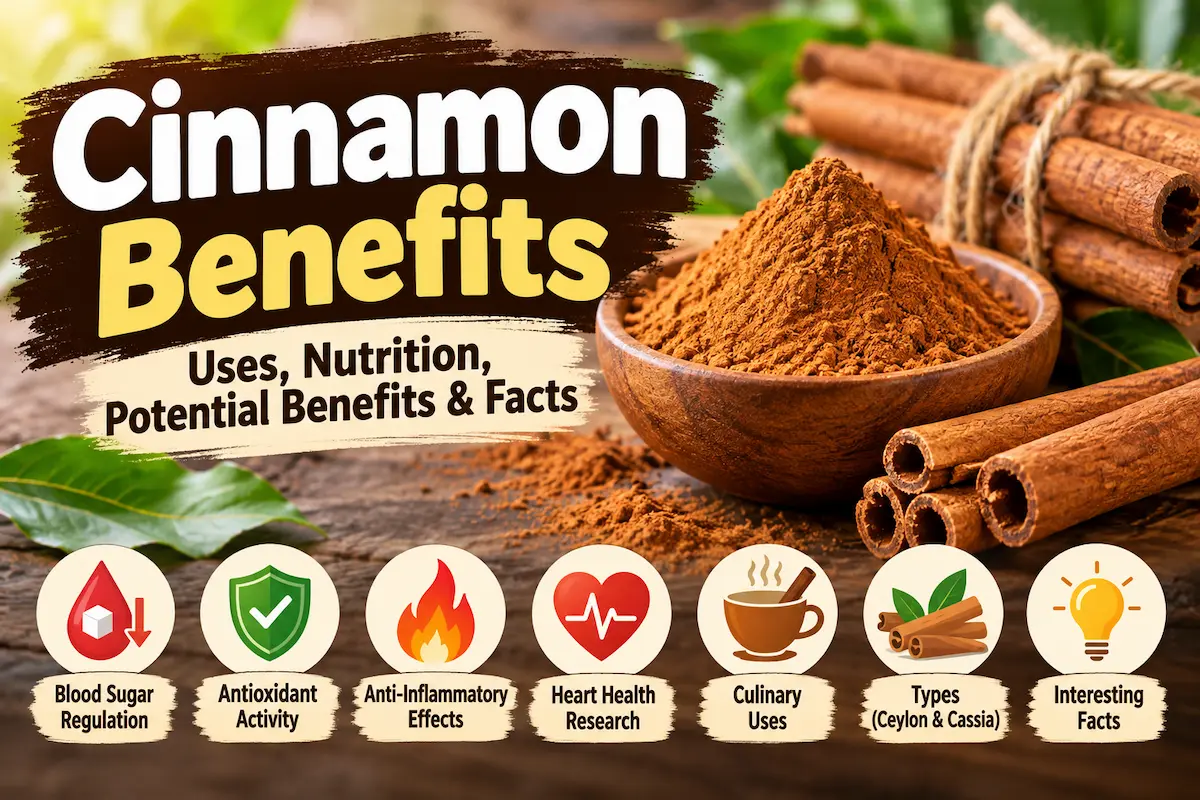
Cinnamon sticks and ground cinnamon illustrating the potential benefits, culinary uses, types, nutrition, safety considerations, and interesting facts about cinnamon.Cinnamon is one of the world's best-known spices, valued for its warm aroma, sweet-spicy flavor, and versatility in both sweet and savory foods.
But does cinnamon have health benefits?
Research has investigated cinnamon for areas such as blood sugar regulation, antioxidant activity, inflammation, and cardiovascular risk factors. However, the evidence is still developing, and cinnamon should be considered a food ingredient rather than a treatment for a disease.
🌿 Quick answer: Cinnamon contains naturally occurring compounds that researchers are studying for potential health effects, but there is not enough consistent evidence to recommend cinnamon as a treatment for a specific health condition.
🌶️40 Common Spices: Names, Pictures, Uses & Interesting Facts
🪵 What Is Cinnamon?
Cinnamon is a spice made from the dried inner bark of several species of Cinnamomum trees.
Two commonly discussed types are:
🌿 Ceylon cinnamon — Cinnamomum verum
🌰 Cassia cinnamon — commonly associated with Cinnamomum cassia and related species
Ceylon cinnamon is traditionally associated with Sri Lanka, while cassia types are widely used around the world. These types also differ in their chemical composition.
👉 You can explore more spices in our guide to 40 Common Spices: Names, Pictures, Uses & Interesting Facts.
✨ Potential Benefits of Cinnamon
Cinnamon has attracted scientific interest because it contains naturally occurring plant compounds.
🛡️ 1. Contains Antioxidant Compounds
Cinnamon contains compounds with antioxidant activity. Antioxidants are substances that can help protect cells from oxidative stress.
This is one reason cinnamon continues to be studied in nutrition and health research.
However, antioxidant activity in laboratory research does not automatically mean that consuming cinnamon will prevent or treat a particular disease.
🩸 2. Cinnamon and Blood Sugar
Blood sugar is one of the most researched areas involving cinnamon.
Some clinical studies and reviews have reported reductions in fasting blood glucose or other measures after cinnamon supplementation. For example, a 2024 systematic review and meta-analysis of 24 randomized controlled trials reported reductions in fasting blood glucose, insulin resistance measures, and HbA1c among people with type 2 diabetes.
However, other reviews have found the evidence inconsistent, and NCCIH states that it remains unclear whether cinnamon supplementation is helpful for diabetes.
👉 Important: Cinnamon should not be used as a replacement for prescribed diabetes treatment.
🔥 3. Cinnamon Contains Compounds Studied for Inflammation
Researchers have investigated cinnamon and its naturally occurring compounds for possible anti-inflammatory effects.
This research includes laboratory and clinical studies, but evidence of an effect from eating ordinary amounts of cinnamon is not strong enough to describe cinnamon as a treatment for inflammatory conditions.
❤️ 4. Cinnamon and Heart Health Research
Some studies have examined whether cinnamon supplementation can influence measures such as cholesterol, triglycerides, or blood pressure.
Results have varied between studies, and differences in cinnamon species, preparations, doses, and study designs make the findings difficult to interpret consistently.
More research is needed before cinnamon can be considered a proven way to improve cardiovascular health.
🍎 How Can You Use Cinnamon?
One of the easiest ways to enjoy cinnamon is simply as a culinary spice.
Try adding a small amount to:
🥣 Oatmeal
🍎 Apples and other fruit
☕ Tea or coffee
🥛 Warm milk
🥧 Baked foods
🍚 Rice dishes
🍛 Curries
🥤 Smoothies
🥜 Nut and fruit combinations
Using cinnamon as a flavoring can add a distinctive taste without needing large quantities.
🌰 Ceylon Cinnamon vs Cassia Cinnamon
The two names you will most often encounter are Ceylon cinnamon and cassia cinnamon.
| Feature | Ceylon Cinnamon | Cassia Cinnamon |
|---|---|---|
| Scientific name | Cinnamomum verum | Cinnamomum cassia and related species |
| Common association | Sri Lanka | Southeast Asia and other regions |
| Flavor | Generally milder and more delicate | Generally stronger and more intense |
| Coumarin | Trace amounts | Can contain substantially more |
| Common use | Cooking and specialty products | Widely used culinary cinnamon |
One important difference is coumarin, a naturally occurring compound found in higher amounts in cassia cinnamon. Large or prolonged consumption of cassia may be a concern for some people, particularly those with liver disease.
⚠️ Is Cinnamon Safe?
Cinnamon is generally considered safe when consumed in the amounts normally used as a food spice.
Problems are more relevant when large amounts are consumed or cinnamon is used for prolonged periods. Possible side effects can include digestive problems and allergic reactions.
Cassia cinnamon can contain significant amounts of coumarin, which may be a concern for people who are particularly sensitive or have liver disease.
🚫 Don't Try the "Cinnamon Challenge"
Never deliberately swallow large amounts of dry cinnamon powder.
The so-called cinnamon challenge can cause serious harm, particularly if the powder is inhaled.
🧠 Cinnamon: What Science Says
| Claim | What the evidence suggests |
|---|---|
| Cinnamon contains antioxidant compounds | ✅ Yes |
| Cinnamon may affect blood sugar | 🔬 Being studied; results are mixed |
| Cinnamon treats diabetes | ❌ Not established |
| Cinnamon causes weight loss | ❌ Not established |
| Cinnamon is safe in normal food amounts | ✅ Generally considered safe |
| Large amounts are always safe | ❌ Not necessarily |
| All cinnamon contains the same amount of coumarin | ❌ No |
The key takeaway is simple: cinnamon is a useful and flavorful spice, but its potential health effects should not be exaggerated. NCCIH currently states that research does not clearly support using cinnamon for any specific health condition.
🌿 Cinnamon in Everyday Cooking
Cinnamon is particularly interesting because it works in both sweet and savory foods.
It can add warmth to:
🍪 Cookies and cakes
🍎 Fruit dishes
☕ Hot drinks
🍚 Rice dishes
🍛 Curries
🥣 Breakfast foods
A small amount can noticeably change the aroma and flavor of a dish.
💡 Interesting Facts About Cinnamon
🌳 1. Cinnamon comes from tree bark.
The spice is made from the dried bark of Cinnamomum trees.
🌿 2. There is more than one type of cinnamon.
Ceylon and cassia are two important types.
🌍 3. Cinnamon has a long culinary history.
It has been used in traditional cuisine in many parts of the world, including China, India, and Persia.
🧪 4. Scientists are still studying cinnamon.
Research has examined cinnamon in areas including diabetes and other health conditions, but results have not produced a clear medical recommendation.
🌰 5. Cassia and Ceylon cinnamon differ chemically.
One important difference is their coumarin content.
🔗 Explore More Spice Guides
🌶️ 40 Common Spices: Names, Pictures, Uses & Interesting Facts — Explore 40 popular spices and learn how they are used.
🌿 100 Spices Name in English and Hindi — Browse a larger collection of spice names.
🌱 Best Spices for Beginners — Discover useful spices for starting a basic kitchen collection.
You can also explore our other food, seed, fruit, and vegetable name guides for more ingredient knowledge.
❓ Frequently Asked Questions
What are the potential benefits of cinnamon?
Cinnamon contains naturally occurring compounds that have been studied for antioxidant activity and possible effects on blood sugar and other health measures. However, research remains mixed, and cinnamon is not established as a treatment for any health condition.
Does cinnamon lower blood sugar?
Some clinical studies have reported reductions in fasting blood glucose and other measures, but results across studies have been inconsistent. Current evidence does not establish cinnamon as a replacement for diabetes treatment.
Which is better, Ceylon cinnamon or cassia cinnamon?
They are different types of cinnamon with different chemical compositions and flavor characteristics. Cassia generally contains more coumarin, while Ceylon cinnamon contains much less. The best choice depends on how the spice is being used and individual circumstances.
Is cinnamon safe to eat every day?
Cinnamon is generally considered safe in the amounts commonly used in food. Regularly consuming large amounts, particularly of cassia cinnamon, may be a concern because of its coumarin content.
Can cinnamon help with weight loss?
There is currently not enough reliable evidence to say that cinnamon supplementation causes meaningful weight loss. NCCIH states that it is unclear whether cinnamon supplementation is helpful for weight loss.
Is cinnamon a spice?
Yes. Cinnamon is a spice obtained from the dried bark of various Cinnamomum trees.
📚 Sources
National Center for Complementary and Integrative Health (NCCIH) — Cinnamon: Usefulness and Safety
NCCIH — Diabetes and Dietary Supplements: What You Need To Know
PubMed — 2024 systematic review and meta-analysis of cinnamon supplementation and glycemic control