
🌶️Best Spices for Beginners: Essential Spices for Your Kitchen
⚡ Quick Answer
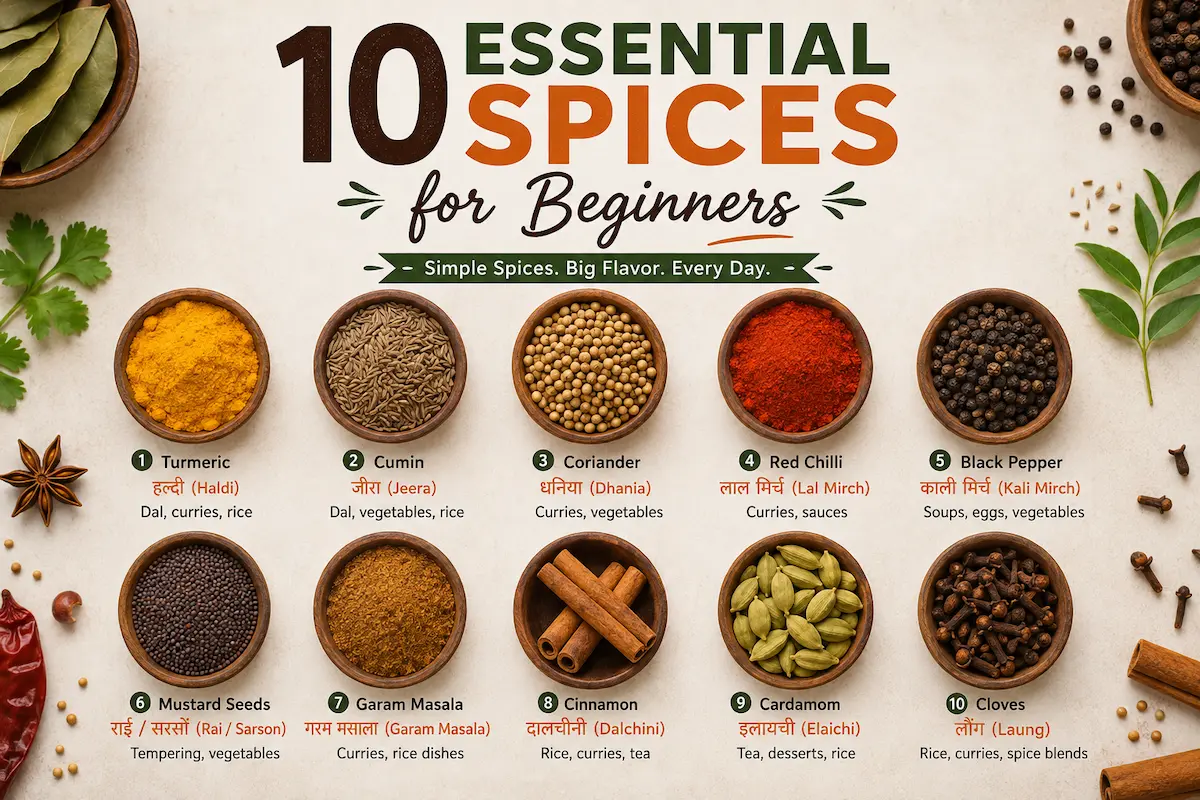
The best spices for beginners are turmeric (हल्दी), cumin (जीरा), coriander (धनिया), red chilli (लाल मिर्च), black pepper (काली मिर्च), mustard seeds (राई), garam masala (गरम मसाला), cinnamon (दालचीनी), cardamom (इलायची), and cloves (लौंग). These versatile Indian spices can be used in everyday Indian dishes such as dal, curries, vegetables, rice, tea, and spice blends. Beginners can start with a few commonly used spices and gradually build their collection.
Spices at glance table
| Spice | Hindi | Main use |
|---|---|---|
| Turmeric | हल्दी | Color & earthy flavor |
| Cumin | जीरा | Warm, earthy aroma |
| Coriander | धनिया | Mild, balanced flavor |
| Red chilli | लाल मिर्च | Heat & color |
| Black pepper | काली मिर्च | Sharp warmth |
| Mustard seeds | राई | Tempering |
| Garam masala | गरम मसाला | Aromatic finish |
| Cinnamon | दालचीनी | Sweet, woody aroma |
| Cardamom | इलायची | Sweet fragrance |
| Cloves | लौंग | Strong warm aroma |
Watch the 15-Second Spice Guide Video
“When I was learning which spices to keep at home, I noticed that I didn't actually use ten spices every day.”
Best Spices for Beginners: 10 Essential Spices to Start Cooking
Starting to cook can feel confusing when you don't know which spices to buy or how to use them. The good news is that you don't need 20 or 30 spice jars to make tasty food. A small collection of versatile spices can completely change the flavor of everyday meals.
If you're a beginner, start with a few reliable spices such as cumin, turmeric, coriander, black pepper, red chilli powder, and garam masala. Each one brings something different—earthy depth, warmth, color, aroma, or heat.
In this guide, you'll learn which spices are best for beginners, what they taste like, what foods you can use them in, and how to start using them without making your food overpowering. You don't have to become a chef overnight. Start with a few spices, learn what each one does, and build your collection as you cook..Check out our 100 Spices Name in English and Hindi
The best approach for a beginner is simple: start with the spices you are most likely to use, learn what each one tastes and smells like, and build your collection gradually. Read Is Paprika Spicy? Guide
Download Free Indian Spices List PDF , it has more than 100 spices name
Table of Contents
- Best Spices for Beginners: 10 Essential Spices to Start Cooking
- Best Spices for Beginners: 10 Essential Spices for Your Kitchen
- 1. Turmeric (Haldi) 🌟
- 2. Cumin (Jeera) 🌿
- 3. Coriander (Dhania) 🌿
- 4. Red Chilli Powder (Lal Mirch) 🌶️
- 5. Black Pepper (Kali Mirch) ⚫
- 6. Mustard Seeds (Rai) 🌱
- 7. Garam Masala 🥘
- 8. Cinnamon (Dalchini) 🌿
- 9. Cardamom (Elaichi) 💚
- 10. Cloves (Laung) 🌸
- 🌶️ What Are Spices?
- 👨🍳 A Simple Beginner's Kitchen Example
- 😋 What Should You Add When Food Tastes Bland?
- 🌶️ More Indian Spices to Explore
- 🧂 50 Indian Spices and Seasonings
- 1. Turmeric (Haldi) 🌟
- 2. Cumin (Jeera) 🌿
- 3. Coriander (Dhania) 🌿
- 4. Red Chilli Powder (Lal Mirch) 🌶️
- 5. Black Pepper (Kali Mirch) ⚫
- 6. Mustard Seeds (Rai) 🌱
- 7. Garam Masala 🥘
- 8. Cinnamon (Dalchini) 🌿
- 9. Cardamom (Elaichi) 💚
- 10. Cloves (Laung) 🌸
- 🆚 Whole Spices vs Ground Spices
- 🛒 How Many Spices Should a Beginner Buy?
- 🫙 How to Store Spices
- 💡 Interesting Facts About Spices
- 🧠 Quick Summary
- 🎯 Quick Spice Quiz
- ❓ Frequently Asked Questions
- What are the best spices for beginners?
- What are the 5 basic spices?
- What spices should every Indian kitchen have?
- Should beginners buy whole spices or powder?
- How should I store spices?
- How long do spices last?
- Which spices are good for Indian cooking?
- 🌶️ Related Articles
- Final Thought
- 📚 Continue Learning at Monto Fact Jungle
👩🍳 Real-Life Example: Mohan R and His Mom Sharada
Imagine Mohan and his mom Sharada are getting ready to cook a simple meal at home. Instead of reaching for a dozen different spice jars, they start with a few basics they already know well—turmeric (हल्दी), cumin (जीरा), coriander (धनिया), and red chilli (लाल मिर्च).
Sharada knows that a small amount of turmeric gives the dish its familiar color, while cumin adds a warm aroma when tempered in oil. Mohan is still learning, so he starts with a little chilli and tastes the food before adding more.
This is a good way for any beginner to learn spices: start with a few everyday spices, understand what each one does, and gradually build your collection as you become more confident in the kitchen.
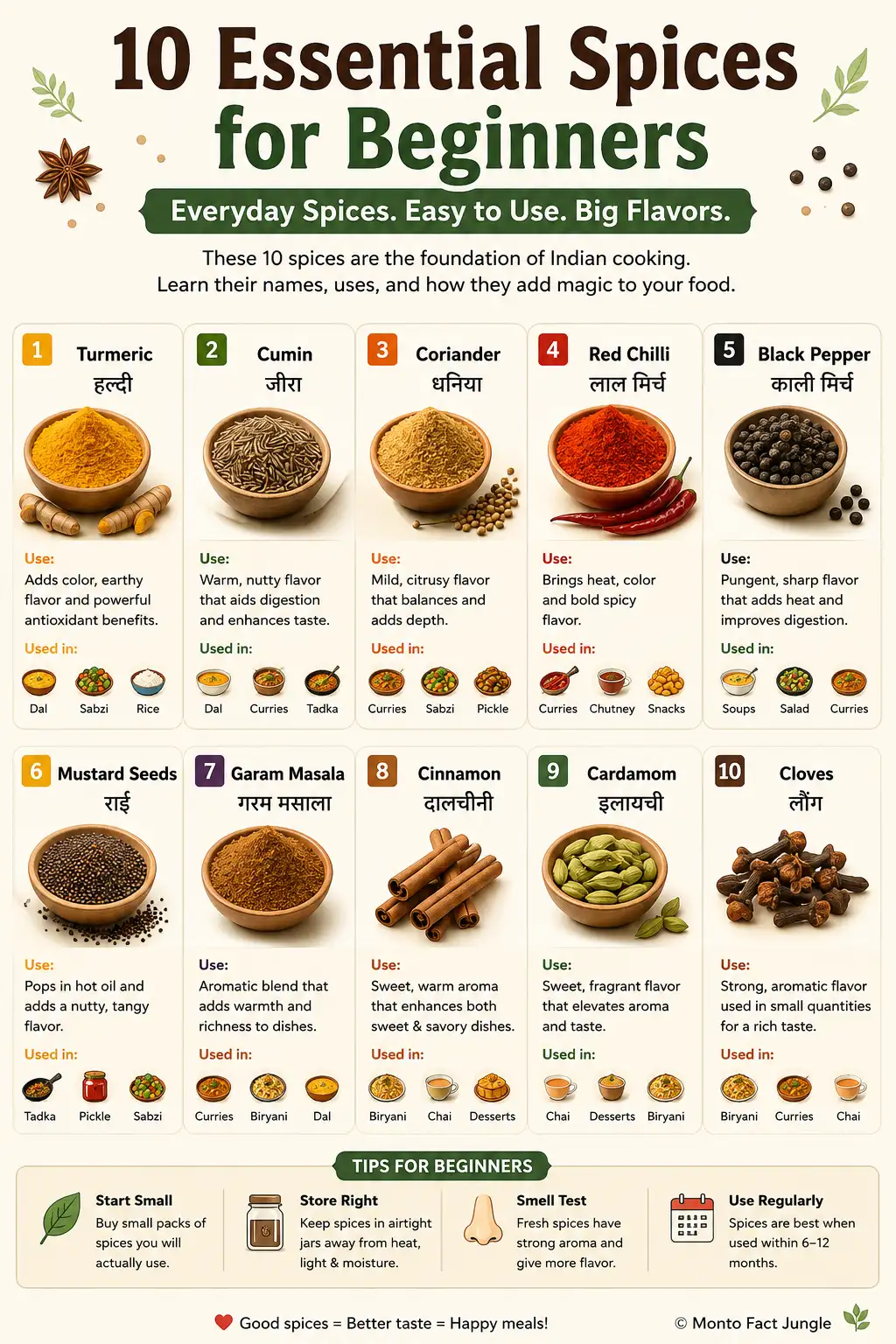
Best Spices for Beginners: 10 Essential Spices for Your Kitchen
As i said above, starting to cook can feel confusing when you see a kitchen shelf filled with dozens of colorful spice jars. The good news is that you don't need a huge collection to make flavorful everyday food. keep these essentials below which i discuss and are my hack in kitchen.
If you're a beginner, start with a small group of versatile spices that you can use in many different dishes. In an Indian kitchen, spices such as turmeric, cumin, coriander, red chilli, black pepper, mustard seeds, and garam masala are especially useful starting points.
In this guide, we'll look at essential spices for beginners, their English and Hindi names, flavor, common uses, and simple tips for using them.
1. Turmeric (Haldi) 🌟
Hindi: हल्दी (Haldi)
Turmeric is one of the most recognizable spices in Indian cooking. Its bright yellow color makes it easy to identify.
It has an earthy, warm flavor and is commonly used in dal, vegetable dishes, curries, rice dishes, and marinades.
Beginner tip: Start with a small amount. Turmeric is usually used to add color and background flavor rather than dominate a dish.
2. Cumin (Jeera) 🌿
Hindi: जीरा (Jeera)
Cumin has a warm, earthy and slightly nutty flavor. It is one of the most useful spices for a beginner because it can quickly add depth to everyday food.
Cumin can be used in:
Dal
Rice
Vegetable dishes
Curries
Spice blends
Cumin seeds are especially useful for tempering. Add them to hot oil and let them become aromatic before adding the other ingredients.
Beginner tip: Try lightly roasting or tempering cumin seeds until they become fragrant. Don't let them burn.
3. Coriander (Dhania) 🌿
Hindi: धनिया (Dhania)
Coriander seeds and coriander powder are widely used in Indian cooking.
Coriander powder has a mild, warm and slightly citrusy flavor. It usually works as a supporting spice rather than being the main source of heat.
It works well in:
Curries
Vegetable dishes
Dal
Gravies
Spice blends
Beginner tip: Coriander powder is generally less intense than chilli powder, so it is useful when you want to build flavor without making a dish very spicy.
4. Red Chilli Powder (Lal Mirch) 🌶️
Hindi: लाल मिर्च (Lal Mirch)
Red chilli powder mainly adds heat and color to food.
Different chilli varieties can have very different levels of heat. Some are chosen more for their bright red color and milder heat, while others can be much hotter.
It is commonly used in:
Curries
Vegetable dishes
Sauces
Marinades
Spice blends
Beginner tip: Start with a small amount and taste as you go. You can always add more, but reducing excess chilli in a finished dish is much harder.
5. Black Pepper (Kali Mirch) ⚫
Hindi: काली मिर्च (Kali Mirch)
Black pepper has a sharp, warm and pungent flavor.
You can use whole peppercorns, freshly crushed pepper, or ground pepper. It works particularly well with:
Eggs
Soups
Vegetables
Rice
Meat and poultry dishes
Beginner tip: Freshly ground black pepper generally gives a stronger aroma than pepper that has been sitting in a container for a long time.
6. Mustard Seeds (Rai) 🌱
Hindi: राई (Rai) / सरसों (Sarson)
Mustard seeds are especially useful for tempering, a cooking technique commonly used in Indian cuisine.
When heated in oil, the seeds begin to pop and release their characteristic aroma.
They are commonly used in:
Vegetable dishes
Dal
Chutneys
Pickles
Regional preparations
Beginner tip: Keep a lid nearby when tempering mustard seeds because they can pop rapidly once they become hot.
7. Garam Masala 🥘
Hindi: गरम मसाला
Garam masala is not a single spice. It is a blend of spices, and its ingredients can vary by recipe, region and brand.
It commonly contains aromatic spices such as pepper, cinnamon, cloves and cardamom, although formulations vary.
Garam masala is commonly used in:
Curries
Vegetable dishes
Rice dishes
Gravies
Some meat and poultry dishes
It is often added toward the later stages of cooking or near the end to provide a warm, aromatic finish.
Beginner tip: You don't need a large amount. Start with a small quantity and adjust according to the dish.
8. Cinnamon (Dalchini) 🌿
Hindi: दालचीनी (Dalchini)
Cinnamon is the dried bark of cinnamon trees. It has a sweet, woody and warm aroma.
It can be used in:
Rice dishes
Curries
Biryani
Tea
Desserts
Beginner tip: Whole cinnamon sticks are useful when you want a gentle background aroma because they can be removed before serving.
9. Cardamom (Elaichi) 💚
Hindi: इलायची (Elaichi)
Cardamom has a distinctive sweet, floral and highly aromatic flavor.
It is commonly used in:
Tea
Desserts
Rice dishes
Biryani
Other aromatic preparations
Beginner tip: Whole cardamom pods can be lightly crushed before adding them to a dish to release more aroma.
10. Cloves (Laung) 🌸
Hindi: लौंग (Laung)
Cloves are dried flower buds with a strong, warm and slightly sweet aroma.
They are commonly used in:
Biryani
Rice dishes
Curries
Spice blends
Tea
Beginner tip: Cloves are powerful, so a small amount is usually enough. Using too many can easily overpower the other flavors in a dish.
🌶️ What Are Spices?
Spices are aromatic parts of plants that are used to add flavor, aroma, color, or heat to food.
They can come from different parts of plants, including seeds, bark, fruits, roots, and flower buds.
For example:
Turmeric comes from a rhizome.
Cumin comes from seeds.
Cinnamon comes from bark.
Cloves are dried flower buds.
Black pepper comes from dried pepper berries.
Spices can be used whole, crushed, roasted, or ground into powders.
👨🍳 A Simple Beginner's Kitchen Example
Imagine you're cooking your first simple dal.
You don't need 20 different spices.
A small amount of turmeric can add color and earthy flavor. Cumin seeds can be used for tempering, while chilli powder can add heat. A little coriander powder can add another layer of flavor.
That's the idea behind a beginner's spice collection: buy the spices you'll actually use regularly before expanding your collection. Also checkout these spices articles
😋 What Should You Add When Food Tastes Bland?
Sometimes a dish isn't bad—it just needs a little more flavor. Instead of randomly adding more salt or throwing several spices into the pan, think about what your food is missing.
| If your food needs... | Try... | What it adds |
|---|---|---|
| 🌿 Earthy depth | Cumin (Jeera) | Warm, earthy and slightly nutty flavor |
| 🟡 More color | Turmeric (Haldi) | Golden color with a mild earthy taste |
| 🌶️ More heat | Red Chilli Powder | Direct, noticeable heat |
| ⚫ Peppery sharpness | Black Pepper | Warm, pungent bite |
| 🌱 Mild aromatic flavor | Coriander (Dhania) | Gentle, citrusy and earthy notes |
| 🔥 Warm aroma | Garam Masala | A fragrant blend of warm spices |
| 🪵 Smoky flavor | Smoked Paprika | Mild sweetness with a smoky character |
| 🍂 Sweet warmth | Cinnamon (Dalchini) | Warm, woody sweetness |
A simple rule for beginners
Don't add everything at once. Start with a small amount of one spice, taste the food, and adjust if needed.
For example:
Dal tastes flat? Try a little cumin or coriander.
Vegetables need more flavor? Try cumin, turmeric or chilli.
Eggs need a little kick? Try black pepper or chilli.
Rice needs more aroma? Try cumin or a small amount of garam masala.
Potatoes taste boring? Try cumin, black pepper, chilli or paprika.
The goal isn't to make food extremely spicy. Good seasoning is about adding the right kind of flavor, not simply adding more heat.
🌶️ More Indian Spices to Explore
You don't need all of these spices when you're just starting out. The 10 spices above are enough to build a useful beginner collection.
Once you're comfortable with the basics, you can gradually explore more Indian spices and seasonings. This list is here as a reference, not a shopping list—buy the ones that match the dishes you actually enjoy cooking.
🧂 50 Indian Spices and Seasonings
| No. | Spice | Hindi Name | Flavor | Common Uses |
|---|---|---|---|---|
| 1 | Turmeric | हल्दी (Haldi) | Earthy, warm | Dal, curries, rice |
| 2 | Cumin | जीरा (Jeera) | Warm, nutty | Dal, vegetables, rice |
| 3 | Coriander | धनिया (Dhania) | Mild, citrusy | Curries, vegetables |
| 4 | Red Chilli | लाल मिर्च (Lal Mirch) | Hot, spicy | Curries, sauces |
| 5 | Black Pepper | काली मिर्च (Kali Mirch) | Sharp, warm | Soups, eggs, vegetables |
| 6 | Mustard Seeds | राई / सरसों (Rai / Sarson) | Pungent, nutty | Tempering, vegetables |
| 7 | Garam Masala | गरम मसाला (Garam Masala) | Warm, aromatic | Curries, rice dishes |
| 8 | Cinnamon | दालचीनी (Dalchini) | Sweet, woody | Rice, curries, tea |
| 9 | Cardamom | इलायची (Elaichi) | Sweet, aromatic | Tea, desserts, rice |
| 10 | Cloves | लौंग (Laung) | Strong, warm | Rice, curries, spice blends |
| 11 | Bay Leaf | तेज पत्ता (Tej Patta) | Aromatic, woody | Rice, curries, pulao |
| 12 | Green Cardamom | छोटी इलायची (Choti Elaichi) | Sweet, floral | Tea, desserts, biryani |
| 13 | Black Cardamom | बड़ी इलायची (Badi Elaichi) | Smoky, earthy | Curries, rice, meat dishes |
| 14 | Fennel Seeds | सौंफ (Saunf) | Sweet, anise-like | Curries, pickles, mouth freshener |
| 15 | Fenugreek Seeds | मेथी दाना (Methi Dana) | Bitter, earthy | Pickles, curries, spice blends |
| 16 | Fenugreek Leaves | कसूरी मेथी (Kasuri Methi) | Earthy, aromatic | Curries, paneer dishes |
| 17 | Carom Seeds | अजवाइन (Ajwain) | Strong, thyme-like | Paratha, pakora, snacks |
| 18 | Nigella Seeds | कलौंजी (Kalonji) | Peppery, nutty | Pickles, naan, vegetables |
| 19 | Asafoetida | हींग (Hing) | Strong, savory | Dal, curries, tempering |
| 20 | Saffron | केसर (Kesar) | Floral, delicate | Desserts, rice, milk |
| 21 | Star Anise | चक्र फूल (Chakra Phool) | Sweet, licorice-like | Biryani, rice, spice blends |
| 22 | Nutmeg | जायफल (Jaiphal) | Warm, nutty | Desserts, spice blends |
| 23 | Mace | जावित्री (Javitri) | Warm, aromatic | Biryani, curries, spice blends |
| 24 | Dried Red Chillies | सूखी लाल मिर्च (Sukhi Lal Mirch) | Hot, smoky | Tempering, curries, chutneys |
| 25 | Chilli Flakes | लाल मिर्च के टुकड़े (Lal Mirch Ke Tukde) | Hot, spicy | Pizza, pasta, snacks |
| 26 | Curry Leaves | करी पत्ता (Kadi Patta) | Citrusy, aromatic | Curries, chutney, tempering |
| 27 | Tamarind | इमली (Imli) | Sour, fruity | Chutneys, sambar, curries |
| 28 | Dry Mango Powder | अमचूर (Amchur) | Tangy, fruity | Chaat, curries, snacks |
| 29 | Black Salt | काला नमक (Kala Namak) | Sulfurous, savory | Chaat, raita, drinks |
| 30 | Rock Salt | सेंधा नमक (Sendha Namak) | Mild, salty | Fasting foods, snacks |
| 31 | Caraway Seeds | शाही जीरा (Shahi Jeera) | Earthy, aromatic | Biryani, rice, breads |
| 32 | Poppy Seeds | खसखस (Khus Khus) | Mild, nutty | Gravies, sweets, breads |
| 33 | Sesame Seeds | तिल (Til) | Nutty, rich | Chutneys, sweets, breads |
| 34 | Dill Seeds | सोया बीज (Soya Beej) | Herbal, slightly bitter | Pickles, curries, vegetables |
| 35 | Celery Seeds | अजमोद के बीज (Ajmod Ke Beej) | Strong, herbal | Pickles, spice blends |
| 36 | Allspice | कबाब चीनी (Kabab Chini) | Warm, peppery | Spice blends, curries |
| 37 | Long Pepper | पीपली (Pippali) | Peppery, pungent | Spice blends, traditional preparations |
| 38 | White Pepper | सफेद मिर्च (Safed Mirch) | Mild, sharp | Soups, sauces, gravies |
| 39 | Green Peppercorns | हरी मिर्च के दाने (Hari Mirch Ke Dane) | Fresh, peppery | Sauces, curries |
| 40 | Anardana | अनारदाना (Anardana) | Tangy, fruity | Chutneys, curries, spice blends |
| 41 | Kokum | कोकम (Kokum) | Sour, fruity | Curries, drinks, coastal dishes |
| 42 | Dried Fenugreek | सूखी मेथी (Sukhi Methi) | Earthy, bitter | Curries, vegetables |
| 43 | Dried Ginger | सोंठ (Sonth) | Warm, spicy | Drinks, curries, spice blends |
| 44 | Cinnamon Powder | दालचीनी पाउडर (Dalchini Powder) | Sweet, woody | Baking, tea, desserts |
| 45 | Cumin Powder | जीरा पाउडर (Jeera Powder) | Warm, earthy | Raita, chaat, curries |
| 46 | Coriander Powder | धनिया पाउडर (Dhania Powder) | Mild, warm | Curries, vegetables |
| 47 | Amchur Powder | अमचूर पाउडर (Amchur Powder) | Tangy, fruity | Chaat, curries, snacks |
| 48 | Ginger Powder | अदरक पाउडर (Adrak Powder) | Warm, spicy | Tea, curries, baking |
| 49 | Garlic Powder | लहसुन पाउडर (Lahsun Powder) | Savory, pungent | Seasoning, sauces, snacks |
| 50 | Onion Powder | प्याज पाउडर (Pyaz Powder) | Savory, sweet | Seasoning, sauces, snacks |
1. Turmeric (Haldi) 🌟
Hindi: हल्दी (Haldi)
Turmeric is one of the most recognizable spices in Indian cooking. Its bright yellow color makes it easy to identify.
It has an earthy, warm flavor and is commonly used in dals, vegetable dishes, curries, rice dishes, and marinades.
Beginner tip
Start with a small amount. Turmeric is usually used to add color and background flavor rather than dominate a dish.
2. Cumin (Jeera) 🌿
Hindi: जीरा (Jeera)
Cumin has a warm, earthy and slightly nutty flavor.
Cumin seeds are especially useful for beginners because they can be added to hot oil for tempering before other ingredients go into the pan.
Cumin is commonly used in:
Dal
Rice
Vegetable dishes
Curries
Spice blends
Beginner tip
Try lightly roasting cumin seeds until they become aromatic. Don't let them burn.
3. Coriander (Dhania) 🌿
Hindi: धनिया (Dhania)
Coriander seeds and coriander powder are widely used in Indian cooking.
Coriander powder has a mild, warm and slightly citrusy character. It is often used as a supporting spice rather than the main source of heat.
It works well in:
Curries
Vegetable dishes
Dal
Gravies
Spice blends
Beginner tip
Coriander powder is generally less intense than chilli powder, so it can be used to build flavor without making food very spicy.
4. Red Chilli Powder (Lal Mirch) 🌶️
Hindi: लाल मिर्च (Lal Mirch)
Red chilli powder adds heat and color.
Different chilli varieties can have very different levels of heat. Some varieties are chosen more for their red color and milder heat, while others are much hotter.
Beginner tip
Start with a small amount and taste as you go. You can always add more, but removing excess chilli from a finished dish is much harder.
5. Black Pepper (Kali Mirch) ⚫
Hindi: काली मिर्च (Kali Mirch)
Black pepper has a sharp, warm and pungent flavor.
You can use whole peppercorns, freshly crushed pepper, or ground pepper.
It works particularly well with:
Eggs
Soups
Vegetables
Rice
Meat and poultry dishes
Beginner tip
Freshly ground black pepper generally gives a stronger aroma than pepper that has been sitting in a container for a long time.
6. Mustard Seeds (Rai) 🌱
Hindi: राई (Rai) / सरसों (Sarson)
Mustard seeds are particularly useful for tempering.
When heated in oil, they begin to pop and release their characteristic aroma.
They are commonly used in many Indian vegetable dishes, dals, chutneys, pickles and regional preparations.
Beginner tip
Use a lid or keep some distance when tempering mustard seeds because they can pop rapidly once they heat up.
7. Garam Masala 🥘
Hindi: गरम मसाला
Garam masala is not a single spice. It is a blend of spices, and the exact ingredients can vary by recipe, region and brand.
It commonly contains aromatic spices such as pepper, cinnamon, cloves and cardamom, although formulations vary.
It is often added toward the later stages of cooking or near the end to provide a warm, aromatic finish.
Beginner tip
You don't need a large amount. Start with a small quantity and adjust according to the dish.
8. Cinnamon (Dalchini) 🌿
Hindi: दालचीनी (Dalchini)
Cinnamon is the dried bark of cinnamon trees.
It has a sweet, woody and warm aroma.
It can be used in:
Rice dishes
Curries
Biryani
Tea
Desserts
Beginner tip
Whole cinnamon sticks are useful when you want a gentle background aroma that can be removed before serving.
9. Cardamom (Elaichi) 💚
Hindi: इलायची (Elaichi)
Cardamom has a distinctive sweet and highly aromatic flavor.
It is commonly associated with Indian tea, desserts, rice dishes and aromatic preparations.
Beginner tip
Whole cardamom pods can be lightly crushed before adding them to a dish to release more aroma.
10. Cloves (Laung) 🌸
Hindi: लौंग (Laung)
Cloves are dried flower buds with a strong, warm and slightly sweet aroma.
They are commonly used in:
Biryani
Rice dishes
Curries
Spice blends
Tea
Beginner tip
Cloves are powerful, so a small amount is usually enough. Read Paprika vs Smoked Paprika Guide
🆚 Whole Spices vs Ground Spices
Beginners often wonder whether they should buy whole spices or powders.
| Whole Spices | Ground Spices |
|---|---|
| Usually have a longer-lasting aroma when stored properly | Convenient and ready to use |
| Can be roasted or tempered | Easy for quick everyday cooking |
| Often used in rice dishes and tempering | Easy to measure |
| Need grinding for some recipes | Can lose aroma faster once ground |
| Great for building a spice collection | Best for convenience |
For a beginner, there's no need to choose only one.
A practical kitchen can have both whole and ground spices depending on how you cook.
🛒 How Many Spices Should a Beginner Buy?
You don't need to buy all 50 immediately.
If you're starting from zero, a simple first collection could be:
Turmeric
Cumin
Coriander powder
Red chilli powder
Black pepper
Garam masala
Once you're comfortable using these, you can add mustard seeds, cinnamon, cardamom and cloves.
This approach also reduces waste because spices gradually lose freshness and quality over time. USDA guidance notes that shelf-stable foods such as spices can be stored at room temperature, while dry goods should be protected from moisture and stored appropriately to preserve quality.
🫙 How to Store Spices
Good storage can help your spices retain their quality for longer.
Keep spices:
In tightly closed containers
In a dry place
Away from moisture
Away from direct sunlight
Away from excessive heat
A spice shelf directly above a hot stove may look convenient, but constant heat isn't ideal for maintaining quality.
Simple rule:
Cool + dry + closed = better spice storage.
💡 Interesting Facts About Spices
Turmeric is known for its bright yellow color.
Cumin seeds are commonly used for tempering.
Cinnamon comes from tree bark.
Cloves are dried flower buds.
Black pepper comes from pepper berries.
Cardamom is one of the most aromatic spices used in many sweet and savory dishes.
Garam masala is a spice blend rather than one individual spice.
Different regions of India use different combinations of spices.
Whole spices can be toasted or tempered to release aroma.
You don't need dozens of spices to start cooking flavorful food.
Indian cuisine is especially diverse in its use of spices, with regional cooking traditions producing different combinations and patterns of spice use. Research into Indian cuisines has also found spices to be a central part of ingredient combinations across regional cuisines.
🧠 Quick Summary
If you're a complete beginner, start with these six:
Turmeric + Cumin + Coriander + Red Chilli + Black Pepper + Garam Masala
Then gradually add:
Mustard Seeds + Cinnamon + Cardamom + Cloves
Don't worry about having a giant spice collection. Learn how a few basic spices taste and how they behave while cooking. Once you understand those, expanding your spice shelf becomes much easier.
🎯 Quick Spice Quiz
1. Which spice gives food a bright yellow color?
A. Cumin
B. Turmeric
C. Clove
D. Cardamom
Answer: B. Turmeric
2. Which spice is commonly used for tempering?
A. Cumin
B. Cardamom
C. Cinnamon
D. Clove
Answer: A. Cumin
3. Garam masala is:
A. A single seed
B. A fruit
C. A spice blend
D. A vegetable
Answer: C. A spice blend
4. Which spice has a strong, warm aroma and is a dried flower bud?
A. Clove
B. Turmeric
C. Cumin
D. Coriander
Answer: A. Clove
5. Which spice is known for its sharp and pungent flavor?
A. Cardamom
B. Black pepper
C. Cinnamon
D. Turmeric
Answer: B. Black pepper
❓ Frequently Asked Questions
What are the best spices for beginners?
Turmeric, cumin, coriander, red chilli, black pepper and garam masala are a practical starting point for many Indian-style everyday dishes.
What are the 5 basic spices?
A simple five-spice starter collection could be turmeric, cumin, coriander, red chilli and black pepper. The exact selection depends on the type of food you cook.
What spices should every Indian kitchen have?
Common choices include turmeric, cumin, coriander, chilli, mustard seeds, black pepper and garam masala, with additional spices depending on regional cooking styles.
Should beginners buy whole spices or powder?
Both are useful. Ground spices are convenient, while whole spices are especially useful for tempering and aromatic dishes.
How should I store spices?
Keep them tightly sealed in a cool, dry place away from moisture, direct sunlight and excessive heat.
How long do spices last?
Spices can remain usable for a long time when stored properly, but their aroma, flavor and color gradually decline. Check the package guidance and use your senses to identify noticeable loss of quality.
Which spices are good for Indian cooking?
Turmeric, cumin, coriander, chilli, mustard seeds, black pepper, cinnamon, cardamom and cloves are among the commonly used spices, although the exact selection varies by regional cuisine and recipe.
🌶️ Related Articles
If you're building your spice collection, you may also want to explore:
Final Thought
You don't need a kitchen full of spice jars to become a better cook.
Start with a few versatile spices, learn what each one tastes like, and gradually build your collection around the food you actually enjoy cooking.
A small spice box you understand is more useful than a big spice box you never use.
📚 Continue Learning at Monto Fact Jungle
Explore our most popular educational resources designed for students, parents, teachers, and lifelong learners.
🍎 Fruits Name in English and Hindi
🌸 Flowers Name in English and Hindi
🦁 Animals Kya Khate Hain List
⌨️ Keyboard Symbols Name in Hindi
📖 Meaning in Hindi with Examples
🦁 50 fruits name in hindi and english
Thank You So Much Meaning in Hindi Examples
🧠 100+ Body Parts Name in Hindi and English
🔠ABCD Chart (A to Z English Alphabet for Kids) – Easy Learning Guide with Pictures
You should also read:
🌶️50 Indian Spices and Their Uses (भारतीय मसालों के उपयोग) – Cooking & Kitchen Guide
🌶️50 Complete Indian Spices and Their Uses (भारतीय मसालों के उपयोग) – Cooking & Kitchen Guide Introduction Indian food is famous around the world because of its rich flavors, colors, and aroma. The secret behind these delicious dishes is spices. From a simple bowl of…
Continue reading...🎂Lucky Number by Date of Birth Calculator (Free) | Find Your Lucky Number
🎂 Lucky Number by Date of Birth Calculator 🍀 Lucky Number by Date of Birth Calculator, Daily Luck Calculator bhi bahut interesting hai, check kijiye aapka daily luck also. Main Mohan hoon, aur agar aap kabhi sochte hain, "Mera lucky number kya hai?" ya "Kya…
Continue reading...🔥 100 Spices Name in English and Hindi (Masalon ke Naam List)
🌶️100 Complete Spices Name in English and Hindi (Masalon ke Naam) 50 spices name in english and hindi 📥 Download Free 100 Spices Name PDF (Hindi & English) 📌 Quick Answer Spices are dried seeds, fruits, roots, bark, or flowers used to add flavor, aroma,…
Continue reading...Calculate your attendance %, required classes, safe bunk days & predicted percentage.
Ultimate Attendance Calculator (India) Calculate your attendance %, required classes, safe bunk days & predicted percentage. <script> document.addEventListener("DOMContentLoaded", function(){ function clamp(v,min,max){ return Math.max(min, Math.min(max, v)); } function runCalc(){ const total = Number(att_total.value || 0); const attended = Number(att_attended.value || 0); const req = Number(att_required.value ||…
Continue reading...