
🧠 50+ Amazing Human Body Facts for Kids | Fun & Easy Facts
🧠 Human Body Facts for Kids
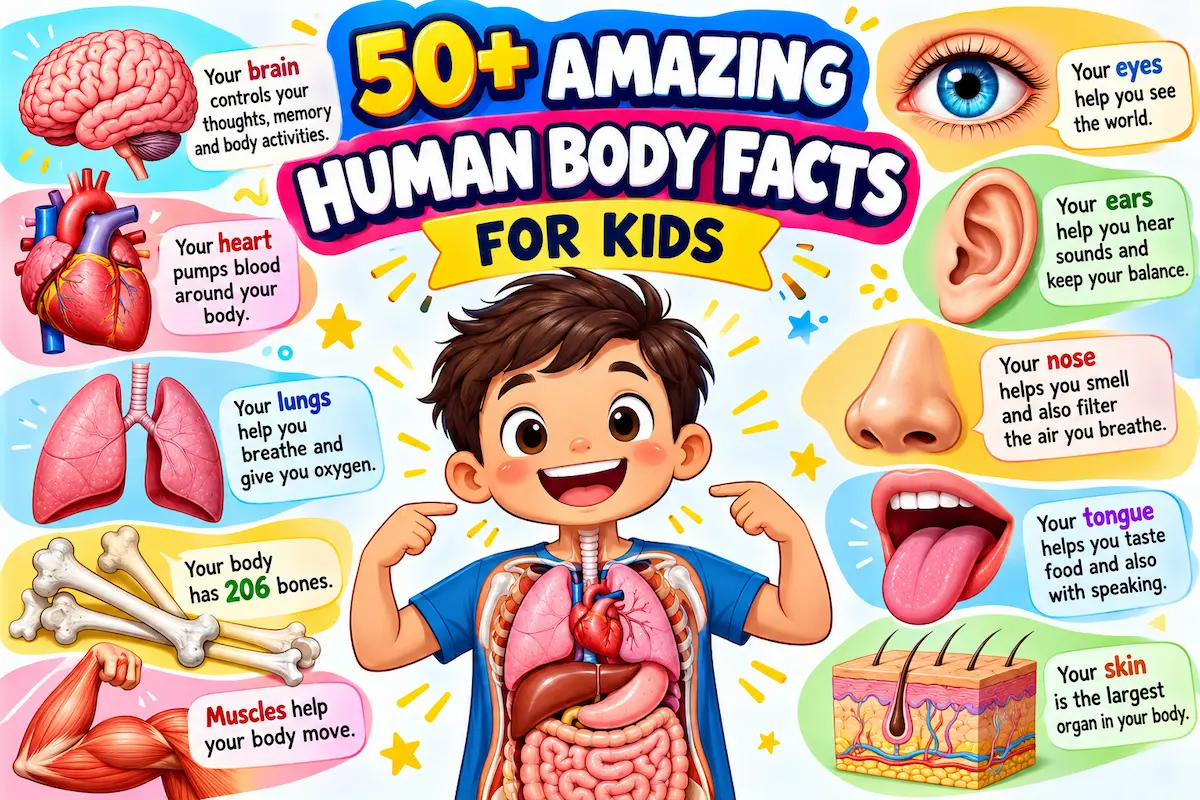
Colorful educational infographic showing amazing human body facts for kids, including facts about the brain, heart, lungs, bones, muscles, eyes, ears, nose, tongue, and skin.
The human body is an amazing system made up of bones, muscles, organs, nerves, blood vessels, skin, and many other structures. Every part works together to help us move, breathe, eat, think, learn, sleep, and stay alive.
From the tiny bones inside your ears to the powerful muscles that help you walk, there is something interesting happening inside your body all the time. 🔬
In this guide, you'll discover 50+ amazing human body facts for kids explained in simple language.
You’ll learn about:
🧠 Brain and nervous system facts
❤️ Heart and blood facts
🦴 Bone and skeleton facts
💪 Muscle facts
👁️ Eye and vision facts
👂 Ear and hearing facts
👃 Nose and smell facts
👅 Taste and tongue facts
🧴 Skin and hair facts
🫁 Breathing and lung facts
🍎 Digestion facts
😴 Sleep and body facts
🤯 Fun and surprising body facts
- Read 🧠 100+ Body Parts Name in Hindi and English
📥 Download Body Parts Name PDF
Want to learn all 100 body parts names offline? Download our free printable PDF with 100+ body parts names in English and Hindi, along with simple functions. It’s useful for students, kids, parents, teachers, and English learners.
👉 [📄 Download 100+ Body Parts Name in Hindi and English PDF]
🔬 50+ Amazing Human Body Facts
🧠 Brain Facts
1. Your brain controls many of your body's activities.
The brain helps control movement, thinking, memory, emotions, breathing, and many other functions.
2. The brain is part of the nervous system.
It works together with the spinal cord and nerves to send and receive information throughout the body.
3. Your brain helps you learn and remember.
Whenever you learn a new word, solve a problem, or remember someone's name, your brain is involved.
4. The brain communicates with the rest of the body through nerves. ⚡
Nerves carry signals between the brain, spinal cord, and different parts of the body.
5. The brain needs a constant supply of oxygen and nutrients.
Blood delivers oxygen and nutrients that brain cells need to function.
❤️ Heart & Blood Facts
6. Your heart pumps blood around your body.
The heart is a muscular organ that continuously pumps blood through the circulatory system.
7. Blood carries oxygen around your body. 🩸
Red blood cells contain hemoglobin, which helps transport oxygen from the lungs to tissues.
8. Blood also carries nutrients.
Nutrients absorbed from food can travel through the blood to cells that need them.
9. Blood vessels form a huge transport network.
Arteries, veins, and smaller blood vessels carry blood to and from different parts of the body.
10. Your heart has four chambers. ❤️
They are the right atrium, right ventricle, left atrium, and left ventricle.
🦴 Bone & Skeleton Facts
11. An adult human skeleton normally has 206 bones. 🦴
12. Babies have more bones than adults.
Many bones in a baby's body are separate and later fuse together as the body develops.
13. The femur is the longest bone in the human body.
It is the large bone running through the thigh.
14. The skeleton gives your body support.
Bones help give the body its shape and provide a framework for muscles and organs.
15. Bones are living tissue.
Bone is continuously maintained and remodeled by the body.
16. Your skull protects your brain. 🧠
The bones of the skull form a protective structure around the brain.
💪 Muscle Facts
17. Muscles help your body move.
They work by contracting and relaxing.
18. You use muscles even when you are sitting still.
Muscles help maintain posture and support many automatic body functions.
19. The heart is made mostly of cardiac muscle. ❤️
This specialized muscle allows the heart to contract continuously.
20. Muscles work with bones to produce movement.
Muscles pull on bones through tendons, helping your joints move.
21. Your body contains hundreds of muscles.
Different muscles have different shapes, sizes, and functions.
👁️ Eye & Vision Facts
22. Your eyes help you see the world around you. 👀
23. The iris controls how much light enters the eye.
It changes the size of the pupil in response to light.
24. The pupil is the opening in the center of the iris.
Light enters the eye through the pupil.
25. Your retina detects light.
It contains specialized cells that respond to light and help create visual signals.
26. Your eyes work together with your brain. 🧠
The eyes collect visual information, while the brain processes and interprets it.
👂 Ear & Hearing Facts
27. Your ears help you hear sounds. 👂
28. Your ears also help with balance.
Structures inside the inner ear help your brain understand the position and movement of your head.
29. The eardrum vibrates when sound reaches it.
These vibrations are passed through structures of the middle ear.
30. The cochlea is found inside the inner ear.
It helps convert sound vibrations into nerve signals that can be processed by the brain.
👃 Nose & Smell Facts
31. Your nose helps you smell. 👃
32. Your nose also helps filter and condition the air you breathe.
Hair, mucus, and other structures help trap particles and warm or humidify incoming air.
33. Smell is connected to the brain. 🧠
Signals from smell receptors are processed by the nervous system.
34. Your nose also contributes to your sense of taste.
Smell and taste work together to create much of what we experience as flavor.
👅 Tongue & Taste Facts
35. Your tongue helps you taste food. 👅
36. Your tongue also helps with speaking.
It changes position and shape to help produce many speech sounds.
37. Your tongue helps move food around your mouth.
It assists with chewing and swallowing.
38. Taste receptors detect different types of tastes.
The main taste categories include sweet, sour, salty, bitter, and umami.
🫁 Lung & Breathing Facts
39. Your lungs help you breathe. 🫁
40. Oxygen from the air enters the blood in the lungs.
Tiny structures called alveoli provide a large surface where gas exchange occurs.
41. You have two lungs.
The right lung and left lung are located inside the chest.
42. Your diaphragm helps you breathe.
This large muscle beneath the lungs changes the space inside the chest when it contracts and relaxes.
43. Breathing removes carbon dioxide from your body.
Carbon dioxide is produced by cells and is carried to the lungs to be exhaled.
🍎 Digestion Facts
44. Digestion begins in your mouth.
Chewing breaks food into smaller pieces, while saliva begins the digestive process.
45. Your stomach helps break down food.
It mixes food with digestive juices.
46. The small intestine absorbs many nutrients.
Nutrients from digested food pass through the intestinal wall into the body.
47. The liver is an important digestive organ.
It produces bile, which helps the body digest fats.
48. The pancreas helps with digestion.
It produces digestive enzymes and also has important roles in blood-sugar regulation.
🧴 Skin & Hair Facts
49. Skin is the body's largest organ.
It forms an outer protective covering and helps with sensation and temperature regulation.
50. Your skin helps protect you from the outside environment. 🛡️
51. Skin contains sensory receptors.
These allow you to detect sensations such as touch, pressure, temperature, and pain.
52. Hair grows from structures called hair follicles.
Hair follicles are located within the skin.
53. Your fingernails and toenails help protect the ends of your fingers and toes. 💅
😴 Sleep & Body Facts
54. Your body continues working while you sleep. 🌙
The brain remains active, breathing continues, and the heart keeps pumping blood.
55. Sleep is important for growing children.
Good sleep supports normal growth, learning, memory, and overall health.
56. Your body follows daily rhythms.
Many body processes change according to the time of day and night.
🤯 Surprising Human Body Facts
Here are a few facts that can make learning about the human body even more interesting:
57. Your fingerprints are highly individual. 🖐️
The patterns on your fingertips develop before birth and are used to help identify people.
58. Your body temperature is regulated by your nervous system. 🌡️
The brain helps coordinate responses that keep your internal temperature within a suitable range.
59. Your spinal cord connects the brain with much of the body.
It is an important part of the central nervous system.
60. Your body is constantly replacing and repairing cells.
Different tissues renew themselves at different rates.
61. Your body needs water to function properly. 💧
Water is involved in many important processes, including transporting substances and regulating temperature.
62. Your immune system helps defend your body. 🛡️
It uses cells, tissues, and organs to recognize and respond to harmful organisms and other threats.
63. Your kidneys filter your blood.
They remove waste and help maintain the body's balance of water and dissolved substances.
64. Your liver performs hundreds of important functions.
It plays major roles in metabolism, processing nutrients, producing bile, and handling many substances in the blood.
65. Your body works as one connected system. 🌍
The digestive, respiratory, circulatory, nervous, muscular, skeletal, and other systems constantly interact.
🌟 Why Is the Human Body So Amazing?
Think about what happens when you eat an apple. 🍎
Your teeth break it into smaller pieces.
Your tongue moves the food around your mouth.
Your saliva begins digestion.
Your stomach continues breaking down the food.
Your small intestine absorbs nutrients.
Your blood transports those nutrients.
Your heart pumps the blood.
Your lungs provide oxygen.
Your brain and nerves coordinate many of these activities.
Your muscles and bones allow you to move.
And your kidneys and other organs help maintain the body's internal balance.
The amazing part is that all of this happens continuously, often without you having to think about it. 🧠❤️
🧩 Human Body Facts: Quick Revision Table
| Topic | One Important Fact |
|---|---|
| 🧠 Brain | Controls and coordinates many body activities |
| ❤️ Heart | Pumps blood through the body |
| 🩸 Blood | Carries oxygen, nutrients and other substances |
| 🦴 Bones | Support and protect the body |
| 💪 Muscles | Help produce movement |
| 👁️ Eyes | Detect light and provide visual information |
| 👂 Ears | Help with hearing and balance |
| 👃 Nose | Helps with smell and breathing |
| 👅 Tongue | Helps with taste, speech and swallowing |
| 🫁 Lungs | Exchange oxygen and carbon dioxide |
| 🍎 Stomach | Helps digest food |
| 🧴 Skin | Protects the body and provides sensation |
| 🫘 Kidneys | Filter blood and help maintain internal balance |
🎯 Human Body Quiz for Kids
1. How many bones does an adult human skeleton normally have?
A. 106
B. 206
C. 306
D. 406
Answer: B. 206
2. Which organ pumps blood around the body?
A. Brain
B. Lung
C. Heart
D. Stomach
Answer: C. Heart
3. Which organ helps you think and remember?
A. Brain
B. Liver
C. Kidney
D. Skin
Answer: A. Brain
4. Which organ helps you breathe?
A. Stomach
B. Lungs
C. Heart
D. Liver
Answer: B. Lungs
5. Which part of the eye controls the amount of light entering?
A. Retina
B. Iris
C. Eyelid
D. Cornea
Answer: B. Iris
6. Which organ helps filter your blood?
A. Kidney
B. Heart
C. Tongue
D. Lung
Answer: A. Kidney
7. Which part of the body helps you hear?
A. Nose
B. Ear
C. Eye
D. Skin
Answer: B. Ear
8. Which organ is the body's largest organ?
A. Heart
B. Brain
C. Skin
D. Liver
Answer: C. Skin
9. Which bone is the longest in the human body?
A. Tibia
B. Radius
C. Femur
D. Humerus
Answer: C. Femur
10. Which muscle helps the lungs expand and contract during breathing?
A. Biceps
B. Diaphragm
C. Quadriceps
D. Triceps
Answer: B. Diaphragm
💡 Easy Way to Remember the Human Body
You don't need to memorize everything at once.
Try this simple method:
🧠 Think → ❤️ Feel → 🫁 Breathe → 🍎 Digest → 💪 Move → 🛡️ Protect
🧠 Brain → Think and coordinate
❤️ Heart → Pump blood
🫁 Lungs → Exchange gases
🍎 Digestive system → Process food
💪 Muscles and bones → Move and support
🛡️ Skin and immune system → Protect and defend
Learning the body becomes much easier when you connect each structure with what it does.
❓ Frequently Asked Questions
What are some interesting facts about the human body?
The human body has 206 bones in a typical adult skeleton, the heart pumps blood throughout the body, the lungs exchange oxygen and carbon dioxide, and the brain coordinates many body activities.
How many bones are in the human body?
A typical adult human skeleton has 206 bones. Babies have more separate bones, and some fuse together during growth.
What is the largest organ in the human body?
The skin is the largest organ of the human body.
What is the longest bone in the human body?
The femur, or thigh bone, is the longest bone in the human body.
What does the heart do?
The heart is a muscular organ that pumps blood through the circulatory system.
Why do humans need lungs?
The lungs allow oxygen from the air to enter the blood and help remove carbon dioxide from the body.
Why are bones important?
Bones provide support, help protect important organs, and work with muscles to allow movement.
How does the brain help the body?
The brain processes information and helps coordinate movement, sensations, thoughts, memory, and many automatic body functions.
📚 Continue Learning About the Human Body
Already know these facts? Explore more MFJ Human Body resources:
📝 Quick Summary
The human body is a complex system in which organs, bones, muscles, nerves, blood, and tissues work together.
From your brain and heart to your bones, skin, lungs, and digestive organs, every part has an important role.
The more you learn about your body, the more you can appreciate how many processes are happening inside you every second. 🧠❤️🦴🫁
Keep exploring, keep asking questions, and keep learning about the amazing human body! 🔬🌟
References:
For the facts article, I'd use more kid/student-friendly authoritative sources:
- NIAMS — The Human Body: Bones, Joints, Muscles and Skin — Science-based educational resources designed for students.
- MedlinePlus — Anatomy — Human anatomy information and educational resources from the U.S. National Library of Medicine.
- Cleveland Clinic — The Human Body — Reviewed overview of body structures and systems.
- NIH/NCBI — Musculoskeletal and Skin Systems — Educational information about bones, muscles and skin.