
🐦Do Birds Have Teeth? The Surprising Truth About Bird Teeth
Do Birds Really Have Teeth? What Birds Use Instead
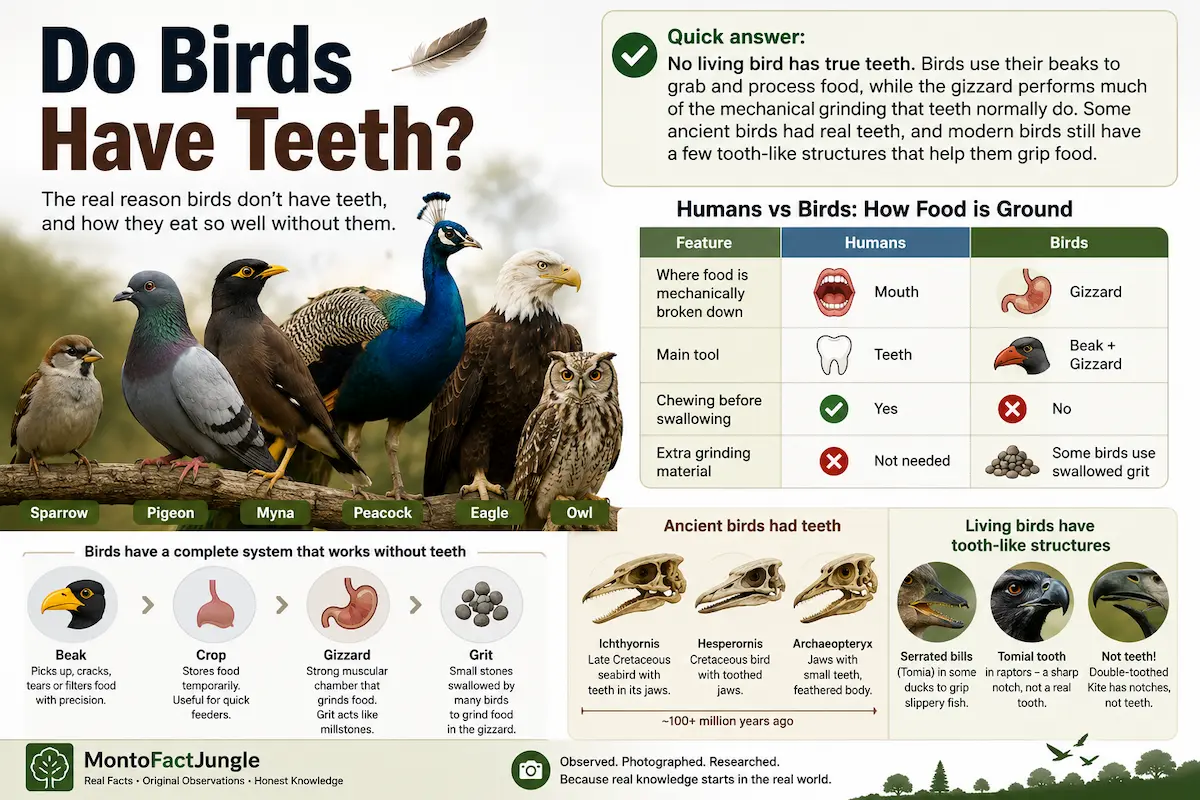
An educational infographic explaining why living birds do not have true teeth, how the beak and gizzard work together, and how some ancient birds had teeth.
⚡ Quick Answer:
Modern birds do not have true teeth. Their ancient ancestors included toothed forms, but teeth were lost during bird evolution. Instead, modern birds use specialized beaks to capture, cut, crack, filter or manipulate food, and many species rely on structures such as the muscular gizzard to help process it after swallowing. Explore our 100 Interesting Facts About Birds and Do birds have lips, Why Do Birds Have Hollow Bones?guide.
🦷 Humans vs Birds: How They Process Food
| Feature | Humans | Birds |
|---|---|---|
| Teeth | ✅ Yes | ❌ No true teeth |
| Main food-processing tool | Teeth | Beak |
| Chewing before swallowing | ✅ Yes | ❌ No |
| Main grinding organ | Mouth | Gizzard |
| Swallowed grit for grinding | ❌ No | 🪨 Some birds |
Table of Contents
- Do Birds Really Have Teeth? What Birds Use Instead
- ⚡ Quick Answer:
- Do Birds Have Teeth?
- If there are no teeth, how do birds eat?
- Why do beaks look so different from bird to bird?
- Ancient birds actually had teeth
- So why did birds lose their teeth?
- Do any living birds have anything tooth-like?
- 🐦 Do Birds Have Teeth? — For Kids
- The takeaway
Do Birds Have Teeth?
Modern birds don't have teeth. Watch a sparrow, pigeon, crow, or myna up close and you'll notice it right away — a beak opens and closes, but there's nothing resembling the rows of teeth we have. Instead, birds pick up, crack, tear, or filter food with their beaks, swallow it, and let their digestive system — including a muscular organ called the gizzard — do the grinding.
But their ancestors weren't always toothless. Some ancient birds had real teeth, and the story of how they lost them is more interesting than a one-line answer.
I started wondering about this the same way most people do: watching ordinary birds around the house. I've photographed a peacock, an eagle, a pigeon, a sparrow, a cuckoo, a myna, and an owl, and every one of them has a completely different-shaped beak with not a tooth in sight. I’ve also watched birds suddenly react to sounds around me—sometimes turning their heads, sometimes flying away before I could even see what caught their attention. That's what sent me down this rabbit hole. If you're just beginning to explore the world of birds, you can also browse our 200+ Birds Name in Hindi and English, with pictures and scientific names and Do Birds Have Ears?guide
| Humans | Birds |
|---|---|
| Where food is mechanically broken down | Mainly in the mouth |
| Main structure used | Teeth |
| Chew before swallowing | Yes |
| How hard food is processed | Teeth crush and grind food |
| Extra help with grinding | Usually not needed |
If there are no teeth, how do birds eat?
We chew food with teeth before swallowing. Birds skip that step entirely. A bird's beak handles the "prep work" — picking up a seed, tearing at flesh, cracking a shell — and then the food goes straight down.
From there, the food usually passes through a crop, a pouch-like enlargement of the esophagus where birds can temporarily store food (handy for a pigeon that wants to grab a lot of grain quickly and move on). It then reaches a two-part stomach: the proventriculus, which adds digestive juices, and the gizzard, a thick, muscular chamber that mechanically grinds the food.
Many birds — pigeons and doves especially — swallow small stones or grit that sit in the gizzard and act like a built-in set of millstones. In a practical sense, the gizzard performs some of the mechanical work that chewing does in mammals—but it isn't literally chewing.
| Humans | Birds |
|---|---|
| Food is mechanically broken down | Mainly in the mouth |
| Main structure used | Teeth |
| Chew before swallowing | Yes |
Why do beaks look so different from bird to bird?
Because they're doing very different jobs. A sparrow's short, sturdy bill is built for handling seeds. A parakeet's curved bill can grip and manipulate hard food almost like a tool. An eagle's large hooked bill is made for tearing prey. An owl's sharp, curved bill is often hidden beneath facial feathers. A duck's broad bill filters food from water and mud.
The beak isn't just a mouth — it's also sensitive. Beneath the hard outer keratin layer are nerves and blood vessels, so birds get real tactile feedback from what they're touching, which is part of why a bird can position and adjust a seed with real precision before swallowing it.
Ancient birds actually had teeth
Go back far enough and the picture changes completely. Ichthyornis, a Late Cretaceous seabird, had a beak and a jaw lined with sharp, curved teeth. Hesperornis, another Cretaceous-era bird, had toothed jaws too. Even Archaeopteryx, one of the earliest known bird-like animals, had small teeth rather than a toothless beak.
So the accurate version of the story isn't "birds never had teeth" — it's that the lineage leading to today's birds lost them somewhere along the way, while several ancient branches kept theirs.
So why did birds lose their teeth?
For a long time, the leading theory was about weight: teeth (and the jaw muscle and bone needed to support them) are heavy, and shedding that weight would make flight easier. It's a tidy explanation, but it doesn't hold up well on its own — plenty of flightless dinosaurs lost their teeth too, so flight alone can't be the whole answer.
A newer and increasingly favored hypothesis, based on research from the University of Bonn and elsewhere, points to incubation time. Researchers counting growth rings in embryonic dinosaur teeth found that forming a full set of teeth can take up to 60% of an egg's incubation period — the embryo effectively has to wait for its teeth to finish developing before it can hatch. Modern birds hatch in days or weeks, not months, and losing teeth may have been part of what let them cut that development time down, hatching sooner and spending less time vulnerable inside the egg.
There's also genetic evidence for when this happened. A 2014 study examining mutated tooth-formation genes across 48 modern bird species found the same inactivating mutations shared by all of them — suggesting the common ancestor of all living birds lost the ability to form tooth enamel around 116 million years ago.
Interestingly, those genes haven't vanished completely. Researchers have found remnants of the molecular pathways for tooth development still sitting in bird genomes — evolutionary leftovers from ancestors that had teeth, even though no living bird actually grows a set. It doesn't mean a chicken could suddenly sprout teeth; it just means the old genetic "blueprint" hasn't been entirely erased.
🥚 Do Baby Birds Have an Egg Tooth?
Some baby birds hatch with a small, temporary pointed structure called an egg tooth.
Despite its name, an egg tooth is not a real tooth.
It is a temporary structure that helps a developing bird break through the eggshell when it hatches. After hatching, the structure is gradually lost.
So:
Egg tooth → helps hatch from the egg
Real tooth → absent in living birds
Do any living birds have anything tooth-like?
Not true teeth, but there are some clever look-alikes:
- Mergansers (sawbill ducks) have serrated ridges along the edge of the bill, called tomia, that help them grip slippery fish.
- Falcons and some other raptors have a sharp notch on the cutting edge of the upper bill known as a tomial tooth — useful for finishing off prey, but structurally nothing like a real tooth.
- Bird names can be misleading here too — the Double-toothed Kite has bill notches, not teeth.
- An extinct group called the Odontopterygiformes, or "pseudo-toothed birds," had rows of bony spikes along their jaws that looked dramatically tooth-like but lacked the enamel and dentin that define actual teeth.
So the full, accurate answer is: no living bird has true teeth, but evolution has produced several convincing stand-ins for birds that need extra grip.
🐦 Do Birds Have Teeth? — For Kids
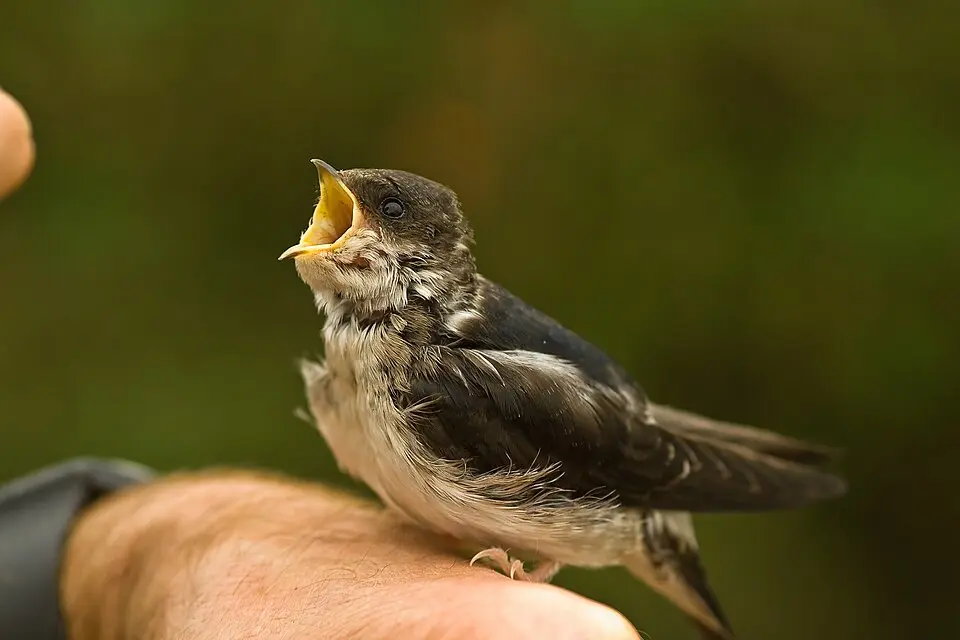
No, living birds do not have true teeth. Instead, birds use their beaks to pick up, tear, crack, or handle food.
But here's a cool surprise: some baby birds hatch with a tiny temporary structure called an egg tooth. It helps them break out of the eggshell. An egg tooth is not a real tooth, and it disappears after the chick hatches.
So remember:
🦷 Humans: Have teeth
🐦 Birds: Have beaks instead
🥚 Baby birds: May have a temporary egg tooth for hatching
🦖 Some ancient bird relatives: Had real teeth
Fun fact: Birds may not chew food with teeth, but many have a muscular gizzard that helps grind their food after they swallow it.
The takeaway
"Birds don't have teeth" is true, but it undersells how well birds actually function without them. A beak built for a specific diet, a crop for storage, a gizzard that grinds with the help of swallowed grit, and — in some species — serrated or hook-tipped bills that do a tooth's job without being one: it's a completely different system that gets the job done, shaped by roughly 100+ million years of birds evolving away from their toothed dinosaur ancestors.
Next time you watch a sparrow or pigeon snap up something that looks too big to swallow whole, you're watching that whole system in action. browse our 200+ Birds Name in Hindi and English, with pictures and scientific names and Do Birds Have Ears?guide
Frequently Asked Questions About Bird Teeth
Do birds have teeth?
No. Modern birds do not have true teeth. They use their beaks to pick up, tear, crack, or handle food, while the gizzard helps mechanically grind it.
How do birds eat without teeth?
Birds use their beaks to handle food and swallow it without chewing. The food then passes through the digestive system, where the gizzard helps break it down.
How do birds grind food without teeth?
Birds use their muscular gizzard to grind food. Some birds also swallow small stones or grit, which can help with mechanical grinding.
Did birds ever have teeth?
Yes. Some ancient bird and bird-like species had real teeth. Examples include Ichthyornis, Hesperornis, and Archaeopteryx.
Why did birds lose their teeth?
Scientists think several evolutionary factors may have contributed. One important hypothesis is that developing teeth took a significant amount of time inside the egg, so losing teeth may have helped shorten development and allow birds to hatch sooner.
Do any living birds have teeth?
No living bird has true teeth. However, some birds have tooth-like structures, such as serrated bill edges or sharp notches that help them grip or process food.
What bird has teeth-like structures?
Mergansers have serrated edges on their bills that help them grip slippery fish. Some raptors, including falcons, have a sharp notch called a tomial tooth, but it is not a true tooth.
Can birds chew food?
Birds do not chew food with teeth like humans do. Instead, their beaks handle food before swallowing, and the gizzard performs much of the mechanical grinding later in digestion.
📚 Continue Exploring the Bird World
If you enjoyed learning about bird nests, there is much more to discover. Explore these related guides to learn about bird types, habitats, flight, body parts, and different kinds of birds.
- 🐦 200 Birds Name in Hindi and English — Explore a large collection of bird names in both Hindi and English.
- 🪶 Types of Birds — Learn about different types of birds and how they are commonly classified.
- 🇮🇳 Birds in India — Discover birds found across India and the habitats they call home.
- ✈️ Flying Birds — Learn how flying birds use flight to feed, migrate, escape predators, and survive.
- 🐧 Flightless Birds — Discover birds that cannot fly and the adaptations that help them survive.
- 👃 Bird Beaks — Understand the different shapes of bird beaks and how they help birds feed.
- 🔤 A–Z Birds Name List (Complete Table) — Find bird names arranged alphabetically from A to Z.
- 🌊 Water Birds Name List — Explore birds commonly found around rivers, lakes, ponds, wetlands, and other water habitats.
- 🏡 Pet Birds Name List — Learn about popular birds commonly kept as pets.
- explore do birds have tongues
- explore do birds have teeth
- 100 interesting facts about birds
- Read our Morning Bird Calls and Pigeon Observation field note
REFERENCES:
- Britannica — Why Don't Birds Have Teeth?
- Bird Spot — Do Birds Have Teeth?
- Live Science — Why Birds Don't Have Teeth
- Birds & Blooms — This Is Why Birds Do Not Have Teeth
You should also read:
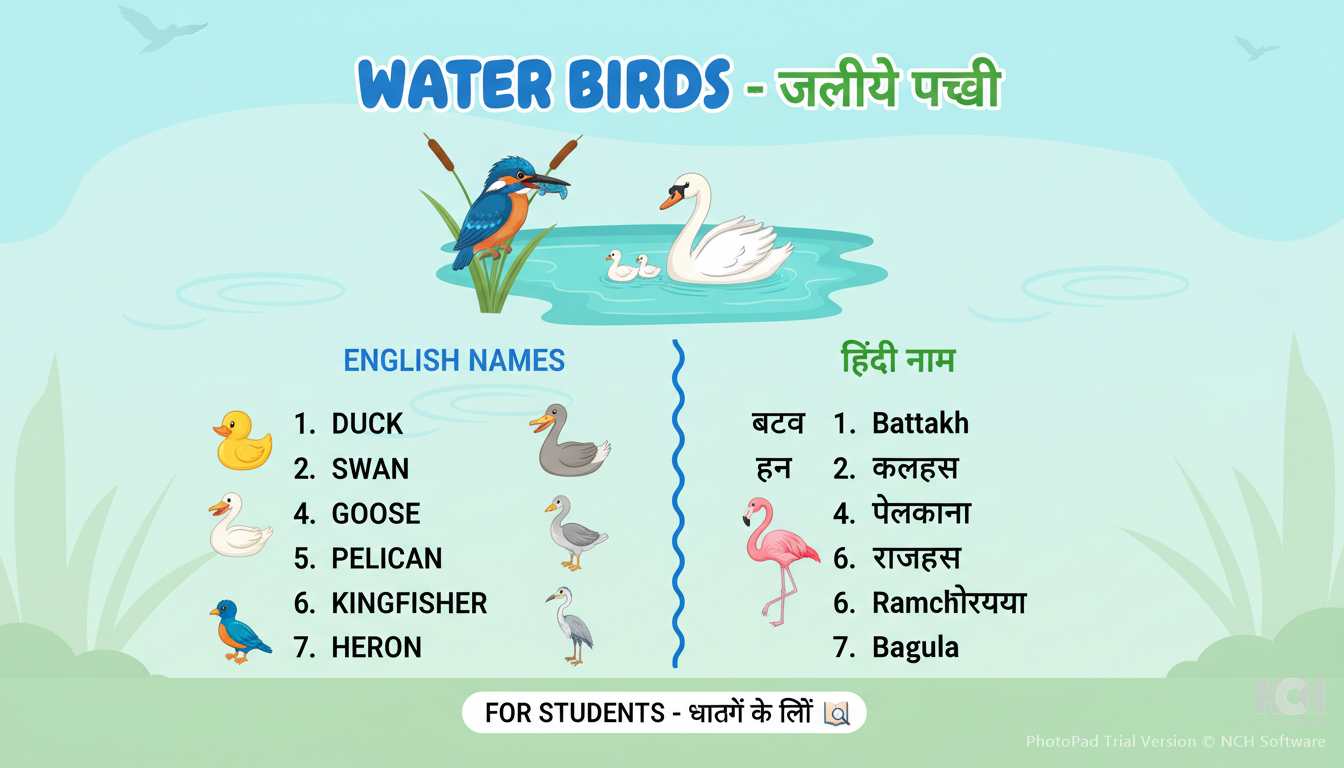
Water Birds Name in English and Hindi (पानी में रहने वाले पक्षियों के नाम)
🦆Water Birds Name in English and Hindi (पानी में रहने वाले पक्षियों के नाम) A goose (Anser cygnoides) is a water bird commonly found near lakes, rivers, wetlands, and coastal areas. A high-quality image of a Goose (Anser cygnoides), a water bird adapted to lakes,…
Continue reading...100 Birds Name in Hindi and English-पक्षियों के नाम हिंदी और अंग्रेज़ी में – आसान, मज़ेदार और पूरी सूची
100 पक्षियों के नाम हिंदी और अंग्रेज़ी में 🌿 Real-Life Example (Gaon Ki Kahani) Maan lo aap summer vacation me gaon gaye ho. Subah 5 baje murga "kukdukoo" karta hai. Thodi der baad ped par baithi koil ki "koo-koo" awaaz aati hai. Ghar ke aas-paas…
Continue reading...20 Birds Name in Hindi and English (20 पक्षियों के नाम) | For Students & Easy Pronunciation
20 Birds Name in Hindi and English Here is a fresh set of 20 birds: क्या आपने कभी notice किया है कि हम रोज़ कई birds देखते हैं, लेकिन उनके English ya Hindi names हमें हमेशा याद नहीं रहते? इसीलिए students अक्सर search करते हैं…
Continue reading...10 Birds Name in Hindi and English (With Easy Meaning & GK Use)
🐦10 Birds Name in Hindi and English Quick Answer: 10 Birds Name in Hindi and English are Hoopoe, Woodpecker, Goose, Dove, Kingfisher, Indian Roller, Bulbul, Lapwing, Penguin, and Kiwi. Kya aapko school homework ya GK preparation ke liye birds ke naam chahiye? Bahut baar students…
Continue reading...