
Do Birds Have Tongues? 👅 How Bird Tongues Work
Do Birds Have Tongues? - How Bird Tongues Work?
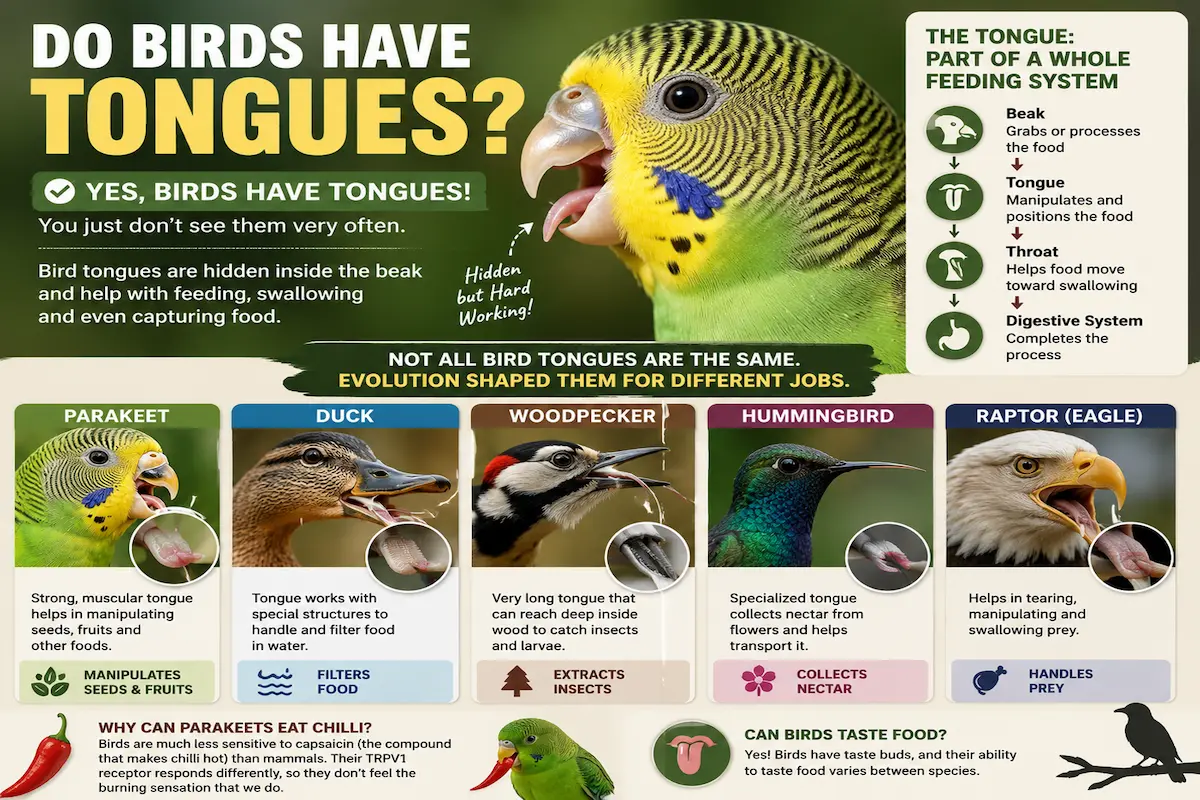
Educational infographic showing how bird tongues help with feeding, swallowing, and food handling, with examples including parakeets, ducks, woodpeckers, hummingbirds, and eagles.
Yes, birds have tongues. 👅
You just don't get to see them very often.
When we look at a sparrow, pigeon, crow, myna, parakeet or owl, our eyes naturally go to the beak. The tongue is tucked away inside it, doing its work mostly out of sight.
I've watched many of these birds feeding around us, but honestly, I rarely thought about their tongues. We notice a pigeon picking up food or a parakeet working on a seed, but the beak gets all the attention. The tongue is almost invisible.
And that's what makes the question interesting: if birds don't have teeth, what is the tongue actually doing inside that beak? Explore our 100 Interesting Facts About Birds and Why Do Birds Have Hollow Bones?guide.
🐦 Bird Tongues: Quick Comparison
| Bird | What the tongue helps it do |
|---|---|
| 🦜 Parakeet | Manipulate seeds, fruits and other food |
| 🦆 Duck | Help handle and filter food |
| 🪵 Woodpecker | Reach insects hidden inside wood |
| 🌸 Hummingbird | Collect nectar from flowers |
| 🦅 Raptor | Help manipulate and swallow prey |
| 🐦 Sparrow | Handle and move seeds and other food |
Quick takeaway: Bird tongues aren't all the same. Their shape and function are closely connected to what each bird eats and how it feeds. 👅🐦
Table of Contents
- Do Birds Have Tongues? - How Bird Tongues Work?
- 🦜 Watch a parakeet eating
- 🐦 The tongue is part of a whole feeding system
- 🌸 And then nectar-feeding birds
- 🦆 Ducks, raptors and other birds
- 👅 Can birds taste food?
- 🦜 Parakeets, chilli, and the hidden tongue
- ❓ Frequently Asked Questions About Bird Tongues
- 1. Do birds have tongues?
- 2. What do birds use their tongues for?
- 3. Do all birds have the same kind of tongue?
- 4. Can birds taste food?
- 5. Why can parakeets eat chilli?
- 6. Do birds have long tongues?
- 7. Which bird has the longest tongue?
- 8. Do birds use their tongues to eat?
- 9. Do parrots have tongues?
- 10. Are bird tongues like human tongues?
- 11. Why don't we normally see a bird's tongue?
- 📚 Continue Exploring the Bird World
- 📚 Explore More Useful Name Lists
👅 A bird's tongue isn't just a tiny human tongue
Bird tongues are not all built the same.
A bird's tongue can help move food around the mouth, manipulate it, guide it toward the throat, and—in some species—actually help capture food. Researchers describe substantial variation in bird tongue length and shape, closely associated with different feeding methods.
So there's no single answer to:
“What does a bird's tongue look like?”
It depends heavily on the bird.
A parakeet's tongue doesn't have the same job as a duck's. A woodpecker's tongue is in a completely different league. And a nectar-feeding bird has its own specialized solution.
That's where this gets really interesting. 👇
You can also browse our Do Birds Have Ears? guide and do birds have teeth guide
🦜 Watch a parakeet eating
I've seen parakeets eating chilli, and honestly, the first time you think about it, it seems strange. 🌶️
We humans know exactly what happens when we bite into a very hot chilli. Your mouth burns, your eyes may water, and you immediately start looking for water or something else to cool it down.
But the parakeet just keeps eating.
That made me curious: does the bird actually experience the chilli as “hot” the way we do?
Parrots have relatively thick, muscular tongues adapted for manipulating food. Bird tongue anatomy is strongly associated with feeding style, and parrots are among the birds whose tongues are specialized for food manipulation.
🐦 The tongue is part of a whole feeding system
Beak → tongue → throat → digestive system
The beak grabs or processes the food.
The tongue helps manipulate and position it.
The bird swallows.
And because modern birds don't have teeth, the rest of the digestive system takes over much of the mechanical processing.
This connects beautifully to yesterday's article:
👉 Do Birds Have Teeth?
The tongue isn't a replacement tooth.
It's another part of the bird's highly specialized feeding system. The tongue and its supporting hyoid apparatus have diversified alongside bird bills and diets.
🤯 Then hit them with the woodpecker
Woodpeckers have exceptionally long tongues. Their tongue-supporting hyoid apparatus extends around the skull, allowing the tongue to be stored when it isn't being used. When the associated muscles contract, the tongue can project forward through the bill.
And the American Bird Conservancy notes that the tongue can reach up to roughly one-third of the bird's total body length, depending on species.
🌸 And then nectar-feeding birds
Hummingbirds take the story in another direction.
Their tongues are specialized for collecting nectar, and research has shown that the tongue's structure works closely with the long bill to transport nectar into the mouth.
So now the reader understands the bigger idea:
Birds don't have one standard tongue design. Evolution has modified the tongue according to what each bird eats and how it gets that food.
🦆 Ducks, raptors and other birds
We can then briefly show the diversity rather than writing giant sections about each species.
Some birds have tongues adapted for:
- 🌾 manipulating seeds
- 🐟 handling slippery prey
- 🌊 filtering food
- 🌸 collecting nectar
- 🪵 extracting insects
- 🍽️ moving food toward the throat
Research describes several broad types of avian tongue adaptations, including thick muscular tongues for seed manipulation, structures for gripping slippery prey, and thread-like papillae associated with aquatic filter feeding.
👅 Can birds taste food?
Yes.
This is another excellent little surprise.
Birds have taste buds, although their number and location vary among species. In some birds, taste buds occur in areas of the mouth beyond the tongue as well.
So don't say:
“Birds can't taste.”
That's an old misconception.
The next time you watch a bird eating, look beyond the beak.
There's a tongue working inside there—but not necessarily one that looks or behaves anything like ours.
A parakeet manipulating a seed, a duck filtering food, a hummingbird drinking nectar and a woodpecker reaching into a tree are all using the same basic organ in remarkably different ways.
Birds have tongues. Evolution simply gave different birds very different jobs for them. 🐦👅
🦜 Parakeets, chilli, and the hidden tongue
One thing I've personally noticed is that parakeets will happily eat chilli. I've watched them eating chilli while using their beaks to hold and work on it. I've also seen parakeets “talking,” moving their mouths as they vocalize.
That made me wonder about something we normally never think about: what is the tongue doing inside that curved bill?
When a parakeet eats, the beak isn't working alone. The tongue helps manipulate food inside the mouth, positioning it and helping move it toward the throat. Parrot tongues are relatively muscular compared with those of many other birds, which suits their lifestyle of handling seeds, fruits and other foods.
And that is an important point about bird tongues: there isn't one standard bird tongue. Evolution has shaped them according to what different birds eat and how they feed.
A parakeet that grips and works on a seed needs a different kind of tongue from a duck filtering food from water or a woodpecker reaching into a hole in a tree.
🌶️ The chilli-eating bird has a secret advantage.
This is where my observation gets even more interesting.
I've watched parakeets eat chilli, and it looks almost ridiculous from a human perspective. We bite into a hot chilli and immediately know about it. The parakeet just keeps eating.
But there's an evolutionary twist.
Capsaicin—the chemical that gives chilli its burning sensation—is much less effective at triggering the heat receptor in birds than it is in mammals.
So the same chilli fruit can be unpleasantly hot to us while being perfectly edible to a parakeet.
And this isn't just a funny accident of nature. Birds can eat chilli fruits and carry their seeds elsewhere, helping disperse the plant. 🌶️🐦
A chilli plant and a bird may essentially have a better relationship than a chilli plant and a human. 😂
🤯 1. The woodpecker tongue that wraps around its skull
🪵 A tongue that can reach around the skull?
Here's one of the strangest things about bird tongues: in woodpeckers, the tongue-supporting hyoid apparatus is extraordinarily long. Parts of this structure extend around the skull and allow the tongue to be stored inside the bird's head when it isn't being used.
Think about that the next time you see a woodpecker hammering into a tree. The bird isn't carrying a ridiculously long tongue simply hanging inside its mouth. It has an internal storage system for it. 🐦🤯
Not all bird tongues are built the same
If you've only looked at common birds around the house, it's easy to imagine that every bird has roughly the same kind of tongue. They don't.
A bird's tongue is closely connected to what it eats and how it gets that food. A seed-eating bird, a nectar-feeding bird, a duck filtering food from water and a woodpecker searching for insects all face completely different feeding problems.
Their tongues have evolved accordingly.
A parakeet, like the ones I've watched eating chilli, has a relatively muscular tongue that helps it manipulate food inside its bill. That matters when the bird is working on seeds, fruits or other foods rather than simply swallowing everything whole.
A duck has a very different problem. Its bill and tongue work together with specialized structures that help it handle food and, in some species, filter material from water.
Then there is the woodpecker. 🪵🐦
Its tongue is one of the strangest examples in the bird world.
A woodpecker needs to reach insects and larvae hidden inside wood. A normal short tongue would not be much use for that job. Instead, woodpeckers have an exceptionally long tongue and an elaborate supporting structure called the hyoid apparatus.
The surprising part is that the tongue doesn't simply sit stretched out inside the bill. Much of its supporting apparatus extends around the skull, allowing the tongue to be stored when it isn't being used. When the bird needs it, the tongue can extend forward through the bill to reach food.
So when you see a woodpecker hammering into a tree, you're not just watching a bird with a strong beak.
You're watching a bird equipped with a specialized feeding system—bill, tongue and supporting structures—all working together.
🌸 Nectar-feeding birds have another solution
Birds that feed heavily on nectar face an entirely different challenge: they need to get liquid food out of flowers.
Hummingbirds are the famous example. Their long bills and specialized tongues work together to collect nectar from flowers.
This is another reason I wouldn't describe a bird's tongue simply as its version of a human tongue.
The tongue is a tool that evolution has modified for the bird's particular way of making a living.
And that's probably the most interesting thing about bird tongues.
We ask, “Do birds have tongues?”
The answer is easy:
Yes.
But the better question is:
“What does a particular bird's tongue allow it to do?”
That's where the real variety begins. 🐦👅
browse our 200+ Birds Name in Hindi and English, with pictures and scientific names and Do Birds Have Ears? guide and do birds have teeth guide
❓ Frequently Asked Questions About Bird Tongues
1. Do birds have tongues?
Yes. Birds have tongues, although you usually can't see them because they are tucked inside the bill. Their tongues help manipulate food, move it through the mouth, and in some species perform highly specialized feeding jobs.
2. What do birds use their tongues for?
Birds use their tongues mainly to manipulate and position food, help with swallowing, and, depending on the species, capture or collect food. A bird's tongue is closely adapted to its diet and feeding method.
3. Do all birds have the same kind of tongue?
No. Bird tongues vary considerably between species. A parakeet, duck, woodpecker and nectar-feeding bird can have very different tongue structures because they use them for different kinds of feeding.
4. Can birds taste food?
Yes. Birds have taste buds and can taste food, although their taste system differs from that of humans and varies between species.
5. Why can parakeets eat chilli?
Parakeets and many other birds are much less sensitive to the burning effects of capsaicin than mammals. Capsaicin activates the TRPV1 heat-and-irritation receptor, but the avian version of this receptor responds differently, allowing many birds to eat chilli without experiencing the same burning sensation humans do.
6. Do birds have long tongues?
Some do. Woodpeckers are particularly famous for their exceptionally long tongues. Their tongue-supporting hyoid apparatus extends around the skull and allows the tongue to be stored and extended when the bird is feeding.
7. Which bird has the longest tongue?
There isn't one simple answer for every bird species because tongue length and body size vary, but woodpeckers are among the most remarkable birds for tongue length relative to their bodies. Their specialized tongue apparatus allows them to reach insects hidden deep inside wood.
8. Do birds use their tongues to eat?
Yes. A bird's tongue can help manipulate, position and move food toward the throat. However, the exact role varies greatly depending on the bird and what it eats.
9. Do parrots have tongues?
Yes. Parrots, including parakeets, have relatively muscular tongues that help them manipulate food inside their bills. This is particularly useful when handling seeds, fruits and other foods.
10. Are bird tongues like human tongues?
Not exactly. Birds and humans both have tongues, but bird tongues have evolved into many specialized forms. A bird's tongue is adapted to its particular bill, diet and feeding behavior rather than simply being a smaller version of a human tongue.
11. Why don't we normally see a bird's tongue?
Bird tongues are usually hidden inside the bill, so we tend to notice the bill rather than the tongue. You may get a brief glimpse while a bird is eating, drinking, calling or opening its mouth.
📚 Continue Exploring the Bird World
Explore these related guides to learn about bird types, habitats, flight, body parts, and different kinds of birds.
- 🐦 200 Birds Name in Hindi and English — Explore a large collection of bird names in both Hindi and English.
- 🪶 Types of Birds — Learn about different types of birds and how they are commonly classified.
- 🇮🇳 Birds in India — Discover birds found across India and the habitats they call home.
- ✈️ Flying Birds — Learn how flying birds use flight to feed, migrate, escape predators, and survive.
- 🐧 Flightless Birds — Discover birds that cannot fly and the adaptations that help them survive.
- 👃 Bird Beaks — Understand the different shapes of bird beaks and how they help birds feed.
- 🔤 A–Z Birds Name List (Complete Table) — Find bird names arranged alphabetically from A to Z.
- 🌊 Water Birds Name List — Explore birds commonly found around rivers, lakes, ponds, wetlands, and other water habitats.
- 🏡 Pet Birds Name List — Learn about popular birds commonly kept as pets.
- explore do birds have tongues
- explore do birds have teeth
- 100 interesting facts about birds
- Read our Morning Bird Calls and Pigeon Observation field note
You should also read:
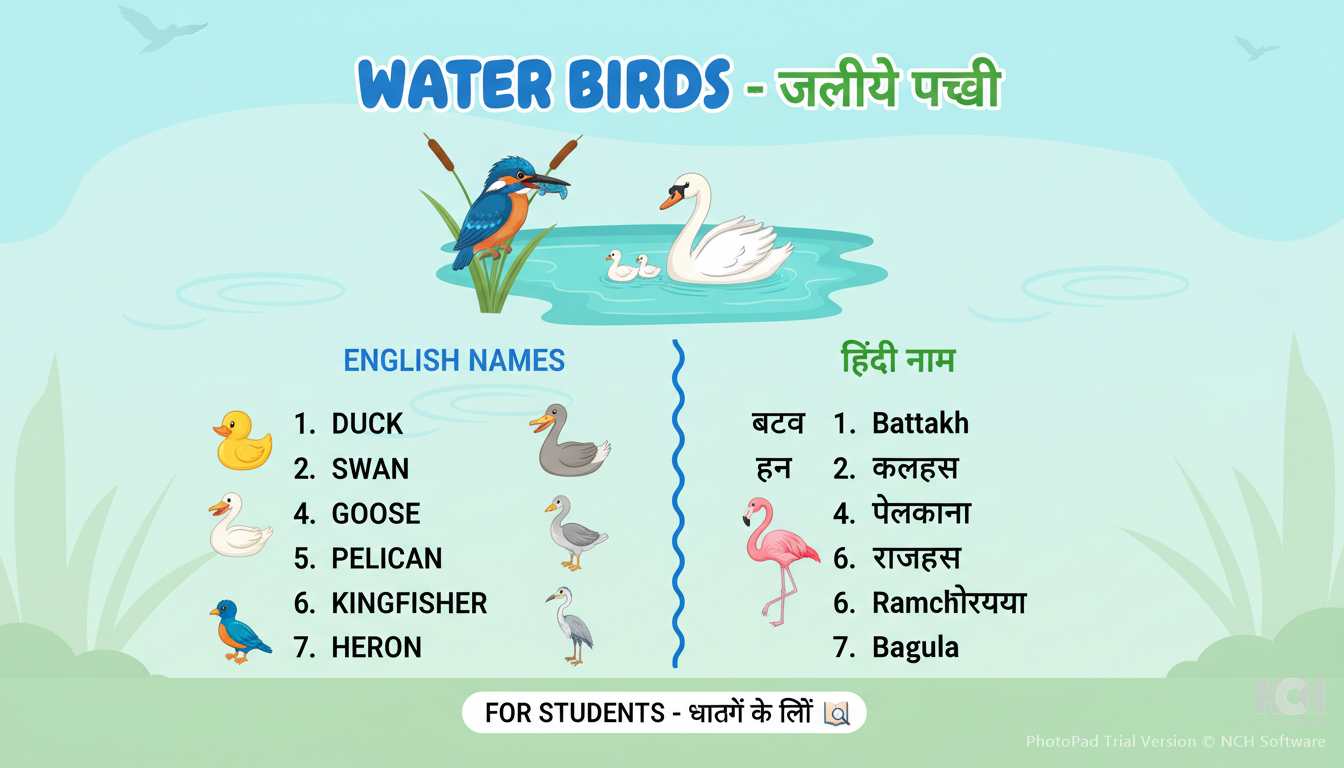
Water Birds Name in English and Hindi (पानी में रहने वाले पक्षियों के नाम)
🦆Water Birds Name in English and Hindi (पानी में रहने वाले पक्षियों के नाम) A goose (Anser cygnoides) is a water bird commonly found near lakes, rivers, wetlands, and coastal areas. A high-quality image of a Goose (Anser cygnoides), a water bird adapted to lakes,…
Continue reading...100 Birds Name in Hindi and English-पक्षियों के नाम हिंदी और अंग्रेज़ी में – आसान, मज़ेदार और पूरी सूची
100 पक्षियों के नाम हिंदी और अंग्रेज़ी में 🌿 Real-Life Example (Gaon Ki Kahani) Maan lo aap summer vacation me gaon gaye ho. Subah 5 baje murga "kukdukoo" karta hai. Thodi der baad ped par baithi koil ki "koo-koo" awaaz aati hai. Ghar ke aas-paas…
Continue reading...20 Birds Name in Hindi and English (20 पक्षियों के नाम) | For Students & Easy Pronunciation
20 Birds Name in Hindi and English Here is a fresh set of 20 birds: क्या आपने कभी notice किया है कि हम रोज़ कई birds देखते हैं, लेकिन उनके English ya Hindi names हमें हमेशा याद नहीं रहते? इसीलिए students अक्सर search करते हैं…
Continue reading...10 Birds Name in Hindi and English (With Easy Meaning & GK Use)
🐦10 Birds Name in Hindi and English Quick Answer: 10 Birds Name in Hindi and English are Hoopoe, Woodpecker, Goose, Dove, Kingfisher, Indian Roller, Bulbul, Lapwing, Penguin, and Kiwi. Kya aapko school homework ya GK preparation ke liye birds ke naam chahiye? Bahut baar students…
Continue reading...