
🐦Why Do Birds Have Hollow Bones? The Truth About Their Lightweight Skeleton
🐦Why Do Birds Have Hollow Bones? The Truth About Their Lightweight Skeleton
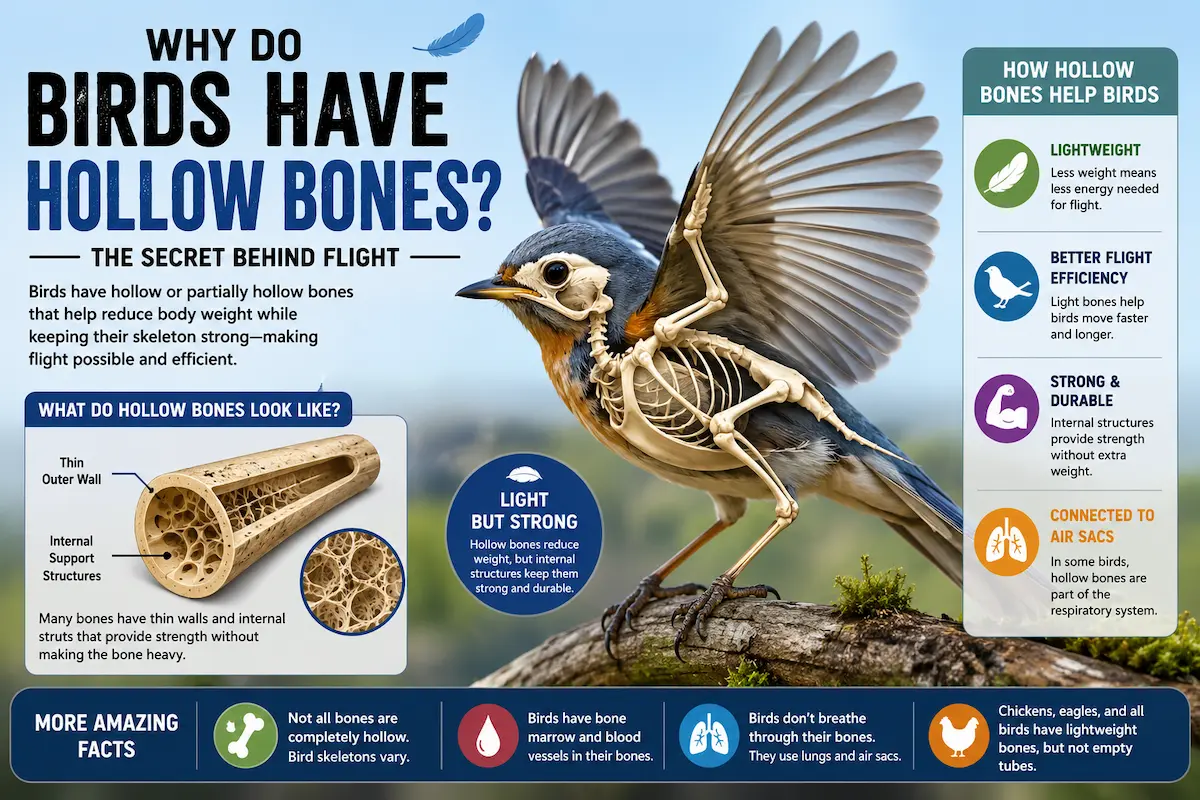
Quick Answer:
Why Do Birds Have Hollow Bones?
Birds have lightweight, hollow or partially hollow bones because reducing skeletal mass helps their bodies stay efficient during flight. Many bird bones are reinforced with internal structures, so they can be lightweight without simply becoming weak. In some species, air sacs also extend into certain bones and connect the skeleton with the respiratory system.
Explore our 100 Interesting Facts About Birds guide.
INTRODUCTION
Have you ever watched a small bird suddenly take off from the ground and thought, “How does something that tiny fly so easily?”
I have.
I have watched common birds around my home and garden lift themselves from the ground, flap hard for a few seconds, and then disappear over the trees as if gravity had simply decided to give them a break.
That always makes me curious about the things we normally don't see.
We can see the feathers. We can see the wings. We can see the bird flying.
But underneath all that is a skeleton specially adapted for a lightweight, active body.
And that brings us to a question many of us have heard since childhood:
Why do birds have hollow bones?
The short answer is that many bird bones are lightweight and contain internal air spaces or thin-walled structures that reduce skeletal mass while maintaining strength. In some birds, certain bones are also connected to the respiratory air-sac system.
But there is a little more to the story.
The popular sentence “birds have hollow bones so they can fly” is not completely wrong — it is just much too simple.
So, no, a bird's skeleton isn't just a collection of fragile empty tubes.
Think of it more like lightweight engineering.
A cardboard box is mostly empty inside, but its folded structure gives it surprising strength.
Bird bones use a somewhat similar principle: less material in the right places, with structural support where it matters.
So the best answer is:
Many birds have lightweight, air-filled bones as part of a body design that helps them meet the demands of flight, but hollow bones alone are not what makes birds fly.
Their entire body is involved.
Many flying birds have lightweight, air-filled bones called pneumatic bones. These structures can reduce skeletal mass while remaining strong, but birds do not fly simply because their bones are hollow. Their entire skeleton, wings, feathers, muscles and respiratory system work together. If you're just beginning to explore the world of birds, you can also browse our 200+ Birds Name in Hindi and English, with pictures and scientific names.
🧠 The One-Line Takeaway
Bird bones aren't simply “empty.” They're part of a lightweight biological design built to balance strength, movement and mass.
Let's look at what is really happening.
Table of Contents
- 🐦Why Do Birds Have Hollow Bones? The Truth About Their Lightweight Skeleton
- INTRODUCTION
- 🦴 What “Hollow” Really Means in Bird Bones
- What Does “Hollow Bones” Actually Mean?
- How Do Hollow Bones Help Birds Fly?
- 🏡 Real-Life Example: Think About a Bicycle Frame
- Are Hollow Bones Weak?
- A Simple Real-Life Example From Home
- Do All Birds Have Completely Hollow Bones?
- Do Hollow Bones Help Birds Breathe?
- What Are Pneumatic Bones?
- Do Birds Have Bone Marrow?
- Do Chickens Have Hollow Bones?
- Do Eagles Have Hollow Bones?
- What About Small Birds?
- Hollow Bones vs. Feathers: Which Is More Important for Flight?
- Why Don't Birds Just Have Extremely Tiny Bones?
- The “Hollow Bone” Myth in One Minute
- Why Did Birds Evolve Lightweight Skeletons?
- 🦴 A Quick Bird Bone Cheat Sheet
- 🧠 Class 4 Short Answer: Why Do Birds Have Hollow Bones?
- 🏡 A Simple Family Question
- What I Find Most Amazing About Bird Bones
- Frequently Asked Questions About Bird Bones
- Why do birds have hollow bones?
- Do all birds have hollow bones?
- How do hollow bones help birds fly?
- Are bird bones really hollow?
- Are hollow bird bones weak?
- Do birds have bone marrow?
- Do birds breathe through their hollow bones?
- Do chickens have hollow bones?
- Do eagles have hollow bones?
- Why are bird bones lightweight?
- Final Thought
- Sources & Further Reading
- ❤️ A Little Note From Monto Fact Jungle
🦴 What “Hollow” Really Means in Bird Bones
| What people often imagine | What actually happens |
|---|---|
| 🥤 An empty tube | 🦴 A structured bone with internal support |
| 🪶 Every bird has hollow bones | 🐦 Pneumaticity varies between birds |
| 💨 The bone itself breathes | 🫁 Air sacs and the respiratory system are involved |
| ⚖️ Hollow means extremely light | 🏗️ The skeleton balances low mass with strength |
| 🪽 Hollow bones make birds fly | 🔗 Bones are only one part of the flight system |
| 🧱 Hollow means fragile | 💪 Internal structure can provide reinforcement |
| 🦖 Hollow bones evolved only for flight | 🧬 Pneumaticity has a much older evolutionary history |
What Does “Hollow Bones” Actually Mean?
This is where the common explanation gets a little misleading.
When we hear “hollow bones,” it is easy to imagine a bird with bones that are literally empty pipes.
That's not quite how it works.
Bird bones can have thin walls and internal air spaces, and some contain internal struts that provide structural support. The exact degree of air-filled bone varies among birds and among different bones in the same bird.
Scientists use the term pneumatic bones for bones that contain air spaces connected with the respiratory system.
So:
Hollow ≠ empty and useless.
It is better to think:
Lightweight + structurally reinforced + sometimes connected to air sacs.
That is a much more accurate picture.
How Do Hollow Bones Help Birds Fly?
Flight is expensive.
A bird has to repeatedly move its wings, generate lift, control its body and maintain a very high level of physical activity.
A lighter body can make that job more manageable.
The Smithsonian's National Zoo describes the bird skeleton as lightweight and notes that hollow bones help reduce the energy required to become and remain airborne.
But here's something important:
Hollow bones are only one part of the flight system.
A bird does not fly simply because its bones are hollow.
It has an entire package of adaptations working together:
| Bird feature | What it contributes |
|---|---|
| 🦴 Lightweight skeleton | Helps reduce body mass |
| 🪶 Flight feathers | Help generate lift and control airflow |
| 💪 Strong flight muscles | Power the wings |
| 🫁 Efficient respiratory system | Supplies oxygen for demanding activity |
| 🫀 Powerful circulation | Delivers oxygen and nutrients |
| 🪽 Wing shape | Helps generate lift and thrust |
| ⚖️ Streamlined body | Helps reduce unnecessary drag |
That's why saying “birds fly because they have hollow bones” is an oversimplification. And this is only one of the many surprising things about birds. If you're curious about the stranger side of bird biology, you can explore our 100 Interesting Facts About Birds.
The skeleton is one piece of a much bigger biological machine.
🏡 Real-Life Example: Think About a Bicycle Frame
Here's an easy way to picture what is happening inside some bird bones.
Think about a bicycle frame.
A bicycle frame doesn't need to be a completely solid block of metal to be strong. In fact, making the entire frame solid would add a huge amount of unnecessary weight.
Instead, engineers use tubes and carefully designed structures to provide strength while keeping the frame relatively light.
A bird's skeleton isn't designed by an engineer, of course—but the basic idea of strength without unnecessary weight is useful for understanding it.
Some bird bones have air-filled spaces and internal supporting structures rather than simply being solid throughout.
So when you hear “hollow bones,” don't picture a fragile straw.
Picture something closer to a lightweight biological framework.
And there's an even better way to see why this matters.
Imagine carrying a heavy backpack all day while trying to run, jump and climb.
Now imagine doing the same thing with a much lighter load.
The difference in effort would be obvious.
A flying bird has to move its body through the air repeatedly, so managing body mass matters.
The clever part is that the bird doesn't simply remove material. It changes the structure.
That is the idea that makes the phrase “hollow bones” much easier to understand. Many of the birds we see around homes and gardens—sparrows, crows, pigeons and mynas—make this whole subject feel much less like a textbook chapter. You can find more familiar species in our 50 Birds Name in Hindi and English guide
Are Hollow Bones Weak?
This is probably the biggest misconception.
Lightweight does not automatically mean weak.
Some bird bones have internal bony struts that reinforce the structure. The Smithsonian's educational material describes bird bones as lightweight but strong, with thin reinforcing braces inside some hollow bones.
A simple way to picture it is a building.
A large empty room doesn't need a solid block of concrete filling every cubic centimetre.
Instead, engineers use:
beams
columns
braces
carefully arranged supports
The result can be strong without being unnecessarily heavy.
Bird skeletons are biological engineering in a similar spirit.
A Simple Real-Life Example From Home
This is the sort of thing I like explaining to my family because you don't need a laboratory to understand the basic idea.
Imagine holding:
a solid metal rod, and
a lightweight tube.
The solid rod may feel heavier simply because there is much more material inside it.
The tube can still be surprisingly strong because its material is arranged around the outside rather than filling the entire centre.
Bird bones aren't simply tubes copied from a hardware shop, of course.
But the comparison gives us a useful mental picture:
The goal isn't to remove strength. The goal is to reduce unnecessary weight while keeping enough structure to do the job.
And that's what makes bird skeletons so fascinating.
Do All Birds Have Completely Hollow Bones?
No.
This is one of the most important corrections to the common schoolbook explanation.
Not every bone in every bird is a completely empty, air-filled tube.
The amount and distribution of skeletal pneumaticity varies between species and between different parts of the skeleton. Research on bird and theropod skeletons shows that pneumaticity can differ considerably.
Some birds have highly pneumatic skeletons.
Others have much less.
And some bones remain relatively solid because they need to perform particular mechanical jobs.
So the statement:
“All bird bones are hollow.”
is better replaced with:
“Many bird bones are lightweight and some are pneumatic, but bird skeletons vary considerably.”
That small distinction makes the explanation much more scientifically accurate. Birds are incredibly diverse, so their bodies aren't built exactly the same way. You can see just how varied the bird world is in our 200+ Birds Name in Hindi and English list.
Do Hollow Bones Help Birds Breathe?
Here's where the story gets even more interesting.
Birds have a highly specialized respiratory system involving lungs and air sacs.
In some birds, air sacs extend into certain bones, creating pneumatic bones. This means the respiratory and skeletal systems can be physically connected.
But don't picture the bird breathing through its bones.
That's not what happens.
The lungs are still the organs responsible for gas exchange.
The air sacs work as part of the bird's respiratory system, helping move air through the lungs.
So:
Bones don't replace lungs.
Instead, in some species, parts of the skeleton become connected with the bird's air-sac system.
That is one of the strangest and coolest features of bird anatomy.
What Are Pneumatic Bones?
The scientific word you may come across is pneumatic.
It basically refers to bones that contain air spaces associated with the respiratory system.
These air-filled spaces can occur in different parts of a bird's skeleton depending on the species.
This is why it is more accurate to talk about skeletal pneumaticity than simply saying every bird has hollow bones.
And here's another fascinating point:
The evolution of air-filled bones did not begin suddenly when birds started flying.
Research into theropod dinosaurs shows that pneumatic bones and air-sac-related structures existed in some dinosaur groups before modern birds evolved. Birds inherited and further modified parts of this remarkable body plan.
So when you look at a bird skeleton, you're looking at a piece of an evolutionary story that goes far beyond modern birds. Read Do Birds Pee?
Do Birds Have Bone Marrow?
Yes, birds have bone marrow.
So another common misconception is worth clearing up:
A hollow bird bone is not necessarily an empty bone with nothing inside.
Bones are living tissues.
Bird bones can contain marrow, blood vessels and other internal structures, depending on the particular bone and species.
The word “hollow” is therefore a convenient everyday description, not a perfect anatomical description of every bird bone.
Do Chickens Have Hollow Bones?
This is a very common question, probably because chickens are birds most people have actually seen up close.
Yes, chickens have lightweight bones, and some bones can be pneumatic, but their skeleton is not made entirely of empty hollow tubes.
Different bones have different structures and functions.
And this is a good reminder that:
“Bird bones are hollow” is a simplified description, not a rule that every bird bone looks like an empty drinking straw.
Do Eagles Have Hollow Bones?
Yes, eagles have lightweight bird skeletons with pneumatic bones among their skeletal adaptations.
But an eagle's ability to soar has much more to do with the complete combination of its anatomy:
large wings
specialized feathers
powerful muscles
aerodynamic body shape
lightweight skeleton
efficient respiratory and circulatory systems
The bones help.
They don't do all the work.
What About Small Birds?
Small birds can be surprisingly lightweight.
Think about a sparrow sitting quietly on a wall or a tiny bird jumping between branches.
Then suddenly—
flap, flap, flap… gone.
That little body has to generate enough force to leave the ground and control itself in three-dimensional space.
Hummingbirds take this even further.
The Smithsonian notes that hummingbirds have hollow bones and extremely tiny, lightweight leg bones, helping reduce weight during hovering flight.
That's pretty remarkable when you consider how much energy a hummingbird spends simply staying in one place in the air.
Hollow Bones vs. Feathers: Which Is More Important for Flight?
This is a fun comparison because both features are famous bird adaptations, but they do different jobs.
| Feature | Main role |
|---|---|
| 🦴 Lightweight bones | Reduce skeletal mass |
| 🪶 Flight feathers | Generate lift and help control flight |
| 💪 Chest muscles | Power wing movement |
| 🫁 Air sacs and lungs | Support the bird's high metabolic demands |
| 🪽 Wings | Provide the aerodynamic surface |
The feathers are especially important because the wings need an aerodynamic surface to interact with the air.
The bones provide the framework.
The muscles provide the power.
The respiratory system supplies oxygen.
It's a team effort.
Why Don't Birds Just Have Extremely Tiny Bones?
Because lighter isn't always better.
A bird still needs bones strong enough to:
support its body
attach muscles
withstand landing forces
protect organs
move joints
resist bending and twisting
If evolution simply made every bone thinner and weaker, the bird would have a serious problem.
The trick is balance.
Light enough to reduce unnecessary mass.
Strong enough to survive everyday life.
That's the real story.
The “Hollow Bone” Myth in One Minute
Let's clean up the myth.
❌ Myth:
All bird bones are completely empty.
✅ Reality:
Bird skeletons contain different types of bones, and many are lightweight or partially hollow. Some bones contain air spaces connected with the respiratory system.
❌ Myth:
Hollow bones alone make birds fly.
✅ Reality:
Flight depends on an entire system involving wings, feathers, muscles, skeleton, metabolism, respiration and body shape.
❌ Myth:
Hollow means fragile.
✅ Reality:
Many bird bones have structural features that provide strength while keeping them lightweight.
Why Did Birds Evolve Lightweight Skeletons?
There isn't one simple answer.
Reducing skeletal mass can be useful for animals that fly, but skeletal pneumaticity has a more complicated evolutionary history than the simple statement “birds evolved hollow bones so they could fly.”
Research on theropod dinosaurs indicates that pneumatic bones appeared in some dinosaur lineages before modern bird flight evolved, suggesting that reducing skeletal density was not originally just a flight adaptation.
That is one of my favourite parts of this topic.
Something we often explain as:
“Birds have hollow bones because they fly.”
turns out to have a much deeper evolutionary story.
Nature rarely gives us a one-line answer.
🦴 A Quick Bird Bone Cheat Sheet
| Question | Simple answer |
|---|---|
| Do birds have hollow bones? | Many have lightweight or pneumatic bones |
| Are all bird bones hollow? | No |
| Are hollow bones weak? | Not necessarily; many have reinforcing structures |
| Do hollow bones help flight? | Yes, by helping reduce skeletal mass |
| Do birds breathe through their bones? | No |
| Can air sacs connect to bones? | Yes, in pneumatic bones |
| Do chickens have lightweight bones? | Yes |
| Do eagles have pneumatic bones? | Yes, as part of their bird anatomy |
| Do birds have bone marrow? | Yes |
| Are hollow bones the only reason birds fly? | No |
🧠 Class 4 Short Answer: Why Do Birds Have Hollow Bones?
If you need a simple school answer:
Birds have lightweight, hollow or partially hollow bones that help reduce their body weight and make flight more efficient. Their bones can also have internal supports that make them strong despite being lightweight.
That's the short answer.
But now you know the longer answer is much more interesting.
🏡 A Simple Family Question
This is also the kind of science question that can easily become a conversation at home.
Imagine someone seeing a bird fly past and asking:
“Are its bones really hollow?”
The easy answer is:
“Yes.”
But now we can make the conversation more interesting.
“Sort of. Many birds have air-filled spaces in some bones, but not every bone is hollow—and the skeleton has internal support.”
Then comes the next question:
“So how does it fly?”
And suddenly one little bird has opened the door to a conversation about:
bones → wings → feathers → muscles → breathing → evolution → dinosaurs.
That's what I enjoy about this kind of topic.
A good science question doesn't always end with one answer.
Sometimes it gives you five more questions.
What I Find Most Amazing About Bird Bones
For me, the interesting part isn't simply that bird bones are “hollow.”
It's the engineering behind them.
A bird needs a skeleton that is:
light + strong + flexible enough + properly connected to muscles + adapted to movement.
And it has to work every day.
A sparrow doesn't need to understand biomechanics before jumping from the ground to a wall.
An eagle doesn't need an instruction manual before spreading its wings.
A hummingbird doesn't need to calculate lift before hovering.
The body simply does it.
That is the part that makes me stop and look at the ordinary birds around my home a little differently.
The next time I see one suddenly fly away, I'll probably think less about the feathers I can see and more about the incredible skeleton I can't.
📚 Continue Exploring the Bird World
If you enjoyed learning about bird nests, there is much more to discover. Explore these related guides to learn about bird types, habitats, flight, body parts, and different kinds of birds.
- 🐦 200 Birds Name in Hindi and English — Explore a large collection of bird names in both Hindi and English.
- 🪶 Types of Birds — Learn about different types of birds and how they are commonly classified.
- 🇮🇳 Birds in India — Discover birds found across India and the habitats they call home.
- ✈️ Flying Birds — Learn how flying birds use flight to feed, migrate, escape predators, and survive.
- 🐧 Flightless Birds — Discover birds that cannot fly and the adaptations that help them survive.
- 👃 Bird Beaks — Understand the different shapes of bird beaks and how they help birds feed.
- 🔤 A–Z Birds Name List (Complete Table) — Find bird names arranged alphabetically from A to Z.
- 🌊 Water Birds Name List — Explore birds commonly found around rivers, lakes, ponds, wetlands, and other water habitats.
- 🏡 Pet Birds Name List — Learn about popular birds commonly kept as pets.
- explore do birds have tongues
- explore do birds have teeth
- 100 interesting facts about birds
- How do birds sleep
- Read our Morning Bird Calls and Pigeon Observation field note
Frequently Asked Questions About Bird Bones
Why do birds have hollow bones?
Birds have lightweight, hollow or partially hollow bones that can reduce skeletal mass and help make flight more efficient. Some bones also contain internal supporting structures, while certain bones in some species are connected to the respiratory air-sac system.
Do all birds have hollow bones?
No. Bird skeletons vary between species and between individual bones. Not every bird bone is completely hollow or pneumatic.
How do hollow bones help birds fly?
Lightweight bones reduce skeletal mass, which can help reduce the energy required for flight. However, bones are only one part of a bird's flight adaptations.
Are bird bones really hollow?
Some are hollow or partially hollow, but “hollow” is a simplified term. Many bird bones have thin walls and internal supporting structures.
Are hollow bird bones weak?
No. Many bird bones are reinforced with internal structures that provide strength without requiring the bone to be completely solid.
Do birds have bone marrow?
Yes. Bird bones are living tissues and can contain bone marrow and blood vessels.
Do birds breathe through their hollow bones?
No. Birds breathe using their lungs and specialized air-sac system. In some species, air sacs extend into certain bones, making those bones pneumatic.
Do chickens have hollow bones?
Chickens have lightweight bones, and some bones can be pneumatic, but their entire skeleton is not simply a collection of empty hollow tubes.
Do eagles have hollow bones?
Eagles, like other birds, have lightweight skeletons and pneumatic bones among their anatomical adaptations. Their flight depends on many features working together.
Why are bird bones lightweight?
Lightweight skeletal structures can reduce body mass and help birds operate efficiently during flight and other movement.
Final Thought
The next time a bird flies over your head, remember that you're watching much more than a pair of wings.
You're watching feathers, muscles, lungs, air sacs, bones, balance and millions of years of evolution working together.
And somewhere inside that little body is a skeleton that manages something humans still haven't made nearly as elegantly:
being strong without carrying unnecessary weight.
That is pretty amazing for a bird we might normally ignore on the way to the kitchen.
This article created with love into it. Share it and Love it. Cheers.
Sources & Further Reading
The scientific explanation in this article is informed by material from the Smithsonian Institution and research on avian and theropod skeletal pneumaticity.
❤️ A Little Note From Monto Fact Jungle
This article was created with a lot of curiosity, care, and love for the amazing world around us.
It started with a simple question after watching a bird fly:
How can something so small carry itself through the sky?
That question led much further than I expected—from bones and flight to breathing, evolution and dinosaurs.
If this article made you look a little more closely at the next bird you see, then it has done its job.
Share it. Love it. Keep exploring. 🐦❤️
Cheers,
Monto Fact Jungle
📚 Explore More Useful Name Lists
Looking for more easy-to-understand name lists? Explore these related Monto Fact Jungle guides covering fruits, flowers, birds, animals, body parts, and spices.
- 🍎 50 Fruits Name in Hindi and English
- 🍎 100 Fruits Name in English and Hindi
- 🌸 100 Flowers Name in English and Hindi
- 🐦 200+ Birds Name in Hindi and English
- 🦁 Animals Kya Khate Hain — Animals Food List
- 🧠 100+ Body Parts Name in Hindi and English
- 🌶️ 100 Spices Name in English and Hindi
- ⌨️ Keyboard Symbols Name in Hindi
- 📖 Meaning in Hindi with Examples
You should also read:

Water Birds Name in English and Hindi (पानी में रहने वाले पक्षियों के नाम)
🦆Water Birds Name in English and Hindi (पानी में रहने वाले पक्षियों के नाम) A goose (Anser cygnoides) is a water bird commonly found near lakes, rivers, wetlands, and coastal areas. A high-quality image of a Goose (Anser cygnoides), a water bird adapted to lakes,…
Continue reading...100 Birds Name in Hindi and English-पक्षियों के नाम हिंदी और अंग्रेज़ी में – आसान, मज़ेदार और पूरी सूची
100 पक्षियों के नाम हिंदी और अंग्रेज़ी में 🌿 Real-Life Example (Gaon Ki Kahani) Maan lo aap summer vacation me gaon gaye ho. Subah 5 baje murga "kukdukoo" karta hai. Thodi der baad ped par baithi koil ki "koo-koo" awaaz aati hai. Ghar ke aas-paas…
Continue reading...20 Birds Name in Hindi and English (20 पक्षियों के नाम) | For Students & Easy Pronunciation
20 Birds Name in Hindi and English Here is a fresh set of 20 birds: क्या आपने कभी notice किया है कि हम रोज़ कई birds देखते हैं, लेकिन उनके English ya Hindi names हमें हमेशा याद नहीं रहते? इसीलिए students अक्सर search करते हैं…
Continue reading...10 Birds Name in Hindi and English (With Easy Meaning & GK Use)
🐦10 Birds Name in Hindi and English Quick Answer: 10 Birds Name in Hindi and English are Hoopoe, Woodpecker, Goose, Dove, Kingfisher, Indian Roller, Bulbul, Lapwing, Penguin, and Kiwi. Kya aapko school homework ya GK preparation ke liye birds ke naam chahiye? Bahut baar students…
Continue reading...