
🐦 How Do Birds Sleep? Where Do They Go at Night?
How Do Birds Sleep? Where Do They Go at Night?
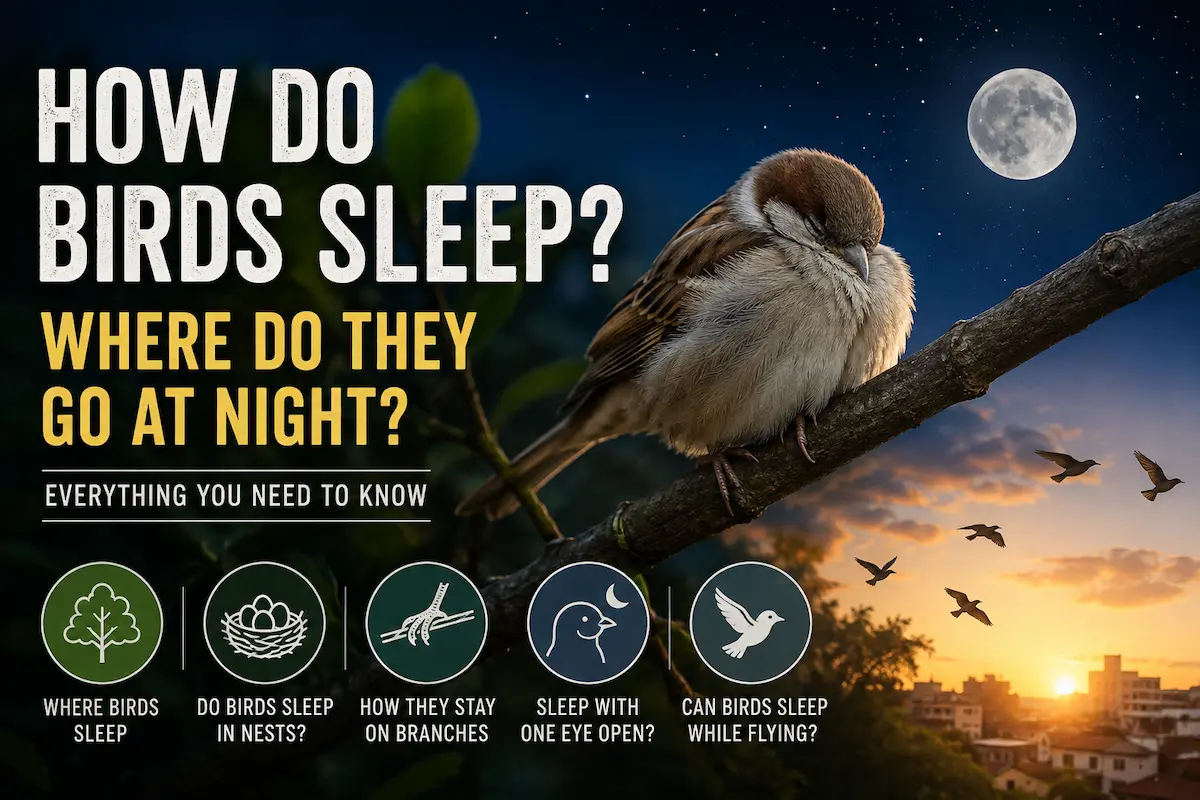
Quick Answer
Yes, birds sleep. At night, most birds settle into a safe roost, such as a tree branch, dense vegetation, tree cavity, building ledge, or another sheltered spot. Some birds return to familiar roosts, while others choose different places depending on the weather, predators, and surroundings.
So when the birds disappear from your terrace at sunset, they haven't gone far—they've simply gone somewhere safe to rest for the night. 🌙🐦
Explore our 100 Interesting Facts About Birds and Why Do Birds Have Hollow Bones?guide.
Bird Sleep — Quick Table
| Question | Quick Answer |
|---|---|
| Do birds sleep? | Yes, birds need regular periods of sleep and rest. |
| Where do birds sleep? | On branches, in dense vegetation, tree cavities, ledges, near water, and other safe spots. |
| What is a roost? | A place where a bird settles down to rest or sleep. |
| Do birds sleep in nests? | Not always. Nests are mainly used for eggs and chicks; many birds roost elsewhere. |
| Do birds return to the same place? | Some reuse familiar roosts, while others change locations. |
| Do birds sleep standing up? | Many perching birds can sleep while perched. |
| How do birds avoid falling? | Their leg and foot tendons help their toes grip the perch automatically. |
| Can birds sleep with one eye open? | Some birds can, allowing part of the brain to remain more alert. |
| Do birds sleep all night? | Sleep can occur in shorter periods and may be interrupted. |
| Can birds sleep while flying? | Some birds, including frigatebirds, can sleep briefly during flight. |
| Where do birds go at sunset? | They usually move to a suitable roost and settle down for the night. |
| When do birds wake up? | Increasing daylight and their internal biological rhythms help trigger morning activity. |
Table of Contents
- How Do Birds Sleep? Where Do They Go at Night?
- 🌙 Do Birds Sleep?
- 🌳 Where Do Birds Sleep at Night?
- 🪺 Do Birds Sleep in Nests?
- 🏠 Do Birds Have a Permanent Sleeping Place?
- 🔁 Do Birds Sleep in the Same Place Every Night?
- 🦶 How Do Birds Sleep on a Branch Without Falling?
- 😴 Do Birds Sleep Standing Up?
- 🪶 Why Do Birds Fluff Up Their Feathers While Sleeping?
- 👁️ Do Birds Sleep With Their Eyes Open?
- 🧠 Can Half of a Bird's Brain Sleep?
- 🦆 Why Do Some Ducks Sleep With One Eye Toward the Outside?
- ⏰ How Long Do Birds Sleep?
- 🌌 What Time Do Birds Go to Sleep?
- 🌅 How Do Birds Know When to Wake Up?
- ✈️ Can Birds Sleep While Flying?
- 🥶 How Do Birds Sleep in Very Cold Weather?
- 🐦 So Where Do Birds Go When the Sun Goes Down?
- 🌅 The Next Time You Watch Your Terrace
- 🐦 FAQs About How Birds Sleep
- 1. Do birds sleep at night?
- 2. Where do birds go at night?
- 3. Do birds sleep in nests?
- 4. Do birds sleep in the same place every night?
- 5. How do birds sleep without falling from trees?
- 6. Do birds sleep standing up?
- 7. Can birds sleep with one eye open?
- 8. Do birds sleep with half their brain awake?
- 9. How long do birds sleep?
- 10. Can birds sleep while flying?
- 11. Where do birds sleep during rain or cold weather?
- 12. When do birds wake up?
- 13. Why do birds disappear at sunset?
- 14. Do all birds sleep at night?
- 15. What is a bird's sleeping place called?
- 📚 Explore More Useful Name Lists
🐦 How Do Birds Sleep? Where Do They Go at Night?
Have you ever stepped onto your terrace in the evening and wondered where all the birds have gone?
During the day, you may see sparrows, pigeons, crows and other birds flying around, feeding and calling. But as the light fades, they seem to disappear.
Where do they go? Do birds actually sleep? Do they return to the same place every night? And do they sleep in nests?
Yes, birds sleep, but they don't all sleep in the same way or in the same kind of place. Many birds settle into a roost — a safe place where they can rest during the night. Depending on the species, a roost might be a tree branch, dense vegetation, a tree cavity, a building ledge or even the surface of the water.
And here's the fascinating part: some birds can sleep while gripping a branch without falling, some can sleep with one eye open, and a few can even sleep during flight.
So when the birds disappear from your terrace at sunset, they haven't vanished. They've simply gone somewhere to spend the night. 🌙🐦
You can also browse our 200+ Birds Name in Hindi and English, with pictures and scientific names and Do Birds Have Ears? guide and do birds have teeth ,do birds have tongues , and do birds have nose guide
🌙 Do Birds Sleep?
Yes, birds sleep.
Most birds have regular periods of sleep and rest, although their sleep isn't exactly like ours.
Many familiar birds are active during daylight. As evening approaches, they reduce their activity and move toward a place where they can spend the night.
That place is generally called a roost.
A roost is simply a location where a bird settles down to rest or sleep.
And there isn't one universal bird bedroom.
A sparrow might disappear into dense vegetation. A pigeon may settle on a building ledge or another sheltered perch. A woodpecker may use a tree cavity. A duck may rest on water.
Cornell and All About Birds both describe birds using secluded branches, tree cavities and other sheltered locations for sleep.
So when your terrace becomes quiet after sunset, the birds haven't necessarily gone very far.
Many have simply gone to bed somewhere you can't see them.
🌳 Where Do Birds Sleep at Night?
This is probably the biggest question behind the mystery.
Birds can sleep in many different places depending on their species and surroundings.
🌿 Dense trees and bushes
Many small birds choose thick vegetation where their bodies are difficult for predators to spot.
Evergreen trees can be particularly useful because their dense branches provide cover even after dark.
A small bird tucked deep inside foliage can be surprisingly difficult to find.
🌳 Tree branches
Many perching birds simply spend the night on a branch.
They may choose a branch close to the trunk or somewhere surrounded by foliage rather than sitting exposed on the highest, most visible branch.
🕳️ Tree cavities
Some birds use holes and cavities in trees.
Woodpeckers, bluebirds, chickadees and other cavity-using species may use these sheltered spaces, sometimes even outside the breeding season.
🌊 Water
Water birds have completely different options.
Ducks and some other waterfowl can rest on water, while other species may sleep along shorelines or in shallow areas.
🏠 Buildings and other structures
Urban birds have learned to use the environment we have built around them.
Ledges, barns, eaves, chimneys and other sheltered structures can become useful roosting places.
So if you live in a city, the birds disappearing at sunset doesn't necessarily mean they've flown into a forest somewhere.
Their bedroom might be much closer than you think.
🪺 Do Birds Sleep in Nests?
This is one of the biggest misconceptions about bird sleep.
Usually, a nest is not a bird's regular nighttime bed.
A nest is primarily associated with breeding — eggs and chicks.
During the breeding season, an adult may spend the night in or around the nest because it is incubating eggs or caring for young.
But once the young have left, the adults may use a completely different roost.
That's why it is useful to remember:
A nest is mainly a nursery. A roost is a sleeping place.
There are exceptions, of course. Some cavity-nesting birds can use cavities as both breeding and sleeping locations.
But the idea that every bird goes back to its nest every evening is simply not correct.
🏠 Do Birds Have a Permanent Sleeping Place?
Now we're getting to the question I think many people have when they watch birds from a terrace:
“Does that bird have a fixed place where it goes every night?”
Sometimes, yes — at least in the sense of a regularly used roost.
If a bird finds a place that provides good shelter and protection, there may be little reason to abandon it.
A particular tree, bush, cavity or building structure can become a familiar sleeping location.
But it isn't necessarily a permanent bedroom.
Weather can change.
A predator may appear.
A tree can be damaged or removed.
Another bird may take over a useful cavity.
The surrounding environment can change.
So birds need some flexibility.
Think of it this way:
A bird may have a favourite sleeping place without having a permanent bedroom.
Some birds also gather in communal roosts, while others sleep alone or in small groups.
🔁 Do Birds Sleep in the Same Place Every Night?
Some may, but not necessarily every night.
A safe, familiar roost can be reused.
But birds don't follow a human-style rule that says:
“This is my bedroom, and I must sleep here every night.”
Their choice depends on conditions.
A bird may return to the same tree for weeks or longer if it remains safe and suitable.
But if heavy rain, strong wind, predators or some other disturbance makes that location unsafe, the bird may choose another place.
This flexibility is especially important for birds that migrate.
A migrating bird cannot return to its usual home roost every night when it is travelling hundreds or thousands of kilometres.
Instead, it needs suitable places to rest along the journey.
🦶 How Do Birds Sleep on a Branch Without Falling?
Now comes one of the coolest parts.
Imagine falling asleep on a thin branch several metres above the ground.
For us, that sounds like a terrible plan.
For a perching bird, it's completely normal.
Many perching birds have a specialized arrangement of muscles, tendons and toes that helps them grip a branch automatically.
When the bird settles onto the perch and bends its legs, tendons in the foot pull the toes into a curled position around the branch.
The bird doesn't have to consciously squeeze the branch all night.
Its anatomy helps maintain the grip.
Cornell's search results and other sources in the research specifically highlight this perching mechanism, including the flexor-tendon system that helps birds maintain their grip without continuous active muscle effort.
So when you see a small bird sitting on a branch at sunset, it isn't balancing there by concentrating really hard.
Its feet are doing the job.
😴 Do Birds Sleep Standing Up?
Many birds can sleep while perched upright.
A bird may settle its body, grip the perch and close its eyes.
Some birds also sleep while standing on one leg.
The exact posture depends on the species and the place where it is resting.
A branch doesn't have to be comfortable by human standards.
For a bird, its feet, legs and body are adapted to make that position perfectly workable.
And there's another thing you may notice.
A sleeping bird often looks rounder and fluffier than it does during the day.
🪶 Why Do Birds Fluff Up Their Feathers While Sleeping?
When birds fluff their feathers, they trap air between the feathers and the body.
That trapped layer of air provides insulation and helps reduce heat loss.
You may also see a bird tuck its head backward and place its beak among the feathers on its back.
It looks incredibly comfortable.
And there is a practical reason for it: keeping warm and reducing exposed surface area.
So that tiny fluffy ball you see sitting quietly in a tree isn't simply cute.
It's conserving heat. 🐦❄️
👁️ Do Birds Sleep With Their Eyes Open?
Sometimes.
And this is where bird sleep becomes genuinely strange.
Some birds can use a form of sleep called unihemispheric slow-wave sleep.
In this state, one hemisphere of the brain can sleep while the other remains more alert.
The bird may keep the eye associated with the more alert side open.
So yes:
A bird can sometimes sleep with one eye open.
But don't take that to mean that every bird sleeps this way all night.
It's a flexible strategy, not a permanent “one eye open” rule.
🧠 Can Half of a Bird's Brain Sleep?
Yes.
This is one of the most fascinating adaptations in bird sleep.
If one side of the brain is resting while the other remains alert, the bird can maintain some awareness of its surroundings.
Why would that be useful?
Because sleeping can make an animal vulnerable.
A completely unaware bird could be easier for a predator to approach.
Remaining partly alert gives some birds a way to balance two competing needs:
rest and survival.
Research and educational sources in your SERP specifically highlight unihemispheric sleep and the ability to keep one eye open.
🦆 Why Do Some Ducks Sleep With One Eye Toward the Outside?
This is an especially fascinating example.
When ducks rest in groups, the birds at the outside of the group are more exposed to danger than those in the middle.
The idea of unihemispheric sleep becomes particularly useful here: a bird can remain partly alert while resting.
In other words, where a bird sleeps can influence how it sleeps.
The safest position and the most exposed position don't necessarily require the same level of vigilance.
That is a beautiful example of behavior adapting to risk.
⏰ How Long Do Birds Sleep?
There isn't one number that applies to every bird.
Bird sleep varies with species, environment and circumstances.
And birds don't necessarily sleep in one long, uninterrupted block like humans often do.
Cornell's educational material notes that birds tend to sleep in small snatches and can be startled awake by predators, neighbouring birds or cold conditions.
So asking:
“How many hours do birds sleep?”
doesn't have one simple answer for all birds.
Their sleep can be interrupted, adjusted and divided into shorter periods.
🌌 What Time Do Birds Go to Sleep?
There isn't a universal bird bedtime such as 8:00 PM.
For many daytime-active birds, the approach of darkness is a major environmental signal.
As daylight fades, they stop feeding and flying around and begin moving toward their roosts.
Their internal biological clocks also help regulate their daily activity and rest.
That is why the transition can seem almost automatic.
One moment your terrace is full of bird activity.
A little later:
silence.
The birds have followed their normal daily rhythm and settled down.
🌅 How Do Birds Know When to Wake Up?
Morning works in the opposite direction.
Increasing light, environmental conditions and the bird's internal circadian rhythm help shift it from rest back toward activity.
Then the neighbourhood suddenly comes alive.
You hear calls.
Pigeons become active.
Sparrows begin moving around.
Crows leave their resting areas.
And you may wonder:
“Where did all these birds come from?”
They were there all along.
They were simply sleeping somewhere you couldn't see.
✈️ Can Birds Sleep While Flying?
This sounds impossible:
Can a bird actually sleep while flying?
For some birds, remarkably, yes.
Frigatebirds are a famous example.
These ocean-going birds can spend very long periods in flight, and research has found that they can take short periods of sleep while airborne, including during gliding.
This is not normal sleep for every bird.
It is a highly specialized adaptation associated with a very different lifestyle.
A bird that spends days travelling over open ocean cannot simply land on a tree every few hours.
Its sleeping strategy has to fit its life.
🥶 How Do Birds Sleep in Very Cold Weather?
Cold nights create another challenge.
Fluffing feathers is one important way birds reduce heat loss.
But some species have more dramatic adaptations.
Hummingbirds can enter torpor, reducing their body temperature and energy expenditure during cold periods.
This allows them to survive nights when maintaining a normal body temperature would require enormous amounts of energy.
The research you collected also highlights the common poorwill, a remarkable bird capable of entering a much deeper, prolonged state resembling hibernation during harsh conditions.
Birds don't all solve the cold-weather problem in the same way.
Some find better shelter.
Some fluff their feathers.
Some gather together.
And a few have evolved extraordinary physiological adaptations.
🐦 So Where Do Birds Go When the Sun Goes Down?
Now we can return to that original terrace question.
Every evening, the birds around us seem to disappear.
But they haven't vanished.
They are following a routine that has been shaped by millions of years of evolution.
Some settle into branches.
Some disappear into dense vegetation.
Some enter tree cavities.
Some rest on water.
Some use buildings and other sheltered structures.
Some gather with other birds.
Some sleep alone.
And a few have evolved truly extraordinary ways of resting.
Their sleeping place doesn't have to be permanent.
Their sleep doesn't have to be continuous.
And in some cases, even part of the brain can remain alert.
You can also browse our 200+ Birds Name in Hindi and English, with pictures and scientific names and Do Birds Have Ears? guide and do birds have teeth ,do birds have tongues , and do birds have nose guide
🌅 The Next Time You Watch Your Terrace
Try something simple.
One evening, just before sunset, watch the birds around your home.
Notice where they are feeding.
Notice which direction they fly as the light fades.
Then look again after dark.
You probably won't see them.
But now you'll know what is likely happening.
They have gone to roost.
Somewhere nearby, a sparrow may be tucked inside thick foliage.
A pigeon may be sitting quietly on a ledge.
Another bird may be gripping a branch with its feet while it sleeps.
And somewhere in the darkness, a bird may be resting while keeping part of its brain alert to the world around it.
Then morning arrives.
The light returns.
The birds wake.
And suddenly your terrace is full of them again.
They didn't disappear.
They simply had somewhere else to be. 🐦🌙
📚 Continue Exploring the Bird World
If you enjoyed learning about bird nests, there is much more to discover. Explore these related guides to learn about bird types, habitats, flight, body parts, and different kinds of birds.
- 🐦 200 Birds Name in Hindi and English — Explore a large collection of bird names in both Hindi and English.
- 🪶 Types of Birds — Learn about different types of birds and how they are commonly classified.
- 🇮🇳 Birds in India — Discover birds found across India and the habitats they call home.
- ✈️ Flying Birds — Learn how flying birds use flight to feed, migrate, escape predators, and survive.
- 🐧 Flightless Birds — Discover birds that cannot fly and the adaptations that help them survive.
- 👃 Bird Beaks — Understand the different shapes of bird beaks and how they help birds feed.
- 🔤 A–Z Birds Name List (Complete Table) — Find bird names arranged alphabetically from A to Z.
- 🌊 Water Birds Name List — Explore birds commonly found around rivers, lakes, ponds, wetlands, and other water habitats.
- 🏡 Pet Birds Name List — Learn about popular birds commonly kept as pets.
- explore do birds have tongues
- explore do birds have teeth
- 100 interesting facts about birds
- Read our Morning Bird Calls and Pigeon Observation field note
🐦 FAQs About How Birds Sleep
1. Do birds sleep at night?
Yes. Most birds that are active during the day settle into a safe place called a roost and sleep or rest at night.
2. Where do birds go at night?
Birds may roost on tree branches, inside dense vegetation, in tree cavities, on ledges, near water, or in other sheltered places. The location depends on the species and its surroundings.
3. Do birds sleep in nests?
Not necessarily. A nest is mainly used for eggs and chicks. Many adult birds use a separate roost for nighttime sleep, although sleeping habits vary among species.
4. Do birds sleep in the same place every night?
Some birds may repeatedly use a familiar roost if it remains safe and suitable. Others may change locations because of weather, predators, disturbance, or seasonal changes.
5. How do birds sleep without falling from trees?
Many perching birds have specialized leg and foot tendons that help their toes grip a branch when they settle onto it. This allows them to remain securely perched while resting.
6. Do birds sleep standing up?
Many birds can sleep while standing or perched. Some species can even rest while standing on one leg.
7. Can birds sleep with one eye open?
Yes, some birds can sleep with one eye open. This is associated with unihemispheric sleep, where one side of the brain rests while the other remains more alert.
8. Do birds sleep with half their brain awake?
Some birds can. During unihemispheric slow-wave sleep, one brain hemisphere can rest while the other remains relatively alert, helping the bird monitor its surroundings.
9. How long do birds sleep?
There is no single answer for all birds. Sleep duration and patterns vary between species and can be affected by environmental conditions, predators, weather, and other disturbances.
10. Can birds sleep while flying?
Yes, some birds can. Frigatebirds, for example, have been documented taking brief periods of sleep during flight.
11. Where do birds sleep during rain or cold weather?
Birds may seek more sheltered roosts during bad weather, such as dense vegetation, cavities or protected structures. Some species also conserve heat by fluffing their feathers.
12. When do birds wake up?
Increasing daylight and the bird's internal biological clock help regulate the transition from nighttime rest to daytime activity.
13. Why do birds disappear at sunset?
Many daytime birds stop feeding and flying as darkness approaches and move to their nighttime roosts. That's why a busy terrace can suddenly become almost silent.
14. Do all birds sleep at night?
No. Many birds are mainly active during the day, but some birds, such as owls and other nocturnal species, are active at night and rest during the day.
15. What is a bird's sleeping place called?
A bird's sleeping or resting place is generally called a roost.
📚 Explore More Useful Name Lists
Looking for more easy-to-understand name lists? Explore these related Monto Fact Jungle guides covering fruits, flowers, birds, animals, body parts, and spices.
- 🍎 50 Fruits Name in Hindi and English
- 🍎 100 Fruits Name in English and Hindi
- 🌸 100 Flowers Name in English and Hindi
- 🐦 200+ Birds Name in Hindi and English
- 🦁 Animals Kya Khate Hain — Animals Food List
- 🧠 100+ Body Parts Name in Hindi and English
- 🌶️ 100 Spices Name in English and Hindi
- ⌨️ Keyboard Symbols Name in Hindi
- 📖 Meaning in Hindi with Examples
You should also read:
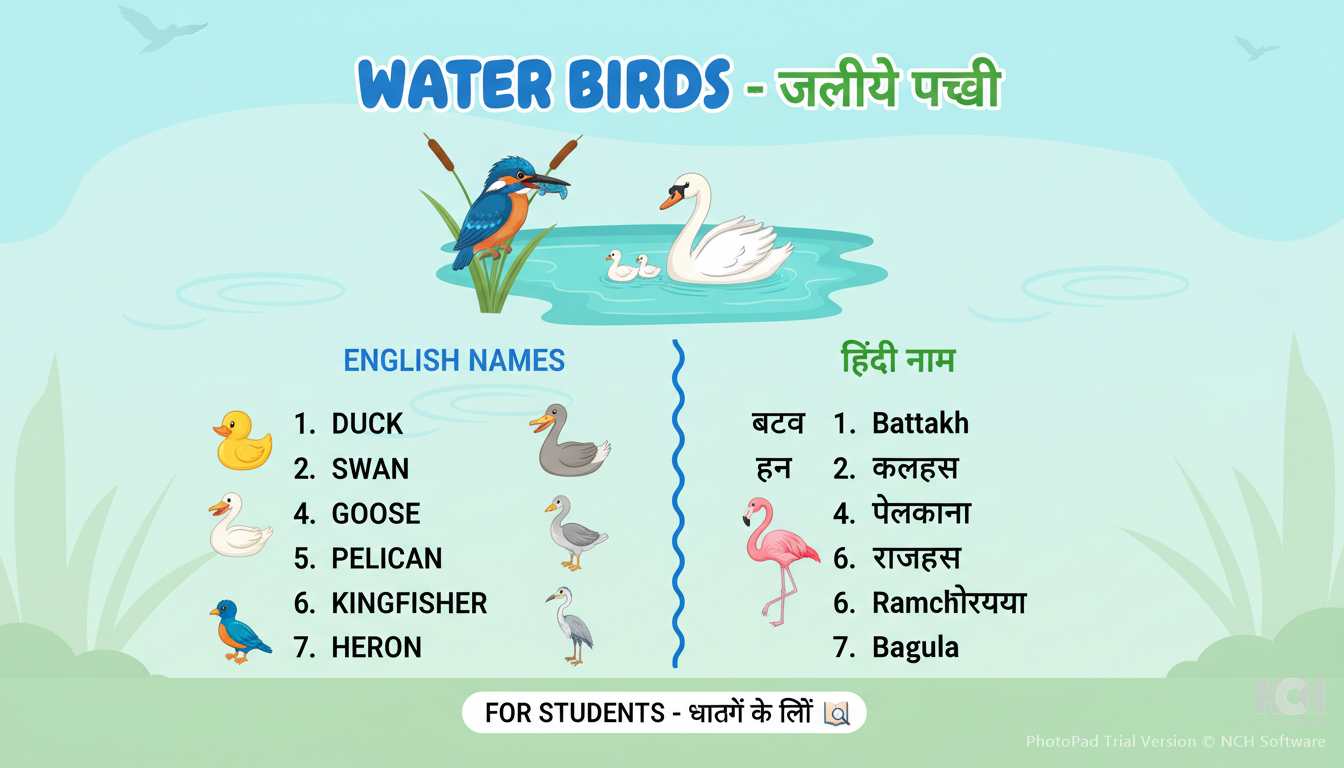
Water Birds Name in English and Hindi (पानी में रहने वाले पक्षियों के नाम)
🦆Water Birds Name in English and Hindi (पानी में रहने वाले पक्षियों के नाम) A goose (Anser cygnoides) is a water bird commonly found near lakes, rivers, wetlands, and coastal areas. A high-quality image of a Goose (Anser cygnoides), a water bird adapted to lakes,…
Continue reading...100 Birds Name in Hindi and English-पक्षियों के नाम हिंदी और अंग्रेज़ी में – आसान, मज़ेदार और पूरी सूची
100 पक्षियों के नाम हिंदी और अंग्रेज़ी में 🌿 Real-Life Example (Gaon Ki Kahani) Maan lo aap summer vacation me gaon gaye ho. Subah 5 baje murga "kukdukoo" karta hai. Thodi der baad ped par baithi koil ki "koo-koo" awaaz aati hai. Ghar ke aas-paas…
Continue reading...20 Birds Name in Hindi and English (20 पक्षियों के नाम) | For Students & Easy Pronunciation
20 Birds Name in Hindi and English Here is a fresh set of 20 birds: क्या आपने कभी notice किया है कि हम रोज़ कई birds देखते हैं, लेकिन उनके English ya Hindi names हमें हमेशा याद नहीं रहते? इसीलिए students अक्सर search करते हैं…
Continue reading...10 Birds Name in Hindi and English (With Easy Meaning & GK Use)
🐦10 Birds Name in Hindi and English Quick Answer: 10 Birds Name in Hindi and English are Hoopoe, Woodpecker, Goose, Dove, Kingfisher, Indian Roller, Bulbul, Lapwing, Penguin, and Kiwi. Kya aapko school homework ya GK preparation ke liye birds ke naam chahiye? Bahut baar students…
Continue reading...