
🪽Why Do Birds Have Wings? 7 Amazing Jobs Bird Wings Do
Why Do Birds Have Wings? 7 Amazing Jobs Bird Wings Do
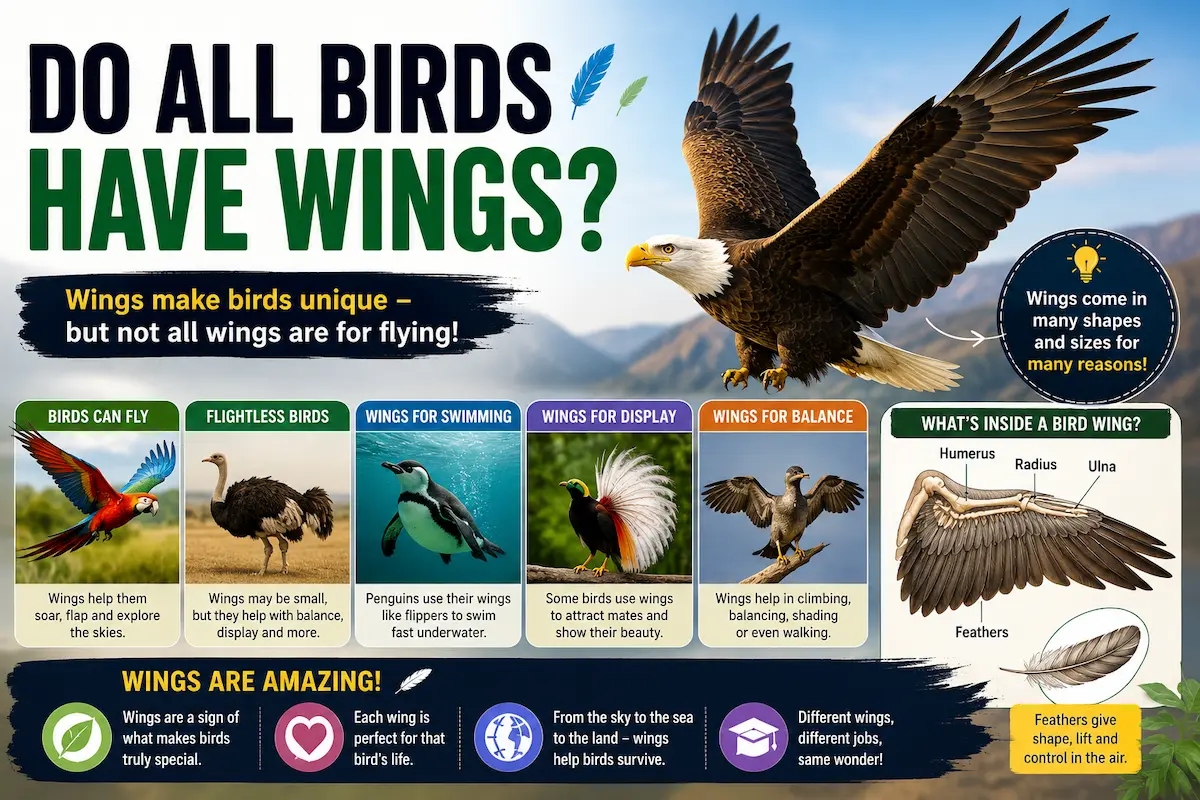
Birds have wings because their forelimbs evolved into specialized structures that help them move through air, water, and even across land. For most birds, wings make flight possible by generating lift and controlling movement. But wings can also help birds steer, balance, swim, communicate, attract mates, and perform other specialized jobs. Even flightless birds such as penguins and ostriches still have wings because wings can be useful without powered flight. Explore why do birds have feathers
Explore our 100 Interesting Facts About Birds,and Do Birds Have Eyelids guides.
🪽 Quick Look: What Do Bird Wings Do?
| Wing job | How it helps a bird |
|---|---|
| Flight | Generates and controls the aerodynamic forces that keep a bird airborne. |
| Steering | Changes wing position and shape to help birds turn, slow down, and maneuver. |
| Takeoff & landing | Helps birds generate enough lift to leave the ground and control their descent. |
| Soaring | Lets some birds exploit rising air currents and travel with little flapping. |
| Swimming | Penguin wings have evolved into powerful flippers for underwater movement. |
| Balance | Flightless birds can use their wings to stabilize themselves while running. |
| Display | Wing movements and patterns can communicate or form part of courtship displays. |
Quick takeaway: Bird wings are best known for flight, but they are versatile forelimbs that can be adapted for several different jobs.
1. 🪽 Bird Wings Make Flight Possible
For most birds, the main reason to have wings is flight.
A bird's wing acts as an aerodynamic surface. As air moves around the wing, the wing's shape and movement help generate lift, while the bird's muscles and wing feathers control movement through the air. The primary and secondary flight feathers are especially important: the primaries contribute strongly to forward thrust, while the overlapping secondaries help form an efficient lifting surface.
The wing is not a rigid paddle. Birds continuously change its shape during a wingbeat, adjusting the angle and position of the feathers to control lift, thrust, braking, and turning.
That's why watching a bird fly is more complicated than simply watching it flap.
2. 🦅 Different Bird Wings Are Built for Different Jobs
Birds don't all have the same wing shape. A sparrow flying through vegetation and an albatross crossing an ocean face completely different aerodynamic problems, so their wings are shaped differently.
Scientists commonly describe four broad wing types:
| Wing type | Shape | Best suited for | Examples |
|---|---|---|---|
| Elliptical | Short, broad and rounded | Quick takeoffs and tight maneuvering | Sparrows, doves, crows |
| High-speed | Narrow, pointed and relatively streamlined | Fast flight | Falcons, swifts, swallows |
| High-aspect-ratio / soaring | Very long and narrow | Efficient gliding and soaring | Albatrosses, gulls |
| Slotted high-lift | Broad wings with separated primary tips | Slow flight and soaring | Eagles, vultures, hawks |
These categories are widely used in bird-flight education and aerodynamic research, although real bird wings can combine characteristics rather than fitting perfectly into one box.
A useful clue is the wingtip. The separated primary feathers of many soaring birds create slots that help them generate lift efficiently at relatively low speeds.
3. 🌀 Wings Help Birds Turn, Brake, and Land
A wing isn't useful only when a bird wants to go upward.
Birds constantly alter the shape and position of their wings to control their movement. During landing, for example, a bird can spread and adjust its wings to increase drag and reduce forward speed. During a turn, the wings help change the direction of the aerodynamic forces acting on the body.
This control is especially important for birds that fly through forests or other confined environments. Shorter, rounded wings allow many woodland birds to accelerate quickly and maneuver through tight spaces.
So a bird's wings are not simply engines. They are also steering and braking systems.
4. 🐧 Penguin Wings Became Flippers
Penguins cannot fly through the air, but their wings are far from useless.
Over evolutionary time, penguin wings became short, rigid flippers specialized for swimming. Their streamlined bodies and powerful flippers allow them to move efficiently underwater. Unlike flying birds, penguins generate propulsion during both the downstroke and upstroke of their underwater wingbeats.
In other words, a penguin didn't lose its wings.
Its wings changed jobs.
That makes penguins one of the clearest examples of how the same basic bird structure can be adapted to a completely different environment.
5. 🏃 Flightless Birds Can Use Wings on Land
Ostriches, emus, rheas, and other flightless birds still have wings even though they cannot use them for powered flight.
Their wings can contribute to behaviors such as balance, display, shading, and other forms of communication. The American Bird Conservancy notes that flightless birds can use their wings for purposes including balance and display.
This is an important reminder that “flightless” does not mean “wingless.”
A structure can become less useful for its original function while remaining valuable for other purposes.
6. ❤️ Wings Can Help Birds Communicate and Attract Mates
Bird wings can also become part of a bird's visual language.
Some species expose brightly colored wing patches during displays. Others spread, flap, raise, or position their wings during courtship, territorial encounters, or other social interactions.
Wing feathers themselves can also carry striking patterns. Ducks, for example, may have colorful reflective patches called specula on their wings.
So when a bird suddenly spreads its wings, it isn't necessarily preparing to fly.
Sometimes the display itself is the message.
7. ⚖️ Wings Can Help With Balance and Other Specialized Jobs
Wings can also act as movable stabilizers.
A flightless bird running at speed may use its wings to help control body movement, while birds on the ground can use wing movements during courtship, aggression, escape behavior, or other interactions.
The exact function depends on the species and its lifestyle.
This is why asking only “What are bird wings for?” has a surprisingly complicated answer.
For most birds, flight is the dominant function. But evolution has repeatedly modified wings for different environments and behaviors.
🤯 WOW FACT: Penguins Fly — Underwater
Penguins cannot fly through the air, but their wings still produce propulsion underwater.
Their wings are so specialized for swimming that they function more like powerful flippers than the flexible flight wings of most birds.
🧬 Where Did Bird Wings Come From?
A bird wing is a modified forelimb. Its basic skeleton contains the same major bones found in other vertebrate forelimbs, including the humerus, radius, and ulna, but these bones have been reshaped and combined with specialized joints, muscles, feathers, and other structures for bird-specific movement.
Bird wings are therefore not completely new body parts invented for flight.
They are evolutionarily modified arms.
The feathers covering those wings are equally important. Flight feathers have specialized structures that create strong, lightweight aerodynamic surfaces, while the arrangement of feathers helps maintain the wing's shape during flight.
🐦 The Takeaway
Birds have wings because their forelimbs evolved into highly versatile structures. For most birds, wings provide the aerodynamic surfaces needed for flight, but different species have adapted them for soaring, maneuvering, swimming, balance, and display.
The most interesting part is that there is no single “bird wing.” A sparrow's wing, an eagle's wing, an albatross's wing, and a penguin's flipper are different solutions to different problems.
❓ Frequently Asked Questions
Do all birds have wings?
Yes. Wings are a defining feature of birds, although their size, shape, and function vary greatly among species.
Why do birds have wings if some cannot fly?
Flightless birds can still use their wings for swimming, balance, display, shading, or other species-specific behaviors.
What are bird wings made of?
Bird wings contain bones such as the humerus, radius, and ulna, along with muscles, skin, connective tissues, and specialized feathers.
Do all birds have the same wing shape?
No. Wing shape varies with lifestyle. Short, rounded wings favor maneuverability, while long, narrow wings are well suited to efficient gliding or soaring.
Why do penguins have wings if they cannot fly?
Penguin wings evolved into rigid flippers that propel them through water.
How do bird wings help birds fly?
Their shape, movement, and feathers interact with the air to generate and control aerodynamic forces such as lift and thrust.
🔗 Continue Exploring the Bird World
Sources
Cornell Lab of Ornithology — Birds and Their Wing Shapes Cornell Lab of Ornithology
Cornell Lab of Ornithology — Everything You Need to Know About Feathers Cornell Lab of Ornithology
Smithsonian Gardens — Different Wings for Different Birds Smithsonian Gardens
American Bird Conservancy — Extraordinary Appendages: An Introduction to Bird Wings American Bird Conservancy
Smithsonian Ocean — Penguins Smithsonian Ocean
Journal of Bionic Engineering — A Brief Review on Aerodynamic Performance of Wingtip Slots and Research Prospect Journal of Bionic Engineering
You should also read:
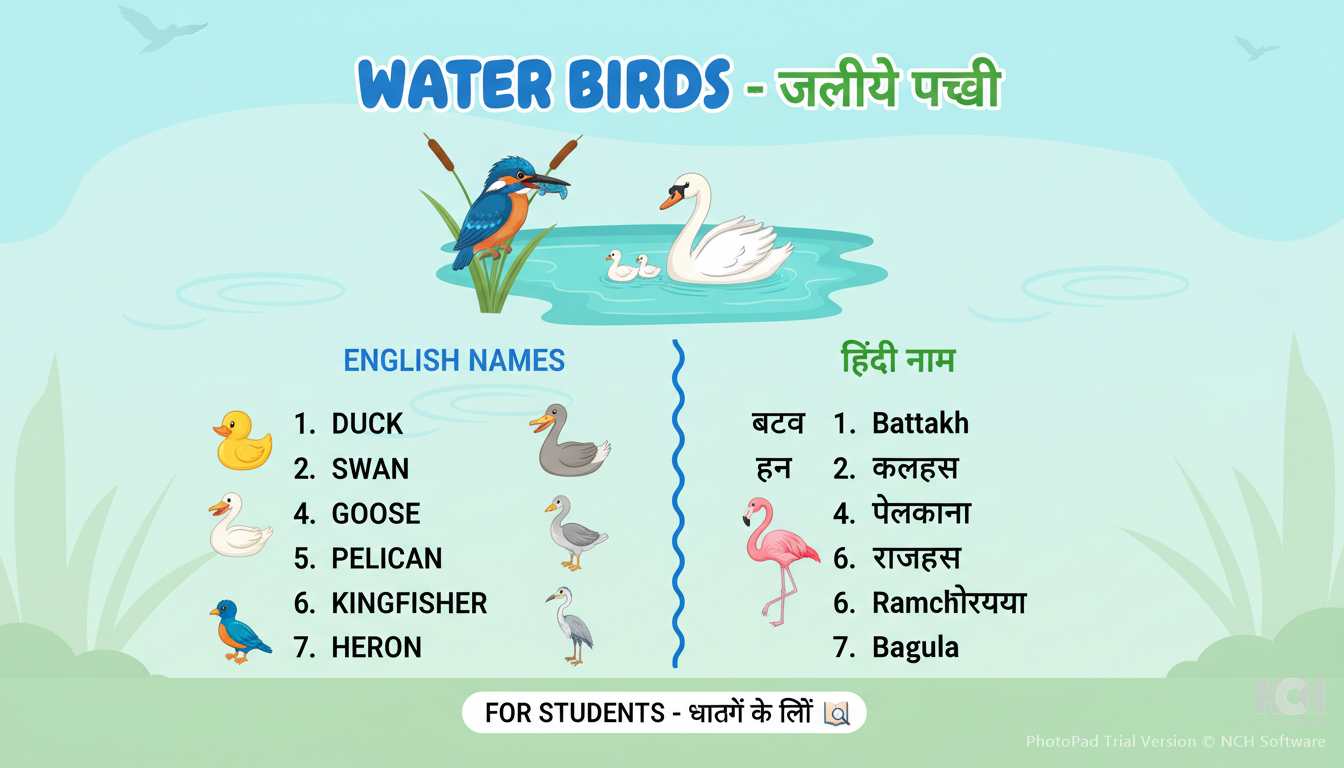
Water Birds Name in English and Hindi (पानी में रहने वाले पक्षियों के नाम)
🦆Water Birds Name in English and Hindi (पानी में रहने वाले पक्षियों के नाम) A goose (Anser cygnoides) is a water bird commonly found near lakes, rivers, wetlands, and coastal areas. A high-quality image of a Goose (Anser cygnoides), a water bird adapted to lakes,…
Continue reading...100 Birds Name in Hindi and English-पक्षियों के नाम हिंदी और अंग्रेज़ी में – आसान, मज़ेदार और पूरी सूची
100 पक्षियों के नाम हिंदी और अंग्रेज़ी में 🌿 Real-Life Example (Gaon Ki Kahani) Maan lo aap summer vacation me gaon gaye ho. Subah 5 baje murga "kukdukoo" karta hai. Thodi der baad ped par baithi koil ki "koo-koo" awaaz aati hai. Ghar ke aas-paas…
Continue reading...20 Birds Name in Hindi and English (20 पक्षियों के नाम) | For Students & Easy Pronunciation
20 Birds Name in Hindi and English Here is a fresh set of 20 birds: क्या आपने कभी notice किया है कि हम रोज़ कई birds देखते हैं, लेकिन उनके English ya Hindi names हमें हमेशा याद नहीं रहते? इसीलिए students अक्सर search करते हैं…
Continue reading...10 Birds Name in Hindi and English (With Easy Meaning & GK Use)
🐦10 Birds Name in Hindi and English Quick Answer: 10 Birds Name in Hindi and English are Hoopoe, Woodpecker, Goose, Dove, Kingfisher, Indian Roller, Bulbul, Lapwing, Penguin, and Kiwi. Kya aapko school homework ya GK preparation ke liye birds ke naam chahiye? Bahut baar students…
Continue reading...