
🐦 Do Birds Have Eyelids? Yes — Three of Them
Do Birds Have Eyelids? Yes — Three of Them
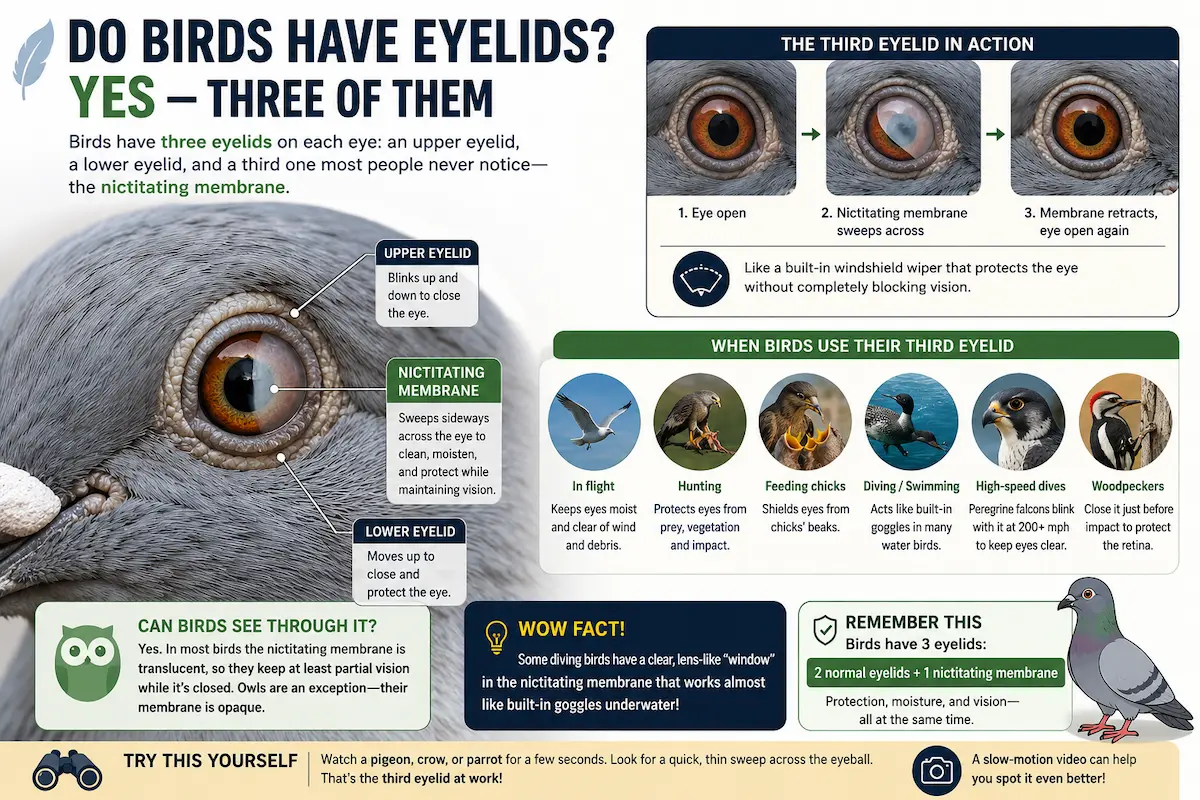
🐦 Quick Answer
Do birds have eyelids?
Yes. Birds have three eyelids on each eye: an upper eyelid, a lower eyelid and a third eyelid called the nictitating membrane.
The nictitating membrane sweeps across the eye and helps protect, clean and moisten it. In many birds, it is transparent or translucent enough to allow some vision while it is closed.
🤯 Wow Fact: Birds Have a Built-In Windshield Wiper!
A bird's third eyelid—the nictitating membrane—can sweep sideways across the eye like a tiny windshield wiper. In many birds, it's translucent, so the membrane can protect and moisten the eye without completely blocking vision. For a bird flying through wind, dust, or debris, that's one seriously clever piece of natural engineering. 🐦👁️
Three eyelids. One tiny windshield wiper. Nature didn't mess around. 😄
Explore our 100 Interesting Facts About Birds and Why Do Birds Have Hollow Bones?guide.
👁️ Bird Eyelids vs Human Eyelids
| Feature | Birds | Humans |
|---|---|---|
| Upper eyelid | ✅ | ✅ |
| Lower eyelid | ✅ | ✅ |
| Nictitating membrane | ✅ | ❌ Not a functional third eyelid like in birds |
| Eye protection from debris | ✅ | ✅ |
| Can use an extra membrane across the eye | ✅ | ❌ |
You can also browse our 200+ Birds Name in Hindi and English, with pictures and scientific names and Do Birds Have Ears? guide and do birds have teeth ,do birds have tongue and do birds have nose guide
The key difference is that birds have this additional nictitating membrane.
Table of Contents
- Do Birds Have Eyelids? Yes — Three of Them
- 🐦 Quick Answer
- 👁️ Bird Eyelids vs Human Eyelids
- 👁️ How Many Eyelids Do Birds Have?
- 👁️ What Is a Bird's Third Eyelid?
- 🔄 How Does the Nictitating Membrane Work?
- ✈️ When Do Birds Use Their Third Eyelid?
- 🦅 What About Peregrine Falcons?
- 🪵 Do Woodpeckers Use Their Third Eyelid?
- Do Woodpeckers Use Their Third Eyelid?
- 👀 Can Birds See Through Their Third Eyelid?
- 🦉 Do Owls Have Three Eyelids?
- Do Owls Have Three Eyelids?
- 🐦 Do Pigeons Have Three Eyelids?
- 🦜 Do Parrots Have Three Eyelids?
- 😴 Do Birds Close Their Eyes When They Sleep?
- 🤔 Why Don't We Notice Bird Eyelids?
- 🐦 A Small MFJ Observation
- 🔬 Why the Third Eyelid Matters
- 🤯 What Surprised Me
- 🏠 The Terrace Test
- 📊 Bird Eyelids at a Glance
- ❓ Frequently Asked Questions
- Do birds have eyelids?
- How many eyelids does a bird have?
- What is the third eyelid of a bird called?
- Can birds blink?
- Can birds see through their third eyelid?
- Why do birds have a third eyelid?
- Do pigeons have three eyelids?
- Do owls have three eyelids?
- Do parrots have three eyelids?
- Do birds close their eyes when they sleep?
- 🌿 The Takeaway
- 📚 References
Yes, birds have eyelids — and they have three on each eye. Birds have an upper eyelid, a lower eyelid, and a special third eyelid called the nictitating membrane.
That third eyelid is the one most people never notice. Instead of simply moving up and down, it can sweep sideways across the surface of the eye. It helps protect and clean the eye, spread moisture across it, and, in many birds, allows some vision to remain while it is closed.
So if you've ever watched a pigeon, crow, parrot or eagle and thought, “Did that bird just blink sideways?” — you may have caught its third eyelid in action. Explore How do birds sleep
👁️ How Many Eyelids Do Birds Have?
A bird has three eyelids on each eye:
| Eyelid | Main function |
|---|---|
| Upper eyelid | Helps close and protect the eye |
| Lower eyelid | Helps close and protect the eye |
| Nictitating membrane | Sweeps across the eye to protect, clean and moisten it |
The upper and lower eyelids are the ones most similar to the eyelids we have.
The third one is much more unusual.
👁️ What Is a Bird's Third Eyelid?
The third eyelid is called the nictitating membrane.
It is a thin membrane associated with the inner corner of the eye. Instead of closing vertically like a normal blink, it can move horizontally across the cornea.
Audubon describes it as an extra eyelid that helps keep the eye moist and clean while protecting it from wind, dust and other hazards.
A simple way to picture it is as a built-in windshield wiper for the eye. 🚗👁️
It isn't literally a windshield, of course, but the comparison makes its job easy to understand.
🔄 How Does the Nictitating Membrane Work?
When the membrane moves across the eye, it can help:
- 💧 spread moisture across the eye
- 🧹 clear small particles and debris
- 🛡️ protect the cornea
- 🌬️ shield the eye from wind and dust
- 👀 allow some vision to remain in many species
The membrane is largely transparent in many birds, although its transparency varies between species.
That means a bird doesn't always have to completely shut its normal eyelids just to protect its eyes.
And that's a pretty useful adaptation for an animal that may be flying, hunting or swimming while its eyes need protection.
👀 A Question I Had While Watching Birds
I've watched pigeons and other birds around my terrace many times, but I never really paid attention to their eyes. When a bird suddenly blinks, the movement is so quick that it looks almost ordinary.
Then I learned about the nictitating membrane and started watching more closely.
That changed the way I look at a bird's face.
What looks like a simple blink can actually involve a third eyelid sweeping across the eye. It is one of those tiny details that is easy to miss until you know what you're looking for.
That is the interesting thing about observing birds: sometimes the best discoveries are hiding in plain sight.
✈️ When Do Birds Use Their Third Eyelid?
The nictitating membrane isn't simply there for decoration. Birds can use it when their eyes are exposed to particular risks.
Flying
A bird flying through the air is constantly exposed to moving air, dust and tiny particles.
The membrane can help protect the eye while the bird continues to operate in its environment.
Hunting
Predatory birds can encounter branches, vegetation, struggling prey and rapidly moving air.
Raptors can use the membrane as an additional layer of eye protection when attacking prey.
Feeding chicks
This one is surprisingly practical.
Some birds use the membrane to protect their eyes while feeding young birds, whose movements and beaks can come dangerously close to the parent's eyes.
Swimming and diving
For birds that enter water, the membrane can work like natural goggles.
Some diving birds use it to protect their eyes underwater. Audubon notes that the hooded merganser's transparent nictitating membrane probably acts much like a pair of goggles while swimming.
The American dipper is another excellent example: its nictitating membranes help it see underwater while searching for prey in fast-moving streams.
🦅 What About Peregrine Falcons?
Peregrine falcons take the whole thing to another level.
These birds are famous for extremely fast dives while hunting. During those dives, the nictitating membrane can protect their eyes from rushing air and dust.
The Buffalo Bill Center of the West explains that the membrane closes sideways across the eye and helps lubricate and clean it, while protecting the eye during a high-speed dive.
Imagine putting your face outside a moving car at high speed.
Now imagine doing it while hunting.
Yeah. The bird needs some serious eye protection. 😄
🪵 Do Woodpeckers Use Their Third Eyelid?
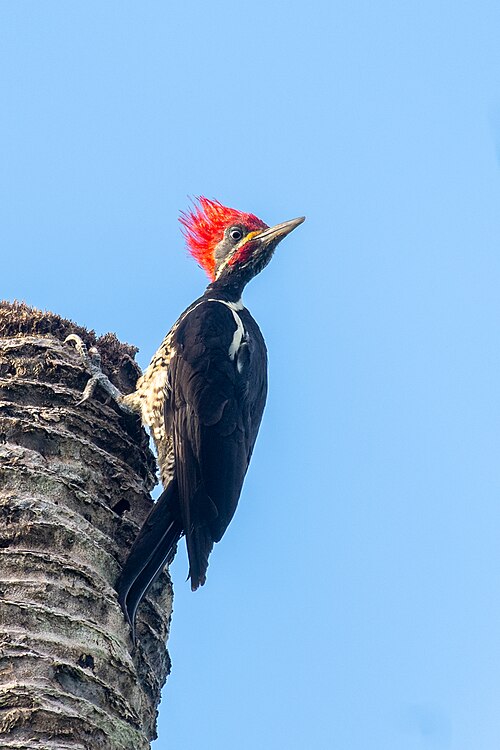
Do Woodpeckers Use Their Third Eyelid?
Hobbyfotowiki, CC0, via Wikimedia CommonsWoodpeckers are another fascinating case because their eyes experience repeated impacts while they hammer into wood.
Their eye-protection system is highly specialized, and the nictitating membrane is part of the broader protection around the eye.
This is one reason bird eyes are worth studying beyond simply asking whether birds can see well.
A bird's eye isn't just an eyeball sitting inside the skull.
It is part of an entire protective system adapted to the bird's lifestyle.
👀 Can Birds See Through Their Third Eyelid?
Many birds can retain some vision when the nictitating membrane is closed.
That's possible because the membrane is transparent or translucent in many species.
But we shouldn't think of it as giving every bird perfectly clear vision through a completely invisible sheet.
The amount of vision available depends on the bird and the transparency of its membrane.
And there are exceptions.
Owls have an opaque nictitating membrane, according to the Buffalo Bill Center of the West.
So the third eyelid isn't identical across every bird species.
🦉 Do Owls Have Three Eyelids?
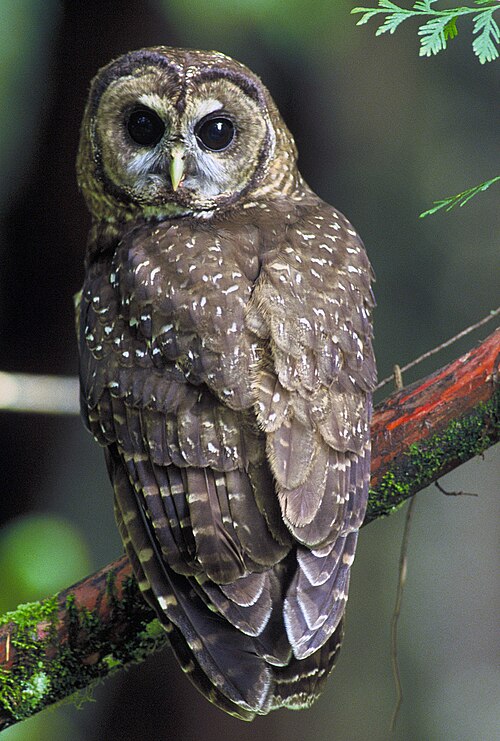
Do Owls Have Three Eyelids?
Hollingsworth, John and Karen; photo by USFS Region 5 (Pacific Southwest), Public domain, via Wikimedia CommonsYes. Owls have three eyelids on each eye.
Their large eyes are one of their most recognizable features, and protecting those eyes is obviously important.
The third eyelid provides another layer of protection for the eye.
But there's a detail that makes owls particularly interesting:
Their nictitating membrane is opaque rather than transparent.
So the way an owl uses its third eyelid isn't necessarily identical to the way a diving bird uses its membrane underwater.
🐦 Do Pigeons Have Three Eyelids?
Yes, pigeons have three eyelids too.
They have:
Upper eyelid + lower eyelid + nictitating membrane
And this is one of those facts hiding in plain sight.
Pigeons are everywhere — on terraces, rooftops, balconies, roads and buildings — but most of us never stop to examine their eyes closely.
👀 Try watching one
The next time a pigeon comes near, watch its eye for a few seconds.
You may see what looks like an extremely quick movement across the eye.
That could be the nictitating membrane sweeping across the surface.
Once you know what you're looking for, you'll start noticing details in birds that were always there.
🦜 Do Parrots Have Three Eyelids?
Yes. Parrots also have three eyelids, including a nictitating membrane.
The membrane is part of the normal avian eye structure and helps protect the eye.
If you watch a parrot closely enough, you may occasionally catch that rapid movement across the eye.
It can be surprisingly difficult to notice because the movement is so quick.
😴 Do Birds Close Their Eyes When They Sleep?
Yes.
Birds can close their eyes when sleeping or resting, using their normal eyelids.
But bird sleep is much more complicated than simply shutting both eyes and switching off.
Some birds have remarkable adaptations that help them rest while remaining aware of their surroundings.
That's actually a whole different story — and one we've already explored in How Do Birds Sleep?
🤔 Why Don't We Notice Bird Eyelids?
This is probably the biggest reason people ask:
“Do birds even have eyelids?”
Birds don't have the obvious human-style blinking that we constantly notice in ourselves.
And the nictitating membrane can move extremely quickly.
When it is open, it can also be difficult to distinguish from the rest of the eye.
Unless you're watching closely — or using slow-motion video or a photograph — you can easily miss it.
That's why someone can watch pigeons for years without ever realizing that they're looking at a bird with three eyelids per eye.
🐦 A Small MFJ Observation
👀 Watch the Eye, Not Just the Feathers
Most of us notice the obvious things when we see a bird: its feathers, beak, wings and feet.
But try something different next time.
Watch its eye.
I've found that once you start paying attention to small details like this, an ordinary pigeon on a terrace suddenly becomes much more interesting.
A tiny movement across the eye can happen so quickly that you might miss it completely.
But once you know that birds have a third eyelid, you start looking for it.
That's the fun part of observing birds — sometimes the most interesting things are the things we were looking at without actually seeing.
🔬 Why the Third Eyelid Matters
Birds depend heavily on their vision.
They use their eyes to:
- find food
- detect predators
- navigate
- judge distances
- locate other birds
- land safely
- hunt prey
- care for young
So protecting the surface of the eye is incredibly important.
The nictitating membrane gives birds an additional tool for doing exactly that.
It isn't just another eyelid.
It's an adaptation that helps birds protect one of their most important senses while continuing to function in demanding environments.
🤯 What Surprised Me
The surprising part isn't simply that birds have three eyelids.
It's that we rarely notice the third one.
Most people see a bird blink and assume it's doing exactly what we do. But the nictitating membrane works differently. It can sweep across the eye while the bird is still using its vision.
A bird's face suddenly becomes much more interesting when you realize that.
🏠 The Terrace Test
If you regularly see pigeons on your terrace, try something simple.
The next time one lands nearby, don't immediately look at its feathers or beak.
Look at its eye.
Watch for a few seconds.
You may notice a blink that seems slightly different from yours — extremely fast, almost like a transparent film sliding over the eye.
That's the kind of small detail that turns an everyday terrace bird into something worth investigating.
📊 Bird Eyelids at a Glance
| Question | Answer |
|---|---|
| Do birds have eyelids? | Yes |
| How many eyelids do birds have? | Three per eye |
| What is the third eyelid called? | Nictitating membrane |
| Does it move sideways? | Yes |
| Does it protect the eye? | Yes |
| Does it help clean the eye? | Yes |
| Does it spread moisture? | Yes |
| Can birds retain some vision through it? | Many can |
| Do pigeons have three eyelids? | Yes |
| Do parrots have three eyelids? | Yes |
| Do owls have three eyelids? | Yes |
| Do birds close their eyes when sleeping? | Yes |
You can also browse our 200+ Birds Name in Hindi and English, with pictures and scientific names and Do Birds Have Ears? guide and do birds have teeth ,do birds have tongues , and do birds have nose guide
❓ Frequently Asked Questions
Do birds have eyelids?
Yes. Birds have three eyelids on each eye: an upper eyelid, lower eyelid and nictitating membrane.
How many eyelids does a bird have?
A bird generally has three eyelids per eye.
What is the third eyelid of a bird called?
It is called the nictitating membrane.
Can birds blink?
Yes. Birds can blink with their normal eyelids, and their nictitating membrane can also sweep across the eye.
Can birds see through their third eyelid?
Many birds can retain some vision because their nictitating membrane is transparent or translucent, although the amount of vision varies between species.
Why do birds have a third eyelid?
The nictitating membrane helps protect and clean the eye and spread moisture across its surface. It can be especially useful when birds are flying, hunting or swimming.
Do pigeons have three eyelids?
Yes. Pigeons have an upper eyelid, lower eyelid and nictitating membrane.
Do owls have three eyelids?
Yes. Owls have three eyelids on each eye. Their nictitating membrane is opaque.
Do parrots have three eyelids?
Yes. Parrots have an upper eyelid, lower eyelid and nictitating membrane.
Do birds close their eyes when they sleep?
Yes. Birds can close their eyes when sleeping or resting, although their sleep behavior varies considerably between species.
🌿 The Takeaway
The next time you see a bird blink, look closely.
That tiny movement may reveal something most people never notice: birds don't have just two eyelids — they have a specialized third eyelid that can sweep across the eye to protect and maintain it.
A pigeon on a terrace, a sparrow on a wall, an owl in a tree or a falcon diving after prey may look completely ordinary.
But look closer.
There's a remarkable piece of biology happening behind that tiny blink. 🐦👁️
Read our Morning Bird Calls and Pigeon Observation field note
📚 Continue Exploring the Bird World
If you enjoyed learning about bird nests, there is much more to discover. Explore these related guides to learn about bird types, habitats, flight, body parts, and different kinds of birds.
- 🐦 200 Birds Name in Hindi and English — Explore a large collection of bird names in both Hindi and English.
- 🪶 Types of Birds — Learn about different types of birds and how they are commonly classified.
- 🇮🇳 Birds in India — Discover birds found across India and the habitats they call home.
- ✈️ Flying Birds — Learn how flying birds use flight to feed, migrate, escape predators, and survive.
- 🐧 Flightless Birds — Discover birds that cannot fly and the adaptations that help them survive.
- 👃 Bird Beaks — Understand the different shapes of bird beaks and how they help birds feed.
- 🔤 A–Z Birds Name List (Complete Table) — Find bird names arranged alphabetically from A to Z.
- 🌊 Water Birds Name List — Explore birds commonly found around rivers, lakes, ponds, wetlands, and other water habitats.
- 🏡 Pet Birds Name List — Learn about popular birds commonly kept as pets.
- do birds have tongues
- do birds have teeth
- do birds have nose
- how do birds sleep
- 100 interesting facts about birds
📚 References
- Audubon — Birds Have Built-In Goggles
- Bryan Ribelin — Nictitating Membrane (citing the Cornell Lab of Ornithology's Handbook of Bird Biology)
- All Birds Wiki — Nictitating Membrane
- Center of the West — A Closer Look at the Fascinating World of Bird Eyelids
📚 Explore More Useful Name Lists
Looking for more easy-to-understand name lists? Explore these related Monto Fact Jungle guides covering fruits, flowers, birds, animals, body parts, and spices.
- 🍎 50 Fruits Name in Hindi and English
- 🍎 100 Fruits Name in English and Hindi
- 🌸 100 Flowers Name in English and Hindi
- 🐦 200+ Birds Name in Hindi and English
- 🦁 Animals Kya Khate Hain — Animals Food List
- 🧠 100+ Body Parts Name in Hindi and English
- 🌶️ 100 Spices Name in English and Hindi
- ⌨️ Keyboard Symbols Name in Hindi
- 📖 Meaning in Hindi with Examples
You should also read:
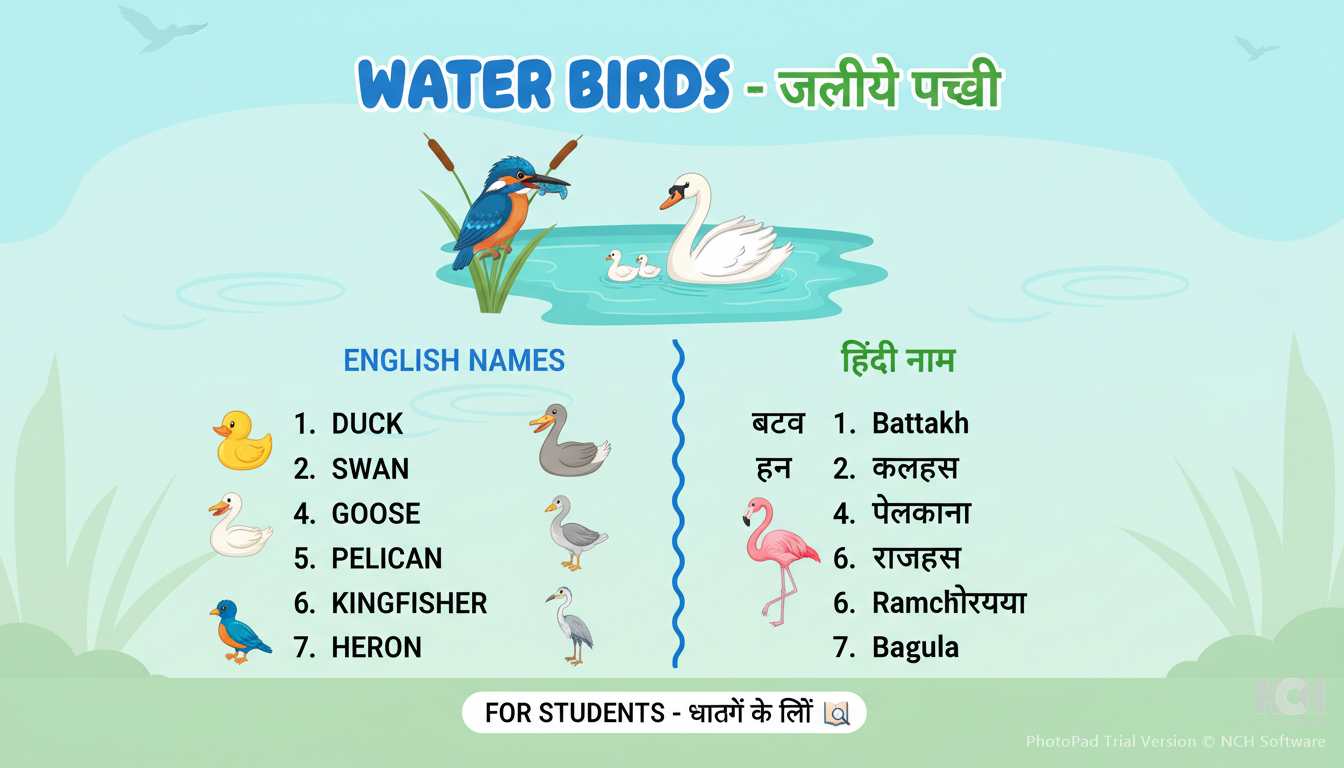
Water Birds Name in English and Hindi (पानी में रहने वाले पक्षियों के नाम)
🦆Water Birds Name in English and Hindi (पानी में रहने वाले पक्षियों के नाम) A goose (Anser cygnoides) is a water bird commonly found near lakes, rivers, wetlands, and coastal areas. A high-quality image of a Goose (Anser cygnoides), a water bird adapted to lakes,…
Continue reading...100 Birds Name in Hindi and English-पक्षियों के नाम हिंदी और अंग्रेज़ी में – आसान, मज़ेदार और पूरी सूची
100 पक्षियों के नाम हिंदी और अंग्रेज़ी में 🌿 Real-Life Example (Gaon Ki Kahani) Maan lo aap summer vacation me gaon gaye ho. Subah 5 baje murga "kukdukoo" karta hai. Thodi der baad ped par baithi koil ki "koo-koo" awaaz aati hai. Ghar ke aas-paas…
Continue reading...20 Birds Name in Hindi and English (20 पक्षियों के नाम) | For Students & Easy Pronunciation
20 Birds Name in Hindi and English Here is a fresh set of 20 birds: क्या आपने कभी notice किया है कि हम रोज़ कई birds देखते हैं, लेकिन उनके English ya Hindi names हमें हमेशा याद नहीं रहते? इसीलिए students अक्सर search करते हैं…
Continue reading...10 Birds Name in Hindi and English (With Easy Meaning & GK Use)
🐦10 Birds Name in Hindi and English Quick Answer: 10 Birds Name in Hindi and English are Hoopoe, Woodpecker, Goose, Dove, Kingfisher, Indian Roller, Bulbul, Lapwing, Penguin, and Kiwi. Kya aapko school homework ya GK preparation ke liye birds ke naam chahiye? Bahut baar students…
Continue reading...