
🐦 Do Birds Have Noses? Where Are Their Nostrils?
Do Birds Have Noses? Where Are Their Nostrils?⚡
Quick Answer
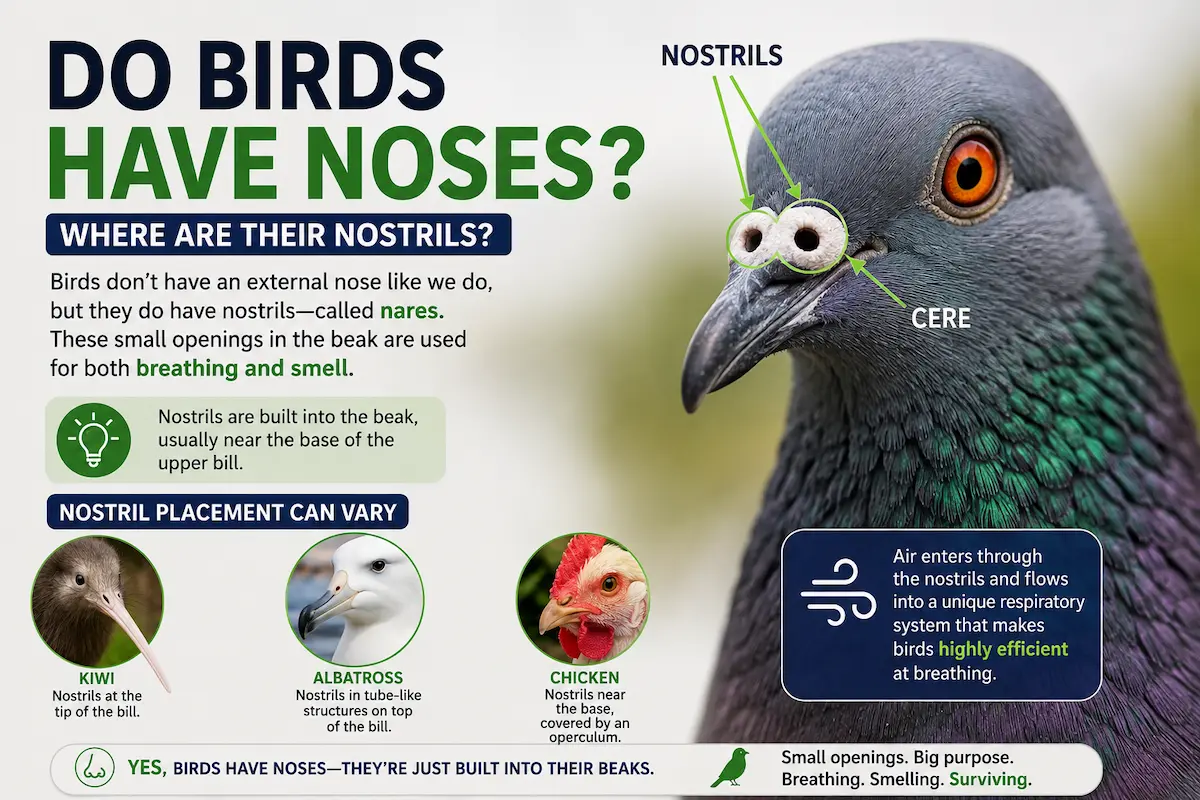
Yes, birds have nostrils. Their nostrils are called nares and are usually located on the upper beak, often near its base. Birds use them for breathing, and many species also use their sense of smell to find food, navigate and interact with their environment. Explore our 100 Interesting Facts About Birds and Why Do Birds Have Hollow Bones?guide.
📊 Bird Nostrils at a Glance
| Question | Quick answer |
|---|---|
| Do birds have noses? | Yes, but not a human-like external nose |
| What are bird nostrils called? | Nares |
| Where are bird nostrils? | Usually on the upper beak |
| Do birds breathe through their nostrils? | Yes |
| Can birds smell? | Yes |
| Can pigeons smell? | Yes |
| Which bird has nostrils at the bill tip? | Kiwi |
| Which bird is famous for its sense of smell? | Turkey Vulture |
| What is a pigeon’s fleshy nose area called? | Cere |
| Do all birds have identical nostrils? | No |
Have you ever looked closely at a pigeon, sparrow or parrot and wondered where its nose is?
We can easily spot a bird's eyes and beak, but there doesn't seem to be a nose anywhere.
So where does a bird breathe from?
And can a bird actually smell?
Yes, birds have nostrils, and birds can smell. Their nostrils are called nares (singular: naris) and are usually located on the upper part of the beak, often near its base. They are the openings through which air enters the bird's respiratory system.
So that tiny pair of openings you may have noticed near the top of a pigeon's beak?
Those are its nostrils. 👃🐦 You can also browse our 200+ Birds Name in Hindi and English, with pictures and scientific names and Do Birds Have Ears? and do birds have teeth ,do birds have tongues, how do birds sleep guide
Table of Contents
- Do Birds Have Noses? Where Are Their Nostrils?⚡
- Quick Answer
- 📊 Bird Nostrils at a Glance
- 👃 Where Are a Bird's Nostrils?
- 🥝 The Bird With Nostrils at the Tip of Its Beak
- 🌬️ How Do Birds Breathe?
- 👃 Can Birds Smell?
- 🦅 Why Turkey Vultures Have an Incredible Sense of Smell
- 🌊 Some Birds Use Smell Over the Ocean
- 🐦 Can Pigeons Smell?
- 🐦 Do All Birds Have the Same Kind of Nostrils?
- 🔬 What Are Bird Nostrils Called?
- 👃 Bird Nostrils vs Human Nostrils
- 🐦 So, Do Birds Have Noses?
- ❓ Frequently Asked Questions
- Do birds have noses?
- What is a bird's nose called?
- Where are birds' nostrils?
- Do birds breathe through their beaks?
- Can birds smell?
- Can pigeons smell?
- Which bird has the best sense of smell?
- Why does a pigeon have a bump above its beak?
- Do all birds have nostrils in the same place?
- Why are some bird nostrils covered?
- 🧠 The simple answer to remember
👃 Where Are a Bird's Nostrils?
Birds don't have a separate fleshy nose sticking out from the face like humans do.
Instead, their nostrils are built into the upper beak.
In most birds, the nares are found near the base of the upper bill. Look closely at a pigeon, for example, and you'll see the openings sitting in a fleshy area at the base of its beak.
Some birds have structures that partly cover or protect the openings.
One of these is the operculum, a flap that partially covers the nares and may help keep dust and other debris out. Cornell's Bird Academy notes that opercula occur in some ground-feeding birds, including pigeons and chickens.
Other birds have small feathers or bristles around the nostrils that can help prevent foreign material from entering the respiratory system.
🐦 What about pigeons?
Pigeons have a particularly easy-to-see example.
Their nares sit on a prominent fleshy structure called the cere at the base of the bill. The cere is the leathery area of skin surrounding the nostrils in birds such as pigeons, hawks and some parrots.
So if you've ever looked at a pigeon and thought, “Where on earth is its nose?”
You're probably looking right at it.
🐦 A Small Thing I Started Noticing
I often see pigeons and other birds on my terrace and garden, and once you start looking closely at a bird's beak, you can spot something you might normally miss: the tiny openings near the top of the bill.
Before learning about bird anatomy, I never really thought of those openings as a bird's nostrils. But they are the nares — part of the bird's respiratory system and one of the ways we can see just how differently birds are built from us.
The next time a pigeon comes close, take a look at its beak. You may notice its “nose” hiding in plain sight.
🥝 The Bird With Nostrils at the Tip of Its Beak
Most birds have their nostrils near the base of the bill.
But the kiwi does things differently.
The kiwi has nostrils near the tip of its long bill — an unusual arrangement among birds. Kiwis use their bills to probe through soil and leaf litter while searching for food, and their sense of smell helps them locate prey.
It's almost as if the kiwi has put its nose at the end of a long probe.
And for a bird that spends much of its time searching through the ground, that arrangement makes perfect sense.
🌬️ How Do Birds Breathe?
Those tiny openings aren't just for smelling.
Birds breathe through their nares.
Air enters through the nostrils, passes through the nasal cavity and continues into the respiratory system.
But bird breathing is considerably different from human breathing.
Birds have lungs and air sacs arranged in a specialized respiratory system that moves air through the lungs in a highly efficient flow pattern. The air travels through the respiratory system rather than simply moving in and out of the lungs in the same way it does in humans.
A simplified version looks like this:
👃 Nares → nasal passages → trachea → air sacs & lungs → oxygen enters the bloodstream
The nasal passages themselves also do useful work. Cornell's Bird Academy describes structures inside the nasal cavity that are lined with mucus and olfactory nerve endings. The mucus can trap dust, while blood vessels help warm incoming air.
So those two tiny holes in a bird's beak are connected to a surprisingly sophisticated system. Browse our 200+ Birds Name in Hindi and English, with pictures and scientific names and Do Birds Have Ears? and do birds have teeth ,do birds have tongues, how do birds sleep guide
👃 Can Birds Smell?
Yes. Birds can smell.
For a long time, birds were widely thought to have a poor or insignificant sense of smell. That idea has changed substantially as research has shown that many birds detect and use odors.
Birds can use smell in different ways, including finding food, recognizing their surroundings, locating nesting areas and, in some species, helping with navigation. How important smell is varies considerably from one species to another.
So the answer isn't simply:
“Birds can smell.”
It's more interesting than that.
Different birds use their sense of smell in very different ways.
🦅 Why Turkey Vultures Have an Incredible Sense of Smell
If you want to see just how powerful a bird's sense of smell can become, look at the Turkey Vulture.
These birds are famous for locating carrion by smell.
Their olfactory system is remarkably developed. A scientific study found that Turkey Vultures have olfactory bulbs about four times larger than those of Black Vultures, despite having smaller overall brains. The researchers concluded that their enlarged olfactory system is consistent with a highly sensitive sense of smell.
And this ability is genuinely useful.
A dead animal hidden beneath vegetation isn't necessarily easy to see from the sky.
But its odor can travel through the air.
Turkey Vultures can use those airborne chemical signals to locate food that may be difficult to spot visually.
🤯 An amazing real-world example
The connection between Turkey Vultures and smell has even been used by humans.
Natural gas companies have used compounds with a smell resembling decomposing material to help detect pipeline leaks. Turkey Vultures have been attracted to some of these leaks because they can detect the odor.
Nature accidentally created a bird with a nose good enough to become useful to humans.
🌊 Some Birds Use Smell Over the Ocean
Turkey Vultures aren't the only birds with impressive noses.
Some seabirds also rely on smell while searching for food in the open ocean.
Storm Petrels, for example, can recognize odors associated with compounds produced by their prey. This is particularly useful in an environment where there may be few visual landmarks and food can be widely scattered.
For these birds, smell isn't some minor background sense.
It can help them find the dinner table in the middle of an enormous ocean.
🐦 Can Pigeons Smell?
Yes, pigeons have a sense of smell.
Pigeons are especially interesting because researchers have investigated whether odors may contribute to their ability to navigate.
One idea, known as the olfactory map hypothesis, proposes that homing pigeons can associate environmental odors with directions and use those odor patterns as one source of navigational information. The exact mechanisms of pigeon navigation remain more complicated than simply “following a smell,” and researchers continue to study how different sensory cues work together.
So when a pigeon finds its way home over a long distance, its impressive navigation isn't necessarily just about eyesight.
Its nose may be part of the story too.
🐦 Do All Birds Have the Same Kind of Nostrils?
No.
Birds have evolved a remarkable variety of nasal structures.
Most have paired nares on the upper bill, usually near the base. But their exact shape, position and surrounding structures can vary between species.
Some birds have:
- Ceres around the nostrils
- Opercula partly covering the nares
- Feathers or bristles protecting the openings
- Tubular nares in certain seabirds
- Nostrils at the tip of the bill, as in kiwis
The tubenose seabirds are particularly unusual. Albatrosses, petrels and storm-petrels have tubular structures on top of the bill through which their nares open. These birds also deal with large amounts of salt, and their specialized nasal structures are associated with their salt-excretion system.
🔬 What Are Bird Nostrils Called?
The scientific term for a bird's nostril is naris.
The plural is nares.
So:
One → naris
More than one → nares
You may come across the word nares in bird anatomy guides and scientific literature. Cornell's Bird Academy defines the nares as the openings of the nasal cavity, usually located in the upper beak near its base.
In everyday language, though, you can simply call them nostrils.
👃 Bird Nostrils vs Human Nostrils
| Feature | Birds | Humans |
|---|---|---|
| External openings | Nares | Nostrils |
| Usual location | Upper beak | Face |
| Main breathing role | Yes | Yes |
| Sense of smell | Present, varies by species | Well developed |
| External nose | No separate fleshy nose like ours | Yes |
| Special adaptations | Vary widely between species | Comparatively uniform |
The biggest difference is simple:
Our nostrils are part of an external nose. A bird's nostrils are incorporated into its beak.
🐦 So, Do Birds Have Noses?
Birds have a nasal system with nostrils, nasal passages and the ability to detect odors, but they don't have an external nose like humans do.
Their nostrils are called nares and are usually found on the upper part of the beak, often near its base. They allow air into the respiratory system and also provide the pathway through which odors reach the bird's olfactory system.
And once you know what you're looking for, you start noticing bird noses everywhere.
The next time a pigeon lands on your balcony, don't just look at its feathers.
Look closely at the top of its beak.
Those two little openings?
That's its nose. 👃🐦
It just happens to be built into the beak.
📚 Continue Exploring the Bird World
If you enjoyed learning about bird nests, there is much more to discover. Explore these related guides to learn about bird types, habitats, flight, body parts, and different kinds of birds.
- 🐦 200 Birds Name in Hindi and English — Explore a large collection of bird names in both Hindi and English.
- 🪶 Types of Birds — Learn about different types of birds and how they are commonly classified.
- 🇮🇳 Birds in India — Discover birds found across India and the habitats they call home.
- ✈️ Flying Birds — Learn how flying birds use flight to feed, migrate, escape predators, and survive.
- 🐧 Flightless Birds — Discover birds that cannot fly and the adaptations that help them survive.
- 👃 Bird Beaks — Understand the different shapes of bird beaks and how they help birds feed.
- 🔤 A–Z Birds Name List (Complete Table) — Find bird names arranged alphabetically from A to Z.
- 🌊 Water Birds Name List — Explore birds commonly found around rivers, lakes, ponds, wetlands, and other water habitats.
- 🏡 Pet Birds Name List — Learn about popular birds commonly kept as pets.
- explore do birds have tongues
- explore do birds have teeth
- 100 interesting facts about birds
- Read our Morning Bird Calls and Pigeon Observation field note
❓ Frequently Asked Questions
Do birds have noses?
Yes. Birds have a nasal system and nostrils, although they don't have a separate external nose like humans. Their nostrils are called nares.
What is a bird's nose called?
A bird's nostrils are called nares. The singular form is naris.
Where are birds' nostrils?
In most birds, the nostrils are located on the upper beak, usually near its base. The kiwi is a notable exception, with nostrils near the tip of its bill.
Do birds breathe through their beaks?
Birds normally breathe through their nares, the nostril openings on the beak. Air then travels through the respiratory system to the lungs and air sacs.
Can birds smell?
Yes. Many birds can detect odors, although the importance of smell varies greatly between species. Some use smell to find food, while others may also use it in navigation or recognizing their surroundings.
Can pigeons smell?
Yes. Pigeons have a functional sense of smell, and researchers have investigated the role of odors in their navigation.
Which bird has the best sense of smell?
There isn't one universally agreed “best-smelling bird,” because olfactory ability can be measured in different ways. Turkey Vultures are among the most remarkable examples: research has found exceptionally large olfactory bulbs and strong evidence for scent-guided foraging.
Why does a pigeon have a bump above its beak?
That fleshy area is called the cere. In pigeons, the nares open through the cere at the base of the bill.
Do all birds have nostrils in the same place?
No. Most birds have nares near the base of the upper beak, but their position and structure vary. Kiwis, for example, have their nostrils near the tip of the bill.
Why are some bird nostrils covered?
Some birds have an operculum, feathers or other structures around the nares that can help protect the openings from dust, debris or, in some species, water.
🧠 The simple answer to remember
Birds don't have noses like we do — but they absolutely have nostrils, and many birds have a surprisingly useful sense of smell.
That tiny hole on a pigeon's beak isn't just a hole.
It's the entrance to an entire sensory and respiratory system.
Read our Morning Bird Calls and Pigeon Observation filed note
📚 Explore More Useful Name Lists
Looking for more easy-to-understand name lists? Explore these related Monto Fact Jungle guides covering fruits, flowers, birds, animals, body parts, and spices.
- 🍎 50 Fruits Name in Hindi and English
- 🍎 100 Fruits Name in English and Hindi
- 🌸 100 Flowers Name in English and Hindi
- 🐦 200+ Birds Name in Hindi and English
- 🦁 Animals Kya Khate Hain — Animals Food List
- 🧠 100+ Body Parts Name in Hindi and English
- 🌶️ 100 Spices Name in English and Hindi
- ⌨️ Keyboard Symbols Name in Hindi
- 📖 Meaning in Hindi with Examples
You should also read:
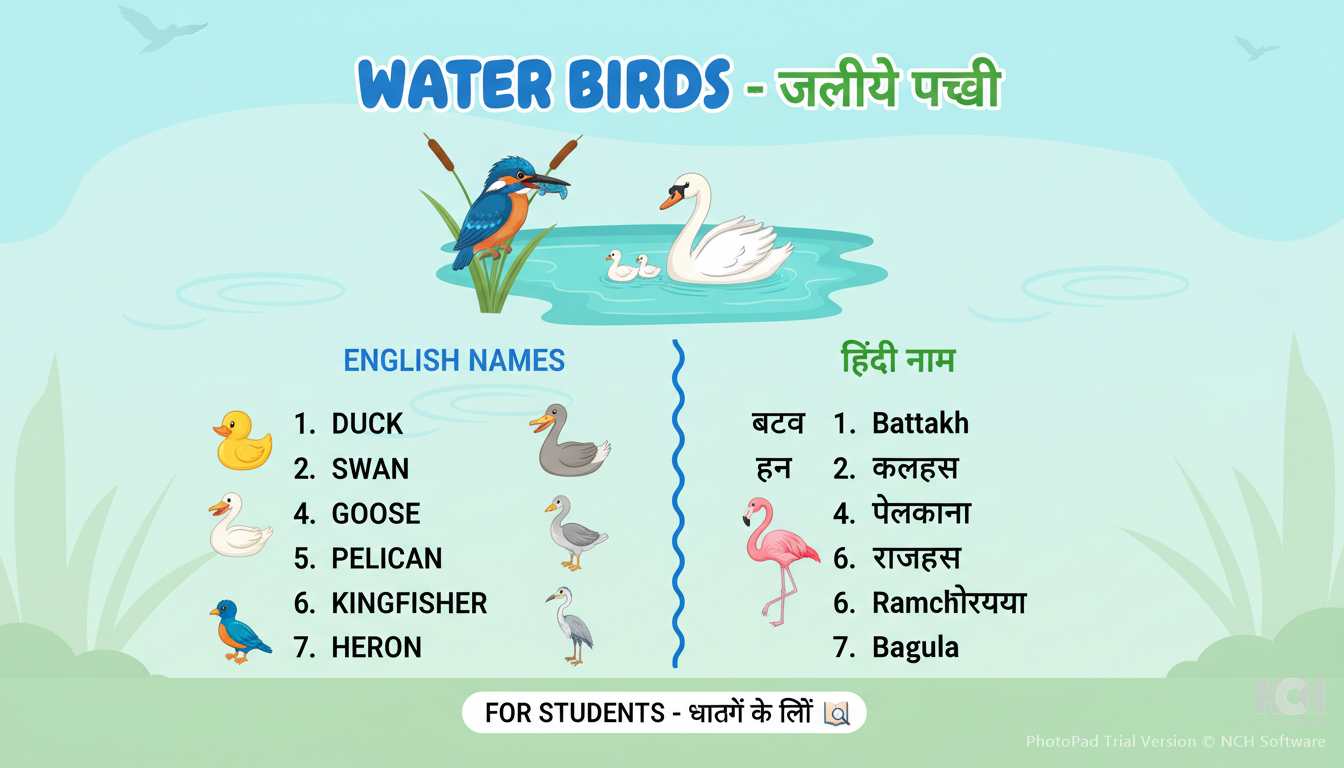
Water Birds Name in English and Hindi (पानी में रहने वाले पक्षियों के नाम)
🦆Water Birds Name in English and Hindi (पानी में रहने वाले पक्षियों के नाम) A goose (Anser cygnoides) is a water bird commonly found near lakes, rivers, wetlands, and coastal areas. A high-quality image of a Goose (Anser cygnoides), a water bird adapted to lakes,…
Continue reading...100 Birds Name in Hindi and English-पक्षियों के नाम हिंदी और अंग्रेज़ी में – आसान, मज़ेदार और पूरी सूची
100 पक्षियों के नाम हिंदी और अंग्रेज़ी में 🌿 Real-Life Example (Gaon Ki Kahani) Maan lo aap summer vacation me gaon gaye ho. Subah 5 baje murga "kukdukoo" karta hai. Thodi der baad ped par baithi koil ki "koo-koo" awaaz aati hai. Ghar ke aas-paas…
Continue reading...20 Birds Name in Hindi and English (20 पक्षियों के नाम) | For Students & Easy Pronunciation
20 Birds Name in Hindi and English Here is a fresh set of 20 birds: क्या आपने कभी notice किया है कि हम रोज़ कई birds देखते हैं, लेकिन उनके English ya Hindi names हमें हमेशा याद नहीं रहते? इसीलिए students अक्सर search करते हैं…
Continue reading...10 Birds Name in Hindi and English (With Easy Meaning & GK Use)
🐦10 Birds Name in Hindi and English Quick Answer: 10 Birds Name in Hindi and English are Hoopoe, Woodpecker, Goose, Dove, Kingfisher, Indian Roller, Bulbul, Lapwing, Penguin, and Kiwi. Kya aapko school homework ya GK preparation ke liye birds ke naam chahiye? Bahut baar students…
Continue reading...